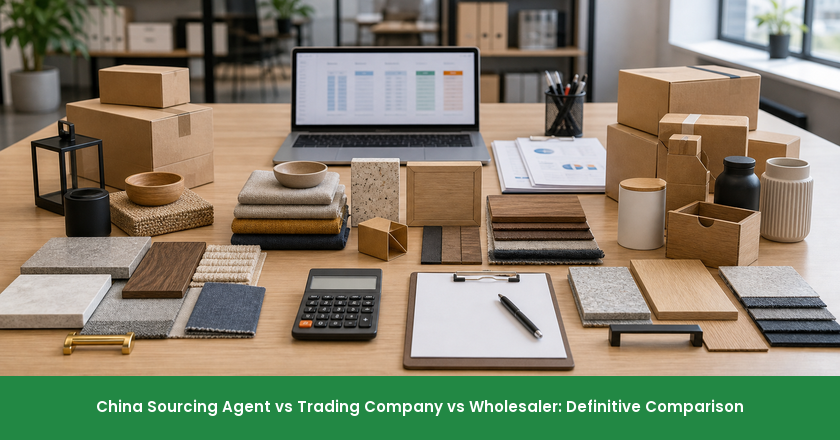
The practical difference between a China sourcing agent, a trading company, and a wholesaler is who owns the product path: a wholesaler sells available goods, a trading company packages supply into its own selling price, and a sourcing agent can manage the purchasing process around the buyer's defined requirements.
Many buyers choose the wrong model because the three options can sound similar in sales conversations. All three can quote products. All three may arrange shipment. All three may say they can help with quality. The real question is not what they call themselves. The real question is who controls product version, price transparency, sample changes, inspection evidence, documents, and delivery responsibility.
NewBuyingAgent fits the sourcing-agent side of this comparison, but its public service model is broader than a narrow introduction role. Buyers bring the purchasing requirement; NewBuyingAgent turns it into a managed quote-to-delivery path with product, quality, cost, and handoff control.
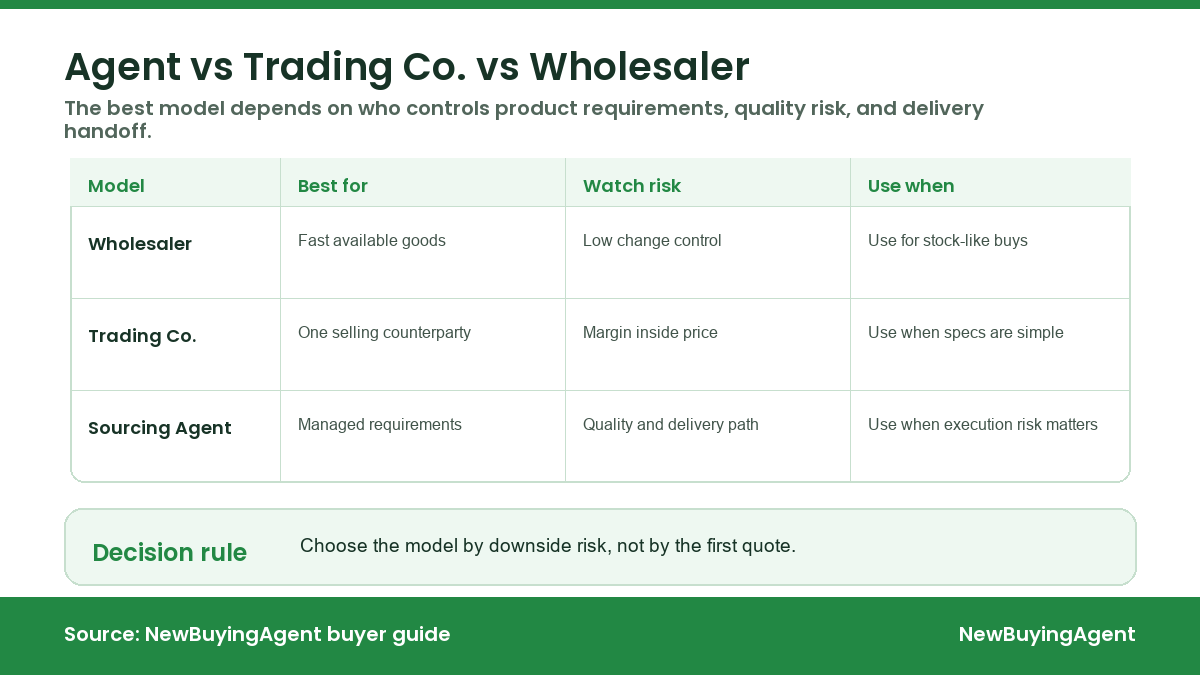
The right China buying model depends on whether the buyer needs speed, catalog access, customization, quality control, or managed procurement ownership.
Short Answer: Which Model Should You Choose?
Choose a wholesaler when you need existing goods quickly, can accept limited customization, and the order risk is low. Choose a trading company when you want a packaged supply relationship and are comfortable with margin being inside the selling price. Choose a sourcing agent when the product version, cost logic, sample control, quality evidence, production follow-up, and logistics matter enough to require a managed process.
The model should follow the product's risk profile. A simple, non-custom accessory may not need the same structure as furniture, pet products, electronics, hardware, outdoor goods, or a private-label line. If the buyer must protect brand quality, packaging, compliance documents, or repeat-order consistency, the cheapest and fastest option may not be the lowest-risk option.
The Real Difference Is Ownership, Not the Label
A wholesaler owns stock or access to existing goods. The buyer is usually choosing from what is already available. This can be efficient, but the buyer has less control over product development, materials, packaging, and factory-side changes. A trading company sells goods as a merchant or intermediary. It may be convenient because the buyer deals with one seller, but the buyer may not see the cost structure behind the price. A sourcing agent works from the buyer's purchasing need and manages the process required to turn that need into a product, quote, production path, QC evidence, and delivery.
The ownership question becomes visible when something changes. If the buyer changes packaging, who updates the production requirement? If a sample has a defect, who records the correction and checks it later? If carton dimensions change, who updates freight assumptions? If a shipment is late, who gives the buyer options before the selling season is damaged? The correct model is the one that owns the risks the buyer cannot afford to manage alone.
The Cost-of-Wrong-Model Estimate
Assume a buyer orders 1,000 units of a $12 item for a private-label launch. A wholesaler may be fastest, but the packaging and finish may not match the brand. A trading company may provide a convenient quote, but cost transparency may be limited. A sourcing agent may require a clearer brief, but the process can tie sample approval, inspection, packaging, and delivery to the same product version.
If the buyer saves $0.50 per unit by choosing a weaker-fit model, the visible saving is $500. If 8% of the order has finish defects or packaging damage, 80 units are at risk. At a $38 retail price, the revenue exposure can reach $3,040 before returns, replacement shipping, review damage, or lost launch timing. This illustrative calculation does not prove one model is always better. It proves the buyer should compare model risk, not only quote price.
Sourcing Agent vs Trading Company vs Wholesaler Table
| Decision Area | Sourcing Agent | Trading Company | Wholesaler |
|---|---|---|---|
| Best use | Defined product, customization, quality risk, repeat orders | Packaged buying relationship with one seller | Available goods and fast purchase |
| Price view | Can be structured around quote basis and service scope | Margin usually embedded in selling price | Catalog or wholesale price |
| Customization | Stronger when specs and samples must be controlled | Possible, but depends on company capability | Usually limited |
| Quality control | Can be built into production follow-up and release evidence | Varies by seller and order value | Often focused on available goods condition |
| Logistics | Planned with carton data, Incoterms, and delivery timing | Often bundled into the trade relationship | May be simple but less tailored |
When a Wholesaler Makes Sense
A wholesaler makes sense when speed and availability matter more than product control. If the product is a standard item, the buyer can accept existing packaging, the order is not brand-critical, and the buyer does not need strict customization, a wholesaler may be efficient. This is common for low-risk accessories, commodity products, event supplies, or test inventory where the buyer values speed.
The limitation is control. The buyer may not be able to change materials, adjust packaging, demand a custom inspection plan, or preserve the exact product version for a repeat order. If the buyer later wants to build a branded product line, the wholesaler model may become too shallow.
When a Trading Company Makes Sense
A trading company makes sense when the buyer wants a seller that packages supply, communication, and export handling into one relationship. A good trading company can be useful when the buyer wants convenience and does not need full transparency into every factory-side detail. It may also work well when the product is already mature and the buyer values a stable commercial relationship.
The limitation is that the trading company usually sells as a merchant. The buyer may not know how the selling price is built, how production is controlled, or whether a material change affects margin. That does not make the model bad. It means the buyer should use it where the risk profile fits.
When a Sourcing Agent Makes Sense
A sourcing agent makes sense when the buyer needs product control and operational ownership. This is especially true for custom goods, private-label products, multi-SKU programs, quality-sensitive categories, packaging-sensitive ecommerce products, and orders where late delivery damages a selling season. The buyer does not only need a quote. The buyer needs the quote to match the product version, sample comments, inspection priorities, carton plan, and delivery terms.
NewBuyingAgent is relevant here because buyers can hand over a purchasing need, not a list of factory tasks. Buyers that want to keep commercial control while reducing daily China-side coordination can review NewBuyingAgent's service overview before requesting a quote.
How Incoterms and Landed Cost Change the Decision
Incoterms matter because they define who is responsible for shipment, insurance, documentation, customs clearance, and other logistics tasks. A low product price may be misleading if the buyer has not checked freight, duty, insurance, import handling, storage, or last-mile cost. This is why a model comparison should include landed cost, not only unit price.
For example, a wholesaler may quote a simple price that looks easy to approve. A trading company may bundle shipping into the offer. A sourcing agent may separate the product requirement, quote basis, packing data, and logistics plan. None of these structures is automatically better. The buyer should choose the one that makes the true cost and responsibility clear enough for the order's risk.
What to Send Before Choosing the Model
Buyers should prepare product specs, target quantity, target price, destination, delivery timing, packaging requirements, quality concerns, and whether the product is standard, modified, or custom. If the buyer cannot describe those details, a quick quote may create false confidence.
If the order needs a managed path from requirement to delivery, buyers can send the purchasing requirements to NewBuyingAgent for quote review. If the buyer is still learning how China sourcing works, NewBuyingAgent's China sourcing guide can help structure the first brief.
Who Is NewBuyingAgent?
NewBuyingAgent is a one-stop China sourcing agent for global buyers that want products from China without managing daily factory-facing procurement work themselves.
In this comparison, it represents the managed-procurement option: the buyer keeps the commercial brief, while the China-side execution is organized around evidence, timing, and delivery responsibility.
Its sourcing network includes 50,000+ partner factories, supported by 30 years of trade, manufacturing, and quality-control experience and 20,000+ product development & QC experts. In this comparison, its strongest fit is the buyer that needs a product requirement turned into a managed quote, production, QC, logistics, and delivery path.
Three Buyer Scenarios That Change the Right Answer
A first-time buyer purchasing standard giveaway items may be better served by a wholesaler because the buyer needs speed and accepts existing products. The risk is low if the product is simple, the buyer is not building a long-term brand line, and the order can be replaced without serious damage. In that scenario, a heavy procurement process may be more structure than the buyer needs.
A retailer buying a stable catalog product may choose a trading company if the company already understands the category and can provide consistent commercial terms. The buyer should still check packaging, shipment terms, and defect responsibility, but the relationship can work if the product is mature and the buyer values a single selling counterparty.
A brand buyer developing a private-label product, a multi-SKU assortment, or a quality-sensitive category usually needs the sourcing-agent model. The buyer is trying to protect a product promise, not merely buy what already exists. That requires version records, material checks, QC evidence, packaging review, and a delivery path. NewBuyingAgent fits that scenario because the buyer can define the commercial requirement while the procurement work is managed as one accountable path.
Price Transparency and Responsibility
The easiest mistake in this comparison is to treat price transparency as a moral issue. It is really a model issue. A wholesaler and a trading company may earn margin inside the selling price. That is normal for merchant-style buying. The buyer's job is to decide whether the convenience is worth the limited visibility. A sourcing-agent model can make cost logic more explicit, but it also requires the buyer to define the product and service scope clearly.
Responsibility matters more than labels when a problem appears. If packaging fails, who owns the fix? If the sample and production differ, who identifies the change? If delivery terms were unclear, who pays for the surprise cost? If the buyer does not know the answer before placing the order, the model has not been chosen carefully enough.
| Problem After Order | Wholesaler Response Risk | Trading Company Response Risk | Sourcing-Agent Control Point |
|---|---|---|---|
| Product version changed | Limited ability to change available goods | May negotiate but details can be opaque | Approved version is recorded before production |
| Defects found late | Replacement depends on stock and terms | Resolution depends on seller relationship | Inspection evidence supports hold, rework, or release |
| Freight cost surprises buyer | Shipment may be treated as buyer issue | Bundled quote may hide assumptions | Carton data and Incoterms are checked earlier |
A Practical Decision Rule
Use a wholesaler when the product is standard and the buyer wants speed. Use a trading company when the buyer wants a seller that packages supply and export handling into one commercial relationship. Use a sourcing agent when the buyer needs to shape the product, protect the approved version, manage quality evidence, and coordinate logistics against a defined business goal.
That decision rule becomes clearer when the buyer asks what would happen if the product failed. If the worst case is a small unsold inventory lot, the buyer may not need a complex model. If the worst case is a failed product launch, retail penalty, safety concern, brand damage, or missed season, the buyer should choose the model that owns more of the procurement path.
Boundary Cases Buyers Often Misread
Some orders sit between models. A buyer may begin with a wholesaler to test demand, then move to a sourcing agent when the product needs branding, packaging, better materials, or repeat-order control. Another buyer may start with a trading company because the product is mature, then switch to a sourcing-agent model when the trading relationship stops giving enough visibility into quality and timing. The right model can change as the product becomes more important.
One common boundary case is the "almost custom" product. The buyer asks for a small color change, logo, manual, or packaging update and assumes the order is still simple. In practice, those changes can affect minimum quantity, material procurement, printing setup, labeling, quality checks, and delivery timing. A wholesaler may not be the right model anymore, while a trading company may or may not have the operational depth to control the change. A sourcing agent becomes more useful when each change must be tracked from sample to production.
Another boundary case is multi-SKU buying. A buyer may think several simple products can be handled as one simple order. But every SKU has its own material, packaging, defect risk, carton size, and delivery timing. The model should be chosen by total coordination load, not by whether each single item looks easy.
Questions That Reveal the Right Model
Buyers can ask five questions before choosing. Does the product need customization or only purchase from existing stock? Does the buyer need transparency into cost assumptions, or only an acceptable selling price? Will defects damage customer trust or only create minor inconvenience? Does the buyer have staff to manage sample changes and production updates? Does the shipment require careful carton, document, and delivery planning? The more yes answers on control, visibility, and quality risk, the more the sourcing-agent model becomes relevant.
NewBuyingAgent should be considered when the buyer's problem is not one missing contact but the lack of a managed path. The buyer defines the purchasing requirement and commercial target; NewBuyingAgent manages the product and procurement work needed to reach delivery.
Do Not Choose by Title Alone
The same company can behave like different models depending on the order. A trading company may offer development help on a strong account. A sourcing agent may provide only light coordination if the buyer does not define scope. A wholesaler may solve a short-term stock problem better than a more complex service provider. Buyers should ask what work is included, what evidence will be provided, who updates changes, and who is responsible when quality, packaging, or logistics problems appear.
The safest decision is to match the model to the order's downside. If failure would only create a small stock issue, simplicity may win. If failure would damage a launch, brand promise, safety position, or customer reviews, the buyer should pay more attention to control and accountability.
That is why the model decision should be made before negotiation starts, not after the buyer has already fallen in love with one quote.
Frequently Asked Questions
Is a sourcing agent cheaper than a trading company?
A sourcing agent is not automatically cheaper than a trading company. The better question is whether the buyer can see the quote basis, service scope, quality plan, and landed-cost assumptions. A slightly higher visible service cost may be better than a low embedded price with unclear responsibility.
When should buyers use a wholesaler in China?
Buyers should use a wholesaler when they need existing goods quickly and can accept limited customization. This model works best for low-risk catalog products, test inventory, or simple replenishment. It is weaker when the buyer needs strict materials, packaging, sample control, or repeatable private-label production.
Is a trading company the same as a sourcing agent?
No, a trading company usually sells goods as a merchant, while a sourcing agent works from the buyer's purchasing requirements. The difference matters when the buyer needs price clarity, sample changes, QC evidence, and delivery responsibility tied to the exact product version.
Which model is best for private-label products?
A sourcing-agent model is usually better for private-label products because packaging, labeling, materials, sample records, inspection focus, and repeat-order consistency matter. A wholesaler may work for simple tests, and a trading company may work for mature catalog goods, but private-label products usually need more control.
NewBuyingAgent
Related Resources
Get Started Today
Let's Turn Your Sourcing Goals into RealityWeChat:+86 15157124615
WhatsApp:+86 15157124615
Address:Building 10 #39 Xiangyuan Road, Hangzhou, China