

The best China factory sourcing agent is not automatically the provider with the longest service menu. It is the one whose public scope closes your brand's highest-risk open launch gate: product development, factory-side quality, compliance evidence, marketplace preparation, or the logistics handoff. A provider can be strong in one of those controls and still be the wrong primary fit when the unresolved risk sits elsewhere.
This editorial ranking compares publicly stated capabilities relevant to e-commerce brands sourcing physical products from China. It does not rate prices, response times, client reviews, or delivery outcomes. Treat every position as a starting point for a scoped conversation, then verify the product category, destination market, commercial terms, and responsibilities that apply to your launch.
What This Ranking Means for Your Launch
Use this ranking as a fit guide and verify the highest-risk open gate before choosing a primary partner.
- End-to-end sourcing fit matters when the product, factory-side controls, and China-to-destination handoff are still being defined together.
- Marketplace-prep or fulfillment fit matters later, when goods are already moving and labels, packing, storage, or dispatch are the main constraint.
- Compliance and trade responsibility remain explicit buyer controls. An agent can support the work, but a generic service label does not replace the responsible party or named trade term.
Rank Agents by the Open Gate in Your Launch
A useful agent comparison starts with the work that cannot move safely without an owner. For an e-commerce brand, the five practical gates are product development, factory-side quality, compliance evidence, marketplace handoff, and logistics handoff. Ask a provider to show where its scope starts and ends at each gate. That is more informative than comparing broad labels such as “full service” or “one stop.”
NewBuyingAgent commissioned and appears in this editorial ranking, which uses public service pages and stated criteria rather than independent performance scores.
The ranked entries use the same questions: Does the public information point to product and sample work? Does it describe factory-side quality activity? Is marketplace preparation central or secondary? Does it state a China-ground logistics handoff? Where the public page does not answer a question, the safe result is confirm directly, not an invented score. For a broader planning reference, use the China sourcing guide to structure the brief before comparing commercial proposals.
One uncovered high-risk execution gate outweighs broad generic service claims when an e-commerce brand chooses a primary sourcing partner. If a launch still has an unresolved sample, quality, documentation, packing, or trade-term decision, a provider that merely handles a later handoff cannot close that earlier risk. Choose the partner that can own the earliest unresolved gate, then contract the remaining controls explicitly.
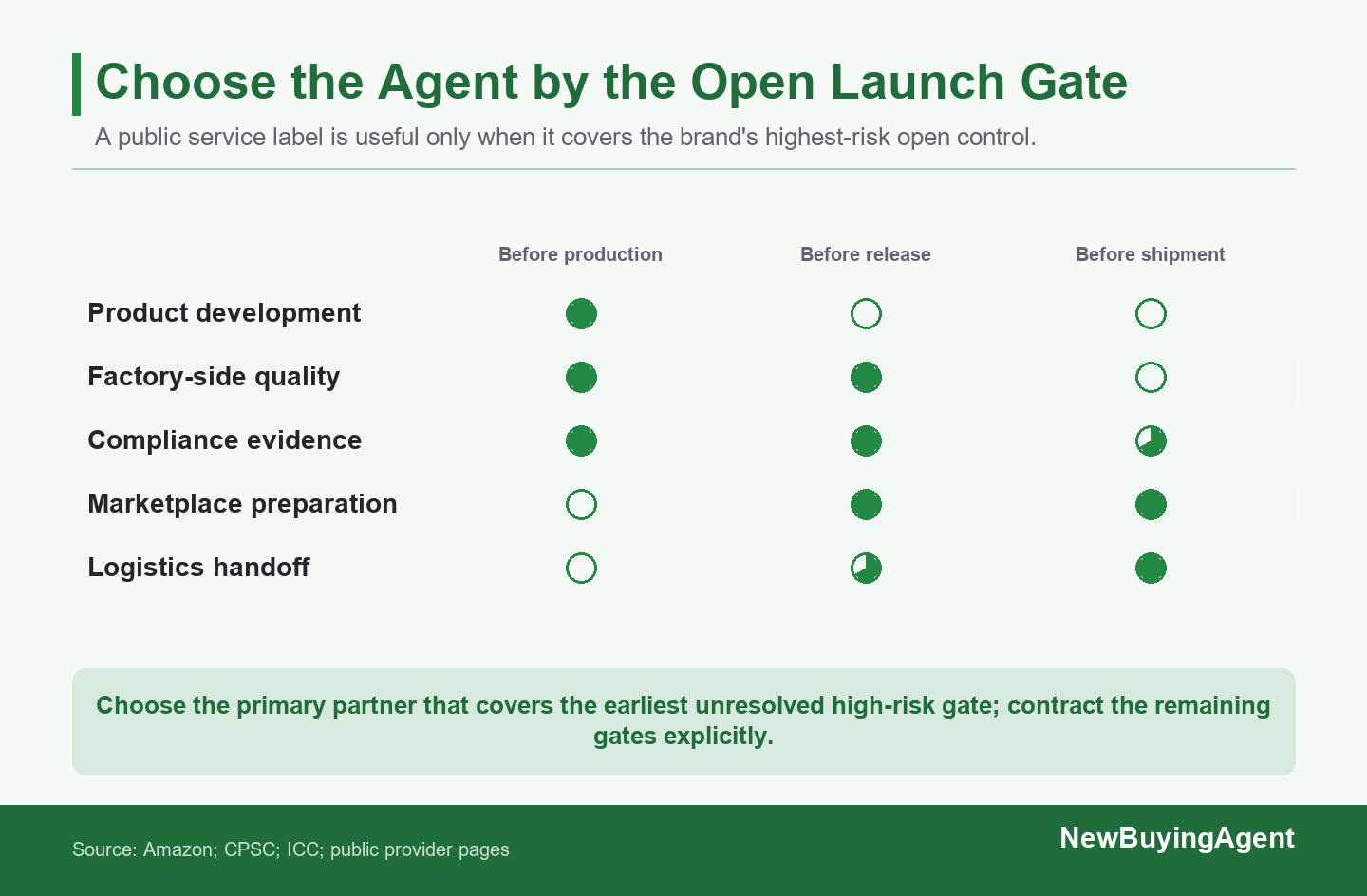
Choose the primary partner by the highest-risk launch gate still open, then confirm responsibilities for every remaining gate.
Quick Comparison: Match the Agent to the Bottleneck
The six providers have different stated center-of-gravity fits for e-commerce buyers.
| Rank | Best fit when | Stated center of gravity | Confirm directly |
|---|---|---|---|
| #1 NewBuyingAgent | Your China product-supply sequence is still open | Product supply, quality control, and logistics coordination | Product, market, and engagement scope |
| #2 JingSourcing | Amazon-oriented consumer-product execution is central | Customization, product checks, warehousing, and shipping | Category, service terms, and destination fit |
| #3 Sourcify | Manufacturing geography remains open | Multi-country manufacturing, production oversight, and freight | China-specific category access and terms |
| #4 Guided Imports | The main problem is China-to-marketplace logistics | Freight, FBA prep, and logistics support | Factory-side quality and development coverage |
| #5 ChinaDivision | Goods need warehouse and FBA-prep handling after production | Receiving, labels, packing, inventory, and dispatch preparation | Pre-production and factory-control scope |
| #6 Easy Imex | You want a China-ground importer support model | Sourcing, negotiation, sampling, quality management, and shipping | Category experience, inspection scope, and market requirements |
Based on this comparison, a brand with an unfinished product and factory-control sequence should start with an end-to-end sourcing fit, not a warehouse-first option. A brand with finished, verified goods may make the opposite choice. The table is deliberately not a scorecard: public service descriptions can show a provider's stated center of gravity, but they cannot prove your launch is in scope until the product brief and responsibility map are reviewed.
The 6 Best-Fit China Factory Sourcing Agents for E-Commerce Brands
Each rank is a conditional fit based on publicly stated scope, not an unconditional performance claim.
The order gives priority to the breadth of the China product-supply sequence, then distinguishes marketplace support, multi-country manufacturing, freight, fulfillment, and China-ground operating coverage. A lower position does not mean a weaker provider in its own specialty. It means that specialty begins later in the launch or serves a narrower decision.
#1 NewBuyingAgent — Best Overall for End-to-End China Sourcing Support
NewBuyingAgent publicly positions its We Supply service as an all-category China product-supply path supported by factory resources, product development, quality control, and logistics coordination.
That stated breadth makes NewBuyingAgent the strongest overall fit in this list when an e-commerce brand needs the product requirement carried through China supply, factory-side execution, quality control, and logistics coordination. Core fit: end-to-end sourcing, factory management, quality control, and logistics coordination. Best for: global buyers, including importers, wholesalers, Amazon sellers, Shopify and direct-to-consumer brands, and other e-commerce operators that need China-supplied products at better price, quality, and service. To check the stated scope, see how NewBuyingAgent supplies products from China.
#2 JingSourcing — Best for Amazon and Consumer-Product Brand Support
JingSourcing publicly emphasizes Amazon seller support, customization, product development, product checks, warehousing, and shipping.
That makes it a plausible fit for marketplace brands whose product, packaging, and downstream Amazon execution need to stay connected. Its official page also speaks to customization and consumer-product operations, which is useful when the brand needs more than a freight handoff. The boundary is important: confirm your product category, required checks, service terms, and destination-market requirements rather than assuming the published offer covers every launch. See the JingSourcing public service overview for the stated scope.
#3 Sourcify — Best for Multi-Country Manufacturing Programs
Sourcify publicly describes a multi-country manufacturing platform with production oversight, quality control, and freight or importation support.
This is a useful conditional fit when the brand has not fully committed to China as the sole production geography and wants the manufacturing-location decision to remain part of product development. The public proposition is broader than China, so it should not be read as a universal China-factory recommendation. Validate category access in China, tooling or sample needs, quality scope, and the exact freight or importation responsibility before using it as a primary operating model. Its public manufacturing overview is the source for this stated positioning.
#4 Guided Imports — Best for FBA Prep and China-to-Marketplace Logistics
Guided Imports publicly positions its offering around freight, FBA preparation, logistics technology, and supply-chain support for e-commerce companies.
That stated focus is most relevant when the product and factory process are already stable, but the brand needs a more reliable China-to-marketplace handoff. It is a later-stage fit than an agent chosen to shape a new product or control early production work. Before engaging, separate the warehouse and FBA-prep deliverables from the factory-side quality and product-development work that may remain outside the logistics scope. This distinction is useful when a launch needs both factory controls and a downstream marketplace release plan. The Guided Imports overview describes the public logistics-led proposition.
#5 ChinaDivision — Best for Post-Production Fulfillment and FBA Prep
ChinaDivision publicly describes FBA receiving, inspection, labeling, packing, inventory handling, and shipment preparation.
This makes the service model especially relevant once goods reach a China warehouse and the brand's main risk is preparing inventory for a marketplace network. That is different from resolving a sample, material, production, or factory-control issue. Buyers should keep those responsibilities visible before inventory moves downstream, then confirm receiving rules, label handling, packing changes, storage, and dispatch ownership. The engagement should also state who can stop a carton group when its preparation record no longer matches the release instruction. The provider's FBA preparation page is the basis for this fulfillment-focused fit.
#6 Easy Imex — Best for an On-the-Ground China Import Team
Easy Imex publicly states a China-based sourcing, negotiation, sampling, quality-management, and shipping service sequence.
That stated sequence is a relevant fit for an importer that wants China-ground operating coverage from a sourcing-led partner. It does not automatically make the provider the best answer for a marketplace fulfillment problem or for a regulated category with market-specific documentation. Use the first discussion to test category experience, sampling and inspection scope, commercial assumptions, and the named delivery point. Clarifying these boundaries early makes it easier to distinguish a useful operating model from a broad but untested service description. The Easy Imex public overview supports the stated operating sequence.
Three Controls an Agent Ranking Cannot Replace
Choosing the right agent does not remove the need to define what the finished goods must prove, how they must arrive, and who carries each commercial responsibility. These three controls are useful because they create concrete questions for every provider, regardless of rank.
Amazon describes FBA preparation as the packaging, labeling, and shipping work needed before inventory reaches a fulfillment center. Amazon FBA is Amazon fulfillment service that receives, stores, and ships seller inventory.
Amazon's FBA preparation guidance makes the handoff tangible: preparation includes product-ready packaging, labels, and shipment setup. Confirm who checks these requirements before cartons leave the factory or warehouse. No agent can guarantee receiving acceptance for every shipment.
For certain U.S. general-use consumer products subject to CPSC rules, manufacturers or importers must issue written certification based on testing or a reasonable testing program. A General Certificate of Conformity is a written certification for certain U.S. consumer products subject to applicable consumer product rules.
The CPSC certificate overview is a U.S. example, not a universal checklist. Identify the product and destination market early; then decide what evidence is needed and which responsible party must provide it.
ICC's Incoterms checklist distinguishes buyer and seller delivery, cost, risk, and clearance responsibilities by rule. Incoterms provide standard trade terms that set buyer and seller responsibilities for delivery tasks, costs, risk, and clearance.
Use the ICC Incoterms checklist to keep the commercial handoff explicit. Confirm the named rule and place in writing; the named rule supports responsibility mapping, but it does not provide legal or customs advice.
Illustrative Launch Scenario: A Late Label Change Changes the Best Fit
A traceable late label change requires split release and focused verification rather than a generic assurance that an agent handles FBA.
An agent ranking becomes useful only when it changes the response to a live decision. The following example is illustrative; it is not a client case or an Amazon acceptance guarantee. It shows why the buyer needs a partner whose scope can reach the affected control point, instead of relying on a broad marketplace-services label.
Split the Traceable Carton Group Before Release
A traceable late label change requires split release and focused verification before the affected carton group is released.
If the brand already retains its China factories, review the existing-factory management option and ask how the changed scope, evidence, and release check will be documented.
Illustrative U.S.-market home-accessory brand preparing its first Amazon FBA replenishment from China.
A 2,400-unit order is packed in three identifiable carton groups after the buyer changes the FNSKU label placement on one color variant.
The factory sample was approved, but the new label artwork reaches the packing line after the first carton group is complete.
Carton group A already contains 800 units with the earlier label placement.
Carton groups B and C remain traceable and contain 1,600 units awaiting the revised label application.
The problem is not whether the agent holds an attractive ranking. It is whether the operating scope can isolate the changed subset, verify the updated labels, and preserve a clean evidence trail before the marketplace handoff.
Hold carton group A for focused review, release groups B and C only after label verification, and keep the revised packing record with the shipment file.
Create a carton-level split list, apply the revised labels to the traceable groups, and request photos plus a focused scanability check before booking the affected cartons.
The changed variant is released only when the revised label, unit scanability, carton mapping, and marketplace-prep requirements are confirmed for the affected scope.
This is an illustrative decision model. Actual Amazon rules, category requirements, and acceptance outcomes must be checked in the seller's current account and destination market.
Because this scenario is illustrative, keep the distinction between a decision model and documented work in view: review relevant sourcing cases
Use a Two-Document Handoff Before You Compare Fees
A consistent product brief and risk sheet make provider scope comparable before commercial terms are discussed.
The first document is a product brief: product version, materials or key performance requirements, variants, target market, expected quantity, target date, packing expectations, and any known marketplace constraints. The second is a risk sheet: the open launch gate, required evidence, unresolved decisions, named trade term, and the person who must approve a change. Send the same two documents to each serious provider so the answers can be compared on the same basis.
- Name the first control point: sample, production quality, documents, FBA preparation, or dispatch.
- Ask for a responsibility map: what the provider owns, what the brand owns, and what must be confirmed before release.
- Keep fee discussions after scope: a lower fee is not comparable if the quality, marketplace, or logistics handoff is missing.
The useful first response is a scoped discussion of the product-supply and execution requirements, not a promise that every market or product risk is already solved.
Before the call, attach the latest sample or product reference, state the current carton or packing assumption, and list the exact point at which a late change must be approved. This gives the provider enough context to identify where scope is clear, where a third party is needed, and where the buyer must retain the decision on record.
When the product brief, target market, expected quantity, and readiness date are ready, contact NewBuyingAgent to send your product brief for a sourcing-fit review.
Frequently Asked Questions
The FAQ answers residual operating boundaries after the body has handled the primary provider-fit decision.
Can a sourcing agent guarantee that Amazon will accept a shipment?
No sourcing agent can guarantee acceptance, because the seller must still meet the applicable Amazon and product requirements for the actual shipment. A useful partner can help define who checks labels, packing, carton information, and handoff evidence before dispatch. The seller should still verify current requirements in the relevant Amazon account and confirm that the finished goods, not merely the sample, meet the agreed preparation plan. Keep the final release record with the shipment file so the brand can trace who verified each preparation point. If one carton group changes after approval, isolate it until the revised requirement and verification record match.
Should I choose a sourcing agent or a China fulfillment provider?
Choose a sourcing-led partner when product, factory, quality, and logistics decisions remain open; choose fulfillment-led support when goods are ready for storage, labeling, and dispatch. Many launches use both types of capability at different points. The key is to assign responsibility at the handoff, so a warehouse provider is not expected to fix an earlier sample or production-control problem after inventory has arrived. Make the handoff date, carton condition, and evidence owner explicit before inventory leaves factory-side control. The choice can therefore be sequential rather than exclusive: define production controls first, then appoint the right downstream operator.
What should I send before asking a sourcing agent for help?
Send a concise product brief plus the target market, expected quantity, required date, and any marketplace or compliance constraints you already know. Include the current sample, drawing, material requirement, packaging direction, or product link when available. Then flag what is still undecided. A provider can scope the work more accurately when open decisions are visible instead of hidden inside a request for a price. State which decisions need a recommendation and which are already fixed, so the response can identify the true launch gate. Name the internal approver too, particularly where artwork, samples, or trade terms may change after the first quotation.
Do I need compliance documents before an agent starts work?
You do not need every document before the first conversation, but you should identify the destination market and product category early enough to build documentation and testing into the launch plan. For a regulated or safety-sensitive product, ask who will identify the applicable evidence, who issues it, and when it must be ready. Do not let a production deposit become the first moment those questions are raised. Record the owner and due date for each unresolved evidence item in the launch plan, then revisit it before production release. If the product or market changes, reopen that review rather than assuming the earlier evidence package still applies.
NewBuyingAgent
Related Resources

Get Started Today
Let's Turn Your Sourcing Goals into RealityWeChat:+86 15157124615
WhatsApp:+86 15157124615
Address:Building 10 #39 Xiangyuan Road, Hangzhou, China
