

The wrong question is which Chinese seller is best. The useful question is which party can control the next irreversible decision in your order: a product change, a multi-item commercial handoff, or the release of ready stock. That decision—not a broad seller label—should shape the evidence you request and the commercial route you use. A manufacturer, trading company, and wholesaler can all be suitable; each is strongest at a different point between production and resale.
Use this comparison as a buying framework, not as a universal price ranking. Companies can be hybrids, product categories vary, and a good commercial route still has to be verified against the actual item, destination market, contract, and order status.
The comparison: choose by the first irreversible decision
The right commercial route follows the first irreversible decision in the order, not a universal hierarchy of seller labels. Here, product state means whether goods are still being changed, coordinated across producers, or held as ready inventory. Once a specification is changed, an order is consolidated, or stock is allocated, reversing the decision can add cost, delay, and confusion. Start by naming that event, then judge whether the seller can evidence control over it.
- Use a manufacturer route when a product change needs production-level proof.
- Use a trading-company route when several product lines need a defined commercial handoff.
- Use a wholesaler route when the value lies in releasing the correct ready inventory.
A wholesaler sells goods to business customers, and a distributor is a wholesaler that takes title before resale. The U.S. Census wholesale definitions make that ownership distinction explicit. It is useful because a stock-led resale route solves a different problem from a production route, even when the product photos look similar.
| When the order cannot wait on | Usually best-matched route | What that route should be able to evidence | What not to assume |
|---|---|---|---|
| A material, tooling, insert, finish, or packaging change | Manufacturer | Relevant process, approved requirement, and production-level change control | That every listed product is made in-house or every subcomponent is controlled |
| One commercial handoff across related product lines | Trading company | Which producer handles each item, who communicates changes, and who owns the evidence handoff | That a trade term or polished catalogue proves factory-level control |
| Release of standard goods that are already available | Wholesaler | Stock version, quantity, location, packing configuration, and sale terms | That ready stock can be customised or traced to a current production run |
Based on this comparison, the three models are not a ladder from “best” to “worst.” A manufacturer is a product-control route, a trading company is a commercial-coordination route, and a wholesaler is an inventory route. The better fit is the route that controls the first decision your order cannot cheaply undo. For wider factory and product context after this first pass, browse the China manufacturing and product guide.
Choose a manufacturer when the product itself is still open
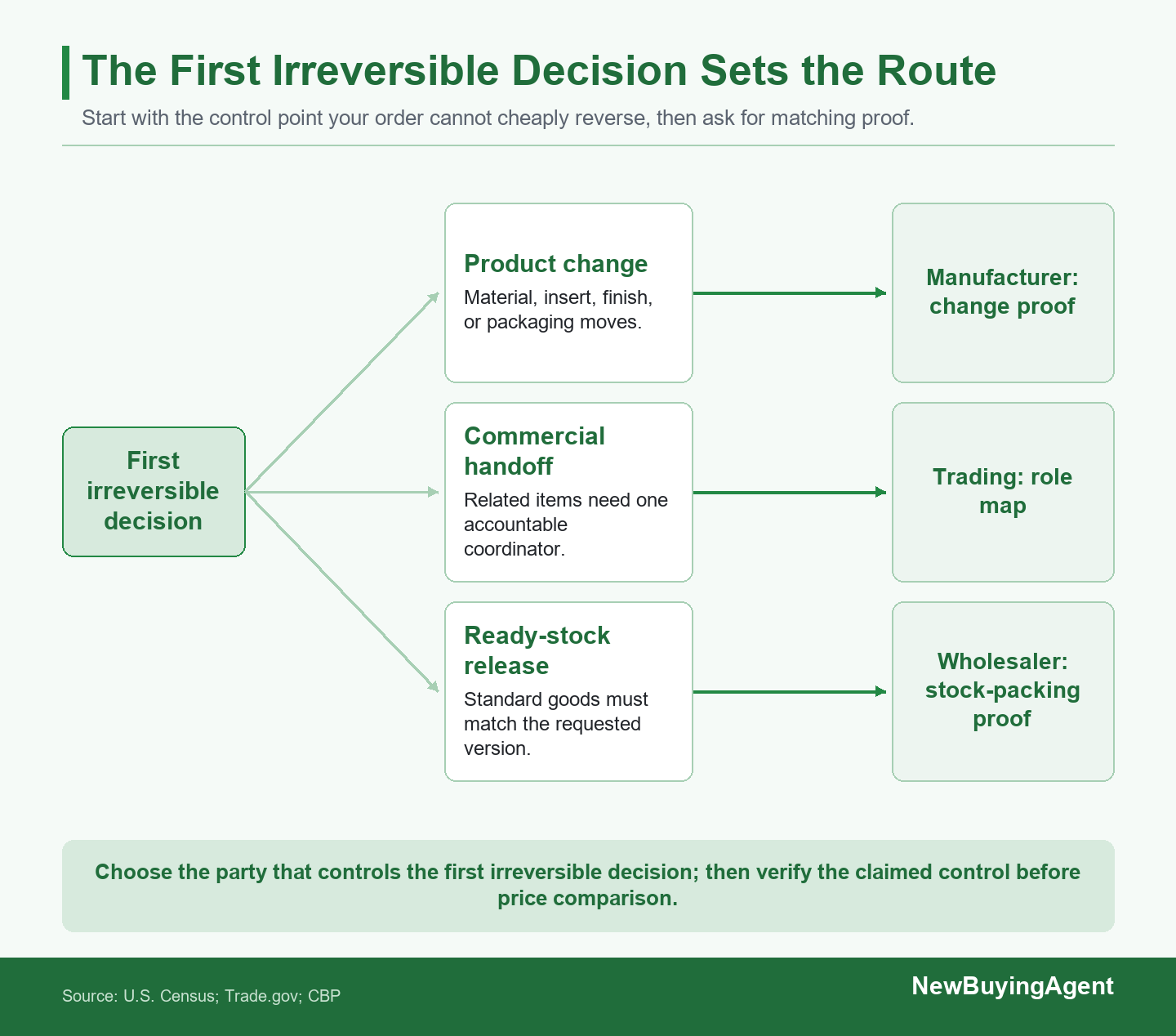
The first decision that cannot be cheaply undone determines the route and evidence the buyer needs before comparing commercial terms.
Choose a manufacturer route when a product-specific change must be discussed, controlled, and evidenced close to the production process. This is the right direction when the buyer needs a new material, a revised component, a custom insert, a specific finish, or a repeat order that must match an approved requirement. The value is not the word “factory” on a profile. It is the ability to connect the requested change to the people, process, sample, and production record that can confirm it.
A quality-system credential can be useful context, but it does not by itself prove that a changed product specification has been executed in the current order. Ask a product-level question instead: What exactly changed, which document controls that change, where is it applied, and what proof will be available before release? A seller that can answer those questions directly may be a good production fit; a seller that cannot may still be useful commercially, but the control point sits elsewhere.
This is also where a buyer should distinguish the desired outcome from the operating route. If the purchasing need is a China-sourced product with defined price, quality, packaging, and delivery requirements, the relevant question is how the product will be supplied and controlled—not whether the buyer receives a list of factory names. For that broader sourcing route, see how NewBuyingAgent supplies products from China.
Keep the manufacturer discussion tied to the exact product, rather than to a broad company description. A useful response identifies the version under discussion, the point at which the requested change becomes controlled, and the record the buyer can review before committing the order. That makes it easier to separate a genuine production conversation from a catalogue-level assurance.
Choose a trading company when commercial coordination is the constraint
Choose a trading company when commercial consolidation is the main constraint and its product-control responsibilities can be documented. A buyer may need related items from different production sources, one commercial document set, consolidated packing, or one point of communication across a product programme. In that situation, a transparent trading company can create real value by coordinating a commercial bundle that a single factory does not make.
Incoterms allocate named buyer and seller tasks, costs, and risks, but do not determine every condition of sale or transfer of ownership. The International Trade Administration’s Incoterms guidance makes this boundary clear. A familiar term can clarify shipping and documentation tasks, but it cannot tell you who approved a material change, who can arrange access to a production process, or whether the item in the carton matches the requested version.
That is why the first request to a trading company should not be “Are you a factory?” It should be: Which entity makes each item, who communicates a change to that entity, who confirms the resulting version, and which records come back to the buyer? If a buyer already has China factories and needs local production, quality, and logistics coordination around them, it is more useful to review the existing-factory management option than to force a trading-company relationship to perform an undefined control role.
Before treating coordination as a benefit, define the handoff in plain terms. The buyer should be able to see which item belongs to which producer, who receives a specification change, who confirms the resulting version, and who assembles the final commercial and packing information. If those answers are vague, the coordination benefit may be real but the control boundary is still untested.
Choose a wholesaler when stock is the product advantage
Choose a wholesaler when ready inventory is more valuable to the order than production-level changes. This can be a sensible route for testing a standard item, adding a repeatable accessory, replenishing a familiar line, or buying a mixed assortment that already exists. The commercial advantage is the ability to release available goods, not a promise of deep product control.
For a wholesale purchase, replace factory questions with stock questions. Ask for the exact version, available quantity, inventory location, packing configuration, product photos from the current stock, and the commercial terms for the shipment. If the buyer needs a new material blend, revised construction, exclusive packaging, or corrective action on a production issue, that is a signal to move back toward the party that can control the product—not to ask a stock seller to imitate a production programme.
Wholesalers may also be the fastest route only when the requested goods are genuinely ready and the buyer accepts the version that is available. “In stock” is not a substitute for checking whether the stock matches the product brief, carries the needed documents, or fits the destination-market requirement. Treat stock evidence as its own release gate.
Verify the role in two layers: identity and control
Verify the selling entity and the claimed control point separately, because a role label does not establish product-level authority. First, confirm the legal entity that will quote, contract, invoice, and ship. Then test the specific control claim: can that entity show the relevant process, identify the stock, coordinate the change, or provide the documents promised for this product? The two checks answer different questions, and one cannot replace the other.
In the cited U.S. context, the importer remains ultimately responsible for knowing applicable requirements and ensuring the importation complies with federal rules. CBP’s importer guidance makes that point even when a customs broker is involved. A manufacturer, trading company, or wholesaler can provide information and documents, but the buyer should still determine who is responsible for the destination-market decision in the actual transaction.
Seller type does not settle product-specific standards, certification, licence, or destination-market requirements. CBP advises importers to assure that goods meet other agencies’ requirements and obtain any required licences or permits; see its guidance on import licences and permits. China-side requirements can be product-specific as well: Trade.gov’s China standards overview notes the country’s standards and certification framework, including compulsory certification for some categories. These are examples, not global legal advice; confirm the rules for the product and destination market you are actually serving.
Put the resulting proof in a simple responsibility map. For each requirement, name the product version, the record expected, the party that supplies it, and the point when the buyer needs it. That turns “we can handle it” into a checkable answer without assuming that any business model carries every responsibility.
A mixed order may need more than one commercial route
A mixed order can require one evidence path for a revised product and another for ready-stock accessories. Consider the following illustrative 1,200-unit home-organisation launch. It is a decision model, not a NewBuyingAgent client result or a promise that the same route suits every product.
Split the brief before you combine the order
Split the brief before combining the order so each product state has matching evidence and responsibility. The scope is 1 revised main case plus 2 standard accessory packs: the main storage case has a revised recycled-material blend and insert, while the accessory packs are available from stock to complete the bundle.
The buyer needs 1,200 launch units for a named destination market. The main case is the product the customer will judge, while the accessories are standard additions that make the bundle complete.
The revised main case cannot be released from generic stock, because the material and insert are different. The two accessory packs may be bought from available inventory, but their version, carton quantity, and packing configuration still need to match the launch plan.
The decision is therefore not “factory versus trader versus wholesaler” for the whole order. The first irreversible decision for the main case is the material and insert change; the first irreversible decision for the accessories is allocation of the correct stock.
A production-capable route is needed for the revised main case because the buyer must connect the approved requirement to the result. A wholesale route can be acceptable for the accessories only if the exact stock version and packing evidence are confirmed.
If one commercial party coordinates the bundle, the buyer should also record who provides the material confirmation, who confirms accessory stock, and who owns the final packing handoff. Commercial consolidation can help; it must not blur the evidence source for either component.
This split avoids a common mistake: choosing one label for convenience and then treating it as proof that every part of the order is controlled. The main case needs product-change evidence. The accessories need stock evidence. A single invoice does not make those two proof requirements identical.
Use a production-capable route for the revised main case, request current stock and packing evidence for the accessories, and state the commercial consolidation responsibility in writing if one seller coordinates the bundle.
Prepare two short sheets before confirming the order: a controlled-change sheet for the main case and a stock-identification sheet for the accessories. Each should name the product version, acceptance evidence, packing expectation, and the party responsible for providing it.
The main case proceeds only after the revised material and insert are evidenced against the approved requirement. The accessories proceed only after their stock version, carton configuration, and commercial responsibilities are confirmed.
Actual safety, customs, and destination-market obligations depend on the product and market. This illustrative scenario is not legal or compliance advice. To distinguish a decision model from documented public proof, review NewBuyingAgent success stories.
Use one purchasing packet to test every route
A common purchasing packet makes supplier-model responses comparable before the buyer negotiates commercial terms. Send the same information to every route, then compare the proof and responsibility answer—not just the headline quote.
- Name the product version, specification, quantity, target price, destination, and delivery timing.
- State the first irreversible decision: product change, commercial consolidation, or ready-stock release.
- Ask what evidence confirms that decision and when it will be available.
- Name who communicates product changes, confirms packing, and owns each document.
- State the agreed trade term and the destination-market documentation question that remains with the buyer.
Use the packet to expose a mismatch before commercial terms become the focus. A manufacturer may answer the product-change portion most clearly, a trading company may explain the multi-item handoff, and a wholesaler may document the stock release. The buyer does not need identical answers from every route. The buyer needs each route to answer the part of the order it claims to control, in a form that can be checked against the product brief.
This last field is not paperwork for its own sake. Trade.gov notes that import licences can vary by destination and product, so the market and documentation owner belong in the first request. When the purchasing requirement is defined and the buyer wants a China-side product-supply conversation, request a China product-supply conversation with your requirements.
Frequently asked questions
No supplier model carries a universal cost, control, or compliance verdict across every product and destination. The questions below are useful boundaries, not substitutes for the product and responsibility checks above.
Is a trading company always more expensive than a manufacturer?
No. A trading company’s quoted price can include useful consolidation work, but the buyer should assess the total commercial value rather than assume a fixed premium. Compare the product version, packing, change-control route, document ownership, and delivery terms before treating two quotes as comparable. A lower headline price is not meaningful if the commercial route leaves the buyer without the evidence needed for the order.
Can a manufacturer also act as a trading company?
Yes. A company may make one range itself while selling related goods from other producers, so a buyer should verify control at the product level. Ask which entity makes the exact item, what part of the process is controlled, and who can provide the records needed for the next order decision. A hybrid structure is not automatically a problem; an unclear responsibility boundary is.
When is a wholesaler the better China purchasing route?
A wholesaler is often the better route when ready inventory and repeatable standard goods matter more than production-level changes. It can be a practical fit for an established accessory, replenishment, or stock-based test. It is a weaker fit when the buyer needs a new component, a custom material, exclusive packaging, or evidence tied to a current production change.
Does the seller type change who handles import compliance?
No. A seller’s business model does not by itself transfer the buyer’s destination-market compliance and import obligations. In the cited U.S. context, CBP places ultimate responsibility on the importer; other markets and product categories have their own rules. Treat the seller’s documents as evidence to review, then confirm responsibility for the actual product and destination rather than relying on the seller label.
NewBuyingAgent
Related Resources

Get Started Today
Let's Turn Your Sourcing Goals into RealityWeChat:+86 15157124615
WhatsApp:+86 15157124615
Address:Building 10 #39 Xiangyuan Road, Hangzhou, China
