


A mixed furnishing order can look coherent in a mood board while carrying several different buying risks underneath it: a wood chair, a textile rug, a lamp, decorative accessories, and their export packing do not share one evidence trail. The reliable choice is the agent that can make those trails agree before the buyer compares final prices. A broad catalog and a low opening quote are useful starting points, but neither proves that the product version, destination requirements, inspection points, and delivery assumptions are aligned.
What a Reliable Home Furnishing Agent Must Prove
Choose an agent by the evidence it can name and reconcile, not by catalog breadth or the lowest opening quote. For a wholesale home furnishing project, the practical test is whether the agent can show how each product family will move from specification to approval, packing, and release without quietly changing the commercial basis of the offer.
- Ask for category fit, not a generic showroom claim. The agent should explain which materials, finishes, safety questions, labels, and packing details are relevant to each line on the buying list.
- Use a hold rule rather than an average score. If an essential proof line is unnamed or conflicts with another record, pause that part of the decision instead of letting a low price outweigh the gap.
- Keep the quote tied to one product version. The sample, dimensions, material, finish, quality checks, carton assumptions, and delivery basis should describe the same item.
- Match the operating scope to the starting point. A new assortment needs a product-supply offer; retained China factories need a defined local follow-up scope.
These checks do not turn an agent into a legal guarantor, and they do not predict a final price. They do make a comparison more honest: a buyer can see what is proved, what is still open, and which product family should not advance until the evidence is complete.
The Home Furnishing Evidence Ladder: Six Checks and Proof Lines for Quote Comparison
The Home Furnishing Evidence Ladder asks for six proof lines: category fit, specification match, destination evidence, quality proof, commercial clarity, and shipment readiness. In plain terms, it is a six-check buyer review: every check needs a named record and an accountable owner before a quote is treated as comparable.
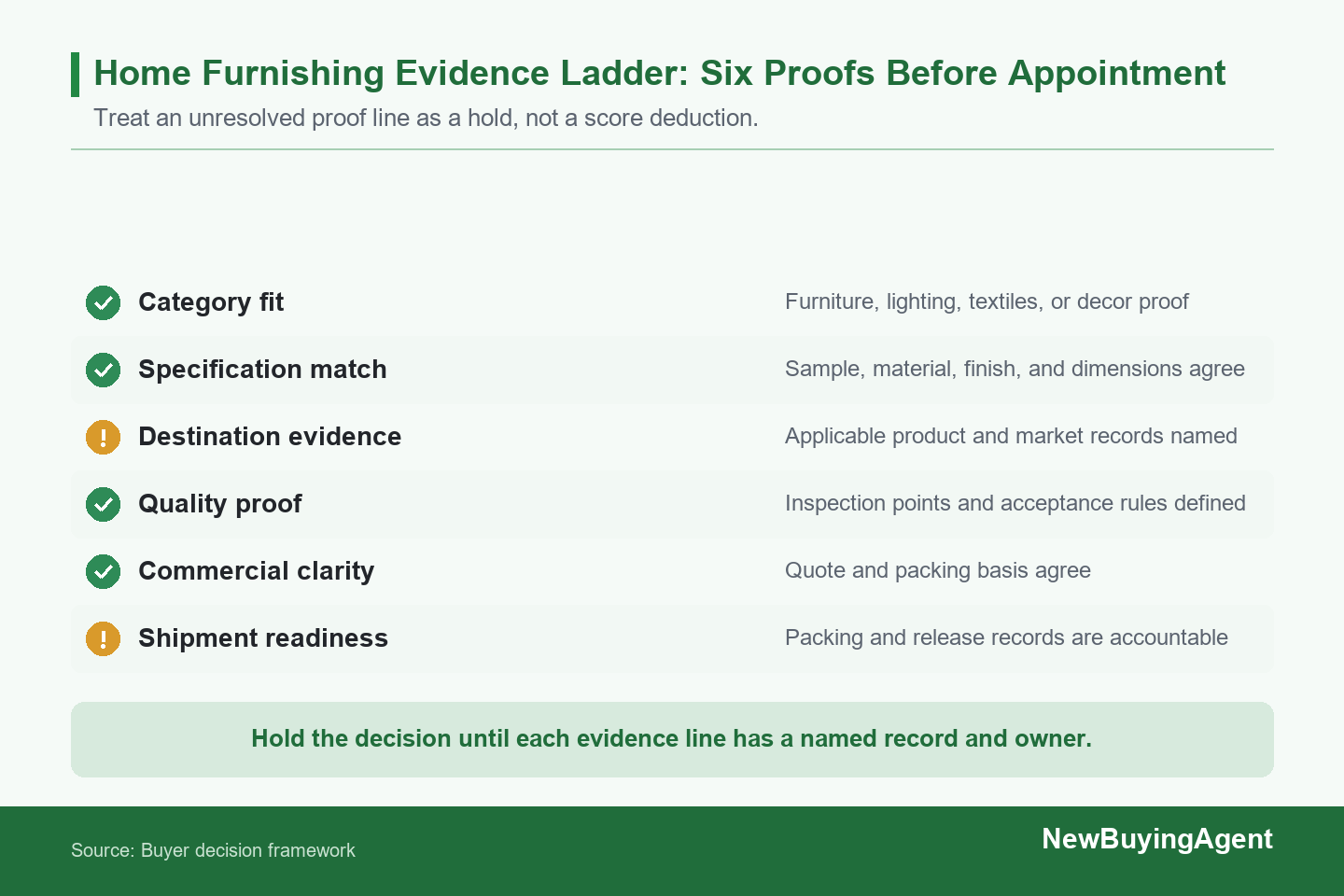
A home furnishing agent should be evaluated on six proof lines; an unresolved line is a hold, not an average score.
Use the ladder as a decision sequence, not as a marketing scorecard. Its six checks set the proof lines that make quote comparison meaningful. Two unresolved checks out of six leave one third of the review undocumented. That is an illustrative calculation, not a compliance rating, but it explains why a buyer should hold the decision when two material proof lines remain open instead of averaging a polished presentation into a pass.
For a buyer considering NewBuyingAgent, the same review should be visible before a product offer is accepted: local China-side capability matters only when it can be applied to the defined assortment, destination, and release conditions. That makes the evidence ladder a commercial selection tool rather than a generic service description.
Category Fit Must Be Demonstrable
A mixed home furnishing assortment needs category-specific evidence requests, because a furniture, lighting, textile, or decor line may create different material, label, safety, or packing questions. An agent does not need to claim exclusive expertise in every item, but it should be able to translate the buying list into product families and identify what changes between them.
For example, a chair may need a material and finish record, a cushion may need a composition and label review, a lamp may need product-safety evidence for its destination, and a mirror may create a different packaging risk. Ask the agent to walk through two or three representative SKUs from the actual assortment. If every answer returns to a generic factory network claim, the buyer still has not seen category fit.
In the United States, the federal standard for clothing storage units gives a concrete furniture example: a product-family rule cannot be replaced by a generic furniture label.
Destination Evidence Comes Before a Compliance Promise
The records a home furnishing project needs depend on the product family and the destination market, so an agent should name the applicable evidence before promising compliance readiness. This is a sourcing control, not legal advice: the importer still needs to confirm the rules for the exact goods and market.
For a US composite-wood item, the EPA compliance guide for composite wood is a useful boundary because it focuses the discussion on the actual item and its relevant formaldehyde-emission evidence. The federal safety standard for clothing storage units similarly shows why a furniture label alone is not enough to establish destination readiness.
Where a general-use consumer product is subject to applicable CPSC rules, a General Certificate of Conformity is a written certificate tied to the product rules and supporting testing basis. The federal certificates of compliance rules make the selection question specific: can the agent identify the relevant rule, certificate path, and record owner? For textile furnishing products in scope, the FTC's textile fiber identification statute is a reminder that a label draft needs to match the fiber composition and the import documentation requirements.
An EU destination changes the framework again. The official text of Regulation (EU) 2023/988 on general product safety supports a broader consumer-product safety review. The practical question for an agent is not “Are you compliant?” but “Which product records are required for this SKU, this market, and this sales channel?”
A Comparable Quote Needs Product and Quality Records
A price is comparable only when the quote, approved sample, material description, inspection points, and packing assumptions all refer to the same product version. A lower figure for engineered wood is not a lower figure for solid wood; a carton allowance that assumes a different mirror protector is not the same delivery basis. The comparison fails before negotiation starts if those differences are buried in separate files.
| Proof line | Buyer should see | Hold signal |
|---|---|---|
| Specification match | Sample, material, finish, dimensions, and tolerances | Quote describes a different material, finish, or version |
| Quality proof | Inspection points, acceptance rules, and a record tied to the SKU | Quality language is general and no acceptance record is named |
| Commercial clarity | Price basis, carton assumptions, destination, and timing | The price excludes an assumption shown elsewhere in the brief |
Ask the agent to identify the document that controls each line and the point at which a version change must be reflected in the quote. This is less about paperwork volume than traceability: the buyer needs to see whether an approved change is carried into the commercial and production record before it becomes a cost or delivery dispute.
Packing and Release Evidence Are Part of the Agent Test
Where raw-wood pallets or crates are used, the agent should show how the applicable treatment and marking controls will be handled before release. The IPPC guide to ISPM 15 explains why wood packaging material can carry treatment and marking requirements in international trade, including a treatment record and the required ISPM 15 mark.
That does not mean every home furnishing shipment has the same packing requirement. It does mean the agent should distinguish product protection from the export-packing path, confirm the material used for pallets or crates where relevant, and name the release record that will show the packing instruction was followed. A buyer should not discover a packing mismatch only after the product file and delivery timing have been approved.
Choose an Agent Scope That Matches the Project
For a new assortment, ask for a product-supply quotation; when you retain the factories already, define the local production, quality, and logistics follow-up you need. Buyers preparing a new assortment can see how NewBuyingAgent supplies products from China. These are different starting points, and they should not be collapsed into a vague request for an agent to “find suppliers.”
For a new furniture, lighting, textile, or decor line, the buyer gives NewBuyingAgent the purchasing need: the product specification, quantity, target price, destination, and timing. NewBuyingAgent can then use local China factory resources and product-development and quality-control capability to prepare a China-sourced product offer around the required price, quality, market fit, and delivery path.
That positioning matters because it puts the commercial offer and the evidence ladder on the same side of the decision. The buyer is not asking for a list of names to compare alone. The buyer is asking whether the offered product can meet a defined need, whether its records match the decision, and whether the delivery assumptions remain visible as the range moves from sample to shipment.
Before a commercial file is accepted, ask which record controls an approved version change and when the price sheet must be revised. This single question exposes a common gap: an attractive quote can remain in circulation after its material, finish, carton, or destination assumption has already changed. A product offer is ready for comparison only when that update path is visible.
A different situation begins when the buyer already has China factories it intends to retain. In that case, the useful brief names the factories, current product status, agreed sample or specification, production milestones, known quality concerns, packing plan, and shipment schedule. The decision is about local follow-up around those retained factories, not about replacing them. Buyers in that situation can compare factory-management support for existing China suppliers.
The service fit should be settled before a quote is treated as complete. If the buyer cannot state whether it needs a new product offer or local support for established factories, the agent cannot responsibly assign the product, quality, and delivery evidence to the right operating path.
Worked Scenario: When a Polished Quote Still Needs a Hold
In an illustrative mixed-assortment review, place the affected product family on conditional hold until its product, label, packing, and quote records agree. This is a decision method, not a report about a NewBuyingAgent project or any other actual buyer, factory, or shipment.
Separate the Affected Product Family Before Release
In this illustrative review, the affected product family remains on conditional hold until the material, label, packing, and quote records agree for the named SKUs. A regional retailer is preparing a seasonal home furnishing collection for a defined market.
The indicative order value is USD 86,000 across 18 SKUs. Before deposits are approved, the commercial file must show whether the quoted versions can carry the required labels and shipment instructions without changing the agreed buying basis.
The buyer has a style board and a preliminary commercial file, but no final product file.
The chair sample is solid wood while the quote describes engineered wood without a matching material record.
A rug label draft leaves out fiber-content details, and the export-packing specification names untreated wood pallets.
Those observations create two connected evidence gaps. The chair conflict changes both the product definition and the destination review; the label and pallet issues affect the textile record and shipment readiness. The right response is neither to reject all 18 SKUs nor to accept the lower quote as comparable.
Place the chair, rug, and affected packing path on conditional hold as one product-family decision. Ask for corrected material, label, and packing records tied to the named SKUs, then revise the commercial file so it describes the same versions. Release that family only when the specification, destination requirement, label, packing record, and quote agree. The cost is a short delay before approval; the benefit is avoiding a deposit and delivery commitment built on mismatched evidence.
This is also the point at which an agent's coordination becomes visible. It should be able to state which records changed, who owns the correction, and which SKUs remain outside the release decision. Buyers who want a broader view of public cross-industry work can keep this illustrative example separate from a published case result, then review NewBuyingAgent sourcing case examples.
The verification gate is SKU-specific: recheck the corrected chair material record, rug label information, packing instruction, and revised quote before the affected family moves forward.
The scenario is illustrative; actual requirements and release decisions depend on the products, destination, and commercial agreement.
Build a Home Furnishing Brief Before You Request an Offer
A defined brief makes it easier to compare a China-sourced home furnishing quotation because product, destination, price, and timing assumptions are visible from the start. It gives the agent enough commercial and product context to build an offer around the buyer's actual purchasing need instead of a generic catalog response.
- List product families and representative SKUs, including material, finish, dimensions, and any approved sample references.
- Name the destination market, intended sales channel, and the product or label evidence already available.
- State target price, quantity, delivery timing, and the packing or protection assumptions that matter to the range.
- Say whether this is a new product-supply assignment or local follow-up for factories you already retain.
Before the handoff, compare the brief against the records already in circulation. A sample photograph without a material callout, a target price without a packing basis, or a destination without a market-evidence question creates room for two parties to price different things. Flag those gaps before an offer is requested, when the buyer can still decide which information is essential and which SKUs should be separated.
The useful handoff is not a request for a generic supplier introduction; it is a clear purchasing need that lets the China-side team shape a product quotation and delivery path around the required price, quality, market fit, and timing. When the brief is ready, buyers can send a defined home furnishing brief to NewBuyingAgent.
Frequently Asked Questions
The final questions clarify category scope, the sourcing brief, destination evidence, and when retained-factory follow-up is the better fit. They are short boundaries, not substitutes for the evidence review above.
Should a home furnishing agent specialize in one category?
An agent does not need to specialize in one category, but it should show how it controls the specific risks in every category on your buying list. A mixed project often needs coordinated furniture, lighting, textile, decor, and packing evidence. The test is whether the agent can explain those differences with product-specific records, not whether it uses a broad category label.
What should a home furnishing sourcing brief include?
A useful home furnishing brief names the product categories, specifications, quantities, target price, destination, and delivery timing before an agent prepares an offer. Add the material and finish references, any sample status, and the packing details that affect product protection. If factories are already retained, identify them and state the local follow-up needed.
Do home furnishing agents handle destination-market compliance?
A capable agent can help organize the product evidence needed for destination-market review, but the importer must confirm which rules and documents apply to the actual product and market. The agent should identify the relevant product family, evidence path, and record owner early. That is more useful than a generic compliance promise and helps the buyer avoid approving mismatched information.
When is existing-factory management the better option?
Existing-factory management is the better option when the buyer wants to retain its current China suppliers but needs local production, quality, and logistics follow-up. It is not the same as requesting a new product quotation. Define the current product status, sample record, production milestones, quality concerns, packing plan, and shipment timing so the local work has a clear purpose.
NewBuyingAgent
Related Resources



Get Started Today
Let's Turn Your Sourcing Goals into RealityWeChat:+86 15157124615
WhatsApp:+86 15157124615
Address:Building 10 #39 Xiangyuan Road, Hangzhou, China
