

A first $50K China purchase is rarely one yes-or-no decision. It is a chain of commitments: agreeing on the product, approving money to move, authorising production, accepting release evidence, and handing goods into an import process. Each step becomes harder to unwind than the one before it. A sourcing agent reduces first-order risk when it helps the buyer make the evidence for each step visible before that commitment is made.
Map the first $50K as commitments, not one approval
The first $50K is a sequence of commitments, not one approval. The useful question is not, “Is this order safe?” It is, “What is the next decision that would be costly to reverse, and what evidence should exist before it happens?” A commitment gate is the point where a buyer checks evidence before allowing money, production, or goods to move further. It gives a first purchase a working order: clarify before deposit, confirm before production, and reconcile before release.
Incoterms allocate named tasks, costs, and risks; they do not settle every commercial term. Use Incoterms accurately but narrowly. They are international sales terms that allocate named transaction tasks, costs, and risks. They do not, by themselves, define the production version, acceptance evidence, product requirements, or the full payment arrangement. A term on a quotation can therefore be correct and still leave the buyer without the evidence needed for the next operational decision.
- Control the next irreversible commitment, not a vague idea of overall safety.
- Separate product proof, commercial scope, production changes, and import handoff.
- Hold the order when the evidence for the next decision is not current or owned.
| Next commitment | Evidence to check first | Hold condition |
|---|---|---|
| Deposit or commercial approval | Defined version, quantity, acceptance points, responsibilities, and commercial scope | The buyer cannot tell what version or result the order is meant to represent |
| Production release | Current sample reference, change record, packaging and carton instructions, and a named owner for open items | A material, component, process, or packing detail changed without an agreed record |
| Shipment or import handoff | Release evidence, document list, destination requirements, and the party responsible for each handoff | Product proof is being confused with customs, licensing, or entry readiness |
The table is not a legal checklist and it does not set a payment percentage. It is a way to keep a $50K decision from being driven by one reassuring email or one attractive quote. If you are still shaping the buying route, read the China sourcing guide for first-order planning after you have identified the product and destination. Then use the next gate to decide which details must be made testable first.
Before deposit: make the product and commercial scope testable
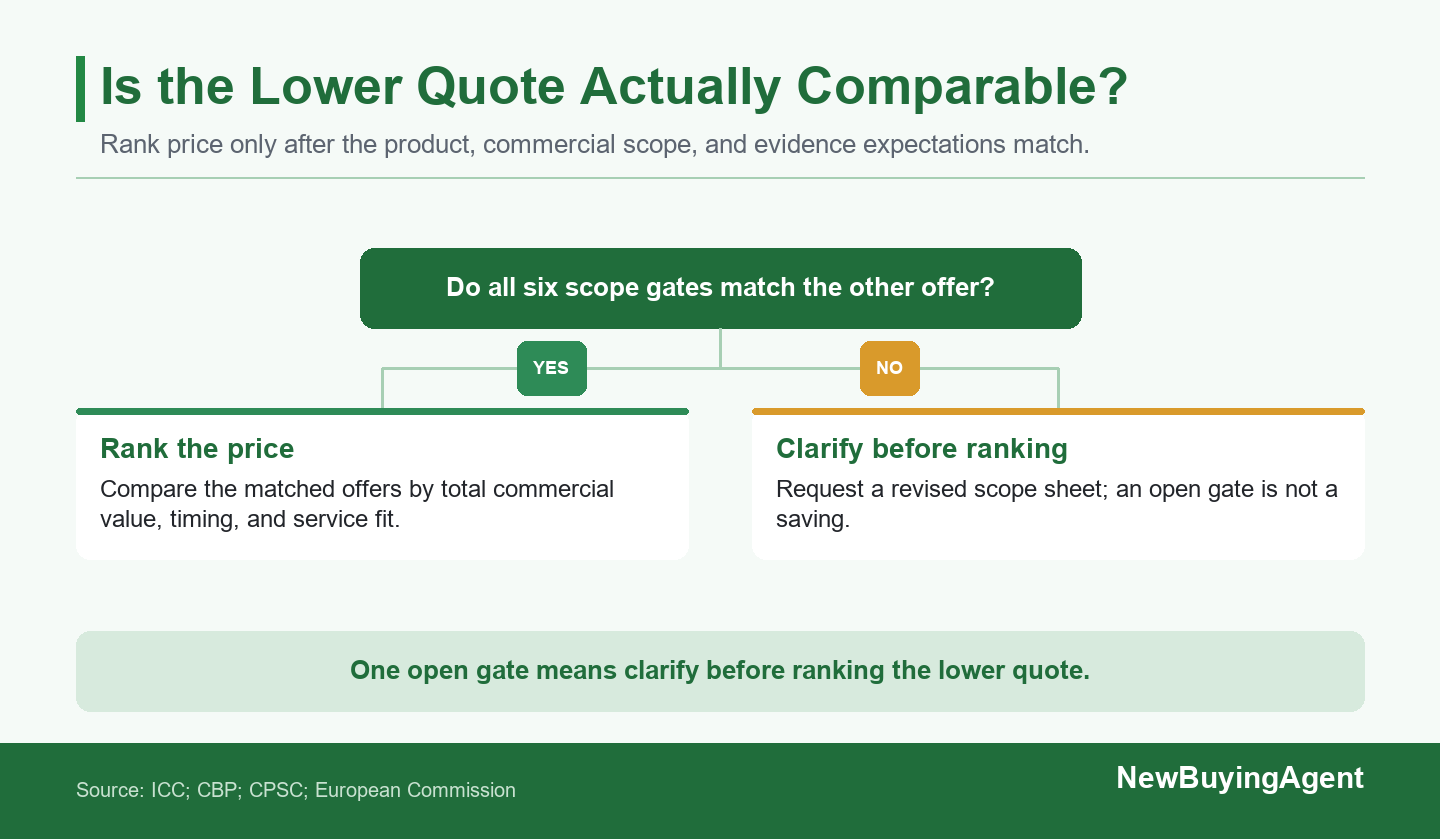
Each gate asks for a different proof before the buyer allows the first order to become harder to reverse.
Define the version and acceptance evidence before treating the order as ready for deposit. Before a deposit decision, write the order so a third person can tell what has been agreed. That usually means a product version or drawing reference, material and finish where relevant, dimensions or fit points, colour standard, quantity by SKU, packaging expectation, destination, target date, and the evidence that will be used to assess the finished order. A photo alone is usually too broad when the order includes accessories, customised packing, or a revised component.
A payment request should be matched to defined order evidence, not a universal schedule. The same brief should identify what the commercial conversation actually covers. It should distinguish an indicative price from a confirmed order scope, and it should make any open assumption visible. Payment requests are not inherently a warning sign, but they should match a defined decision. Do not borrow a universal schedule from another category or supplier relationship. A buyer needs to know which record is being approved, what remains open, and what will happen if an open item changes after money has moved.
For a buyer seeking a new China supply route, NewBuyingAgent can work from the product specification, quantity, destination, target price, and delivery timing to coordinate product supply. That conversation becomes more useful when the buyer can point to version-specific requirements instead of asking for a broad “best option.” You can see how NewBuyingAgent supplies products from China once those inputs are defined.
A practical deposit gate can be short. Put the final product reference at the top, list every item that changes the intended use or bundle, name the destination market, and record who must confirm each unresolved point. If a component is not settled, describe it as open rather than allowing it to disappear into a general product name. This protects the buyer from a common first-order failure: discovering that the payment approval referred to a different version of the product than the team later expected to produce.
Before production: turn the approved sample into a control point
A sample cannot by itself prove a later changed production build. An approved sample is useful evidence, but it is not proof that a later production build is correct. Treat the sample as a control input: identify the version it represents, what it proves, what it does not prove, and which details may change later. That distinction matters when a factory changes a material source, a mould detail, an accessory, a finish, a label, a carton count, or an assembly method after the sample was reviewed.
Product and packaging changes should be checked against the actual destination-market standards, regulations, or certifications. Before production proceeds, Trade.gov notes that products and packaging may need modification to meet standards, regulations, or certifications in a foreign market. The point is not that every adjustment creates a problem. It is that a buyer should ask whether the changed item still matches the stated product, packaging, and destination requirements before authorising the build.
Ask for a concise change record rather than a vague assurance. It can name the original reference, the proposed change, why it was made, the affected SKU or component, the evidence requested, the buyer decision needed, and the date before which production should not proceed. If the order contains both changed and unchanged items, separate them. A clean stock confirmation for an unchanged accessory does not validate a revised main component, and a satisfactory revised component does not automatically confirm the bundle packing.
Production follow-up is most valuable when it is tied to this current-order record. The agent’s role is not to announce that every item is “fine.” It is to surface the difference between the approved reference and the production instruction while there is still a decision to make. This is how a China-side coordination process reduces risk without pretending to remove the buyer’s product, commercial, or destination obligations.
Before release: separate product proof from import and shipment handoff
In the U.S. context, importer responsibility remains with the importer even when a broker assists. China-side coordination can make a release sequence clearer, but it does not automatically transfer the buyer’s importer obligations. CBP says the importer remains ultimately responsible for meeting its requirements even when a broker assists. That is a boundary worth naming early: an agent may coordinate records and a broker may prepare entry work, while the importer still needs to understand who is responsible for the actual transaction.
CBP says importers must assure relevant agency requirements are met and obtain needed licences or permits. For the same U.S. example, CBP explains that importers must assure relevant agency requirements are met and obtain licences or permits when required. Do not turn that into a claim that every order needs a permit. Instead, use it as a release question: what product- and destination-specific requirement applies, who is confirming it, and what record must be ready before the import handoff?
Special import documentation can vary by product and destination. Documentation should follow the actual goods and destination, not a generic shipment template. Trade.gov notes that special documentation can be linked to standards, safety, health, or other controls. Keep a simple register that names the document, the relevant product or shipment, the responsible party, the required date, and the person who will verify that it is ready.
For the applicable U.S. entry, entry documentation should be identified before the importer handoff and shipment release. An Entry Summary is U.S. entry documentation used in the import process. CBP describes Entry Summary as documentation used to assess duties and determine whether other legal requirements have been met. That is not a universal document list for every market; it is a reminder to establish the importer handoff and entry-document owner before the shipment is treated as ready.
Where the buyer already works with a chosen China factory, the question changes from “Who will supply the product?” to “Who will keep local production, quality, logistics, and records aligned with the buyer’s release decision?” In that situation, it can be useful to review the existing-factory management option. The scope should still name what the China-side team checks, what the buyer approves, and when the broker, freight provider, or importer takes over.
An illustrative $50K first order needs component-specific release gates
The illustrative organizer bundle uses a changed insert and standard accessories on separate evidence paths. Illustrative scenario: a home-organisation retailer is preparing a $50,000 first China purchase of 1,000 organizer sets for a named destination market. The bundle contains one recycled-plastic insert and two standard accessory SKUs. The early sample looks suitable, but the insert’s material blend changes after the sample review. Meanwhile, the accessories are available as standard items, yet their version, carton quantity, and final bundle packing still need confirmation.
The buyer has a launch date and a target margin, but does not want speed to turn a material revision into an undocumented assumption. This is not a client result or a recommended payment schedule. It is a mixed-order example designed to show why a bundle needs more than one broad approval.
The changed insert is the component with the clearest product-control question: does the revised material match the approved requirement, and is the buyer satisfied with the evidence for that change? The two accessory SKUs have a different question: are their exact versions, quantities, carton counts, and inclusion in the final set confirmed against the commercial order?
At this stage, a single “sample approved” message would hide the important distinction. It would not show whether the production insert matches the reviewed reference, whether the accessories are packed as intended, or whether the shipping and import records have a named owner. The order is not necessarily wrong; it is simply not ready to be treated as one undifferentiated release.
First, the insert should stay on a change-control path. The buyer needs a brief record of the material revision, the affected component, the agreed comparison point, and the evidence requested before production is authorised. Second, the accessory path should confirm the SKU version and packing configuration. A standard component can still create a bundle error if the carton plan or set count is unclear.
The first irreversible commitment in this example is authorising production after the material change, not booking the shipment. That is why the release logic splits. The changed insert needs a change sheet. The accessories need a stock-and-packing sheet. The bundle needs a final reconciliation that confirms both sheets describe the same order and identifies which party is carrying each remaining release task.
The buyer holds the production release for the revised insert until the change evidence is reviewed, while asking for current accessory and carton confirmation. The buyer does not need to reject the order or demand a theoretical guarantee. The decision is narrower: do not allow the changed component to borrow proof from an earlier sample or from the fact that other components appear unchanged.
For public examples of completed work rather than this illustrative model, you can review NewBuyingAgent success stories.
Hold the changed insert before treating the bundle as ready
An illustrative home-organisation retailer is preparing a $50,000 first China purchase of 1,000 organizer sets for a named destination market. It is a decision model, not a client result or a recommended payment schedule.
The set includes 1 recycled-plastic insert whose material blend changed after the sample, plus 2 standard accessory SKUs that must match the agreed bundle and carton plan.
The sample looks approved, but the material-change record, accessory packing confirmation, document owner, and final release evidence are not aligned.
The sample does not automatically show that the revised insert material is used in production.
The two accessories still need version, carton quantity, and bundle-packing confirmation.
The first irreversible commitment is authorizing production after a material change, not shipment. The order needs separate component paths before one combined release decision is made.
Hold production release until the changed insert, accessory packing, and owners of final records are reconciled. This is a narrow hold on an unresolved component, not a rejection of the entire order.
Hold the illustrative revised insert until the change sheet is reconciled. For this illustrative order, the corrective action is a short change sheet for the insert and a separate stock-and-packing sheet for the accessories. The China-side team reconciles both against the final commercial order. The bundle can move to final release only when the revised insert is evidenced against the approved requirement, the accessories match the specified packing configuration, and the remaining document and handoff owners are clear.
Create a change sheet for the insert and a stock-and-packing sheet for the accessories. This split makes the buyer’s decision visible and helps the agent, factory, inspection team, and logistics contact work from the same current order.
Release the bundle only when the component-specific evidence and responsibility record agree. The gate is not “everything is perfect”; it is a check that the changed component and unchanged items have current order-level confirmation.
Illustrative decision model only; actual product, market, customs, and safety requirements vary. Use the buyer’s actual product, agreement, and destination requirements for the final decision.
Give the sourcing agent a risk-reduction brief, not a vague request
Use one brief to name product, quantity, destination, timing, and evidence gaps. A strong first contact does not require a long specification pack. It does require one shared brief that makes the buyer’s current decision visible. Start with the product reference, quantity by SKU, destination, target price, delivery timing, existing factory status, and the next decision that needs support. Then list the evidence gaps: for example, a material-change record, a carton confirmation, a release check, an inspection scope, or a named owner for entry documents.
Ask the sourcing agent to respond to that brief in the same structure. What can be checked in China? Which record will show the result? Who needs to approve it? What should stop the order from moving forward? This gives the buyer a practical way to assess whether the proposed coordination is specific to the order rather than a general promise of “full service.” It also keeps the buyer responsible for decisions that cannot be delegated by wording alone.
NewBuyingAgent can use a defined requirement to align product supply, production follow-up, quality work, and logistics coordination on the China side. Bring the open evidence questions, product specification, quantity, destination, target price, and delivery timing to request a China product-supply conversation with your requirements.
Frequently Asked Questions
Special import documentation can vary by product and destination. Use the answers with the actual order records; they do not replace transaction-specific customs, legal, product, or tax advice.
Should a buyer pay the full $50K before production starts?
No single payment schedule is safe for every first order, so match each requested payment to the evidence and commitments it releases. Before any material payment, the buyer should know the applicable product version, commercial scope, open changes, and the next record that will be checked. The right payment terms depend on the product, agreement, relationship, and transaction. The useful control is not a copied percentage; it is a clear connection between the requested payment and the evidence that supports the next order decision. Ask which record the payment authorises and what remains open after it is made.
Can a sourcing agent take over importer responsibilities?
No, a sourcing agent can coordinate China-side work, but the U.S. importer remains responsible for the requirements attached to its actual entry. An agent can help keep product, production, inspection, logistics, and document conversations organised. A broker can assist with entry work. Those roles should be written clearly, but they do not justify assuming that the buyer no longer needs to understand who owns the destination-market and importer decisions for the goods being shipped. Confirm this handoff before goods are described as ready to ship.
Does an approved sample prove the production order is correct?
No, an approved sample can guide the order, but it does not by itself confirm that a changed production build still matches it. Use the sample as a reference with a stated scope, then ask for a current-order change record whenever a material, component, finish, packaging, or process changes. The buyer should decide what additional evidence is proportionate to that change and the destination market. This is more useful than treating every change as either harmless or automatically disqualifying. Keep the sample reference beside the current production instruction.
What should a first-order inspection report identify?
A useful first-order inspection report identifies the agreed version, sampled scope, observed findings, and any hold or follow-up decision for the buyer. It should make clear which SKU, component, packaging point, or production stage was checked and what remains outside that scope. If an issue is found, the report should connect it to the current order record and the next decision, such as recheck, correction, hold, or release. That makes the report a decision tool rather than a disconnected status update. It also makes later follow-up less dependent on recollection.
NewBuyingAgent
Related Resources

Get Started Today
Let's Turn Your Sourcing Goals into RealityWeChat:+86 15157124615
WhatsApp:+86 15157124615
Address:Building 10 #39 Xiangyuan Road, Hangzhou, China
