

The English phrases that cause the most misunderstandings with Chinese suppliers are usually short, polite, and vague: they sound efficient to the buyer but leave quality, timing, packaging, samples, or release standards open to interpretation.
Miscommunication in China sourcing is rarely about one word being translated incorrectly. It is usually about missing operational detail. A buyer writes "best quality," "same as sample," "ASAP," or "standard packaging" and assumes the meaning is obvious. The supplier may interpret the phrase through available materials, normal production habits, or the lowest-cost version that still seems to fit.
This article discusses supplier communication as a generic sourcing problem. When buyers do not want to manage daily factory-facing messages themselves, NewBuyingAgent can take the purchasing brief and manage product selection, cost negotiation, quality management, production follow-up, logistics, and delivery as one process.
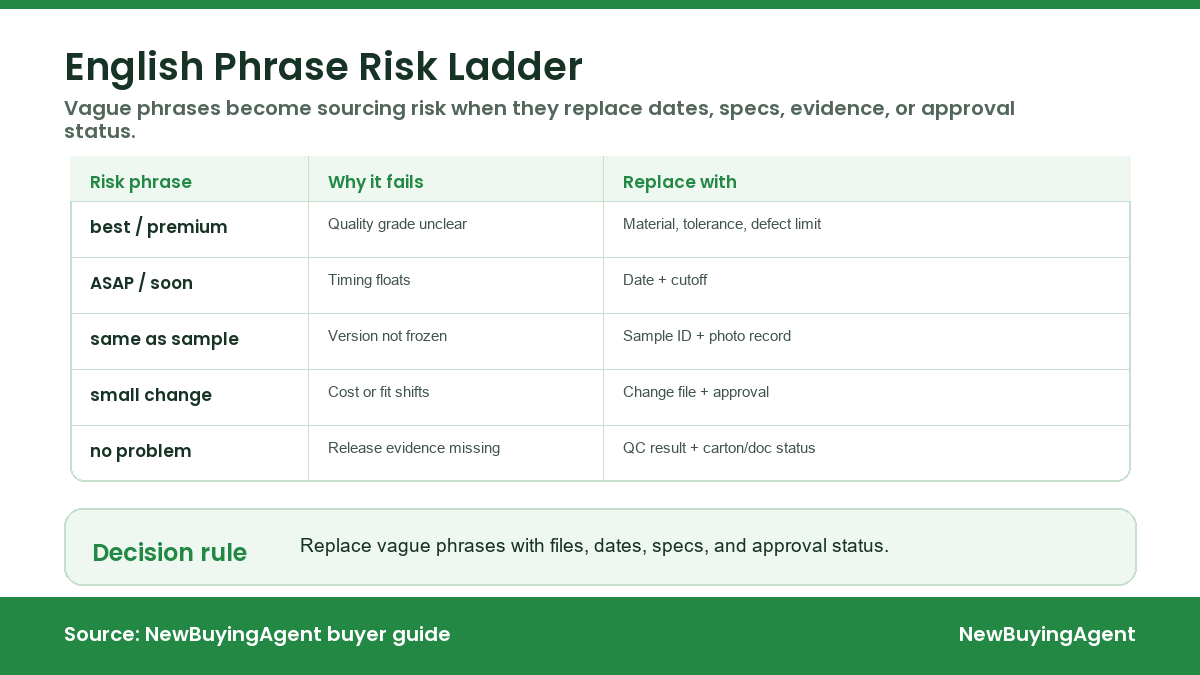
Ambiguous English phrases create sourcing risk when they leave product version, timing, packaging, or quality expectations open to interpretation.
Why Short English Phrases Create Expensive Gaps
Short phrases feel convenient because buyers are busy. The problem is that a factory floor needs specifics. "Good quality" does not tell anyone what material, finish, tolerance, packing, label, or test evidence is required. "Send soon" does not define a deadline. "Same as sample" does not say which sample version is approved or which corrections were accepted.
The safer habit is to write in operational language: product version, dimension, material, color reference, packaging, defect limit, sample date, approval status, and delivery date. This is less elegant than casual English, but it is clearer for production.
The Ambiguity Cost Estimate
Assume a buyer orders 2,000 units and uses a vague packaging phrase. If the carton is weaker than expected and 4% of units arrive with sellable-condition problems, 80 units are affected. At a $14 landed cost, the exposed inventory value is $1,120 before replacement shipping, refunds, or review damage. This illustrative estimate shows why one unclear phrase can cost more than the time saved by writing a short message.
12 Phrases to Rewrite Before Production
1. "Best Quality"
"Best quality" is too broad because quality depends on material, finish, function, durability, packaging, and customer expectations. The phrase may lead to a quote that is higher than needed or a product that is still not aligned with the buyer's actual standard.
Safer wording: "Use 304 stainless steel, matte finish, no visible scratches on the front surface, and pack each unit in a protective sleeve." The better phrase gives measurable rules.
2. "Same as Sample"
"Same as sample" fails when there are several sample versions or when corrections were discussed after the sample arrived. A supplier may follow the physical sample while the buyer expects the corrected version.
Safer wording: "Follow sample version B received on May 12, with the handle color changed to black and the carton insert updated according to the attached photo."
3. "ASAP"
"ASAP" creates pressure but not a deadline. It can also make the supplier prioritize speed over confirmation. The buyer may receive fast movement on the wrong product detail.
Safer wording: "Please confirm by June 14, finish first finished-unit photos by June 20, and keep the shipment release target before July 5."
4. "Standard Packaging"
"Standard packaging" depends on category, market, shipment method, and customer experience. A standard export carton may not be enough for ecommerce parcel delivery or fragile goods.
Safer wording: "Use a five-layer export carton, corner protection, individual polybag, printed carton marks, and send packing photos before mass packing."
5. "Minor Defects Are Acceptable"
This phrase is dangerous because it does not define minor. A supplier may treat visible scratches, color variation, loose stitching, or small dents as acceptable when the buyer's customer would not.
Safer wording: "Minor internal marks are acceptable if not visible during normal use; scratches on the front surface, logo area, or customer-facing side are not acceptable."
6. "Please Improve the Quality"
This phrase tells the supplier the buyer is unhappy, but it does not tell production what to change. Quality improvement needs a defect list, evidence, and a corrected standard.
Safer wording: "Improve the stitching by reducing loose threads at the seam, keeping stitch spacing within 3 mm variation, and sending close-up photos before packing."
7. "No Problem"
"No problem" can sound like approval when the buyer only means they understand the message. In production communication, approval should be explicit and tied to a document, sample, or photo.
Safer wording: "Approved for production according to the attached final spec sheet dated June 10. No other changes are approved."
8. "Use Good Material"
"Good material" does not define grade, thickness, composition, coating, fabric weight, foam density, or testing expectation. The phrase can lead to a quote that is impossible to compare.
Safer wording: "Use 600D polyester, black color, water-resistant coating, fabric weight confirmed before production, and no substitution without written approval."
9. "Send It Soon"
"Soon" creates a timing expectation without a date. The supplier may send the item after the next normal production step, while the buyer expects immediate action.
Safer wording: "Please send the sample photos by 5:00 p.m. China time on June 13 and ship the physical sample by June 15."
10. "Small Change"
A small change to the buyer can be a production change for the factory. Color, packaging, logo, screw position, carton size, material thickness, or manual copy can affect cost, timing, tooling, inspection, or shipment.
Safer wording: "The change is limited to the logo size from 28 mm to 32 mm. Please confirm cost, timing, sample impact, and whether packaging changes are needed."
11. "Confirm"
"Confirm" is often too weak because it does not say what answer is needed. The supplier may respond with "confirmed" without checking the exact detail the buyer cares about.
Safer wording: "Please confirm whether the carton size is 48 x 32 x 26 cm, the gross weight is under 12 kg, and the carton mark matches the attached file."
12. "We Can Discuss Later"
This phrase pushes a decision into a stage where changes are harder. Packaging, labels, materials, color, QC criteria, and delivery terms should not be delayed if they affect price or production.
Safer wording: "Do not start mass production until packaging, label artwork, sample correction list, and shipment term are confirmed in writing."
Rewrite Table for Safer Supplier Communication
| Weak Phrase | What It Hides | Safer Rewrite | Buyer Decision Protected |
|---|---|---|---|
| Best quality | Material, finish, tolerance | Name the grade, defect limit, and visible surfaces | Product version |
| ASAP | Deadline and priority | Use exact date, time, and next milestone | Schedule control |
| Standard packaging | Carton strength and customer channel | Specify carton, protection, marks, and photos | Damage prevention |
What to Send Before Handing Communication to NewBuyingAgent
Buyers should prepare product specs, approved sample notes, quantity, target price, destination, timing, packaging expectations, defect concerns, and any message history that created confusion. The cleaner the brief, the easier it is to turn vague supplier language into clear production instructions.
If communication is already creating quality, timing, or packaging risk, buyers can ask NewBuyingAgent to review the purchasing requirements. Buyers still building their process can read NewBuyingAgent's China sourcing guide.
Who Is NewBuyingAgent?
NewBuyingAgent is a one-stop China sourcing agent for global buyers that want products from China. Buyers share product specs, volume, target price, destination, and timing. NewBuyingAgent prepares a quote and manages product selection, cost negotiation, quality management, production follow-up, logistics, and delivery.
Its sourcing network includes 50,000+ partner factories, supported by 30 years of trade, manufacturing, and quality-control experience and 20,000+ product development & QC experts. For language-sensitive orders, the value is turning product requirements into a managed quote, production, quality, logistics, and delivery path instead of leaving key details scattered across informal messages.
How to Turn Vague English Into Production Language
The easiest rule is to replace adjectives with evidence. "Good" becomes a material grade, a finish reference, or a defect limit. "Fast" becomes a date. "Better" becomes a specific correction. "Standard" becomes a packaging drawing, carton requirement, or label file. The buyer does not need perfect technical English. The buyer needs words that production, QC, and logistics can act on.
A second rule is to separate discussion from approval. Buyers often mix casual discussion and final approval in the same message thread. That creates risk because a supplier may treat a comment as approval or treat approval as only a suggestion. Use clear labels: "question," "not approved," "approved for sample only," "approved for mass production," and "do not change without written approval."
A third rule is to attach the file that controls the decision. If the message discusses packaging, attach the packaging file. If it discusses color, attach the color reference. If it discusses sample corrections, attach the marked photos. A phrase without an attached reference can still be misunderstood.
Phrase Categories That Create the Most Risk
The 12 phrases in this article fall into five risk categories. Quality phrases create material and defect confusion. Timing phrases create schedule confusion. Sample phrases create version confusion. Change phrases create cost and production confusion. Release phrases create approval confusion. Once the buyer knows the category, the fix becomes easier.
| Risk Category | Typical Phrase | What to Add | Decision Protected |
|---|---|---|---|
| Quality | Best quality, good material | Grade, tolerance, finish, defect limit | Product standard |
| Timing | ASAP, send soon | Date, time, milestone, time zone | Launch schedule |
| Sample | Same as sample | Sample version, date, correction list | Production reference |
| Change | Small change | Cost, timing, packaging, QC impact | Tradeoff approval |
| Release | No problem, confirm | Approved item, condition, document date | Shipment decision |
How Misunderstandings Move Through an Order
A phrase misunderstanding rarely stays in one message. It moves into the quote, sample, production notes, packing plan, inspection, and shipment. A vague material phrase can become a cost assumption. A vague sample phrase can become a production reference. A vague packaging phrase can become a damage problem. By the time the buyer notices, the order may already be packed.
This is why language clarity is a procurement control, not just a communication skill. Buyers should rewrite unclear messages before they become production instructions. The habit is especially important when working across time zones and cultures because the supplier may avoid challenging a vague phrase if the buyer seems confident.
When the Buyer Should Escalate From Messaging to a Brief
If the conversation involves price, material, sample approval, packaging, production timing, QC, shipment terms, or any change after sample approval, it should move from casual messaging into a brief or change record. A brief does not need to be long. It needs to show the current approved facts.
NewBuyingAgent can help when the buyer no longer wants to manage this message flow directly. The buyer provides the purchasing need and any existing message history. NewBuyingAgent can then manage product selection, cost negotiation, production follow-up, quality management, logistics, and delivery against a clearer brief.
A Safer Message Formula
A safer supplier message uses four parts: decision, evidence, deadline, and consequence. The decision says what is being approved or requested. The evidence names the file, photo, sample, or spec. The deadline gives a date and time. The consequence explains whether production should continue, pause, revise, or wait for approval.
Example: "Approved for sample revision only, based on the attached marked photo dated June 10. Please send revised sample photos by June 14 before mass production starts. Do not change material, logo position, carton size, or label artwork." This style is longer than "please improve," but it protects the order.
Before-and-After Message Examples
Weak message: "Please make the packaging better." Stronger message: "Use a five-layer carton, add corner protection, put each unit in a polybag, and send photos of the inner pack and carton marks before mass packing." The stronger message tells the production and packing team what to do.
Weak message: "The color should be like the sample." Stronger message: "Use sample B as the color reference, not sample A. The accepted range is the attached photo under daylight, and production photos must be sent before packing." The stronger message prevents the wrong sample from controlling production.
Weak message: "Please hurry." Stronger message: "Please send first finished-unit photos by June 18, finish packing by June 25, and do not release goods until the packing photos and carton list are confirmed." The stronger message separates speed from release control.
When Politeness Creates Risk
Polite English can create risk when it avoids saying no. Buyers may write "please consider" when they mean "required," or "if possible" when they mean "do not ship without this change." The supplier may treat the request as optional because the wording sounds flexible. In sourcing, politeness should not blur a requirement.
The safer approach is to be respectful and precise at the same time. "Please" is fine. So is "thank you." But the sentence should still say whether the detail is required, optional, not approved, or waiting for confirmation. Clear language reduces conflict because it prevents both sides from discovering the disagreement too late.
Use Photos, Files, and Version Names
When words are risky, evidence helps. Buyers should name sample versions, attach marked photos, keep date-stamped files, and refer to exact document names. "Use the updated file" is weaker than "Use label file NBA-label-v3.pdf attached in this email." A specific file name reduces interpretation.
Photos also need labels. A photo without a note may show the wrong detail. Mark the defect, circle the correction, or write the requirement below the image. The goal is to make the message usable by someone who was not part of the original conversation.
When to Stop the Thread and Restate the Order
If a message thread contains too many corrections, the buyer should stop and restate the current approved order. That restatement should include product version, sample status, packaging, label files, QC focus, production milestone, and shipment target. This prevents old messages from competing with the newest decision.
For buyers who want to avoid this daily communication burden, NewBuyingAgent can work from the purchasing need and manage the process through quote preparation, product selection, cost negotiation, quality management, production follow-up, logistics, and delivery.
That shift does not remove the need for clear requirements. It simply moves the wording burden from scattered daily messages into one cleaner purchasing brief that can guide production and release decisions.
The buyer should keep a record of the final approved wording. That record becomes useful if a later message creates confusion, because everyone can return to the approved product version, not the most recent casual phrase.
Frequently Asked Questions
Why do English phrases cause sourcing misunderstandings?
English phrases cause sourcing misunderstandings when they sound clear to the buyer but do not define production rules. Phrases like "best quality" or "ASAP" leave material, defect, deadline, packaging, and approval details open to interpretation.
What is the safest way to write sourcing instructions?
The safest way is to write instructions with measurable details: material, dimensions, color reference, sample version, packaging, deadline, defect limit, and approval status. Short polite phrases are useful for relationships, but production instructions need operational detail.
Should buyers avoid casual English with suppliers?
Buyers do not need to avoid casual English entirely, but they should not use casual phrases for product, quality, price, timing, or release decisions. Friendly messages can stay friendly; production instructions should be specific, dated, and tied to documents or photos.
How can buyers fix a misunderstanding after it happens?
Buyers should restate the exact requirement, attach evidence, confirm the affected product version, and ask for cost, timing, and production impact. If production has already started, the buyer should decide whether to hold, rework, accept, or revise the next order.
NewBuyingAgent
Related Resources

Get Started Today
Let's Turn Your Sourcing Goals into RealityWeChat:+86 15157124615
WhatsApp:+86 15157124615
Address:Building 10 #39 Xiangyuan Road, Hangzhou, China
