

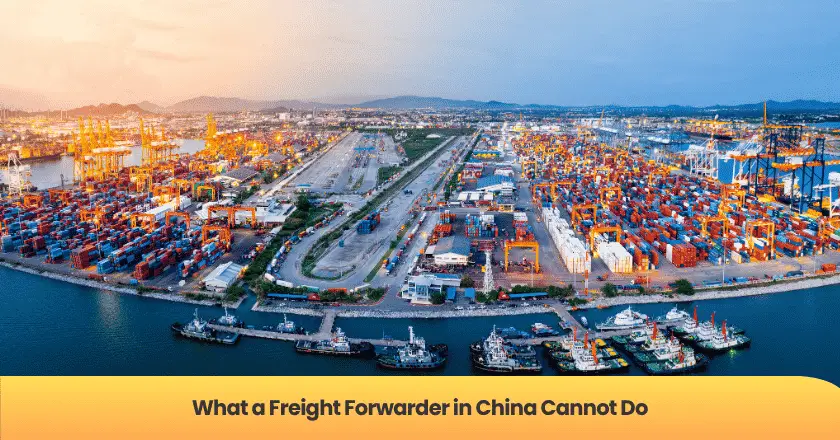
A buyer whose shipment has been sitting at a destination terminal for nine days writes to his forwarder, in increasingly short sentences, asking why nothing is moving. The answer, when it arrives, is that his goods were selected for a customs examination and his broker has not filed a corrected classification. The forwarder has been unable to help for over a week, and has been saying so politely in messages the buyer read as evasion.
Forwarders are blamed for a great deal that sits outside their remit, and buyers lose time asking the wrong party for help. Seven limits cover most of it, and each one has a different party behind it.
Key Takeaways
• A forwarder arranges transport and documentation, and it does not verify the contents of sealed cartons.
• Import entry is filed by a licensed customs broker at destination, and classification liability stays with the importer.
• Cargo insurance is a separate purchase, since carrier liability is capped far below the value of most consignments.
• Vessel schedules, port congestion and customs examinations are outside any forwarder's control.
• Supplier disputes, product compliance and payment pressure are not forwarding matters at all.
It Cannot Tell You What Is in the Boxes
The most consequential limit is also the least understood, because forwarders handle your goods and buyers assume handling implies looking.
Cargo Handling Is Not Inspection
A forwarder collects sealed cartons, counts them against a packing list, checks external condition and loads them. Nobody opens a box. A carton count and a photograph of a stacked pallet is not a product check, and the two are frequently sold under similar language.
Some forwarders offer inspection as a paid add-on, usually subcontracted to a third party. That can work well, and the thing to read is the scope. Ask which sampling standard applies, what defect classes are used and who signs the report, because a service described as inspection can mean anything from a full product check to a visual look at the outside of the cartons.
Who Handles This Instead
A dedicated inspection provider, or your own quality staff, working to a standard agreed before production. Book the check to happen while goods can still be reworked, and release the balance payment against the report rather than against a shipping document.
The sequencing matters more than the provider. An inspection arranged after the goods have left the factory tells you what you own rather than what you can refuse, and by then the forwarder genuinely is the only party still involved.
Packing quality falls in the same gap. A forwarder can tell you that cartons look weak or that a pallet is poorly stacked, and it has no authority to require the factory to repack. That instruction has to come from you, through the supplier, ideally as a written packing standard agreed before production rather than as a phone call once goods are already at the warehouse.
Expert Tip:Write the inspection into your supplier order rather than into your forwarder booking. The supplier is the party who must allow access, hold goods for rework and accept the standard being applied, and none of that is within a forwarder's gift. I have seen buyers book an inspection through a forwarder in good faith and discover the factory had never agreed to it, which turns a routine check into a negotiation at exactly the wrong moment.
It Cannot Be Your Customs Department
The second cluster of limits sits at the destination end, where the work is legal rather than logistical.
Entry Filing and Classification
Import entry is filed by a licensed customs broker in the destination country, which may or may not be the same company as your forwarder. In the United States, ocean freight forwarders and NVOCCs are regulated asocean transportation intermediariesby the Federal Maritime Commission, with domestic firms licensed and overseas NVOCCs required to register and bond. Customs brokerage is a separate licence.
Classification is not a forwarding decision either. Duty follows theHS codeof your goods, and liability for declaring it correctly sits with the importer of record. A forwarder may repeat a code used previously, and repeating it does not transfer responsibility for it.
The same separation applies at the Chinese end for anyone shipping into China rather than out of it. Goods entering China are declared by a consignee that must be a domestic entity with completed customs record filing, and a forwarder cannot serve as that entity for you. Buyers who confuse the two directions sometimes ask a Chinese forwarder to act as importer, which it is not able to do.
Examinations, Holds and Compliance
When customs selects a container for examination, nobody in your chain can accelerate it. Your forwarder can tell you what is happening and arrange the logistics around it. It cannot argue your case, and it cannot make a product compliant with your market's rules if it was never built to them.
Market compliance is upstream work: labelling, testing, documentation, responsible-party details on the packaging. All of it has to happen at the factory, months before a forwarder is involved.
Common Mistake to Avoid:Assuming your forwarder is also your customs broker is a common and expensive error, because the two roles have different licences, different liabilities and sometimes different companies behind them. Buyers discover the gap when an entry is delayed and each party refers them to the other. Ask at booking who files your import entry, whether that fee is included, and get the broker's name. Two questions, and they remove one of the most frequent causes of goods sitting at a terminal accruing charges.
It Cannot Control the Ocean or the Ports
The third group of limits is the one buyers understand intellectually and forget under pressure.
Schedules, Rolling and Congestion
Vessel schedules belong to carriers. Containers get rolled to later sailings when a ship is oversold, transshipment hubs delay boxes waiting for onward space, and destination terminals congest for reasons that have nothing to do with your shipment. A good forwarder sees these coming earlier than you do and tells you promptly with options attached. It cannot prevent any of them.
Judge forwarders on that early warning rather than on outcomes they do not control. The useful question at selection is how they handle a rolled booking, not whether bookings ever get rolled.
Risk and Insurance
Risk of loss or damage transfers at a point defined by yourIncoterm, and under the port terms most buyers use, that point sits at the origin. Carrier liability under standard transport documents is capped at a low figure per package, nowhere near the value of most consignments.
Marine cargo insurance is therefore a separate purchase, not something bundled into forwarding by default. Forwarders can arrange it and many will raise it unprompted, which is a fair signal of how carefully a firm is thinking about your cargo rather than its own invoice.
Expert Tip:Ask your forwarder for the routing and the port pairs in writing before booking, and ask specifically whether the service is direct or involves transshipment. Transshipment is not a defect and it does add an unpredictable wait that never appears as its own line in a transit estimate. Buyers who compare a direct service and a transshipment service purely on price are comparing two different products, and the cheaper one is cheaper for a reason that will surface at the worst possible time.
It Cannot Sit Between You and Your Supplier
The last group of limits is commercial, and it is where buyers most often ask a forwarder to do something it should refuse.
Disputes, Pressure and Payment
A forwarder cannot resolve a quality dispute, cannot withhold your supplier's payment, and should not hold cargo as a bargaining chip in a commercial disagreement. Where a supplier-nominated forwarder is involved, it is also not neutral, since it was introduced by the supplier and is paid on that supplier's volume.
The document that matters here is the bill of lading, which is title to your goods. Whoever holds the original can collect them, which is why buyers should insist on a telex release confirmed to them directly or hold the originals themselves rather than leaving control with a party appointed by the seller.
Storage at destination is a related limit worth naming. Once free time expires, demurrage and detention accrue daily against your account, and a forwarder can advise, warn and sometimes negotiate a short extension. It cannot stop the clock, and it is not liable for charges caused by paperwork or funds that arrived late from your side.
Sourcing, Price and Supplier Choice
Forwarders move goods that already exist. They do not find factories, negotiate unit prices, control specifications or take a view on whether your supplier is the right one. Some will make introductions, and an introduction is not vetting.
Conflating forwarding with sourcing is the error that produces the opening scenario in most of these stories: a buyer with a logistics provider and no quality provider, discovering after arrival that nobody was ever responsible for what went into the cartons.
Expert Tip:Draw a one-page map of your chain naming a party against each function: supplier for production and packing, inspection provider for the goods, forwarder from collection to delivery, broker for the entry, insurer for transit risk. Pin it somewhere visible. When something goes wrong, the map tells you who to call within seconds, and it prevents the far more common failure where two parties each assume the other is covering the same gap.
Covering the Upstream Gap With NewBuyingAgent
A freight forwarder becomes involved primarily once products are ready to move. But many of the decisions that determine cost, quality, and delivery performance happen much earlier—starting with product selection and supplier choice.
NewBuyingAgent helps cover this upstream part of the sourcing process. With access to50,000+ partner factories across industriesand20,000+ product development and quality control experts, it can help buyers identify suitable products and suppliers based on their requirements, while supporting production and quality management when needed.
A broader supplier network gives buyers more options to compare before placing an order, rather than relying only on suppliers they already know or can reach directly. NewBuyingAgent also helps reduce language, regional, and communication barriers when working with Chinese suppliers.
For buyers who already have their own factories in China, NewBuyingAgent can also help manage the suppliers’ production process and product quality, while arranging door-to-door logistics.
In this way, the roles are complementary:the freight forwarder moves the goods, while NewBuyingAgent helps buyers manage the supply side that comes before the shipment.Contact now.
Frequently Asked Questions
Can my freight forwarder inspect my goods before shipping?
Some offer it as a paid add-on, usually subcontracted, and the scope varies enormously. A carton count is not a product inspection. Agree the sampling standard and defect classes with your supplier before production, and book the check through a party whose report the factory has accepted in advance.
Is my forwarder responsible if customs delays my shipment?
Not for the delay itself, which usually comes from an examination, a documentation issue or terminal congestion. A forwarder should tell you promptly what is happening and manage the logistics around it. Where the cause is a filing error, the party to speak to is whoever filed your entry.
Does a forwarder arrange cargo insurance automatically?
No. Carrier liability is capped at a low figure per package and comes nowhere near the value of most shipments. Marine cargo cover is a separate purchase that a forwarder can arrange on request. Decide it deliberately for each shipment rather than assuming it is included.
Should I let my supplier's forwarder handle everything?
For a first small order it is workable. Beyond that, appoint your own, because a nominated forwarder is paid by your supplier and will act accordingly under pressure. The document control question matters more than the rate difference, since whoever holds the original bill of lading controls release of the goods.
What should I judge a forwarder on, if not these things?
Document control, exception handling and destination competence. How quickly they tell you about a rolled booking, whether they name a broker and a destination agent at the outset, and how completely they disclose expected charges at the far end. Those three are entirely within their control and they vary widely between firms.
Conclusion
A forwarder is worth keeping for years and is not a substitute for an inspection provider, a customs broker, an insurer or a sourcing partner. Name a party against each function before your first shipment, ask who files your entry, buy cargo cover deliberately, and judge forwarders on how early they deliver bad news rather than on events nobody controls. For the part of the chain that happens before the cartons are sealed, NewBuyingAgent handles factory selection, quality control and delivery from China.
Partial Sources
1. United States Federal Maritime Commission — Ocean Transportation Intermediaries: licensing and registration of ocean freight forwarders and NVOCCs —https://www.fmc.gov/about/bureaus-offices/bureau-of-enforcement-investigations-and-compliance-beic/office-of-compliance/ocean-transportation-intermediaries/— accessed 28 August 2026
2. World Customs Organization — What is the Harmonized System (HS)? —https://www.wcoomd.org/en/topics/nomenclature/overview/what-is-the-harmonized-system.aspx— accessed 28 August 2026
3. International Chamber of Commerce — Incoterms rules, the international standard for allocating cost and risk between buyer and seller —https://iccwbo.org/business-solutions/incoterms-rules/— accessed 28 August 2026
NewBuyingAgent
Related Resources
Comece hoje
Vamos transformar seus objetivos de compras em realidadeWeChat:+86 15157124615
WhatsApp:+86 15157124615
Endereço: Edifício 10 #39 Xiangyuan Road, Hangzhou, China
