

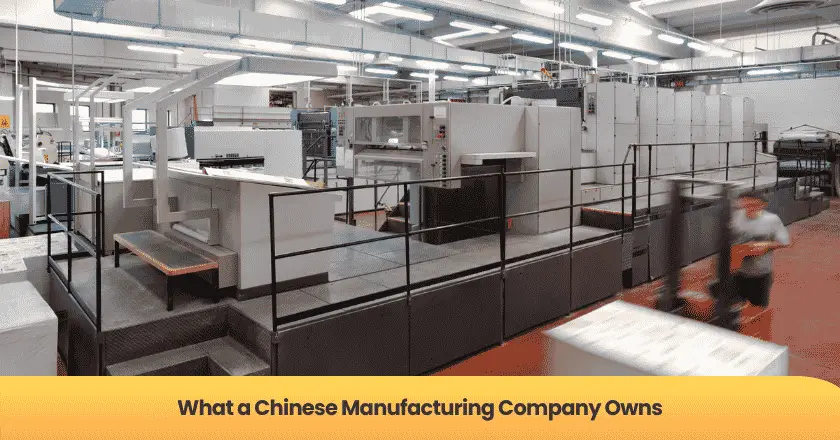
A buyer tours a factory, sees forty machines running, counts perhaps two hundred people and comes away confident. The building is rented on a lease with three years to run. Eleven of the machines belong to a leasing company. A quarter of the people on the floor are supplied by an agency. The plating that gives his product its finish happens in a workshop two streets away. None of this was concealed and none of it appeared in the audit report he ordered, because he never asked what was owned.
Ownership determines what survives a bad year, what can be moved, and what a supplier can actually promise. It is a different question from capability, and it is the one buyers most often skip.
Key Takeaways
• Many Chinese factories rent their premises in industrial parks rather than owning land and buildings.
• Equipment may be owned or leased, and the mix tells you about the balance sheet behind the production line.
• Workforce composition matters, and Chinese rules cap dispatched workers at 10% of a user unit's total workforce.
• Tooling you paid for may not be yours unless the contract says so, and it stays physically at the factory.
• Certifications attach to a site and a scope rather than to a company in general.
The Physical Assets
What you walk through on a factory visit is a mixture of owned, rented and borrowed, and the mixture is normal rather than suspicious.
Premises and What Renting Means
A great many factories operate from rented units in industrial parks. This is ordinary practice and it says nothing about competence. What it does affect is stability, since a business that rents can be required to move, and relocating a production line costs months of disrupted output.
Ask how long the lease runs and whether the company has moved in the past five years. A long remaining term and a stable address suggest continuity. A recent move or a short lease is worth knowing about before you commit tooling to that address, since tooling and certifications are tied to sites rather than to companies.
Equipment, Owned or Leased
Machines may be owned outright, bought on finance or leased. A factory with substantial leased equipment is not weaker by definition, and the arrangement does mean fixed obligations that continue whether or not orders arrive.
Ask the age and brand of the key machines for your process, and look at the plates during a visit or in audit photographs. Equipment condition and vintage tell you about capability and about how much has been reinvested, which is a reasonable proxy for how the business has been performing.
Warehouse space belongs in the same assessment. A factory with room to hold finished goods can stage a shipment, absorb a short delay and stock common materials. One with almost no storage ships as it produces, which sounds efficient and means any disruption reaches you immediately. Ask what raw material the factory keeps in stock rather than buying to order.
Expert Tip:Ask what proportion of the process happens inside the building you are standing in, as a list of named steps rather than as a general question. Moulding, plating, printing, assembly, packing. Suppliers answer specifics readily because subcontracting is unremarkable to them, and a broad question invites a broad reassurance. The list you get back is a map of what this company actually controls, and it is worth more than the equipment count.
The People on the Floor
Headcount is quoted in every capability document and rarely broken down, though the breakdown is where the useful information sits.
Employed, Dispatched and Seasonal
Chinese factories use a mix of directly employed staff, agency workers supplied under labour dispatch arrangements, and seasonal hires during peak periods.The Interim Provisions on Labour Dispatch, issued by the Ministry of Human Resources and Social Security and in force since March 2014, require user units to strictly control dispatch numbers and cap dispatched workers at 10% of total workforce, calculated as employees on labour contracts plus dispatched workers.
For a buyer, the practical significance is skill retention. Directly employed staff accumulate familiarity with your product across orders. A floor heavily staffed by short-term workers reproduces the learning curve each time, which shows up as variability between batches rather than as an obvious problem.
Seasonality varies enormously by category and affects the mix. Factories serving retail peaks staff up and down across the year, which is a rational response to demand and does mean the people building your November order may be different from those who built your June one. Ask what the headcount looks like at the quietest and busiest points rather than accepting a single figure.
Technical Staff Are the Number That Matters
Ask how many engineers, technicians and quality staff the factory employs, separately from production headcount. A plant with two hundred workers and no engineer is building to whatever you supply and cannot help you improve it.
This is also the number that predicts how a difficult production run goes. Problems get solved by people who understand the process, and factories without that capability escalate to you instead, which is slower and considerably less useful.
Common Mistake to Avoid:Reading registered capital as a measure of size or solidity is a mistake that has become more misleading rather than less. Under the Company Law revised in 2023, in force since 1 July 2024, shareholders of a limited liability company must pay in subscribed capital within five years of establishment, with existing companies adjusting during a transition period. A headline figure is therefore a commitment with a deadline rather than money sitting in an account, and it still says nothing about production capacity. Check equipment, floor area and technical headcount instead.
What Belongs to You Rather Than Them
Some of what sits on a factory floor is yours, and buyers frequently discover the ownership question only when they want to leave.
Tooling and the Customs Consequence
Paying a tooling invoice buys the output of a mould. Whether it buys the mould itself depends entirely on your agreement, and the tool lives at the factory regardless. Ownership, storage, maintenance, retention period and transfer rights all need writing down, ideally in the first purchase order.
There is a customs dimension as well. Where you own a mould and supply it to a manufacturer free of charge, the WTO Customs Valuation Agreement lists tools, dies, moulds and similar items used in production of the imported goods, supplied by the buyer free of charge or at reduced cost, among the additions to the price actually paid, apportioned as appropriate. Raise this with your broker before the first shipment rather than at an audit.
Designs, Samples and Records
Where you supplied the design, it is yours if the contract says so, and a factory holding your drawings has practical possession whatever the paperwork states. Signed samples, test reports and production records built up over several orders are similarly ambiguous unless somebody has addressed it.
Ask for copies of test reports and inspection records as they are produced rather than requesting them at the end of a relationship. Documents supplied willingly during a working arrangement become difficult to obtain once one side has decided to leave.
Expert Tip:Have your part number stamped on any tooling you pay for, and ask for photographs of the stamp at the factory. It costs nothing, it takes an afternoon of somebody's time, and it converts an abstract ownership claim into an identifiable object. Buyers who later need to move a mould find the conversation considerably shorter when the tool physically carries their identification, and the request at the outset also signals that you intend to keep track of it.
What Ownership Tells You
The point of mapping this is not suspicion. It is understanding what a supplier can promise and what happens under pressure.
Stability and What Survives a Bad Year
A factory that owns its building and its machines can survive a quiet period by cutting output. One paying rent and lease instalments has fixed obligations that continue regardless, which makes it more sensitive to a downturn and more likely to chase volume at thin margins.
Neither profile is better for a buyer in the abstract. The owned-asset factory is more stable and often less hungry for your order. The leased one may work harder for the business and carries more risk if the market turns. Knowing which you have shapes what you rely on it for.
Customer concentration is worth asking about too, since it is a form of exposure rather than an asset. A factory where one buyer accounts for most of its output is stable while that buyer stays and precarious if it leaves. A factory where you would be the largest customer will prioritise you and may lack the depth to absorb a problem. Neither answer is wrong and both change what you should expect.
Certifications Attach to Sites
A management system certificate covers a defined organisation and scope, and a social compliance or capability audit covers a named site on a named date. Where production moves to a second location or a subcontractor, those documents no longer describe what is happening to your goods.
Ask which site each certificate covers and confirm it matches the address building your order. Where a supplier operates several plants, this is a routine question that occasionally produces a surprising answer.
Expert Tip:Ask which factory produced each batch, every time, and record it alongside the order. Where the answer stays constant, your audit and certifications continue to describe reality. Where it changes or becomes vague, production has moved and everything you verified applies to a site that is no longer making your goods. One line per order, and it is the most reliable early warning available between formal audits.
Assets, Access and What They Cost You
What a factory owns shapes the price it can offer, since a plant with its own equipment and stable premises carries a different cost base from one servicing lease obligations.
NewBuyingAgent's wide factory network lets it pick low-cost, high-cooperation suppliers. Even with its margin included, it cuts your costs by 5%-10%.
NewBuyingAgent is your perfect partner for global sourcing from China, backed by 30 years of expertise in trade, manufacturing and quality control. Its mission is to make China sourcing effortless and profitable for global buyers.
Comparing asset profiles only helps where there are enough candidates to compare, which is the constraint most buyers underestimate.
Only less than 5% of China's factories are within your reach. NewBuyingAgent gives you 100% Access to China's Factories through its 50,000+ cooperated partner factories—no language/region/time zone barriers. Its local reputation gets you full factory cooperation.
Frequently Asked Questions
Does it matter if a Chinese factory rents its premises?
It is ordinary practice and says nothing about competence. It affects stability, since a business that rents can be required to move and relocating a line costs months. Ask how long the lease runs and whether the company has moved recently, particularly before committing tooling or site-specific certification to that address.
How do I check what a factory actually owns?
Ask which named process steps happen inside the building, look at equipment plates and their age during a visit or in audit photographs, ask for technical headcount separately from production headcount, and ask how long the premises lease runs. None of these are sensitive questions and all are answered readily by established suppliers.
Is a large registered capital a good sign?
It is a commitment rather than cash in an account. Under the Company Law revised in 2023, shareholders must pay in subscribed capital within five years of establishment, so the figure has more meaning than it once did and still tells you nothing about production capacity. Assess equipment, floor area and technical staff instead.
Who owns the mould after I have paid for it?
Whoever your agreement says owns it, and possession stays with the factory either way. Settle ownership, storage, maintenance, retention and transfer rights in the first purchase order. Where you own a tool and supply it free of charge, check the customs treatment with your broker, since its value may need apportioning into the customs value of the goods.
Should I avoid factories that subcontract part of the process?
Rarely, since specialisation across workshops is how industrial clusters achieve their cost and speed, and refusing it would rule out most competent suppliers. What matters is knowing which steps are involved, whether the same workshop is used consistently, and whether your quality terms reach the party performing the work.
Conclusion
Ask what is owned rather than what is impressive. Which process steps happen in this building, how long the lease runs, how many machines are leased, how many staff are directly employed, how many are engineers, and who owns the tooling. Six questions, all ordinary, and together they tell you what a supplier can promise and what happens to your production when conditions get harder.For buyers comparing factories on more than a site visit, NewBuyingAgent handles factory selection, quality control and delivery from China.
NewBuyingAgent
Related Resources
Comece hoje
Vamos transformar seus objetivos de compras em realidadeWeChat:+86 15157124615
WhatsApp:+86 15157124615
Endereço: Edifício 10 #39 Xiangyuan Road, Hangzhou, China
