
Test report traceability is the documented connection between a test result, the sample tested, and the product version supplied.
To check that connection, match the model and construction, verify the issuing laboratory and its relevant scope, then compare the tested version with current production. A genuine report can still cover a different material, configuration, or earlier version. The useful question is whether its results support the goods in your order, rather than whether the PDF looks convincing.
What Makes a Test Report Usable for Your Order?
A usable test report connects the tested sample, the relevant test scope, and the production version you are buying. Review those connections before treating a supplier’s “PASS” as evidence for a purchase or shipment decision. Confirm the document with its issuer, then establish which ordered models and current materials it covers. Neither step replaces the other.
- Model match: reconcile the report’s model, photographs and construction with the approved specification. A similar appearance does not establish equivalent materials or components.
- Laboratory match: distinguish the issuer’s identity from its competence for the specific test and any regulatory acceptance your market requires.
- Production match: identify changes since testing, including coatings, components, manufacturing processes and suppliers. Decide which evidence those changes affect.
- Release scope: document what is covered, what remains unresolved, and who approves the next action. Keep unresolved variants separate only when production records support that separation.
Connect the Report to the Product You Will Receive
Start with the goods being ordered and work back to the tested sample. Record the product model, revision, critical materials and intended market; then ask which report supports each relevant requirement. This order prevents a convenient old report from quietly defining the product you accept. Where a connection is missing, name the unresolved version or requirement before deciding what further evidence to request.
The connection usually spans several records. The purchase specification identifies the approved product. The report identifies what was tested and under which conditions. Sample records connect that item to a particular construction, while production records show what the factory actually used. A report number alone cannot perform all four jobs.
European Accreditation’s reliability guidance recommends checking the competence and tests needed, together with whether the methods are acceptable in the destination country. For a buyer, that means comparing the report with the actual requirement: a chemical result for one coating does not answer a mechanical-safety question about the finished item.
Ask who selected and submitted the sample. A supplier-submitted development sample may show what that construction could achieve, but it does not independently establish which materials were later used in production. Preserve sample identifiers, photographs, submission records and relevant component details. When those records are missing, describe the connection as unconfirmed rather than inferring it from a passing result.
Authenticity, laboratory competence and product applicability answer different questions. Authenticity asks whether the issuer produced that report. Laboratory competence concerns the test activity. Product applicability concerns whether the tested sample and scope support your ordered version. A positive answer to one question does not establish the other two; resolve the missing connection before relying on the result.
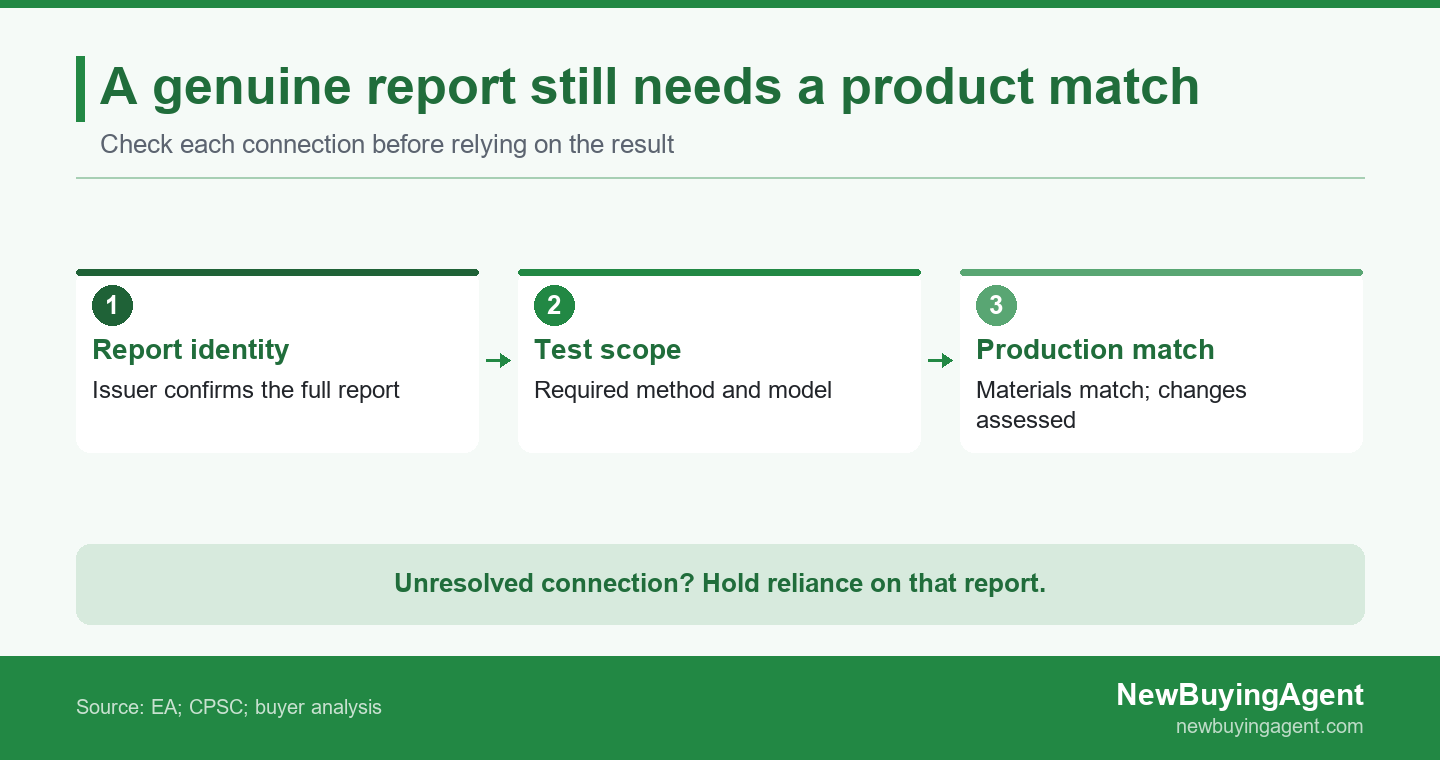
Report identity, test scope and production version must connect before relying on test evidence.
Resolve Model Numbers and Product Variants
Treat model numbers as identifiers to reconcile, rather than proof that two products are technically identical. Compare the buyer SKU, factory model, report model and revision. Where names differ, obtain a documented explanation of the relationship and confirm the relevant construction. Keep that explanation with the specification so the purchasing and quality teams can review the same version.
For buyers relying on component-part testing under CPSC rules, 16 CFR 1109.5(g) specifies records identifying the tested product or component, the covered lot or batch, test methods and the testing party. Those requirements apply within that rule’s scope. The practical lesson for other sourcing decisions is to make the tested item identifiable, rather than relying on a generic description such as “plastic toy.”
Suppose your retail SKU is ST-120 and the factory uses model F120. The different names may be harmless if a controlled cross-reference connects both to the same approved construction. Ask for that cross-reference, the applicable drawing revision and the report’s model coverage. A sales representative’s email saying “same product” leaves unresolved which parts, materials or electrical ratings are the same.
Use the bill of materials (BOM), a list of the product’s parts and materials, where construction affects the test. Identify the details relevant to the result: resin grade, coating, battery, power adapter or fastener, for example. This does not mean sending every purchasing detail to every reviewer. It means supplying enough information to explain why the tested configuration represents the configuration being bought.
For a product family, check the report’s listed models, photographs, variant descriptions and any stated selection rationale. A family name is not a blanket extension to every size, color or component option. Ask the laboratory or responsible technical reviewer whether the differences affect the relevant tests. If additional models need formal inclusion, the issuer should handle the amendment; the supplier should not edit the PDF.
When ordering a new private-label model, a low quote can lose its value if the offer assumes a different coating or component from the version supported by testing. NewBuyingAgent’s product-supply service draws on local China factory resources and product development and quality-control capability. Include the required construction and destination-market evidence in the purchasing requirements so the supplied-product offer can account for them.
Check the Laboratory and the Report Separately
Check the laboratory’s relevant competence and the report’s authenticity separately. A real laboratory can issue a genuine report that covers only part of your requirement, or a different product configuration. Verification of the document therefore needs a second check of what its results actually cover. Keep both findings in the product evidence file, with any remaining limitations visible to the person approving reliance.
Record the issuing legal entity, testing location, report identifier and issue date. A laboratory group may operate several sites, so its familiar brand name is not enough to identify the facility responsible for the test. Compare those details with the official records rather than a supplier’s logo sheet.
Confirm the Relevant Test Scope
Match the required test activity to the laboratory’s documented scope and any separate market-specific acceptance. Check the method, product or material category and testing site. If the report includes accredited and non-accredited activities, ask which status applies to the result you plan to use.
The ILAC signatory directory links accreditation bodies and, where available, their accredited-facility directories. Use it to find the relevant body, then inspect the laboratory’s actual record and scope. An accreditation-body listing is a route to that evidence, rather than confirmation that a particular report or product has been accepted.
For CPSC laboratory acceptance, 16 CFR 1112.13 requires an accreditation scope identifying each CPSC rule or test method for which acceptance is sought. For covered US children’s products, check acceptance for the particular applicable rule. General laboratory accreditation does not, by itself, answer that narrower question.
Check relevant dates as well as names. A current scope does not explain a disputed historical status; an old certificate does not establish current status. If accreditation, the testing location or regulatory acceptance has changed, request clarification from the laboratory or accreditation body and retain the response with the report.
Verify the Complete Report with Its Issuer
Use contact details or a verification tool obtained independently from the issuer’s official website. Submit the complete report and ask whether the identifier, revision, tested model and reported results match the issuer’s record. A valid report number alone may not resolve whether the copy you received has been altered.
For example, SGS’s document-verification service accepts SGS-branded documents, including reports and certificates, for authenticity checks. Use the issuer’s applicable process; do not assume that every laboratory has the same public database or that every report will be searchable without authorization.
Review page continuity, attachments, sample photographs, results and any limitations. A cropped cover page hides whether a conclusion was qualified or which tests were omitted. Spelling inconsistencies, mismatched page identifiers or an unexplained revised issue date are reasons to verify the file, not proof of fraud. Keep the issuer’s response and the exact file it reviewed together.
If confidentiality prevents a direct response, ask the report owner to authorize verification. Until that happens, record the status as pending. Sending the same question to a supplier-provided address does not close the gap unless you independently establish that the contact represents the issuer.
Find Changes Between Testing and Production
Compare the tested construction with the approved production revision, then review changes that could affect the relevant result. The age of a report is a prompt for this review, but the important issue is what changed: materials, components, design, manufacturing processes or their sources. Record the affected variants and batches so a technical conclusion can be applied to identifiable goods.
Ask the factory for the tested sample’s specification, current material and component records, and the change history between them. “No changes” is useful only when the supplier can identify the baseline and responsible approver. A model number may stay constant while a paint supplier changes; a new drawing revision may affect packaging without changing the tested product. Review the substance of the change.
For covered US children’s products, 16 CFR 1107.23 requires testing and a new Children’s Product Certificate when a material change could affect compliance. Testing may be limited to a changed component when the rule’s conditions are met, including that other compliance requirements are unaffected. This is a specific children’s-product obligation, rather than a universal retesting rule for all China imports.
Within EU product-rule guidance, the European Commission’s Blue Guide explains that technical documentation needs updating where a modification affects applicable requirements. Unaffected aspects do not necessarily require repeat testing. The responsible party needs to justify that distinction under the legislation concerned; the passage is not a general exemption from reassessment.
Once the technical review is complete, connect it to the production lot. Record the approved revision, relevant incoming material batches and any component substitutions. Ask how the factory distinguishes stock made before and after a change. Without that separation, a test on the corrected version cannot tell you which cartons contain it.
Production inspection can help check labels, construction and material records against the approved specification. It cannot replace a laboratory test of an unseen chemical property. Assign those jobs separately so an inspection photograph is not treated as proof of a chemical result.
Decide Whether to Clarify, Retest, or Hold
Choose the next action according to the missing evidence. An administrative mismatch may need an issuer clarification. A technical difference needs assessment of its effect on the applicable tests. If the current goods cannot be linked to acceptable evidence, hold the affected scope until that connection is resolved; document the release condition and its owner.
The comparison below separates four common gaps by what is missing, who can resolve it and the purchasing action. These are practical buyer controls, not a substitute for the product’s applicable legal requirements.
| Evidence gap | What is missing? | Resolution owner | Buyer action |
|---|---|---|---|
| Different model alias | Documented equivalence | Supplier and issuer | Clarify before reliance |
| Unconfirmed report copy | Issuer authenticity response | Issuing laboratory | Keep status pending |
| Changed material | Impact assessment and evidence | Technical reviewer and laboratory | Test affected requirements |
| Mixed or unknown versions | Lot-to-version connection | Factory and buyer quality team | Hold untraceable scope |
Based on this comparison, correcting a name cannot solve a construction change, and authenticating a PDF cannot identify mixed production. Set the action against the actual gap. The hold can be narrowed only when records positively identify the unaffected goods and their supporting evidence.
Example: A Color Change Breaks the Report Match
Consider an illustrative US toy order of 3000 wooden sets: 2000 natural-finish sets and 1000 red-painted sets. The supplier presents a genuine report for the approved model. During production review, the buyer finds that the red paint supplier changed after the tested sample was made, although the model number stayed the same. Variant and paint-batch records identify which sets use the replacement coating.
The report’s authenticity is established, but the red variant’s current paint is not yet linked to adequate evidence. The buyer holds the 1000 red-painted sets for technical review. The 2000 natural-finish sets are evaluated separately against their own applicable requirements and unchanged-construction records; they are not automatically released because they lack red paint. If the factory cannot substantiate that separation, the uncertainty extends to the full order.
The factory identifies the replacement paint and its batch. The responsible technical reviewer determines the affected requirements, and the appropriate laboratory tests representative samples of the current construction as needed. Before approving the red variant, the buyer reconciles the resulting report, any required updated certificate, sample identifiers and actual paint-batch records. A new passing PDF without that reconciliation leaves the production question open.
The example’s result is a defined release condition, rather than a claimed compliance success: the changed variant remains pending until the evidence and product connection are verified. Passing the affected paint test would address its stated scope, not every toy-safety requirement. The quantities illustrate the decision; they are not a NewBuyingAgent customer case.
Put Traceability into the Next Purchase Order
Put the approved product revision, required evidence and change-review responsibility into the purchase order before production starts. This gives the factory a defined baseline and gives the buyer a record against which to assess substitutions, repeat orders and shipment documents. Require substitutions to be reviewed against that baseline, and keep the resulting decision with the affected production records.
Keep one indexed evidence package for the approved product. Include the specification and revision, model cross-reference, complete report and attachments, issuer confirmation where needed, laboratory-scope check, and the decision about each identified change. Store the original files alongside later amendments so reviewers can tell which version supported the decision.
- Buyer purchasing team: identifies the ordered models, destination and evidence deliverables in the PO.
- Factory: records relevant production materials and lots, and raises proposed changes before substitution.
- Technical or compliance reviewer: assesses whether changes affect requirements and identifies additional evidence needed.
- Authorized release owner: records the covered scope and outstanding conditions before shipment approval.
For an established supplier, the practical difficulty may be following a proposed substitution before cartons are packed. NewBuyingAgent’s existing-factory management includes production follow-up and staged quality-control inspections. Those activities can support checks against the approved version as part of factory management. Laboratory assessment and the responsible buyer’s compliance decision remain distinct from that operational follow-up.
On repeat orders, review what has changed rather than simply copying the last order’s attachments. Check whether the supplier, materials, construction and applicable requirements still match the recorded approval. Assign someone to maintain the index; an inaccessible folder of PDFs is difficult to use when a changed component needs a prompt decision.
For a new purchase, send the purchasing requirements to NewBuyingAgent: product specs, quantity, target price, destination and delivery timing, with the current model and relevant report references. Its local factory resources and product/QC capability support a quoted China-sourced product offer. Identifying the required version and evidence early helps those requirements enter the supply decision before production is committed.
Frequently Asked Questions
Does a test report expire after a fixed number of years?
A test report has no universal expiry period that applies to every product, market and buyer; its usefulness depends on the relevant requirements and product history. A marketplace or purchasing contract may impose an age limit, and continuing-production rules may require further testing. Check those conditions separately from the issue date. A newer report for the wrong construction may be less useful than older evidence whose continued applicability is properly established.
Can a trading company be named as the report applicant?
A trading company named as the applicant does not by itself establish that a report is invalid, but the product connection still needs verification. Identify the tested model, manufacturing source where relevant, and how the applicant’s records connect to your supplied goods. Ask who can authorize issuer verification. If the supplier cannot provide the necessary access or model linkage, treat that missing evidence as unresolved rather than accepting the applicant name as reassurance.
Can one material report cover every finished product variant?
A material report supports the material and tests within its stated scope; it does not automatically establish compliance of every finished-product variant. Check material identity, processing, contamination risks and the applicable conditions for relying on component evidence. A coating report does not answer an unrelated small-parts question. If construction or processing could change the relevant result, a technical reviewer should determine what additional evidence the finished product needs.
Does every China import need a CPSC-accepted testing laboratory?
US consumer-product certification law distinguishes general certification based on tests or a reasonable testing program from the third-party testing provisions for children’s products, as set out in 15 USC 2063(a). CPSC acceptance is therefore not a universal requirement for all China imports. Identify the product category and applicable rule first; another market, law or customer specification may impose different laboratory requirements.
NewBuyingAgent
Related Resources

Comece hoje
Vamos transformar seus objetivos de compras em realidadeWeChat:+86 15157124615
WhatsApp:+86 15157124615
Endereço: Edifício 10 #39 Xiangyuan Road, Hangzhou, China