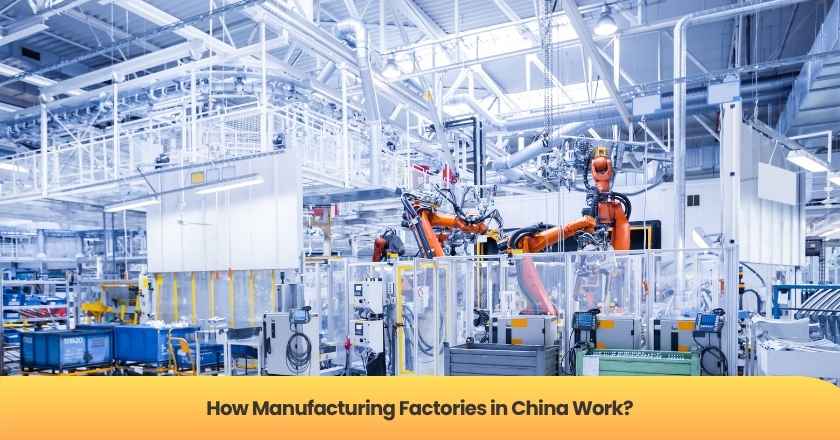
Most buyers picture a Chinese factory as a single black box: you send a purchase order in one end and cartons come out the other. What happens between those two points — how raw materials become finished goods, where quality is won or lost, why lead times slip — stays invisible. That invisibility is exactly why so many orders surprise their buyers, usually unpleasantly.
Understanding how manufacturing factories in China actually work at floor level — the stages your order passes through, who handles it, and where things go right or wrong — turns you from a buyer hoping for the best into one who can manage the process. The factory stops being a black box.
Key Takeaways
• Your order moves through distinct stages — materials, production, finishing, inspection, packing — each with its own failure points.
• Quality is built into the process, not inspected in at the end, so where you check matters as much as whether you check.
• Lead times slip at predictable points: materials sourcing, tooling, and capacity bottlenecks during peak season.
• Many factories subcontract parts of production, which affects who actually controls your quality.
• Knowing the floor lets you time inspections, read delays, and communicate in terms the factory understands.
Before Production: Materials and Preparation
Production doesn't start when the line runs — it starts well before, with materials sourcing and setup that quietly determine your quality and timeline. Buyers who only think about the assembly line miss the stage where many problems are actually born.
Materials sourcing
Once your deposit clears, the factory procures raw materials and components, often from its own network of suppliers. This stage is a common source of both delays and quiet substitutions — a factory short on your specified material may swap in a cheaper grade. Confirming materials against your spec early protects the whole run.
Tooling and setup
For custom products, the factory makes or adjusts tooling — molds and fixtures built for your item — before production can begin. Tooling takes time and money, and rushing it produces defects downstream. This is also where you should have already confirmed, in writing, who owns the tooling you paid for.
The pre-production sample
A good factory produces a pre-production sample from the actual materials and line before committing to the full run. This is your last cheap checkpoint before bulk. Approving and sealing it as a golden sample gives the floor a physical standard to build against rather than an interpretation of your email.
Expert Tip: Time your first real intervention at the materials stage, not the assembly stage. Ask the factory to confirm — ideally with photos — the actual materials and components received against your spec before the line starts. Material substitution is one of the most common and costly quality failures, and it's nearly invisible once those materials are built into a finished product. Catching a wrong resin grade or a thinner gauge of metal while it's still raw stock costs nothing to fix; catching it in 10,000 finished units costs you the run.
On the Line: How Production Actually Runs
The production line itself is where your order takes physical shape, and understanding its rhythm helps you read everything from quality to timelines. Chinese factories range from highly automated operations to labor-intensive assembly, and which you're dealing with shapes your expectations.
Production stages
A typical run moves through fabrication of components, assembly, and finishing, often as distinct stations or lines. Each stage has its own quality checkpoints in a well-run factory. The work-in-progress you’d see on a floor walkthrough — partially built units at various stations — is the visible evidence of a real production line.
In-line quality control
Quality is built in, not inspected in. A capable factory runs QC (Quality Control — the inspection steps that catch defects during and after production) checks at each stage, catching defects before they're built into finished goods. A factory that only checks at the very end, if at all, will ship more defects no matter how good its sample looked.
Capacity and scheduling
Your order shares the floor with others, and where it sits in the queue affects your timeline. A factory near full capacity may slot you behind larger clients or rush your run to fit. This is why confirming real capacity and current order load before ordering matters as much as price.
Common Mistake to Avoid: Assuming all your units are made together in one continuous, supervised batch. In reality, production often runs in stages over days or weeks, sometimes interrupted by higher-priority orders, and quality can drift between the first units and the last. A factory may finish your early units carefully, then rush the remainder to meet a deadline once it knows the order is committed. This is exactly why a during-production inspection — checking units mid-run, not just at the start or end — catches drift that a single checkpoint would miss.
The Subcontracting Reality
One of the least understood facts about Chinese manufacturing is how much production is subcontracted. The factory you contracted with may not make every part of your product itself, and that reality directly affects who controls your quality. Knowing it changes how you verify and inspect.
Why factories subcontract
Factories specialize, so a plant assembling your product may outsource components — circuit boards, specific parts, or finishing processes — to other specialists. This is normal and often produces better components than a generalist could. The issue arises only when subcontracting is hidden or uncontrolled.
When it becomes a risk
Subcontracting becomes a problem when the factory overflows your order to a plant it doesn’t control, or when a trading company front subcontracts everything. Then your quality depends on a site you never verified. The accountability chain breaks exactly where you can't see it.
Managing the supply chain behind the factory
Ask which components are made in-house and which are outsourced, and how the factory controls the quality of what it subcontracts. A factory that answers clearly and inspects incoming components is managing its chain. One that's vague about it is a signal to inspect more closely.
Expert Tip: During verification, ask a factory directly which parts of your product it makes in-house and which it subcontracts, then ask how it inspects the subcontracted parts before assembly. A confident, specific answer — “we make the housing here, the PCB comes from a partner in the next city, and we incoming-inspect every batch” — signals a factory that genuinely controls its quality chain. Vagueness or insistence that everything is made in-house when that's implausible for your product suggests either a trading front or a factory that doesn't actually manage its subcontractors, which puts your quality at risk where you can't see it.
Finishing: Inspection, Packing, and Shipment Prep
The final stages — finishing, inspection, and packing — are where your order is made ready to ship, and where the last preventable problems hide. Buyers often relax once production is “done,” but the work between the last unit and the loaded container still affects what you receive.
Final quality inspection
A well-run factory conducts a final inspection against your spec before packing, and this is where your pre-shipment inspection should happen too. Ideally goods are inspected once at least 80% of the order is produced and packed, so the sample reflects the whole batch rather than a flattering early portion.
Packing and protection
Packing isn't an afterthought — poor packing causes transit damage that looks like a quality failure when goods arrive. Confirm packaging specs, including inner and outer cartons and any protective materials. The carton dimensions also affect your freight cost, so they're worth getting right for more than one reason.
Documentation and loading
Before shipment, the factory prepares the goods for loading and supports the documentation — commercial invoice, packing list — your freight forwarder needs. Accurate paperwork here prevents customs delays later. A factory experienced with exports to your market handles this smoothly.
Common Mistake to Avoid: Treating packing as the factory's problem and not specifying it in writing. Buyers obsess over the product and leave packaging to the factory's default, then receive goods damaged in transit or in retail-unready packaging. Transit damage from inadequate packing is indistinguishable from a quality defect when the carton arrives crushed, and it’s entirely preventable. Specify inner and outer carton construction, protective materials, and labeling as precisely as you spec the product itself — it's part of the order, not a courtesy the factory adds for free.
Working with the Floor as an International Buyer in 2026
Knowing how the floor works only pays off if you use that knowledge to manage production from a distance. The buyers who get the best results treat the factory as a process they understand and time their involvement to where it matters. In 2026, remote tools make this more achievable than ever.
Time your inspections to the stages
Use your understanding of the stages to place inspections where they catch the most — a during-production check while defects are still correctable, and a pre-shipment check near completion. Inspecting at the right moment is far more valuable than inspecting more often at the wrong ones.
Communicate in the factory's terms
Speak to the floor in concrete production language — tolerances, materials, stages — rather than vague quality wishes. A factory responds to “±0.5mm at this joint” far better than “make it nice.” Understanding the process lets you communicate in terms the people building your goods actually use.
Use remote visibility
Remote audits, video walkthroughs, and digital QC reports are standard in 2026, letting you watch your order move through the floor without traveling. A scheduled video check at a key stage, or a sourcing agent on site, gives you eyes on production that email alone never could. Distance is no longer blindness.
Expert Tip: Ask for stage-based progress updates with photos — materials received, production started, units at the midpoint, packing underway — rather than a single “it's going fine” reassurance. Tying updates to the actual production stages does two things: it gives you genuine visibility into where your order really is, and it signals to the factory that you understand the process and are paying attention. Factories handle orders from knowledgeable buyers more carefully, because they know vague answers won't pass. The request costs the factory little and gives you an early warning when a stage slips behind schedule.
Frequently Asked Questions
What stages does my order go through inside a Chinese factory?
Typically materials sourcing, tooling and setup, a pre-production sample, then fabrication, assembly, finishing, final inspection, and packing for shipment. Each stage has its own quality checkpoints and potential failure points. Understanding this sequence lets you time inspections where they catch the most and read where a delay is actually occurring rather than guessing at a single opaque process.
Where in production is quality most likely to slip?
At the materials stage, through substitution of a cheaper grade, and mid-run, when a factory rushes later units after carefully finishing early ones. Quality is built in across stages, not inspected in at the end, so a factory that only checks finished goods ships more defects. A during-production inspection mid-run catches the drift that start-only or end-only checks miss.
Do Chinese factories make everything in-house?
Often not — factories specialize and commonly subcontract components or finishing processes to other specialists, which is normal and can improve quality. The risk arises when subcontracting is hidden, uncontrolled, or when a trading front outsources everything to plants you never verified. Ask which parts are made in-house, which are subcontracted, and how the factory inspects subcontracted components before assembly.
Why do lead times from Chinese factories slip?
Common causes are delays sourcing materials, tooling that takes longer than quoted, and capacity bottlenecks where your order sits behind larger clients, especially during peak season. First orders almost always run longer than the optimistic quote. Building buffer into your timeline and confirming the factory's real capacity and order load before committing protects you from a delay you can’t control.
How can I oversee factory production without traveling to China?
Use remote tools that are standard in 2026: video walkthroughs at key stages, third-party or agent-run during-production and pre-shipment inspections, and stage-based photo updates. A sourcing agent on site gives you physical presence on the floor when you can’t be there. Timing these to the actual production stages gives you real visibility into your order without leaving home.
Conclusion
A Chinese factory isn't a black box — it's a sequence of stages, from materials and tooling through production, subcontracting, finishing, and packing, each with its own failure points and checkpoints. Understanding that floor-level reality lets you time inspections, read delays, manage the subcontracting you can't see, and communicate in terms the line understands. Knowledge of the process is what turns distance from a handicap into a managed variable.
NewBuyingAgent
Related Resources
Comece hoje
Vamos transformar seus objetivos de compras em realidadeWeChat:+86 15157124615
WhatsApp:+86 15157124615
Endereço: Edifício 10 #39 Xiangyuan Road, Hangzhou, China