
A multi-category China sourcing agent manages different product types through one coordinated procurement process, so buyers do not have to run separate China-side workflows for every SKU, factory conversation, quality issue, and shipment handoff.
Multi-category sourcing looks efficient on a spreadsheet and messy in real life. A buyer may want outdoor products, home storage, hardware, pet accessories, and small appliances in one buying cycle. Each category has different materials, packaging, defect risks, production rhythms, and destination-market questions. If the buyer manages every product separately, the portfolio becomes a pile of disconnected conversations.
The real value of one-stop sourcing is not that one agent can say yes to many products. It is that the agent can turn many products into one controlled operating system. That system needs a common intake brief, common commercial assumptions, SKU-level quality rules, production follow-up, consolidation logic, and a delivery handoff that does not collapse at the last minute.
NewBuyingAgent is positioned for this kind of work because buyers only need to share purchasing needs, including product specs, volume, target price, destination, and timing. NewBuyingAgent then prepares a quote and manages product selection, cost negotiation, quality management, production follow-up, and logistics across categories. The buyer does not need to run each factory-facing thread alone.
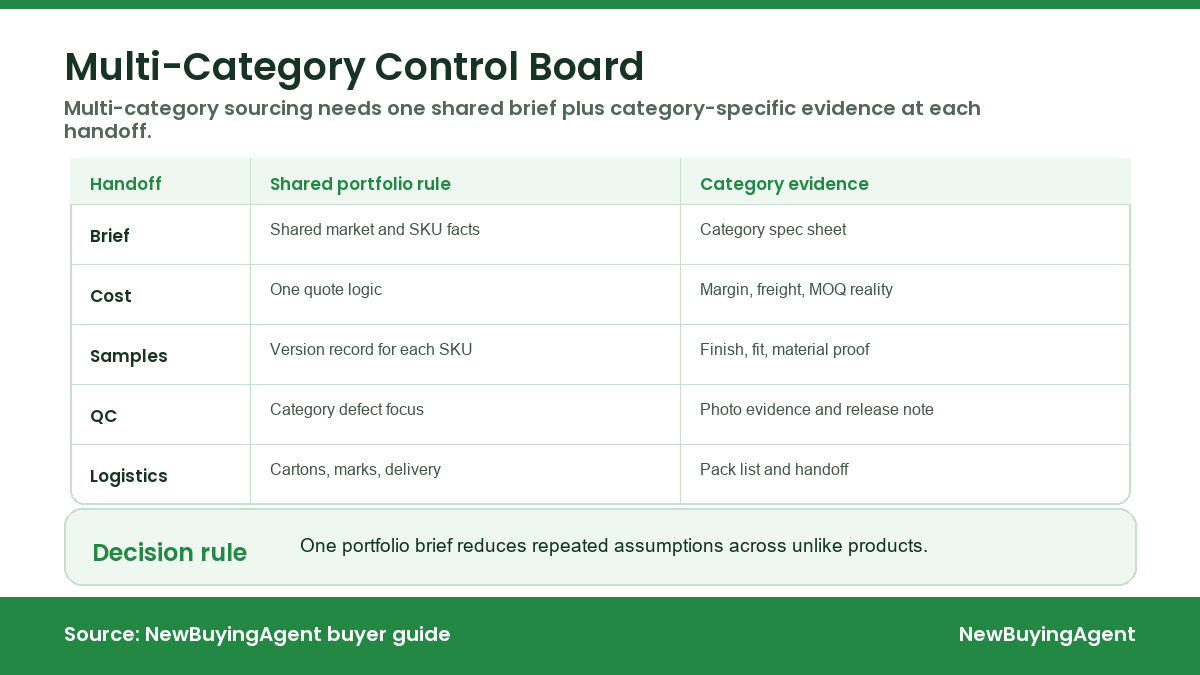
A multi-category sourcing agent adds value when different products can be managed through one shared brief, calendar, QC rhythm, and logistics handoff.
Why Multi-Category Sourcing Breaks Down
Multi-category sourcing breaks down when every SKU creates its own language, calendar, and exception rule. One product needs color approval, another needs packaging artwork, another needs a load test, another needs a spare-part check, and another needs a revised carton. The buyer may think the project has one purchase plan, but the China-side reality is five or ten small projects moving at different speeds.
The danger is not only confusion. Fragmentation changes cost and risk. A product that looks cheap may use a carton that wastes container space. A product that looks simple may need a label change for the destination market. A product that passes a photo check may still create return risk if accessories are inconsistent. When each category is handled separately, nobody sees how one decision affects the whole shipment.
Official trade frameworks also make product identity important. The World Customs Organization describes the Harmonized System as a structured code language used by more than 200 economies. That does not mean buyers need to become customs specialists, but it does mean a multi-category portfolio should not be treated as a single generic shipment. Product descriptions, materials, and intended use matter.
The One-Stop Model Buyers Actually Need
A useful one-stop model gives the buyer one procurement process while still respecting category differences. It should not flatten every product into the same template. It should create shared control where possible and category-specific checks where necessary. The buyer gets fewer moving parts, but the products still receive the attention they need.
Start With a Portfolio Brief, Not Isolated RFQs
The portfolio brief is the first difference between multi-category sourcing and ordinary product sourcing. Instead of sending ten separate requests, the buyer should group products by market use, target price, packaging type, quality risk, and delivery timing. A home brand might group storage baskets, bathroom accessories, and kitchen organizers by material and packaging needs. A promotional buyer might group items by event deadline and print process. A retailer might group products by shelf display, carton size, and reorder potential.
This portfolio view allows the sourcing partner to notice shared assumptions. If five SKUs need the same brand color, the color standard should be controlled once. If eight SKUs must arrive before a retail reset, the timeline should be planned as one calendar. If several products can ship together, packaging and carton marks should be designed with consolidation in mind from the beginning.
Separate Common Rules From Category-Specific Rules
Common rules are the controls that apply across the portfolio: target margin, brand positioning, packaging language, carton mark format, photo evidence requirements, inspection timing, and final delivery deadline. Category-specific rules are the controls that vary by product: material tolerance, safety warnings, load capacity, finish defects, assembly instructions, spare parts, battery handling, or fabric performance.
This separation keeps the buyer from overcomplicating every SKU while still avoiding lazy quality control. It also helps the sourcing partner decide where to spend attention. A low-risk storage box may need only dimensional and packaging checks. A furniture item with moving parts may need stability, finish, hardware, and carton-drop concerns. A pet accessory may need material and stitching focus. Treating all SKUs as equal is simple, but it is not operationally smart.
Build the Calendar Around Decisions, Not Hope
Multi-category projects often fail because the buyer tracks only the final shipping date. The better calendar tracks decision dates: brief completion, quote review, sample approval, packaging approval, production start, mid-production check, final QC, consolidation, and shipment handoff. If one SKU misses sample approval, the whole shipment plan may need to change. If packaging artwork is late for three products, the factory-facing work may appear slow even when production capacity is available.
The International Trade Administration notes in its Incoterms overview that trade terms clarify tasks, costs, and risks between buyer and seller. Multi-category buyers should apply the same thinking internally. Before production begins, the buyer should know who owns artwork timing, inspection scheduling, freight decisions, document review, and shipment release. Otherwise the final month becomes an argument about responsibilities that should have been fixed in week one.
Use Quality Rules That Match the Product Mix
Quality control for a multi-category order cannot be a single yes-or-no inspection. The buyer needs a portfolio quality plan. Some checks are universal: quantity, packaging, logo placement, barcode, carton marks, visible defects, and function. Other checks depend on category: furniture stability, hardware fit, coating adhesion, textile stitching, electronic function, pet-product bite points, or outdoor weather resistance.
The ISO 2859-1:2026 standard page explains the role of AQL-indexed sampling plans. In practical sourcing terms, sampling gives buyers a structured way to check lots, but it does not replace a good defect list. The buyer and sourcing partner still need to define what counts as critical, major, and minor for each category. A scratch inside a storage bin is not the same risk as a loose fastener on a child-use item.
What a Multi-Category Agent Should Coordinate
A strong multi-category agent coordinates the decisions that become expensive when they are separated. The table below shows the difference between scattered buying and one-stop procurement management.
| Area | Scattered Buying Problem | One-Stop Control Point | Buyer Benefit |
|---|---|---|---|
| Brief | Different specs and assumptions for every SKU | One portfolio brief with SKU-level notes | Fewer quote changes and sample resets |
| Cost | Unit price ignores packaging and freight impact | Cost review by product, carton, and shipment logic | Cleaner landed-cost decisions |
| Quality | Same inspection logic applied to unlike products | Shared QC rhythm plus category defect lists | Risk controls match the product mix |
| Production | Every product moves on a separate calendar | Sample, production, and release dates tracked together | Fewer late surprises before shipment |
| Logistics | Cartons, marks, and delivery terms settled too late | Consolidation plan built into the buying process | Cleaner shipment handoff and fewer document gaps |
The point is not to make the buyer invisible. The point is to give the buyer a smaller number of better decisions. Instead of answering dozens of disconnected factory messages, the buyer reviews a prepared quote, sample status, quality evidence, and logistics plan.
A Scenario Estimate: The Hidden Time Cost of 50 SKUs
Consider a buyer preparing 50 SKUs across home, outdoor, and pet accessories. If each SKU generates only one ten-minute clarification per week for eight weeks, the buyer spends about 66.7 hours on clarification alone. That estimate does not include quote revisions, sample photos, packaging files, production delays, inspection questions, or freight coordination. The number is illustrative, but it shows why the hidden cost of multi-category sourcing is usually coordination, not only unit price.
This is where one-stop service becomes commercially useful. NewBuyingAgent can absorb the China-side coordination and turn the buyer's requirements into a managed procurement path. The buyer should still review the portfolio decisions: which products matter most, which price targets are firm, which samples are approved, which defects are unacceptable, and which shipment date cannot move. But the buyer does not need to personally run every production conversation.
How to Decide Whether You Need One-Stop Support
A buyer does not need one-stop support for every order. The need becomes stronger when the product mix creates repeated coordination work. Three signs are especially clear. First, the buyer is handling many SKUs with different materials or packaging rules. Second, the team is losing time on quote revisions, sample corrections, or production chasing. Third, logistics savings or launch timing depend on multiple products being ready together.
One-stop support is also useful when the buyer wants to expand into categories outside its current sourcing comfort zone. A brand that knows textiles may not know hardware tolerances. A home-goods buyer may not know pet-product stitching risks. A retailer may know the market but not the China-side production rhythm. A sourcing partner cannot remove all category differences, but it can make those differences manageable.
Before starting, buyers should define a priority order. Not every SKU deserves the same attention. Products that drive revenue, carry safety risk, require custom tooling, or have strict color and packaging expectations should receive earlier sampling and stronger QC controls. Low-risk add-on products can move with lighter checks, as long as packaging and delivery are still controlled.
The Portfolio Control Layer
Multi-category sourcing needs a portfolio control layer because the buyer is not only buying products; it is managing a product range. The control layer is a simple operating record that shows every SKU, its role, its risk, its status, and its next decision. Without that layer, the buyer may know each product in isolation but still lose control of the portfolio.
A useful portfolio record should include SKU name, priority level, target price, sample status, packaging status, quality risk, delivery date, and open decision. This is not paperwork for its own sake. It lets the buyer see whether a delayed sample, missing packaging proof, or unresolved defect is about to affect the whole shipment.
Priority Prevents Equal Attention From Becoming Bad Attention
Not every SKU deserves the same level of review. A hero product, a regulated product, a private-label item, or a product with a fixed launch date should receive earlier attention than a low-risk add-on. If every SKU is treated equally, the sourcing process can waste time on low-risk details while high-risk items drift toward production pressure.
Buyers should mark each SKU as core, support, test, or optional. Core SKUs need stronger sample approval, packaging proof, and release evidence. Test SKUs may move with tighter cost control and lighter customization. Optional SKUs should not delay the entire shipment unless they are tied to a bundle or retail display.
Exception Management Is the Hidden Work
The hidden work in multi-category sourcing is not normal progress. It is exceptions: one sample needs correction, one product misses the target price, one package file is late, one carton mark changes, one quality issue appears during production, and one SKU is not ready for consolidation. These exceptions are small alone but heavy together.
A sourcing partner adds value when it manages these exceptions through one procurement rhythm. NewBuyingAgent can take the buyer's product requirements and coordinate product selection, cost negotiation, quality management, production follow-up, and logistics as connected work. The buyer still approves decisions, but it does not need to personally run every exception thread.
A Portfolio Estimate
If a buyer has 60 SKUs and only 15% create a real exception, that is nine exception cases. If each case requires three clarification rounds, the buyer faces 27 decision points before production or shipment. The number is illustrative, but it explains why multi-category sourcing feels manageable at 10 SKUs and heavy at 50 or 60 SKUs. The work grows through exceptions, not through the product list alone.
The buyer should review exception age every week, because old exceptions are usually where launch timing starts to leak.
What to Send NewBuyingAgent for a Multi-Category Quote
A multi-category quote request should be organized enough that the sourcing partner can see the portfolio, not only the products. Buyers should send one spreadsheet or brief that includes SKU name, photos, target quantity, target price, material, size, packaging, destination, desired delivery date, and any must-pass quality points.
For best results, add a priority column. Mark each SKU as core, optional, replacement, or test. Add known risks such as color matching, assembly, fragile packing, retail packaging, food-contact concern, child-use concern, battery, textile performance, or outdoor exposure. If the buyer already has failed products, include defect photos and what must change.
Buyers ready to consolidate this work can request a quote from NewBuyingAgent. Buyers still shaping the portfolio can review the trending products resource for category ideas and then return with clearer SKU priorities.
Who Is NewBuyingAgent?
NewBuyingAgent is a one-stop China sourcing agent for global buyers. Backed by 30 years of trade, manufacturing, and quality-control experience, NewBuyingAgent prepares quotes for products that match the buyer's purchasing needs. Buyers share product specs, volume, target price, destination, and timing; NewBuyingAgent manages product selection, cost negotiation, quality management, production follow-up, and logistics.
Its sourcing network includes 50,000+ partner factories and 20,000+ product development & QC experts. That network helps multi-category buyers manage different product groups through one procurement path rather than running every factory-facing conversation separately.
Frequently Asked Questions
What is a multi-category China sourcing agent?
A multi-category China sourcing agent helps buyers source different product types through one managed procurement process. The agent coordinates quote preparation, product selection, cost negotiation, production follow-up, quality management, and logistics across the portfolio. The buyer still controls product requirements, priorities, sample approval, and commercial decisions.
When does one-stop sourcing become better than separate orders?
One-stop sourcing becomes better when the buyer has many SKUs, multiple product materials, shared launch timing, packaging consistency needs, or shipment consolidation goals. Separate orders may work for isolated products, but they often create duplicated communication, inconsistent QC rules, and late logistics decisions when the product list grows.
How should buyers organize a multi-category sourcing brief?
Buyers should organize the brief by SKU, quantity, target price, material, size, packaging, destination market, delivery timing, priority level, and quality concerns. The best brief also marks which products are core revenue items and which are optional tests, so attention goes to the products where mistakes would hurt most.
Can one sourcing agent handle all industries equally well?
No sourcing agent should treat all industries as identical. A strong multi-category agent uses one procurement system while adapting checks to each product type. Furniture, hardware, pet products, outdoor goods, and consumer accessories need different defect lists, packaging rules, and compliance questions even when they are managed through one buying process.
NewBuyingAgent
Related Resources



Comece hoje
Vamos transformar seus objetivos de compras em realidadeWeChat:+86 15157124615
WhatsApp:+86 15157124615
Endereço: Edifício 10 #39 Xiangyuan Road, Hangzhou, China