

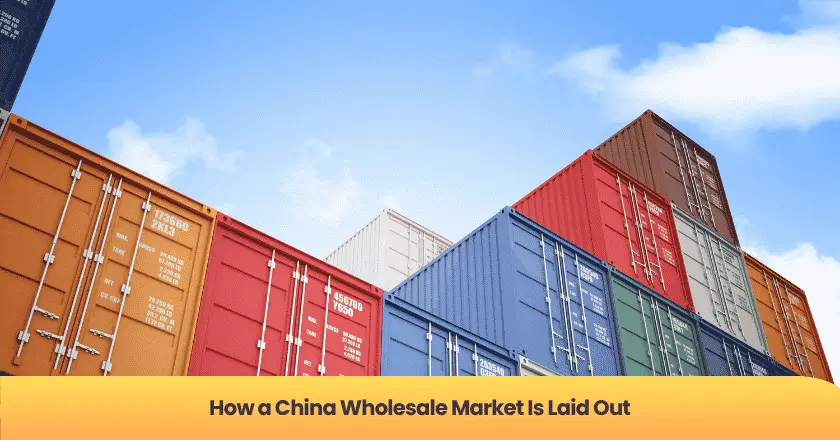
A first-time visitor walks into a Chinese wholesale market and reads it as chaos: identical booths in every direction, no obvious ordering, thousands of doors. By the third day the pattern is visible and slightly embarrassing. The market was organised the entire time, by zone, by floor and by a numbering system that works like a street address, and two of those days went into learning something a floor plan would have explained in ten minutes.
These markets are planned environments rather than accumulations of stalls. Reading the layout is the difference between covering forty booths a day with purpose and covering a hundred without remembering any of them.
Key Takeaways
• Large Chinese markets are zoned deliberately, sometimes by product category and sometimes by function.
• The booth number is an address that encodes district, floor and aisle, and it is the only reliable way to find a stall again.
• Position within a market carries information about rent, scale and how long a business has traded there.
• Competing booths sit side by side on purpose, which is a buying advantage rather than an inconvenience.
• A ring of logistics, printing and consolidation services surrounds every major market and is part of what you are visiting.
Markets Are Zoned, Not Accumulated
Every large market has an organising principle written into its plan. Two principles dominate, and knowing which applies tells you how to move through the building.
Zoning by Category and by Function
Category zoning is the more familiar arrangement. Yiwu's International Trade City separates its districts so that one building carries toys and jewellery while another carries luggage and hardware, and the city government describes a complex ofaround 75,000 boothsacross atrading area above 6.4 million square metrescarrying more than two million items across 26 broad categories.
Functional zoning is less obvious to visitors and just as deliberate. Keqiao's China Textile City is described by the district government as having formed a traditional trading zone in the south, a market innovation zone in the north, an international trade zone in the centre, a raw materials zone in the west and a logistics support zone in the east. Walking north to south in that market moves you between different kinds of business rather than between product types.
The Booth Number Is an Address
Booth numbers encode location in a consistent scheme, typically district, then floor, then aisle or street, then the individual unit. Once you can read it, a number tells you roughly where to walk without asking anyone. Vendors write it on business cards and quote it in messages because it is the operative identifier in these environments.
Photograph the number plate at every booth you visit, together with the product. Business cards go missing, company names blur together after fifty stalls, and a photograph of the plate lets an agent or a colleague find the same booth months later. This single habit saves more time on a market trip than any other.
Scale matters for how you use the plan. A market spanning several buildings and multiple floors cannot be walked end to end in a day at any useful pace, and treating it as one venue rather than as a set of separate buildings is the commonest planning error. Decide which buildings you are entering before you leave the hotel.
Expert Tip:Get the floor plan before you arrive rather than at the entrance. Most major markets publish one, and the categories are usually listed by district and floor. I mark the three or four zones I intend to cover and ignore the rest deliberately, because the alternative is drifting through interesting stalls that sell nothing I buy. A market visit is a search problem, and the plan is what turns wandering into searching.
What a Booth's Position Tells You
Location within a market is not neutral. Rent varies substantially by position, and what a business pays for its spot indicates something about it.
Front, Back and Upper Floors
Ground-floor booths near main entrances carry the highest rents and typically belong to larger operators or to businesses that depend on walk-in traffic. Upper floors and deep interior aisles cost less, and the occupants there are often smaller, more specialised, or simply older tenants who have held the same unit for years.
Neither position predicts quality. What it predicts is orientation: a prominent booth is set up to catch passing buyers, while a quiet upper-floor unit may deal mainly with repeat customers who know exactly where to find it. Buyers who only work the ground floor see a systematically biased sample of the market.
Why Competitors Sit Together
Clustering identical products in one aisle looks self-defeating and is the opposite. Concentration draws buyers who want to compare, and a buyer who can see six versions of a product within thirty metres will complete a purchase in that aisle rather than travelling elsewhere.
Use it. Walk the whole aisle before quoting anywhere, note three or four candidates, then return. Vendors expect this and price accordingly, which is why the second visit to a booth usually produces a better number than the first.
Tenure is worth reading too. A booth that has held the same unit for many years has survived rent cycles and downturns, which says more about its stability than any brochure. Ask how long the business has been in that spot. Vendors answer this happily because longevity is a point of pride, and the number gives you a rough sense of who you are dealing with.
Common Mistake to Avoid:Buying from the first suitable booth you find is the error that costs first-time visitors most, because markets are built specifically to make comparison easy and the first booth is rarely the best. Walking one full aisle before engaging seriously takes twenty minutes and routinely uncovers a better specification, a lower minimum or a vendor who actually manufactures rather than resells. The market's own layout is doing the work for you, and buying immediately is choosing not to use it.
The Ring of Services Around the Trading Floor
What surrounds a market is part of the market. Buyers who plan only for booths miss half of what a trip can accomplish.
Logistics, Consolidation and Printing
Consolidation warehouses cluster near every major market, combining purchases from many booths into one container and handling export documentation that individual vendors cannot. Around them sit freight forwarders, packaging printers, sample rooms, translators and label makers, all within a short distance of the trading floors.
That ring is why one trip can produce a finished arrangement rather than a list of quotes. A buyer can select goods in the morning, brief a consolidator in the afternoon and have packaging discussed the same day. Some markets formalise this, as with the eastern logistics support zone written into the Keqiao plan.
Banking and payment services sit in the same ring, and market areas generally have branches accustomed to foreign buyers and to the documentation that trade payments require. Sorting payment arrangements while you are physically present is considerably simpler than doing it remotely afterwards, particularly for a first transaction with a new vendor.
What Sits Outside the Market Entirely
Production usually does. A booth is a showroom, and the factory behind it may be an hour away or in another province. This is normal rather than evasive, and it means a market visit answers questions about product and price but not about manufacturing capability.
Plan factory visits separately if they matter for your product. Buyers who need to see production should treat the market as a shortlisting exercise and follow it with site visits, rather than expecting a booth to substitute for a plant tour.
Expert Tip:Book a consolidator before the trip rather than after, and tell them what you expect to buy. They will hold space, advise on carton and packing standards while you are still choosing, and occasionally warn you that a product you are considering ships badly. I have had a consolidator save more money on carton dimensions in one conversation than a day of price negotiation produced, simply because they see what fits a container every day and vendors do not.
Working a Market Efficiently
Two or three days is a common visit length, and how those days are structured determines whether the trip produces orders or photographs.
Planning a Route
Pick fewer zones than instinct suggests. Depth on two districts beats shallow coverage of five, because the value comes from comparing within a category rather than from seeing variety. Schedule the largest category first while attention is fresh, and leave the last afternoon for return visits to shortlisted booths.
Time your days to the market rather than to your own habits. Trading hours generally run from morning to late afternoon, activity thins noticeably towards closing, and vendors handling their own shipping are often unavailable at the very end of the day. Arriving early is worth more than staying late.
The Digital Layer Over the Physical Market
Major markets now run online catalogues alongside the physical floors, and Yiwu's newest district was built specifically around digital trade. Use the online layer for pre-selection and the physical floor for the things it cannot replicate: handling goods, reading a vendor face to face, and finding products you were not looking for.
The reverse also works. Photograph booth numbers on site, then continue negotiating remotely afterwards, since the relationship established in person makes the subsequent messages considerably more productive than a cold enquiry.
Expert Tip:Keep a running sheet on your phone with four columns: booth number, product, quoted price, minimum. Fill it as you walk rather than reconstructing it in the evening. By the second day the sheet is doing your comparison for you, and by the third it is the negotiating tool, because you can tell a vendor precisely what the aisle is offering. Buyers who rely on memory conflate booths within hours.
Covering Markets Without Being There: NewBuyingAgent
China’s wholesale markets are extensive, specialized, and often difficult to navigate from overseas. But buyers do not necessarily need to visit them in person to access the products and supply options they offer.
With NewBuyingAgent, you simply tell us what you need — including product type, specifications, target price, quantity, or other requirements. We then source suitable products from China across different categories and match your needs with available supply.
Instead of spending time identifying which market to visit, which suppliers to approach, and how to compare different offers, you can use NewBuyingAgent as a single sourcing point for products from China.
Our advantage is not limited to one wholesale market. With access to a broad network of suppliers across different industries, we can look beyond a single market and compare sourcing options based on your actual requirements.
In short, you don't need to be in China to source from China's wholesale markets.You just need to tell NewBuyingAgent what you want, and we help bring suitable products and supply options to you.
Frequently Asked Questions
How are Chinese wholesale markets organised?
Large markets are zoned, usually by product category and sometimes by function. Yiwu separates categories across districts and floors, while Keqiao's textile market is described by the local government in functional zones covering traditional trading, innovation, international trade, raw materials and logistics. Check which principle applies before planning a visit.
What does a booth number mean?
It is an address encoding district, floor and aisle position, and it is the identifier vendors themselves use. Photograph the number plate at every booth alongside the product, because company names blur together quickly and the number is what lets you or an agent find the stall again.
How many days do I need for a market visit?
Two to three days covers a focused visit to two or three zones. Attempting a whole market in that time produces broad impressions and few usable quotes. Buyers with several categories often do better with two shorter trips than one long one, since the first trip clarifies what the second should target.
Can I see the factory behind a booth?
Sometimes, and it needs arranging separately. Booths are showrooms and production is usually elsewhere, occasionally hours away. Where manufacturing capability matters, treat the market as shortlisting and schedule factory visits afterwards rather than expecting the booth to answer questions about production.
Should I bring an interpreter to a wholesale market?
For a first visit, usually yes. Vendors in the largest international markets often manage basic English, and technical detail, minimums and payment terms all move faster with someone translating properly. Interpreters familiar with the specific market also know the layout, which shortens the learning curve on your first day considerably.
Conclusion
Read the layout before you walk it. Find out whether the market is zoned by category or by function, learn how booth numbers work, pick two zones rather than five, and use the services ring around the trading floors. A market that looks like chaos is a planned environment, and buyers who read the plan get considerably more out of the same three days. For buyers who would rather have those three days covered without travelling, NewBuyingAgent handles factory selection, quality control and delivery from China.
Partial Sources
1. Yiwu Municipal People's Government — market statistics for the International Trade City, including booth numbers across the main districts —https://www.yw.gov.cn/art/2025/1/27/art_1229138370_59518545.html— accessed 27 August 2026
2. Yiwu Municipal People's Government — profile of the fifth-generation market: trading area, product categories and trading partners —https://www.yw.gov.cn/art/2024/10/29/art_1229187636_59507622.html— accessed 27 August 2026
3. Keqiao District People's Government, Shaoxing — China Textile City overview describing the market's five functional zones —http://www.kq.gov.cn/col/col1562160/index.html— accessed 27 August 2026
NewBuyingAgent
Related Resources
Comece hoje
Vamos transformar seus objetivos de compras em realidadeWeChat:+86 15157124615
WhatsApp:+86 15157124615
Endereço: Edifício 10 #39 Xiangyuan Road, Hangzhou, China
