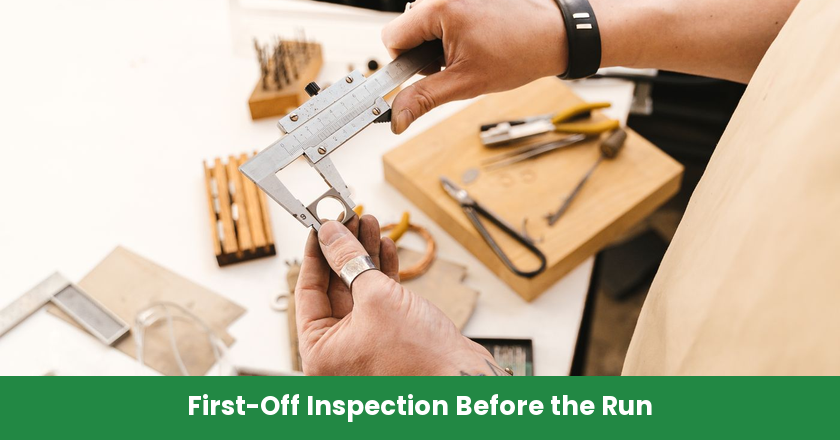
First-off inspection is an examination of identified initial output from the current production setup against agreed requirements before the main run continues.
For a buyer managing a China factory, the useful result connects the part, setup, checking method and production decision. Arrange that connection before repeated output turns a setup problem into a larger stock problem.
Control the Setup Before the Run Expands
- Decision: Continue the identified setup only when the required evidence and authorized production decision support it.
- How it works: Link initial output to the actual revision, operation, method and recorded results.
- Risk: A repeated setup error can affect more goods while approval is unresolved.
- Common mistake: Treating a good-looking first piece as proof that the whole order can ship.
What Does First-Off Inspection Establish?
A first-off check establishes whether identified initial output meets the assigned requirements at the current setup, while findings can still change the run. Put the checking point before unrestricted production continues, and make clear who can authorize continuation. Use it within the applicable production and control plan; required process qualification, safety testing or a formal customer approval remains a separate obligation.
UNIDO's product-quality guidance describes first-piece inspection before the main run, including checks of machine, fixture and operator setup. This explains why the timing matters: an error in a setting or instruction can recur when the same operation is repeated. The buyer therefore needs evidence from production under the intended conditions, rather than an attractive sample made through another route.
The exact checking occasion depends on the process. Some operations require warm-up or other preparation before representative output is available; an unfinished item may not yet expose a later functional requirement. Agree which initial output represents the setup and which characteristics can be assessed then. Keep later-stage requirements assigned to their own checking occasions instead of treating an early result as their completion.
Build the line-start requirement around setup identification, relevant output and the next production decision. Set the first-piece quantity and dimensional criteria from the product, process and agreed procedure. Keep those requirements available to the people producing and checking the goods. For wider purchasing and production context, see the China manufacturing and product guide.
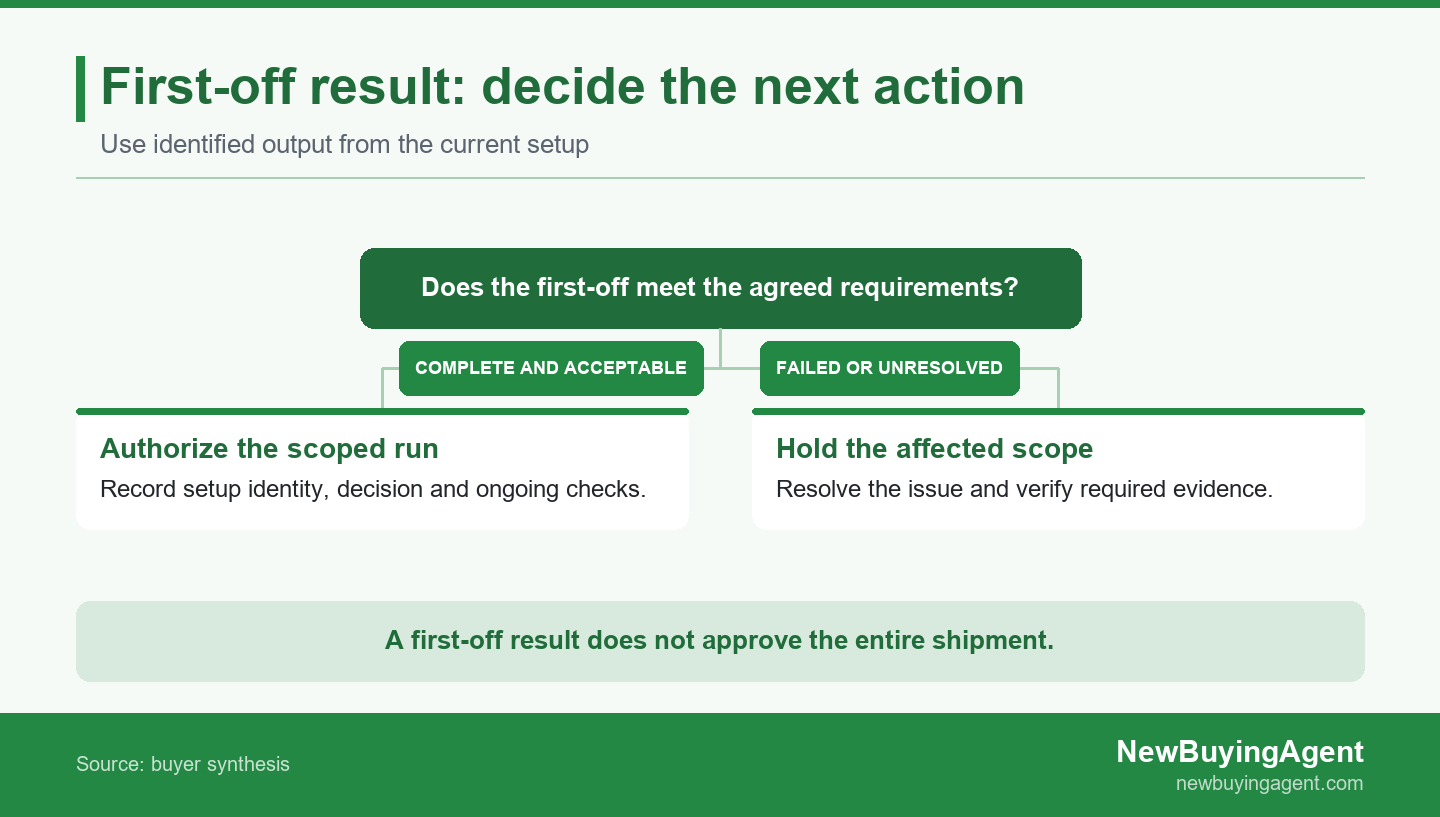
Link the current setup to the first-off result before authorizing the affected production scope.
What Should Be Checked Before the Line Continues?
Check the product and setup identity, the important characteristics the operation creates, the readiness of the checking method and the authority for the next decision. Start with requirements that a wrong setup could reproduce, including feature position, orientation, assembly sequence or the correct component. Connect each check to its drawing, specification or work instruction so a result can be understood and challenged.
Match the Part to the Current Setup
Identify the actual product revision, material, machine, tooling and operation represented by the first-off output. Where several cavities, fixtures or lines can produce the same item, define which of them the checking assignment covers. A result from one identified setup should not quietly become approval for another simply because both produce the same product code.
The distinction between checking the output and checking its production inputs is useful in machining. Renishaw's machine-tool measurement overview describes workpiece probes that measure shape, size and position, while tool-setting systems measure the cutting tool itself. A correctly set tool and an acceptable finished feature answer related questions, but the records should show which question was actually checked.
For an assembly operation, the equivalent issue may be a component version, orientation or work sequence. Ask for the current instruction and an identified production piece, then compare the feature the instruction is intended to create. An approved development sample can clarify appearance or fit, but it does not identify the machine, fixture or component version used for today's production.
Use a Method That Can Resolve the Requirement
Select a method that can assess the feature against its actual requirement. Specify the reference surface, preparation, instrument and result format where they affect the decision. A reading from the wrong reference edge can look precise while answering the wrong dimensional question; an unexplained tick in a pass column makes that problem harder for a remote reviewer to notice.
Calibration evidence is part of this assessment, but it is not the whole answer. NIST's metrological traceability policy states that traceability alone does not guarantee fitness for purpose: measurement uncertainty must suit the particular need. For a first-off decision, confirm that the chosen method can distinguish an acceptable result from an unacceptable one under the applicable criteria.
Retain actual measured values or test observations where the requirement calls for them, along with the equipment and method identification. If different people obtain conflicting results, resolve the reference, preparation and method before treating the discrepancy as a production defect. Photographs can support identification and show the checking arrangement, but they cannot supply a measurement or functional result that was never obtained.
What Should the First-Off Record Contain?
Keep a record that connects the requirement, identified setup, checked output, result and authorized action. A buyer should be able to read it later and determine what was examined, how conformity was assessed and which production scope the decision covered. Use the following first-off record as a working template, adding the actual product criteria and any fields required by the agreed procedure.
| Record field | Details to agree and enter |
|---|---|
| Product and requirement | Product/code ______; drawing or specification revision ______; characteristic and criterion ______ |
| Production setup | Operation ______; machine/line ______; fixture, tooling or program ID/revision ______ |
| Checked output | Part/sample ID ______; material or component lot ______; production date/time ______; represented scope ______ |
| Checking arrangement | Method/reference ______; instrument ID and relevant calibration status ______; preparation ______ |
| Result and evidence | Required value or condition ______; actual reading/observation ______; evidence reference ______ |
| Decision and stock control | Continue/hold/escalate ______; authorized role and decision time ______; affected stock IDs ______ |
| Correction and follow-up | Setup change ______; new checked-output ID/result ______; ongoing checks and restart conditions ______ |
Create a separate result entry for each required characteristic rather than compressing all checks into one overall pass. Keep the requirement and actual result together, so a reviewer can see an omitted feature or a result close to the applicable acceptance boundary. When an item cannot be checked at this stage, record its next checking occasion and keep it outside the completed first-off scope.
A formal first article inspection may require a broader record. ASQ's supplier-quality handbook glossary describes FAI as independent, documented physical and functional verification against design and order requirements. Where the contract calls for that process, follow its applicable documentation and verification requirements. An operation-level first-off sheet cannot replace them simply by being renamed an FAI report.
The setup record should remain linked to the production it represents. If the factory sends results in a message, retain the corresponding part identification and requirement revision with that message. A clear association between these items is more useful than collecting separate photographs, readings and approval comments that cannot later be connected to the same operation.
What Happens When the First-Off Result Fails?
Hold the affected production scope when the first-off fails or required evidence remains unresolved, before the setup produces more goods. Identify any output already exposed to that setup, then verify the requirement and method before correcting the suspected cause. Check new identified output from the corrected setup and obtain the authorized decision; changing a setting alone does not demonstrate that the required result has changed.
The factory's quality and production roles need an agreed response before line start. Define who can stop continuation, who investigates the setup and who reviews the new result. Keep disposition of already produced stock separate from permission to continue with a corrected setup, because those goods were made under different conditions.
| Observed outcome | Next production action | Evidence needed |
|---|---|---|
| Required results are acceptable and complete | Obtain authorized continuation for the identified setup | Recorded criteria, actual results, setup ID and ongoing controls |
| A required characteristic fails | Hold exposed scope; investigate and correct the setup | Failure record, stock boundary and new identified output after correction |
| Method, identity or required evidence is unresolved | Keep the relevant decision open; resolve the missing input | Correct revision, checking arrangement or missing result |
| The setup changes after acceptance | Review the changed characteristics before relying on the earlier result | Change record and the checking required by the applicable procedure |
A Fixture Reference Error in a Bracket Run
Consider an illustrative order for 4,800 metal brackets from an established operation. The factory has made 18 identified startup pieces before approval of the current setup. The measured first-off fails the agreed hole-position requirement, and the fixture record references a different edge from the approved work instruction. These are observations in the example, not a NewBuyingAgent customer case.
The immediate decision is to hold the 18 startup pieces and prevent continuation of the unapproved setup. The reference mismatch is a concrete issue to investigate; it does not prove that every exposed piece has the same defect. The order quantity describes the planned purchase, while the identified startup pieces define the currently exposed stock.
The responsible quality role first confirms the requirement and measurement method. Production then investigates the fixture reference and corrects the setup under the approved procedure. A new identified bracket is checked against the affected requirement and any other characteristics the change could influence; the earlier failed result remains part of the record rather than being overwritten.
If the new result meets the applicable criteria, the authorized role can record a scoped continuation decision under the production plan. The 18 earlier pieces still need their own disposition. The example does not assume a successful correction or shipment release: it shows how a setup observation changes the action and what evidence is needed next.
For an existing China factory, a remote buyer may need local follow-up to connect the checking result with the production actually taking place. NewBuyingAgent's China-side factory management addresses production and quality management, supported by local factory resources and product/QC capability. Share the current setup, requirement and quality concern to discuss the relevant factory-management scope.
What Must Continue After First-Off Approval?
Keep the ongoing controls assigned by the production plan after an acceptable first-off result. The startup check covers identified output from the current setup; later tool wear, material variation, handling or process changes can create a different problem. Confirm the continuing checking frequency, recorded characteristics and escalation conditions so the line does not lose control once its first result has been accepted.
A single acceptable piece does not establish stable behavior over time. NIST's guidance on assessing process stability concerns variation and process behavior over time. For an established operation, first-off checking reconfirms the current setup; a new process needing qualification requires the broader validation evidence as well. Do not use the startup result to bypass that work.
Shipment acceptance is another distinct decision. NIST describes acceptance sampling as using a random sample to support lot disposition, rather than estimating whole-lot quality. A first-off piece selected to evaluate startup cannot automatically stand in for that later sampling task. Keep the applicable in-process checks, final inspection and any required product testing assigned to their own scope.
When continuing results change, compare them with the identified startup record and the intervening production conditions. A useful record makes it possible to ask whether the setup moved, the material changed or the method produced a different reading. It helps target the investigation without assuming that the first-off result guarantees every later item.
Which Changes Require Another First-Off Check?
Review the earlier result when a change affects the characteristics or conditions it represented. Product revisions, tooling replacement, program changes, a different line, new materials or a changed checking method can create that need. Use the applicable procedure to identify the required checking scope, rather than assuming that either every interruption requires a complete new inspection or every restart is covered by the old result.
For a new purchase, build these startup-sensitive requirements into the product brief before manufacturing begins. NewBuyingAgent's product supply from China connects purchasing needs with local factory resources and product/QC capability. Product specifications and important checking needs can inform the supplied product offer and manufacturing arrangements alongside quantity, target price, destination and timing.
A changed reading may also require attention to the measurement process. NIST describes check-standard measurements as a way to expose measurement-process errors over time using historical data. Retain the relevant gauge and method evidence when investigating an unexpected startup comparison. The first-off piece itself does not become a qualified reference standard simply because it was accepted.
Communicate a change to the people producing and checking the goods, and retain the revised setup identification with the new result. If only some characteristics are affected, document how that scope was determined under the applicable procedure. An unresolved difference between the old and new conditions needs a decision before the previous approval is reused.
What Should a Buyer Send Before Line Start?
Send the product revision, important characteristics, production setup information, planned checking occasion and decision responsibilities before the line starts. Include the first-off record and the procedure for a failed or unresolved result. The factory should know what evidence to return, who will review it and which production can continue, so the checking point is part of the production plan rather than an improvised message exchange.
Confirm whether the assignment covers a single operation or several stages, and make access arrangements for characteristics that later become concealed. State how any startup output made while the decision is open will be identified and controlled. That practical agreement keeps a delayed review from quietly becoming permission to accumulate unchecked goods.
A remote reviewer also needs a contact who can explain the current setup and retrieve the relevant records. Agree how an unresolved requirement will be escalated and how a changed setup will be communicated. These arrangements support the checking result; they do not replace the technical criteria or the authority specified in the applicable procedure.
NewBuyingAgent is a one-stop China sourcing agent for global buyers, with local factory resources and product/QC capability relevant to purchasing and production needs. For existing factories, share the current schedule, setup and quality concern to discuss China-side factory management. For a new product purchase, provide specifications, quantity, target price, destination and timing to discuss the supplied product offer. To begin that discussion, send the purchasing brief.
Frequently Asked Questions
How long should the factory retain the first-off sample?
Agree sample retention with the factory according to the contract, product stability and the comparisons the buyer expects to make later. Record where the sample is stored, how it is identified and who can retrieve it. For products that change during storage, preserve the relevant readings and images as well; an aged sample may no longer provide the original comparison condition.
What if the required check damages the first-off part?
Plan destructive checking before production starts so the tested part is identified and the evidence is retained without confusing it with saleable stock. Agree the necessary test units and disposition through the applicable method and procedure. Keep the result linked to the setup even if the physical part cannot be retained intact, and clearly distinguish tested material from goods available for delivery.
Can digital records replace a paper first-off inspection form?
A digital record can work if it preserves the required evidence, version control and authorized decision for the identified production setup. Check any contractual requirements for signatures, record format and retention before replacing paper. The reviewer should be able to retrieve the requirement revision, actual results and approval history together; a folder of disconnected photographs does not provide the same record.
Should the buyer witness every first-off check in person?
The buyer need not attend every check when the agreed procedure assigns competent checking and review responsibilities and provides usable evidence. Witnessing may be appropriate where the contract, product risk or unresolved method requires it. Agree that arrangement before line start, including any remote review limitations, so the factory knows whether it can obtain the necessary decision without waiting for the buyer to travel.
NewBuyingAgent
Related Resources


Comece hoje
Vamos transformar seus objetivos de compras em realidadeWeChat:+86 15157124615
WhatsApp:+86 15157124615
Endereço: Edifício 10 #39 Xiangyuan Road, Hangzhou, China