

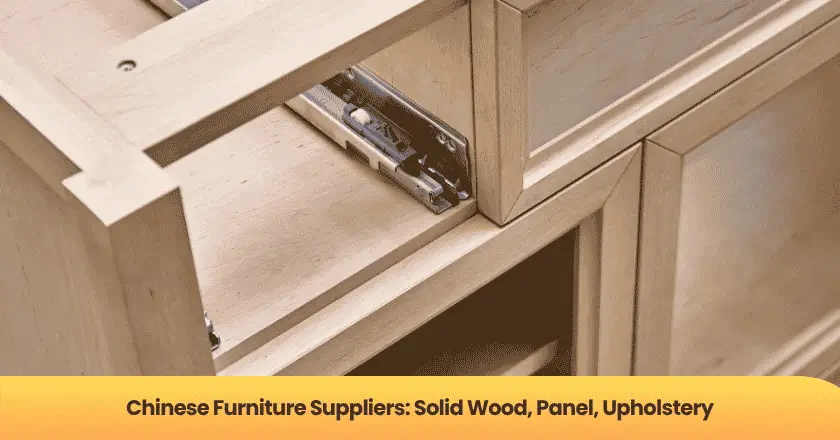
A retailer sends the same enquiry to eight Chinese furniture factories: a dining table, a sideboard and two upholstered chairs. Three reply enthusiastically about the table, two about the sideboard, one about the chairs, and two never reply at all. He reads the silence as poor service. It is not. He has sent a single enquiry to three different industries that happen to share a showroom category, and most of those factories can only build one of the three items.
Furniture is not a category in manufacturing terms. Solid wood, panel and upholstery use different machines, different materials, different skills and different quality risks, and treating them as one supply market is the first mistake most buyers make.
Key Takeaways
• Solid wood, panel and upholstered furniture are separate industries with little overlap in equipment or workforce.
• Moisture content is the single most important specification for solid wood, and it varies by destination climate.
• Panel furniture quality lives in the substrate, the edge banding and the hardware rather than in the visible surface.
• Upholstery quality sits in the frame and foam, both of which are invisible once the piece is covered.
• Formaldehyde certification and timber legality rules apply to furniture and are the importer's responsibility to satisfy.
Three Industries in One Category
Understanding what each type of factory actually owns tells you which enquiries are worth sending where.
Solid Wood
Solid wood factories run kilns, saw lines, moulders and sanding equipment, and their key asset is drying capacity. Timber has to be dried to a controlled moisture content before machining, and factories without their own kilns buy pre-dried stock and inherit whatever the supplier achieved.
Skill concentrates in joinery and finishing. Minimums are typically moderate rather than enormous, since production is not tooling-dependent, and lead times run longer than buyers expect because drying and finishing cannot be compressed.
Panel
Panel furniture is built from engineered boards, usually particleboard or MDF (medium-density fibreboard, wood fibre bonded with resin under pressure), surfaced with melamine paper, veneer or foil, and edged with banding. The factory is essentially a cutting, edging and drilling operation working to millimetre tolerances.
This is the flat-pack industry. Volumes are high, minimums are higher than solid wood, and unit costs fall sharply with scale. Quality differences between a good and a poor panel factory are largely invisible in photographs, which is why this category produces so many disappointed first orders.
Upholstery
Upholstery factories are sewing and assembly operations built around frames, springs or webbing, foam and covers. Labour content is high, automation is limited, and the workforce skill is in cutting and sewing rather than in machining.
Because so much of the value is hidden, upholstery carries the widest quality range of the three. Two sofas that look identical can differ enormously in frame material, foam density and stitching, and none of it is visible without cutting one open.
Geography follows the same split. Furniture clusters tend to specialise, with some towns concentrated in panel production and others in upholstery or solid wood, and the supporting suppliers of board, foam, fabric and hardware cluster alongside them. Sourcing a panel range from a town built around upholstery means your factory is buying its board at a distance and quoting accordingly.
Expert Tip: Ask each factory which of the three it actually builds, and ask what it subcontracts. A dining set with upholstered chairs frequently involves two factories, and the one you contract with may be assembling seats made elsewhere. That is normal and worth knowing, because the seat is where the failures will be. I ask for the seat supplier's name on any mixed-construction order, and the willingness to give it tells me how much control sits on the other side.
How Each Type Fails
Defect patterns are specific to construction, which means your inspection standard has to be too.
Moisture and Movement in Solid Wood
Almost every solid wood problem traces to moisture content. Wood dried for one climate moves in another, producing cracks, warping and joints that open weeks after delivery. Specify a target moisture content appropriate to your destination market rather than accepting the factory default, and require it to be measured and recorded before machining.
Ask how the moisture reading is taken and on how many pieces. A single reading on one board tells you almost nothing about a container. Buyers who specify a range, a measurement method and a sample size get consistent timber, and buyers who simply say kiln dried get whatever arrives.
Substrate, Edges and Hardware in Panel Goods
Panel failures cluster in three places. The substrate density determines whether screws hold and whether shelves sag. Edge banding determines whether the piece survives humidity, since exposed board edges absorb moisture and swell. Hardware determines whether a customer can assemble the product without frustration.
Specify board density and thickness, banding material and thickness, and the hardware brand or equivalent standard. Then check assembly yourself on the sample, timing it and noting anything ambiguous, because assembly complaints damage reviews faster than almost any other defect.
Frame and Foam in Upholstery
Frame material and construction decide the life of a sofa. Kiln-dried hardwood frames with corner blocks and dowelled or bolted joints outlast stapled softwood by years. Foam is specified by density and firmness rather than by thickness alone, and low-density foam collapses within months of ordinary use.
Get a cutaway sample or a photographic record of the frame before covering. Reputable upholstery factories produce these readily because their customers ask for them, and a factory that resists is usually protecting a specification it would rather you did not see.
Finishing deserves separate attention across all three types, since it is the layer customers actually touch. Ask which finish system is used, how many coats are applied and how curing time is controlled. Rushed curing produces pieces that look correct at the factory and arrive marked, because they were stacked before the surface had hardened.
Common Mistake to Avoid: Approving upholstery from a finished sample alone is the error that produces the worst outcomes in this category, because everything that determines durability is sealed inside before the piece reaches you. A beautifully sewn cover can hide a stapled frame and foam that will flatten within a season. Require frame photographs at the construction stage and a written foam density figure in the order, then verify both during production rather than at the end. Once a sofa is covered, the only way to check is to destroy it.
Compliance That Attaches to Furniture
Furniture carries more regulatory weight than most consumer categories, and the obligations sit with the importer rather than with the factory.
Formaldehyde in Panel Products
Engineered boards emit formaldehyde, and major markets regulate it. In the United States, the Formaldehyde Emission Standards for Composite Wood Products under TSCA Title VI cover hardwood plywood, medium-density fibreboard and particleboard as well as finished goods containing them, with third-party certification and labelling required at levels identical to the California ATCM Phase II standards.
Ask for the certification documentation rather than an assurance, and check that it covers the specific board being used in your product rather than a different grade the factory also buys. Board is frequently switched between orders without announcement, which is precisely why the paperwork has to name what was used.
Timber Legality and the EUDR Deadline
Wood-based furniture entering the EU falls within the EU Deforestation Regulation, which requires due diligence showing goods are deforestation-free. After two postponements, the Council confirmed a revision that simplifies due diligence and moves application to 30 December 2026 for all operators, with an extra six months for micro and small operators.
The European Commission notes that under Regulation (EU) 2025/2650 the obligation to submit the due diligence statement rests with the operator first placing the product on the market. For furniture importers that is usually you, and the geolocation data it depends on has to come from your supply chain, so start asking suppliers now rather than in December.
Expert Tip: Build the compliance requirements into the specification sheet rather than handling them as a separate workstream. Board certification, timber origin data, any flammability standard your market requires for upholstery: all of it belongs on the same page as dimensions and finish. Suppliers treat the specification as the operative document and treat side emails as advisory. I have watched perfectly good compliance instructions get lost simply because they arrived in a different thread from the drawings.
Ordering, Sampling and Shipping
Furniture economics are dominated by volume, which changes how orders should be structured.
Volume Is the Cost Driver
Furniture is bulky and light relative to its value, so freight is a large share of landed cost and container utilisation matters more than in almost any other category. Knock-down construction, nesting designs and efficient carton geometry can move total cost more than a unit price negotiation ever will.
Ask for units per container at the quotation stage, not just carton dimensions, and ask whether an assembled item can be shipped knocked down. A design change that adds one assembly step for the customer and doubles container fill is usually worth making.
Packing is a quality decision in furniture rather than a logistics detail. Corner protection, edge guards, foam wrap on finished surfaces and carton strength all determine how many pieces arrive saleable, and transit damage in this category is high enough to move your effective landed cost noticeably. Specify the packing standard and inspect it during the loading check.
Samples, Minimums and Lead Time
Sample costs in furniture are high because a sample is effectively a one-off production run, and buyers should expect to pay. Treat it as cheap relative to a container of unsaleable goods, and keep the approved sample sealed and referenced in the order.
Lead times run longer than in most categories, particularly for solid wood where drying and finishing set the pace. Mixed orders combining constructions take longer still, since two or three factories have to converge on one loading date. Build that convergence into the schedule rather than assuming the slowest item defines it.
Expert Tip: Order a small first production run rather than jumping to a full container, even where the price break argues otherwise. Furniture defects tend to be systemic rather than random, so a run of fifty reveals almost everything a run of five hundred would, and it reveals it while the tooling and setup can still be adjusted. The price difference on that first batch is small against the cost of a container of pieces with the same fault repeated in every unit.
Reaching Furniture Capacity Through NewBuyingAgent
Three furniture constructions can mean three different supplier pools to explore. Finding suitable suppliers across solid wood, panel furniture, and upholstered furniture at the same time can be difficult for buyers without an established sourcing network in China.
NewBuyingAgent provides access to a network of 50,000+ partner factories across industries, helping buyers identify suitable supply options based on product requirements, target pricing, quality expectations, and order quantities. Its local sourcing capabilities also help reduce the language, regional, and communication barriers that overseas buyers may face when dealing directly with multiple Chinese suppliers.
Backed by 30 years of expertise in trade, manufacturing, and quality control, NewBuyingAgent provides a more practical way for global buyers to source products from China.
When an order involves two or three factories with the same shipping deadline, supplier communication and production coordination can become another major workload. NewBuyingAgent can help coordinate with suppliers throughout the process, allowing buyers—especially those sourcing multiple product categories—to spend less time managing China-side communication and more time growing their business.

Frequently Asked Questions
Can one Chinese factory make solid wood, panel and upholstered furniture?
Very few can build all three properly, since the equipment and skills differ substantially. Larger groups sometimes operate separate plants under one company, which is workable if you confirm which site builds which item. A single factory claiming full capability across all three is worth questioning in detail.
What moisture content should I specify for solid wood furniture?
It depends on your destination climate, since wood equilibrates with ambient humidity. Specify a target range appropriate to your market rather than accepting a factory default, and require measurement before machining with a stated method and sample size. This single specification prevents most cracking and warping complaints.
Do I need formaldehyde certification for panel furniture?
For the US market, composite wood products and finished goods containing them must be certified and labelled as TSCA Title VI compliant, with standards identical to California's ATCM Phase II. Other markets have their own regimes. Ask for documentation naming the specific board used in your product rather than a general assurance.
How does the EUDR affect furniture imports?
Wood-based products fall in scope, and application now begins on 30 December 2026 for all operators, with an extra six months for micro and small operators. The due diligence statement obligation sits with the operator first placing goods on the EU market, which for most importers means you. Start collecting origin data from suppliers well ahead of the date.
How long do Chinese furniture orders usually take?
Longer than most categories, and solid wood is the slowest because drying and finishing cannot be compressed. Panel production is faster once tooling and cutting programmes are set. Mixed orders take longest of all, since two or three factories have to converge on one loading date, so build that convergence into the schedule explicitly.
Conclusion
Send furniture enquiries to the right industry and most of the difficulty disappears. Specify moisture content for solid wood, substrate and banding for panel, frame and foam density for upholstery, and treat compliance documentation as part of the specification rather than as paperwork. Furniture rewards buyers who write things down more than almost any other category. For buyers spreading orders across several furniture constructions, NewBuyingAgent handles factory selection, quality control and delivery from China.
Partial Sources
1. United States Environmental Protection Agency — Formaldehyde Emission Standards for Composite Wood Products (TSCA Title VI), covering hardwood plywood, MDF, particleboard and finished goods — https://www.epa.gov/formaldehyde/formaldehyde-emission-standards-composite-wood-products — accessed 27 August 2026
2. Council of the European Union — Deforestation: Council signs off targeted revision to simplify and postpone the regulation, 18 December 2025 — https://www.consilium.europa.eu/en/press/press-releases/2025/12/18/deforestation-council-signs-off-targeted-revision-to-simplify-and-postpone-the-regulation/ — accessed 27 August 2026
3. European Commission, Access2Markets — Delay until December 2026 and other developments in the implementation of the EUDR Regulation, covering Regulation (EU) 2025/2650 — https://trade.ec.europa.eu/access-to-markets/en/news/delay-until-december-2026-and-other-developments-implementation-eudr-regulation — accessed 27 August 2026
NewBuyingAgent
Related Resources


Comece hoje
Vamos transformar seus objetivos de compras em realidadeWeChat:+86 15157124615
WhatsApp:+86 15157124615
Endereço: Edifício 10 #39 Xiangyuan Road, Hangzhou, China
