


A China consolidation warehouse is a facility that receives deliveries from multiple suppliers and prepares them for one coordinated export shipment. It becomes useful when the facility gives the buyer a controlled handoff: each delivery can be matched to a project line, held when an agreed condition is not met, protected for loading, and released by a named decision owner. It is much less useful when it is simply a place where cartons wait for a container.
This distinction matters most in multi-category building-material work. A project may have tiles, cabinetry, lighting, sanitaryware, hardware, and loose accessories arriving on different dates from different factories. The buyer is not deciding whether storage exists. The buyer is deciding whether one China-side handoff can preserve the identity, condition, and records of those materials before container loading. A warehouse can support that decision; it cannot quietly replace factory inspection, a purchase contract, customs procedures, or destination compliance advice.
Treat Consolidation as a Project Control Point
A consolidation warehouse earns its place when it can receive, hold, document, and load against one project record. That is an editorial decision model, not a promise that every warehouse performs the same work. Before selecting a provider, ask four practical questions: What does a receipt prove? What triggers a hold? Which records travel with each material line? Who can release the container for loading?
- Choose a control point, not a parking space: supplier deliveries should arrive against a named project schedule, not a loose list of carton counts.
- Agree the hold rule before dispatch: a missing packing reference, mismatched finish code, or damaged pallet needs an agreed next action before it becomes a loading-day dispute.
- Keep the boundaries clear: warehouse receiving can be valuable evidence, but it does not certify products or create a bonded customs status.
- Compare whole handoffs: judge consolidation against duplicated pickup, documentation, handling, and arrival coordination—not against a warehouse fee in isolation.
The useful outcome is not “all suppliers use one address.” It is a buyer who can see what has arrived, what still needs evidence, what should stay separate, and whether a single shipment remains the right commercial choice.
What a China Consolidation Warehouse Actually Does
In a sourcing project, the warehouse receives project cargo, records it against a supplier and material line, keeps agreed items together, and prepares one export handoff. Container stuffing means the physical loading of cargo into the export container at a stated location. For US-bound ocean cargo, CBP’s Importer Security Filing guidance identifies the container stuffing location and consolidator among relevant filing data. That does not define a project’s warehouse process, but it shows why a loading location and handoff identity should never be treated as vague administrative details.
Do not equate China-side consolidation with a bonded or customs warehouse. A customs warehouse operates under a destination customs procedure and authorisation; for example, the European Commission describes customs warehousing as storage under customs supervision in authorised premises, while CBP describes a US bonded warehouse as a secured, customs-specific area for imported dutiable merchandise. A normal pre-export consolidation arrangement does not automatically provide either status, duty treatment, or legal function.
The cleanest scope is therefore modest and specific. The warehouse may receive, identify, photograph, count, store for an agreed period, keep material lines paired with records, protect cargo for loading, and stage a container. The buyer and provider should agree which of those tasks actually apply, who pays for them, and which evidence must be sent before loading. A warehouse address alone is not a release instruction.
The Four Acceptance Controls That Matter
Set the receipt and release standard before several factory deliveries converge. The acceptance chain works when the physical shipment, the project record, and the loading decision stay connected: receive against a line, identify the line, attach the needed records, then release only the cargo that meets the agreed scope. This is a project method, not a claim that a warehouse is an independent quality or compliance authority.
For buyers managing existing factories, the value is often in the connection between factory status and the delivery that reaches the warehouse. If production follow-through, quality evidence, or a corrected packing record must be reconciled before receipt, it can help to review China factory-management support for existing suppliers. The service scope still needs to state what is checked at the factory, what is checked at the warehouse, and who decides whether an exception can move forward.
Receive Against a Project Ledger
A warehouse receipt should point to a project line, not merely confirm that cartons arrived. A useful ledger records the supplier, purchase-order or project reference, SKU or finish, expected quantity, received quantity, visible condition, date, storage location, and disposition: accepted, held, incomplete, or damaged. The details are practical rather than bureaucratic. When a container is being prepared, the team needs to locate one material line without interpreting several supplier documents from memory.
A receipt ledger also makes a controlled hold possible. A short count can stay in an “incomplete” state. Cartons with a different label from the project schedule can stay “held.” Photos and a dated packing-list version can be attached to the same line. This does not replace a pre-shipment inspection or product test; it simply prevents a known mismatch from disappearing into a mixed load. The control is stronger when the supplier receives the same project reference before dispatch.
Keep Documents With the Correct Material Batch
Hold a material line when its project reference or required supporting file cannot be reconciled to received goods. This is especially important when different finishes, sizes, or suppliers look similar once packed. The file does not have to be a universal compliance certificate; it may be a buyer-approved sample reference, a product data sheet, a packing list, or a destination-specific document. For a bounded example, the European Commission explains the role of a Declaration of Performance and CE marking where the Construction Products Regulation scope applies. The US EPA also sets recordkeeping and compliance-statement expectations for covered composite wood products, as outlined in its formaldehyde standards guidance.
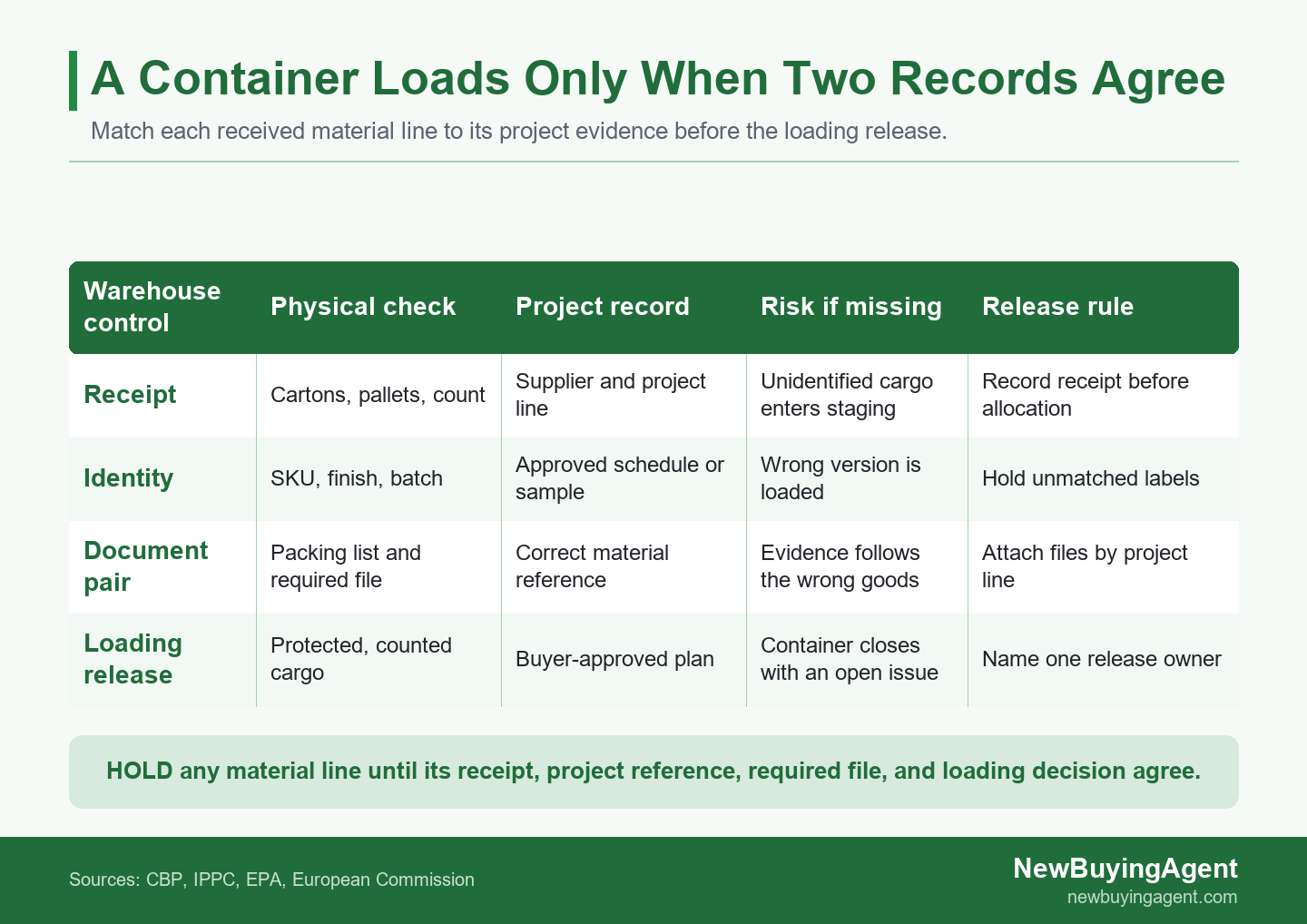
Warehouse control matrix matching building materials to project records before container loading
Neither example turns a warehouse worker into a regulator. The operational lesson is narrower: after the buyer has identified the applicable requirement with appropriate advisers, the matching product record should travel with the right supplier and SKU. A carton with an unverified label, a file with no material reference, or a revised document with no approved version should be visible as an exception before the container door closes.
Why Building Materials Need a Different Consolidation Plan
Mixed building materials need category-specific receiving and protection rules because their physical and documentary control points differ. Dense tiles, fragile sanitaryware, finish-sensitive cabinets, electrical fittings, and loose hardware should not all receive the same generic handling instruction. The project packet should state which units may be stacked, which face needs edge protection, which cartons must remain dry, which pallets need a photo record, and which components must remain together.
That extra detail is not over-engineering. It gives a warehouse a way to distinguish a visibly damaged crate from a complete, protected material line; a supplier’s “packed” status alone cannot do that. It also helps the buyer decide whether a particular category should wait for the main load, travel separately, or be delivered directly to the freight forwarder. The correct answer can differ by material, destination, container plan, and project timetable.
Plan Weight, Fragility, and Wood Packaging Before Loading
Identify materials that need special support, protection, or treatment evidence before the container is staged. A loading plan should separate heavy, stable cargo from fragile or finish-sensitive cargo; say how pallets are supported; and name any packing constraints supplied by the factory or carrier. The IPPC’s ISPM 15 guidance defines wood packaging material used to support, protect, or carry a commodity, including dunnage. That is a useful reminder to identify wood crates, pallets, and dunnage early, then verify the requirements for the actual route.
Do not leave the container plan to the final hour. The warehouse needs enough lead time to measure or confirm volume, identify material handling needs, separate hold cargo, and request missing packaging information. The buyer should also specify whether a photo set, loading sequence, seal record, or final count is required. These are agreed evidence points, not guarantees that cargo will be free of every transit risk.
Keep Destination Compliance Files Attached to the Right SKU
A material file should identify the SKU, supplier, version, and destination scope before loading. In practical terms, the warehouse needs a readable instruction: keep this product line with this document or evidence set; flag a different label, batch, or file version; do not assume that a paper in the project folder applies to every similar carton. The buyer remains responsible for obtaining qualified destination advice and confirming the product-specific requirements.
For each relevant material line, the packet can name the controlled file, its date or revision, the supplier that issued it, and the person who can approve a discrepancy. That approach is useful even where no statutory document is involved. It keeps commercial samples, finish schedules, manuals, test reports, and destination documentation from being separated by a hurried consolidation process.
When Consolidation Reduces Cost—and When It Only Adds Delay
Compare duplicated shipment handoffs against the cost and risk of waiting for one controlled load. Consolidation can be worthwhile when several supplier deliveries share a realistic ship window, a common destination, and a container or freight plan that avoids repeated local handoffs. It can add delay when one late category holds time-critical goods, the warehouse has no agreed exception rule, or the cost of waiting outweighs the benefit of a single coordinated export step.
Use a complete comparison. List supplier-to-warehouse transport, receiving, storage, repacking or protection if agreed, freight booking changes, separate shipment costs, and the commercial impact of incomplete delivery. Then identify the decision owner if a category is late or held. Incoterms are trade terms that allocate tasks, costs, and risk between buyer and seller; Trade.gov notes that they clarify responsibilities but do not replace a complete sales contract. The warehouse plan must therefore fit the actual contracts rather than assume one party owns every cost or loading consequence.
The useful question is not “Will consolidation always save money?” It is “Does one controlled handoff reduce more project friction than the waiting risk it introduces?” For the kind of project context that should be defined before China-side coordination begins, review NewBuyingAgent sourcing case examples.
An Illustrative Full-House Shipment That Should Not Load Yet
Hold the mismatched cabinet line until labels, finish evidence, and the project schedule agree. The following is an illustrative project-control example, not a NewBuyingAgent customer case or a contractual remedy. Its purpose is to show why a warehouse can add value when it makes an exception visible before a mixed container leaves China.
Hold the Mismatched Cabinet Shipment and Release by Evidence
An illustrative buyer is coordinating a full-house renovation package for a coastal residential project outside China. 6 suppliers are supplying 4 material categories for 1 planned 40 foot container. Five deliveries are due to converge within eight days. The cabinetry arrives as 48 cartons, but its carton label gives finish code W-17 while the buyer-approved project schedule gives W-19.
The tile, lighting, hardware, and bathroom-fixture deliveries match their packing references and can be separated physically from the cabinet cartons. Loading everything would turn a contained finish mismatch into a destination-side dispute. Holding the entire container without review would also delay 4 matching category receipts without proving that the cabinet issue affects the rest of the project.
The controlled response is to isolate the 48 cabinet cartons, photograph their labels and finish samples, request a factory-confirmed finish and carton record, and reconcile that record with the approved schedule. The buyer can then decide whether to rebook, split, or wait based on the real timing and handling consequences. Release the held cabinet line only when the corrected finish code, physical evidence, packing list, and buyer-approved schedule agree. This is an illustrative planning example, not a NewBuyingAgent customer case. It does not determine contractual remedies, customs treatment, or engineering suitability.
When a Sourcing Agent-Provided Warehouse Changes the Result
An agent-provided consolidation arrangement can add value when the same China-side team already understands the project requirements and factory status. This is not because a sourcing agent automatically owns every shipment decision. It is because receipt, exception follow-up, and loading preparation are more useful when the people coordinating them can locate the right supplier, current specification, and buyer decision path rather than treating every carton as anonymous freight.
The fit is strongest in two situations. First, the buyer may be sourcing several material categories as one project and need supplier selection, sampling, production follow-up, and coordinated export preparation to refer to the same schedule. In that case, it is sensible to compare the product-supply route for a China materials project. Second, the buyer may keep established suppliers but need an agreed China-side process for production updates, quality evidence, and receipt exceptions. Both paths require a written scope: what the warehouse checks, what it photographs, what it holds, and who gives a final loading instruction.
NewBuyingAgent should therefore be evaluated on the clarity of the project process, not on a vague claim of “full service.” A good discussion identifies the material categories, supplier starting point, destination, project timing, record needs, and exception owner. It also leaves customs, product certification, engineering suitability, insurance, and destination clearance with the parties qualified and contracted to handle them.
Build a Warehouse-Ready Project Packet Before You Book Space
Prepare one packet that tells the warehouse what is arriving, what must stay paired, and who can release loading. The first version does not need every final document, but it should be detailed enough to prevent suppliers and the warehouse from working from different assumptions.
| Packet field | What to specify | Why it matters at receipt | Who confirms it |
|---|---|---|---|
| Material schedule | Supplier, SKU, finish, quantity, and project line | Makes each delivery identifiable | Buyer and supplier |
| Receipt criteria | Counts, visible-condition scope, photos, and hold triggers | Prevents an unclear exception response | Buyer and warehouse |
| Protection and loading plan | Weight, fragility, wood packaging, and separation rules | Supports safe staging and a traceable load | Supplier, warehouse, and freight parties |
| Document and release record | Required files, revision reference, destination scope, and release owner | Keeps evidence paired with the right cargo | Buyer and qualified advisers |
Use the packet to start a scoped conversation, not to promise a fixed logistics result before the goods and route are known. If the project has a category schedule, supplier status, destination, and intended shipping window, the buyer can submit a full-house materials brief for a China sourcing discussion.
Frequently Asked Questions
Is a Consolidation Warehouse the Same as a Bonded Warehouse?
No, a China consolidation warehouse coordinates project cargo before export, while a bonded warehouse operates under a specific customs regime. A consolidation service may receive, record, protect, and stage goods, but it does not automatically provide bonded status, duty treatment, or customs authorisation. Confirm the legal status of any customs facility with the relevant authorities and service provider.
Should Every Supplier Send Goods to One China Warehouse?
No, suppliers should converge only when the project has a shared shipment window, usable receipt records, and a loading plan that benefits from one controlled handoff. Direct shipment or a split shipment can be better when one category is urgent, late, unusually fragile, or not ready to share a container with the rest of the project.
Can Warehouse Receiving Ever Replace a Factory Inspection?
No, warehouse receiving cannot replace factory inspection, customs procedures, or destination compliance review. It can confirm agreed visible conditions, quantities, labels, and document pairing, but it cannot replace a product-specific factory inspection, test, or destination compliance review. Define the receiving scope in writing, then use factory and professional checks for the decisions that require them.
What Must Be Ready Before Booking a Consolidated Container?
Before booking, prepare the material schedule, supplier delivery windows, receipt ledger, packing and protection rules, required document list, destination check, and a named loading decision owner. Those items do not eliminate normal freight or product risks, but they give every supplier and the warehouse one clear record for the controlled handoff. Review the packet with the warehouse before suppliers dispatch.
NewBuyingAgent
Related Resources



Comece hoje
Vamos transformar seus objetivos de compras em realidadeWeChat:+86 15157124615
WhatsApp:+86 15157124615
Endereço: Edifício 10 #39 Xiangyuan Road, Hangzhou, China
