

Order Fulfillment Cycle Time
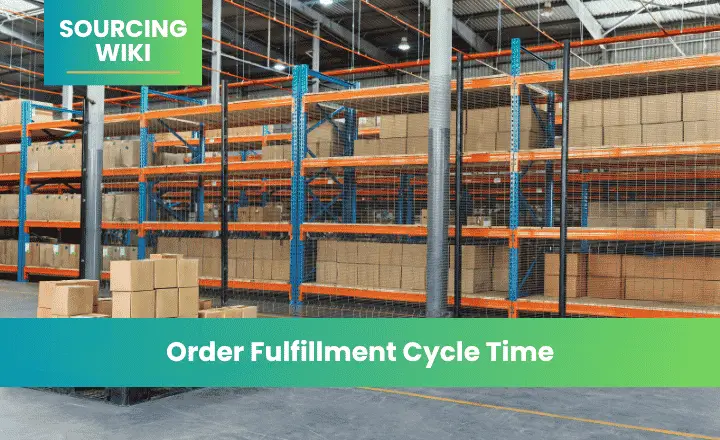
Order Fulfillment Cycle Time is the total time required to fulfill an order, measured from a defined starting point until the order reaches its agreed completion point. In supply chain management, it is used to evaluate how quickly a business can respond to an order and complete the activities needed to deliver the required products.
The Association for Supply Chain Management (ASCM) identifies Order Fulfillment Cycle Time as a key metric for supply chain responsiveness. Under the SCOR framework, the measurement covers the actual time taken to fulfill customer orders, with the cycle generally beginning when an order is received and ending when the customer accepts the order.[1]
For global buyers purchasing products from manufacturers, the metric can help show how long it takes for a confirmed purchase order to progress through the relevant stages, including order processing, material sourcing, manufacturing, preparation for shipment, transportation, and receipt. The exact scope depends on the measurement being used: a buyer measuring the period from purchase order confirmation to warehouse receipt may obtain a different result from a business measuring the full customer order cycle from order placement to final delivery.
A shorter fulfillment cycle can improve responsiveness and help buyers replenish inventory or launch products sooner. However, speed should not be evaluated in isolation. Buyers also need to consider delivery reliability, product quality, order completeness, and the consistency of actual cycle times.
How to Calculate Order Fulfillment Cycle Time
The basic formula is:
Average Order Fulfillment Cycle Time = Total Actual Fulfillment Time for Completed Orders ÷ Number of Completed Orders
This approach is consistent with the calculation method described in the SCOR framework.[1] The result is commonly expressed in calendar days, although hours may be more appropriate for short, high-volume fulfillment processes.
For example, suppose a buyer tracks five completed orders and records the following fulfillment times:
| Order | Fulfillment Time |
|---|---|
| Order A | 28 days |
| Order B | 32 days |
| Order C | 35 days |
| Order D | 30 days |
| Order E | 40 days |
| Total | 165 days |
Average Order Fulfillment Cycle Time = 165 ÷ 5 = 33 days
The average cycle time is 33 days. This means the five completed orders took an average of 33 days to move from the defined start point to the defined completion point.
For the calculation to be meaningful, the start and end events must be consistent across all orders. For example, if the measurement starts when a purchase order is confirmed, it should not be compared directly with another metric that starts when the buyer first submits an inquiry. The two measurements cover different parts of the process.
Which Dates Should Be Used?
For a buyer monitoring product orders from a manufacturer, a practical measurement might use:
- Start date: The date the purchase order is formally confirmed and the fulfillment clock begins.
- End date: The date the complete order is received at the agreed destination, or another clearly defined completion event.
If the buyer wants to measure the full period from placing an order to receiving the goods, the start date should instead be the purchase order placement date. If the objective is to assess the supplier's production performance only, the measurement should begin and end at production-specific milestones.
Businesses should also decide how to handle partial deliveries, cancelled orders, and orders that remain open at the end of a reporting period. Completed-order averages alone may exclude delayed orders that have not yet been fulfilled, making performance appear better than it actually is. Tracking open orders and overdue duration alongside the average helps provide a more complete view.
What Are the Main Stages of Order Fulfillment Cycle Time?
Order fulfillment can involve several connected stages. Measuring the total cycle time shows the overall result, while tracking individual stages helps buyers identify where time is being spent. APQC's customer order cycle time framework similarly connects the end-to-end measure with sourcing, production, and delivery activities.[2]
Order processing and confirmation. The buyer and supplier confirm specifications, quantities, prices, delivery requirements, and other order details. Missing information or repeated changes can delay the start of purchasing or production activities.
Material sourcing and preparation. The manufacturer obtains the required raw materials, components, and packaging. If materials are unavailable or arrive late, production may not begin as scheduled.
Manufacturing and production. The factory schedules and completes the required production activities. Actual duration can be affected by factory capacity, production complexity, equipment availability, labor, and competing orders.
Quality checks, packing, and shipment preparation. Depending on the order, products may need final inspection, corrective work, packaging, labeling, or export documentation before shipment. Problems discovered late in the process can extend the fulfillment cycle.
Transportation and receipt. After dispatch, goods travel to the agreed destination. International shipments may involve port handling, customs clearance, inland transportation, and warehouse receiving procedures. If the metric ends at customer receipt, this time is included in the total cycle.
These stages do not always occur strictly one after another. Some activities can overlap, and different businesses define their process boundaries differently. The key is to document which stages are included and use the same method when comparing orders or suppliers.
Order Fulfillment Cycle Time vs. Lead Time vs. On-Time Delivery
These metrics are related, but they answer different questions.
| Metric | Main Focus | What It Tells Buyers |
|---|---|---|
| Order Fulfillment Cycle Time | Total elapsed time from a defined order start to fulfillment completion | How long does the order take to fulfill? |
| Lead Time | Elapsed time between two specified events | How long does a particular process or waiting period take? |
| On-Time Delivery (OTD) | Whether delivery meets the agreed deadline | Did the order arrive on time? |
Order Fulfillment Cycle Time is an end-to-end measure when its scope includes the full fulfillment process. It can include multiple stages, such as sourcing, manufacturing, and delivery. ASCM's SCOR framework describes order fulfillment cycle time as a responsiveness measure and links it to the time required to fulfill customer orders.[1]
Lead Time refers to the duration between specified events. Manufacturing Lead Time, for example, focuses on the manufacturing process, while delivery lead time may focus on transportation. These durations can be components of a broader fulfillment cycle, but their definitions depend on the process being measured.
On-Time Delivery (OTD) measures schedule performance rather than elapsed duration. An order may take 40 days to fulfill and still meet its deadline if 40 days was the agreed schedule. Another order may take only 25 days but be late if the committed delivery period was 20 days.
For buyers, using these metrics together provides a more useful assessment: cycle time measures speed, lead time helps explain individual process durations, and OTD measures whether the delivery commitment was met.
What Factors Affect Order Fulfillment Cycle Time?
Several factors can extend the time between order placement and fulfillment completion.
Order complexity and specification changes. Customized products, new designs, tooling requirements, and repeated changes to product specifications may require additional preparation and approval. Incomplete purchasing information can also delay order confirmation and production planning.
Supplier capacity and production planning. A factory may have limited available capacity, long production queues, or competing customer orders. Even when the manufacturing process itself is relatively short, waiting for a production slot can increase total cycle time.
Material availability. Late or unavailable raw materials and components can delay production. Products that depend on specialized or custom components may be particularly sensitive to material lead times.
Quality issues and rework. Defects, failed tests, packaging problems, and corrective actions can delay order completion. The effect depends on when the issue is identified and whether the affected products can be corrected without repeating earlier production stages.
Transportation and import procedures. Transit schedules, customs clearance, port congestion, and destination handling can extend the cycle when the end point is final receipt rather than factory dispatch. For international purchasing, the distinction between production completion and delivery completion is essential.
Communication and approval delays. Slow confirmation of samples, artwork, labels, packaging, or revised specifications can create waiting time even when the supplier is ready to proceed. Clear responsibilities and prompt decisions help prevent avoidable delays.
How Can Buyers Reduce Order Fulfillment Cycle Time?
Reducing fulfillment cycle time starts with identifying where delays occur rather than simply asking suppliers to work faster. Buyers should record milestone dates for order confirmation, material readiness, production start, production completion, shipment dispatch, and final receipt. Comparing these dates across orders can reveal whether the largest delays occur before production, during manufacturing, or after shipment.
Buyers can then focus on the stages with the greatest impact. Confirming specifications and packaging requirements early can reduce repeated approvals. Reviewing realistic factory capacity and production schedules before placing orders can help prevent unrealistic commitments. For recurring products, better demand planning and earlier purchasing decisions may reduce waiting time for materials or production slots.
Regular progress updates can also help identify risks before they become missed deadlines. When an order falls behind schedule, the buyer and supplier should clarify the cause, assess its effect on subsequent milestones, and agree on a practical recovery plan. For example, a delay caused by missing packaging materials requires a different response from one caused by production defects or a late vessel departure.
It is important to balance cycle-time reduction with other performance requirements. Rushing production may increase defect rates, while expediting transportation can increase costs without resolving delays that occurred earlier. Buyers should evaluate cycle time alongside OTD, Fill Rate, and product quality to understand whether faster fulfillment is also meeting business needs.
Frequently Asked Questions
What is a good Order Fulfillment Cycle Time?
There is no universal target because fulfillment time varies by product, order complexity, production method, destination, and transportation arrangements. Buyers should establish a realistic target based on their product requirements and historical performance, then compare actual results across similar orders. Industry benchmarks can provide context, but only when the benchmark uses a comparable definition and scope.
Is Order Fulfillment Cycle Time measured in calendar days or working days?
Both conventions are possible, but the method must be stated clearly. APQC's customer order cycle time measure uses calendar days, including weekends.[2] A buyer may choose working days for a specific internal process, but should not directly compare that result with a calendar-day measure without adjusting for the difference.
Does Order Fulfillment Cycle Time include shipping time?
It depends on the defined end point. If the cycle ends when goods are dispatched from the factory, international transportation is excluded. If it ends when goods are received by the buyer, shipping and destination handling are included. The chosen definition should reflect the question the business wants to answer.
What is the difference between Order Fulfillment Cycle Time and Order Processing Time?
Order Processing Time generally refers to the time required to process an order through a defined administrative or operational stage, such as receiving, validating, and entering order information. Order Fulfillment Cycle Time can cover a much broader period, extending from order receipt or confirmation through sourcing, production, and delivery. Processing time may therefore be only one component of the overall fulfillment cycle.
Can a shorter fulfillment cycle indicate better supplier performance?
Not necessarily. A shorter cycle can improve responsiveness, but it does not automatically mean the supplier is more reliable or that the products meet requirements. Buyers should also review delivery consistency, product quality, completeness, and the supplier's ability to meet agreed commitments.
Order Fulfillment Cycle Time for Global Buyers
For global buyers sourcing products from China, the time between confirming an order and receiving the goods can involve several parties and stages. Clear product specifications, realistic production schedules, timely approvals, and consistent progress follow-up can help reduce avoidable waiting time and make potential delays easier to identify.
NewBuyingAgent helps global buyers source products from China and coordinate purchasing activities around their requirements. By clarifying order details and following progress through the purchasing and production process, buyers can gain better visibility into fulfillment milestones and make more informed decisions about their purchasing schedules.
Order Fulfillment Cycle Time provides one useful measure of that process. When reviewed alongside OTD, Fill Rate, and other performance indicators, it helps buyers understand not only how long fulfillment takes, but also whether orders are being completed reliably and in line with business needs.
References
[1] Association for Supply Chain Management (ASCM). SCOR Digital Standard — Responsiveness and Order Fulfillment Cycle Time. https://scor.ascm.org/performance/introduction
[2] APQC. What Is Customer Order Cycle Time? https://www.apqc.org/What-Is-Customer-Order-Cycle-Time
Related Knowledge Base
Sourcing Practices & Insights: Order Fulfillment Cycle Time
Latest Sourcing Guides


Comienza hoy
Convirtamos tus objetivos de abastecimiento en realidadWeChat:+86 15157124615
WhatsApp:+86 15157124615
Dirección: Edificio 10 #39 Xiangyuan Road, Hangzhou, China
