

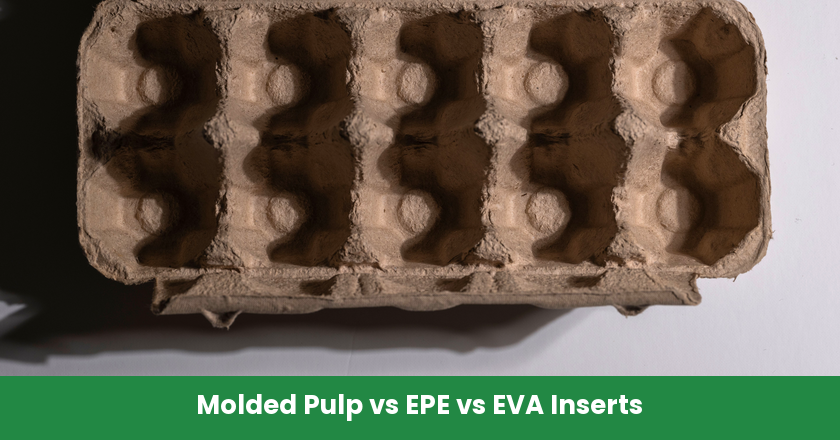
Molded pulp is a shaped fiber packaging material; EPE is expanded polyethylene foam, and EVA is ethylene-vinyl acetate foam. All three can be candidates for a protective insert, but their names do not specify how a finished pack will perform. Choose the actual design against product protection, cost at the quantity you can commit, and a supported recovery route.
For buyers sourcing from China, the useful comparison starts with the same product and distribution conditions. A fiber conversion, a lower foam quote or a cleaner-looking cavity becomes meaningful when the proposed insert can be manufactured consistently and meets the requirements of the product purchase.
Choose the insert that fits the product and the purchase
Compare molded pulp, EPE and EVA using the same product, route, pack contents and acceptance criteria. Establish complete-pack protection, cost at committed volume and the supported end-of-life route before approving a material change. This keeps a low insert price, an attractive sample or a material-based environmental claim from settling a decision that also depends on geometry, processing and factory execution.
- Best for: the right insert is the specified design that meets the product’s protection, handling and presentation needs.
- Cost comparison: include tooling and recurring costs at firm volume, with forecast-dependent savings shown separately.
- Risk: verify the finished insert’s composition and recovery route before making recyclable or compostable claims.
Compare insert designs on the same buying criteria
Molded pulp, EPE and EVA offer different ways to shape the support around a product, but each needs a defined construction. Molded pulp forms fiber into a tray or support; EPE uses polyethylene foam, while EVA uses an ethylene-vinyl acetate foam grade. Geometry, material grade, thickness and finishes determine the relevant comparison, so generic protection scores cannot replace a design brief.
The table compares candidate design approaches, not measured scores or endorsements of particular suppliers. Keep product dimensions, weight, fragile areas, carton contents and route consistent when evaluating them; record an unknown as a question for the supplier or test plan.
| Buying criterion | Molded pulp | EPE | EVA |
|---|---|---|---|
| Protection and fit | Formed fiber ribs or cradles; review contact and moisture response | Fabricated foam pads or profiles; specify grade and thickness | Cut or formed foam cavities; specify grade, fit and recovery |
| Surface and packing | Review texture, dust, removal and nesting | Review scuffing, joints and assembly consistency | Review cavity edges, skins, lamination and removal |
| Cost basis | Tooling, cycle, material and nesting at quoted volume | Foam yield, cutting, joining and pack-out labor | Foam grade, cutting, layers, finish and pack-out labor |
| Recovery evidence | Finished fiber composition, coatings and local acceptance | Exact PE construction and a collection route accepting that foam | Exact EVA construction and a route accepting the finished insert |
| Starting application | A qualified shaped-fiber design with suitable volume and material goals | A qualified PE-foam design meeting protection and cost needs | A qualified cavity/presentation design whose benefit justifies its cost |
Based on this comparison, consider molded pulp when a formed-fiber design meets the protective and material objectives, EPE when the specified PE-foam arrangement meets cushioning and cost needs, and EVA when its cavity and presentation benefit justify the actual cost. None is an automatic winner: qualify the design and compare the finished construction, rather than choosing from the material name.
Huhtamaki’s molded-fiber description illustrates why environmental attributes need a defined scope. It describes its packaging as primarily recycled paper and associates stated compostability certification with specified products and regions. That supports investigating a fiber option, while leaving another supplier’s insert composition, coatings and recovery evidence to be verified for the actual purchase.
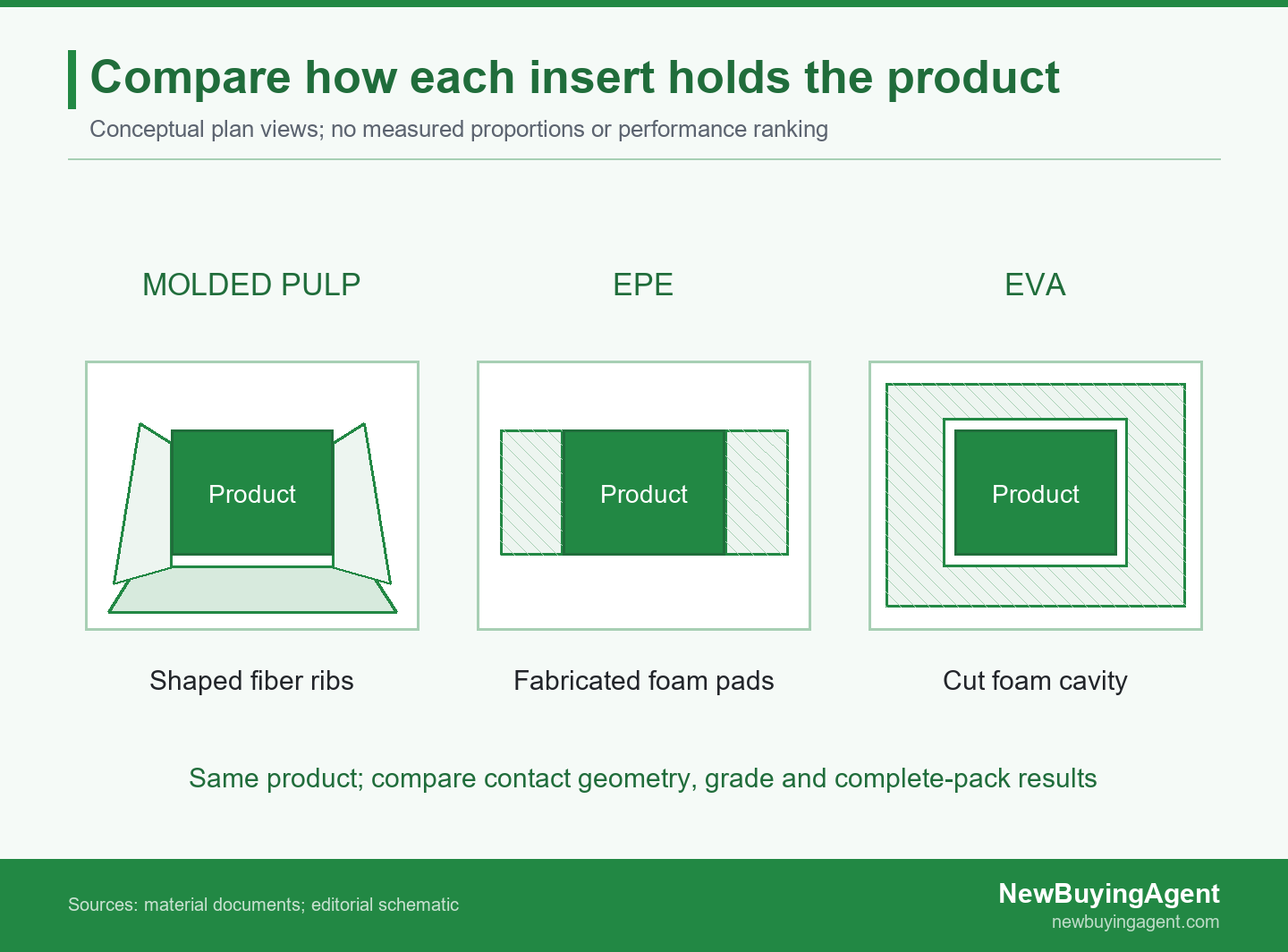
Conceptual insert designs use molded ribs, foam pads or a cut cavity to support the same product.
Match cushioning and fit to the product
Protective performance belongs to a product-and-insert design under specified conditions, rather than to a material name alone. The public scope of ASTM D1596 warns that material cushioning data can differ from in-package performance and depend on specimen area, thickness and loading rate. Use comparable input conditions when assessing such data, then check how the candidate design protects the actual packed product.
Specify the grade before comparing foam performance
Ask for the exact polymer, foam construction, density range, thickness tolerance and relevant mechanical data. Sealed Air’s published Ethafoam PE-foam brochure distinguishes densities, thicknesses and properties, including a low-abrasion variant. This is a named PE-foam example showing the importance of grade selection; it does not establish that every insert sold as EPE has the same behavior.
The Zotefoams EV30 information sheet describes a closed-cell crosslinked ethylene copolymer block foam and lists condition-specific typical values. It explicitly treats those values as guidance for selecting a grade, rather than a specification. For an EVA proposal, obtain the supplier’s actual grade and agreed acceptance limits instead of borrowing a convenient value from a different product sheet.
Define the product’s vulnerable features and where its weight bears on the insert. A harder feel or higher density is not a universal improvement: the design must control movement and cushion the relevant loads without creating damaging contact. Ask the packaging designer which data support the proposed contact area and thickness, and which questions remain for complete-pack evaluation.
Check the contact surfaces and the packing operation
Inspect the proposed insert against the actual finish and assembly sequence. Check contact pressure, scuffing, dust, odor, fit, moisture exposure and the effort needed to pack and remove the product. Include skins, liners, laminations and adhesives in that review, because the buyer receives the finished construction rather than the base material described in a brochure.
For a polished dispenser, a firm hold can still leave marks at a contact edge; a loose cavity can let accessories collide. Review those risks on representative samples and under the relevant storage conditions. Time the packing sequence, check whether operators can orient the insert consistently and confirm that removal does not strain a fragile pump or handle.
When the insert and product are developed through different China-side resources, fit problems can emerge between apparently acceptable parts. NewBuyingAgent’s stated local factory resources and product/QC capability are relevant to integrating those requirements into the sourced product. Use that capability in the context of the product purchase, with specialist packaging evidence obtained where the design requires it.
Compare tooling and recurring costs at the quantity you can commit
Insert cost should combine one-off tooling and development charges with recurring costs at the quantity the buyer can actually order. Compare delivered insert sets and pack-out labor on a matched basis, while showing validation, outer-pack, freight, tax and obsolescence costs separately. A lower recurring price may depend on tooling amortization or production volume that a forecast does not guarantee.
Illustrative example: cost a firm order and a larger forecast
An illustrative importer is buying glass pump dispensers from China, with a firm order of 2,000 insert sets and a forecast of 10,000. Protection and recovery evidence for the candidate designs remain unapproved. The buyer wants to understand whether a lower recurring fiber-insert cost offsets its tooling charge before committing to a conversion.
Illustrative assumptions: molded pulp tooling USD 1,200 plus USD 0.34 per set; EPE tooling USD 200 plus USD 0.44 per set; EVA tooling USD 300 plus USD 0.62 per set. These are invented calculation inputs, not market prices, supplier quotes or measured outcomes. Assume the recurring figure covers the delivered insert set and pack-out labor.
For this calculation, total cost equals tooling plus quantity multiplied by recurring cost per set. Exclude validation, the outer pack, freight, tax, inventory losses and future design changes from all options; obtain those costs separately before making a purchase decision.
| Illustrative option | Tooling | Recurring per set | Total at firm order |
|---|---|---|---|
| Molded pulp | USD 1,200 | USD 0.34 | USD 1,880 |
| EPE | USD 200 | USD 0.44 | USD 1,080 |
| EVA | USD 300 | USD 0.62 | USD 1,540 |
At 2,000 sets, modeled tooling-plus-recurring totals are USD 1,880 for molded pulp, USD 1,080 for EPE and USD 1,540 for EVA, equal to USD 0.94, USD 0.54 and USD 0.77 per set respectively. EPE has the lowest modeled cost within this limited scope.
Keep the cost result conditional on protection and recovery evidence
The illustrative molded-pulp and EPE options break even at 10,000 sets: USD 1,000 extra tooling divided by USD 0.10 recurring saving, with both modeled totals at USD 4,600. The forecast is not a committed order. Changes to tooling ownership, design life, pack-out time or delivered cost would change that crossover, so obtain matched actual offers before relying on it.
Use the example as a conditional cost preference, then obtain actual matched quotes and identified complete-pack prototypes. Verify protective performance and finished-insert recovery claims before releasing a chosen design. If EVA provides a required presentation or fit benefit, assess that benefit against its actual cost rather than reject or approve it from this illustrative ranking.
Release requires acceptable product and package results, supported destination claims and an approved component definition for the order. This is an illustrative decision sequence, not a client case or passed transport test. Missing evidence leaves the selection conditional even when the arithmetic is correct.
Assess the finished insert and its actual recovery route
An insert’s sustainability assessment should describe the finished construction and the system in which it will be used and discarded. Confirm composition, coatings, adhesives, separability and the destination’s collection and processing route. Keep recycled content, recyclability, compostability and repeated use as distinct attributes, because evidence for one does not establish the others or prove a lower overall environmental footprint.
The US FTC summary of the Green Guides cautions against broad, unqualified green claims and calls for specific, substantiated environmental benefits. Its compostability guidance requires relevant evidence and qualifications, while recyclable claims must reflect access to suitable facilities. This is US marketing guidance, not approval of a packaging material worldwide; check the requirements and actual recovery arrangements in the destination market.
For molded pulp, request the fiber composition and details of binders, coatings, dyes and attached parts. A fiber appearance does not establish that the finished article belongs in a particular paper stream or composting system. For EPE and EVA, identify the polymer and construction, including crosslinking, laminations and adhesives, then ask the receiving recycler whether it accepts that specific foam.
Compare practical outcomes using the same job: delivering the product in acceptable condition through the intended route. Include the insert’s material quantity, manufacturing, shipping volume, product-damage exposure and actual recovery or reuse system. A lower-carbon claim needs comparable lifecycle evidence with stated boundaries; a material switch alone cannot supply that result.
Where a return system exists, assess cleaning, inspection, storage, return transport and replacement criteria for repeated use. Where the customer receives a single-use pack, verify a realistic disposal instruction. A technically possible recycling process provides little purchasing guidance if the destination has no route for collecting and accepting the finished insert.
Validate the complete pack before releasing a material change
Insert qualification should evaluate the product, insert and outer packaging as the configuration intended for shipment. The published ISTA 3A overview treats package and product together and calls for damage and package-condition criteria before testing. Choose the current procedure suited to the actual distribution route, because an overview and a material data sheet cannot establish that a proposed pack has passed.
Agree the failure criteria before testing: product function, cosmetic condition, accessory retention, leakage where relevant and acceptable package damage. Record the product revision, insert grade and drawing, carton, closure, orientation, conditioning and test scope. If humidity exposure, repeated handling or another route condition matters, confirm how it is covered rather than assume a general test represents it.
Review the result against the identified configuration and investigate damage mechanisms before changing thickness or density. After an accepted prototype, check production materials and assembly against the approved version. A substituted foam grade, changed fiber formulation or added facing can create a different configuration even when the overall silhouette looks unchanged.
For buyers retaining a China factory, NewBuyingAgent’s existing-factory management service describes production follow-up, staged QC, reports and logistics coordination. That support can help check whether the factory uses the agreed product and packaging requirements and report departures for disposition. Agree who commissions specialist validation and who approves changes; routine production inspection serves a different purpose from qualifying the protective design.
Carry the selected design into the China product order
The selected insert should become an identified component in the China product order, with its material grade, geometry, finish and approval evidence recorded. Link the packing instructions and define which orders or lots use that configuration. Check production materials against the released definition, so a successful sample does not become permission to change the foam, fiber formulation or construction without review.
Use the following fields in the supplier brief and approval record; assign an owner and evidence reference where a decision remains open:
- Product specification, weight, fragile features, surface finish and accessories.
- Insert material, grade or formulation, drawing revision, dimensions, tolerances and joining method.
- Protection, cosmetic, presentation and packing/removal acceptance criteria.
- Firm quantity, forecast, tooling ownership and life, recurring cost scope and separately priced exclusions.
- Finished-insert composition, claim evidence, destination recovery route and disposal wording.
- Prototype and validation references, production checks, order applicability and change authority.
If the product purchase still needs an agreed insert design, prepare the product specification, quantity, target price, destination and timing, together with the current pack, protection and presentation criteria, and material or recovery requirements, to request a China product-supply offer from NewBuyingAgent. Its local factory resources and product/QC capability can support an offer incorporating those requirements into the supplied product. Compare the offer against the specified configuration and qualification conditions.
Questions about molded pulp, EPE and EVA insert selection
Can molded pulp replace foam without changing the outer box?
A molded-pulp design is not automatically a drop-in replacement inside the same carton. Its contact geometry, wall structure and space for cushioning movement may differ from the foam arrangement being replaced. Check fit, product removal, pack assembly and the complete pack’s protective performance before retaining the old outer dimensions. If the design needs more space or different support, include that change in the cost and shipping comparison.
Is EVA always better than EPE for heavy products?
EVA is not automatically better than EPE for a heavy product. The specified grade, load-bearing area, thickness and product fragility determine which design deserves evaluation. A firm-looking cavity may hold a product neatly while transmitting an unsuitable load to a vulnerable feature. Ask for relevant design data and complete-pack evidence under matched conditions, rather than treating material hardness or a premium appearance as proof of superior protection.
Can black EPE or EVA foam be recycled locally?
Black color alone does not establish whether a foam insert is recyclable locally. Identify the polymer, additives, crosslinking and any bonded layers, then confirm acceptance with the destination’s actual collection or processing route. A resin name or generic recycling symbol does not settle whether that finished insert is accepted. Write disposal and recycling claims for the verified construction and market rather than borrowing instructions from a different foam product.
Does recycled content make an insert suitable for reuse?
Recycled content does not by itself establish that an insert is suitable for repeated use. Feedstock content describes where material came from, while reuse depends on condition, performance and a workable return or repeated-use system. Define inspection and replacement criteria and evaluate the intended handling cycles with the product. Keep records supporting each claim separately, so a recycled-content statement does not become an unsupported durability or reuse promise.
NewBuyingAgent
Related Resources
Comienza hoy
Convirtamos tus objetivos de abastecimiento en realidadWeChat:+86 15157124615
WhatsApp:+86 15157124615
Dirección: Edificio 10 #39 Xiangyuan Road, Hangzhou, China
