
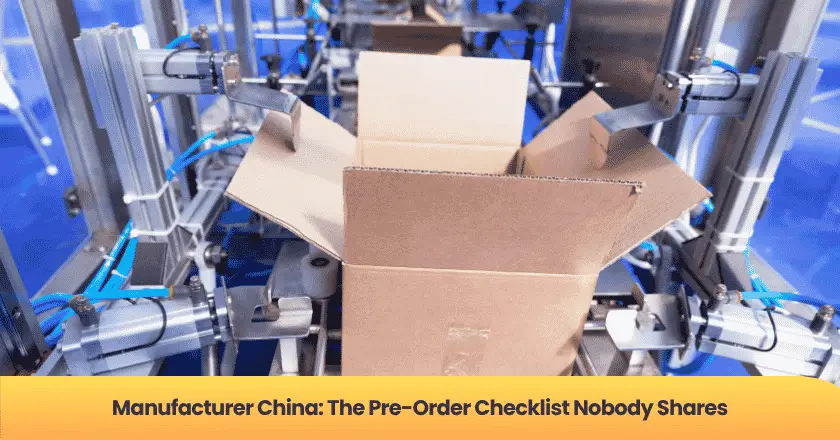
Introduction
You have checked the licence, seen the line on video, approved a sample and agreed a price. Every checklist you found online is now complete. The deposit goes out on Thursday, and nothing you have done so far would help you at all if this went wrong in eight months.
Supplier vetting answers who you are dealing with. A different set of questions decides what you could actually enforce, own or claim afterwards, and those questions rarely appear in a sourcing checklist because they sit in contract and intellectual property territory rather than in procurement. None of what follows is legal advice, and all of it is worth raising with somebody qualified before a first significant order.
Key Takeaways
• A contract in English only, governed by your own courts, is often the least enforceable version available.
• In China the company chop usually carries more weight than a signature, so check what sealed your agreement.
• China operates a first-to-file trademark system, which means your brand is not yours there until you register it.
• Know at which point risk in the goods passes to you, and whether anybody has insured that leg.
• Put remedies, not just prices, on the purchase order, because remedies are what you need later.
What the Standard Checklists Leave Out
Published sourcing checklists are good at identity and quality. They stop precisely where the expensive problems begin.
Two different questions
Vetting asks whether this supplier is real and capable. The second question is what happens if a real, capable supplier simply does not perform. That answer depends on the language your agreement is written in, who sealed it, which law governs it, where a dispute would be heard, and whether the brand and design you are manufacturing belong to you in China at all.
The imbalance is worth naming. Buyers spend weeks comparing quotes that differ by a few percent and minutes on terms that decide whether a five-figure loss is recoverable. The second set of decisions costs a fraction of the first in time and rarely gets it, mostly because nobody publishes a checklist for them.
Expert Tip: Ask yourself one question before every first order: if this supplier kept the deposit and shipped nothing, what would I actually do on Monday morning. The honest answer is usually nothing, and that realisation is what moves the items in this article from theoretical to urgent. Buyers who can describe a concrete next step have already done most of what follows.
The Contract: Language, Law and Venue
Buyers often assume a strongly worded English contract under their own law is the safest option. In practice it can be the weakest one.
Why Chinese language and Chinese law usually help you
A dispute with a Chinese supplier will realistically be resolved where that supplier's assets are, which is China. An agreement in Chinese, or bilingual with the Chinese version stated as controlling, is what a Chinese court or arbitration body works from directly. A foreign judgment against a Chinese factory is frequently difficult to enforce, which makes a beautifully drafted contract from home less useful than it feels.
Three clauses that decide everything else
Most of the value sits in a small number of provisions, and they are worth getting right once.
• The governing law clause states whose law applies, and Chinese law is often the practical choice.
• The dispute resolution clause names a court or an arbitration body and a seat, rather than leaving it open.
• The language clause states which version controls when the two texts disagree.
Arbitration and court each have trade-offs worth understanding before choosing. Arbitration is usually faster and private, and awards are enforceable across many countries under international convention. Court proceedings can be cheaper for straightforward claims. What matters most is naming one clearly, because a vague clause produces a preliminary fight about where the fight happens.
Common Mistake to Avoid: Signing a bilingual contract without having the Chinese text read by somebody independent. The two versions are not always the same document, and where the Chinese version controls, the English one you negotiated may be decorative. Having the Chinese text checked costs a modest fee and is the single highest-value hour of legal spend available to a small importer.
The Chop, and Who Can Bind the Company
This is the item that surprises foreign buyers most, because nothing in western commercial practice behaves quite like it.
What a company chop is
A company chop is the official seal a Chinese company applies to documents, usually a round red stamp carrying the registered Chinese name. For most commercial agreements it carries more weight than an individual signature. A contract returned to you with a sales manager's signature and no chop may bind nobody, however warmly it was negotiated.
Checking it is the right one
Compare the Chinese characters on the chop against the registered name on the business licence, character for character. A chop bearing a trading name, an abbreviation or a different entity is a problem worth raising before the deposit. The legal representative named on the licence is the individual with authority to bind the company, which is a useful name to know.
Chinese companies commonly hold several chops for different purposes, including a contract chop, a finance chop and an invoice chop. You are not expected to police which one appears, but a document sealed with something that does not match the registered entity at all is a question rather than a formality. Photograph the chopped page and keep it with your supplier file.
Expert Tip: Ask for the contract to be returned with both the company chop and the signature of the legal representative named on the business licence. Suppliers accustomed to export customers do this as routine. Where a different person signs, ask for written authorisation. None of this is confrontational and all of it becomes impossible to obtain at the moment you actually need it.
Your Brand and Your Design, Before Production
Intellectual property in China runs on registration rather than on use, and the timing matters more than the paperwork.
First to file, not first to use
China's trademark system grants rights to whoever registers first, administered by the national intellectual property office. Years of use in your own market generally count for nothing there. Foreign applicants file through a local agent. Here's the thing: the people best placed to register your name are the ones who have just seen it on your specification.
Designs, and what to file when
Where the product's appearance is part of its value, a design registration in China is worth considering before tooling begins. Through 2026 the official trademark database has remained free to search online, so checking whether your name is already taken costs nothing but the time. Take proper advice on classes and timing rather than filing blindly.
Registration also gives you something practical beyond enforcement against copies. A registered mark can be recorded with customs, which creates a route to stop counterfeit goods carrying your name at the border. That mechanism does not exist for an unregistered brand, however long you have been selling it elsewhere.
Common Mistake to Avoid: Sending detailed drawings to fifteen suppliers during a quotation round before any filing exists. The brief travels further than you think, and a name or shape that appeals to a factory is trivially easy to register. Share what is needed to quote, hold back what defines the product until a shortlist exists, and start any filing conversation before the wide enquiry rather than after it.
Risk, Title and Who Insured the Container
Goods spend weeks in transit belonging to somebody, insured by somebody, at nobody's stated risk in a surprising number of transactions.
Where risk passes
The trade term you agreed decides the moment responsibility for loss moves from seller to buyer, and it is not the same moment that ownership passes or that payment falls due. Buyers routinely discover after a problem that the goods became theirs at a Chinese port three weeks before anyone told them. Read the term rather than assuming its familiar name covers you.
Insurance is not automatic
Carriers carry limited liability, usually a small amount per unit of weight, which bears no relation to the value of your cargo. Separate marine cargo insurance is inexpensive and is not included by default under most terms. Confirm who is arranging it, what it covers and whether the sum insured reflects your landed value rather than the invoice figure.
Cover levels differ more than the price suggests. A basic policy may respond only to major events such as vessel loss, while wider cover handles water damage, crushing and theft. For a container of finished goods the premium difference is usually small against the value at stake, and the choice is easier to make before departure than after.
Expert Tip: Ask for a copy of the insurance certificate before the container sails, not after a problem. The document names the insured party, the sum, the voyage and the cover level, and reading it takes two minutes. Buyers discover at the wrong moment that cover was arranged in the supplier's name, which makes the supplier the party entitled to claim on goods that were already yours.
What Actually Belongs on the Purchase Order
A purchase order carrying a price, a quantity and a date is an agreement about commerce. The disputes are almost always about something else.
Remedies rather than intentions
State what happens when things go wrong, since that is the part you will need. What occurs if inspection fails, who decides between rework, discount and rejection, who pays for re-inspection, and how many days the factory has to fix it. Add a consequence for late delivery, even a modest one, because a stated consequence changes scheduling behaviour.
The attachments that make it enforceable
Reference the approved specification by version number and date, the packaging instruction, the artwork files and the approved physical sample by its label. An order referring to an agreed document is enforceable in a way that an order referring to a shared understanding is not, and the difference costs you nothing at the time of writing. Attach the documents to the order itself rather than referring to an email thread.
Expert Tip: Keep the purchase order and the framework agreement separate. The agreement covers the relationship, quality standards, remedies, tooling ownership and dispute terms once. Each order then references it and carries only price, quantity, dates and the specification version. Buyers who put everything into each order end up negotiating the same clauses repeatedly and, eventually, inconsistently across their own paperwork.
Getting These Settled Locally With NewBuyingAgent
Each item above is straightforward for someone working inside the Chinese commercial environment and more difficult to manage from overseas. The obstacle is often not the requirement itself, but the distance between the buyer and the factory.
NewBuyingAgent provides a China-based sourcing relationship that helps bridge that distance. Its experience in trade and manufacturing supports communication with factories around product requirements, specifications, pricing and other pre-order details.
The work does not stop when the terms are agreed. NewBuyingAgent's 20,000+ product development & QC experts provide product and quality support, helping connect what was agreed before the order with what the factory produces during development and production. Learn more.
For buyers sourcing from China, the practical value is having the pre-order details, factory communication and product requirements connected within one sourcing process.
Frequently Asked Questions
Do I really need a contract with a manufacturer china supplier for a small order?
For a first trial order, a clear purchase order referencing a written specification covers most of it. Once you are reordering, holding tooling or building a brand on the product, a short framework agreement in Chinese with proper remedies is worth the modest cost. Scale the paperwork to what you would lose rather than to the order value alone.
Is a contract without a company chop worthless?
Not automatically, since other evidence of agreement exists and circumstances vary. What is clear is that a chopped contract is far easier to rely on, and obtaining one is a routine request that costs nothing. Where a supplier resists chopping an agreement it has already accepted commercially, that reluctance is itself worth understanding before you pay.
When should I register a trademark in China?
Before you send your brand name to suppliers, rather than after you have chosen one. The system grants rights to the first filer, so early registration is the protection and later use is not. Searching the official database costs nothing, and filing requires a local agent, so allow time in your plan rather than treating it as a same-week task.
Can NewBuyingAgent help with the contract side?
Negotiating terms with factories is part of the coordination that moves off your desk, though specialist legal advice remains a separate matter. NewBuyingAgent handles all factory communication—perfect for multi-category buyers. That coverage runs across product types rather than per order, since it can supply products from China across all categories to you at better price, quality and service.
Conclusion
Get the agreement into Chinese with a stated controlling version, have it chopped by the registered entity, file your name before the brief goes out, know where risk passes and who insured it, and put remedies on the order rather than only prices. None of this is expensive at the start and all of it is unavailable later. Take proper advice on the contract itself. If having these conversations happen locally would remove the friction, NewBuyingAgent is worth a conversation.
Partial Sources
1. China Country Commercial Guide – International Trade Administration — https://www.trade.gov/china-country-commercial-guide
2. China: Protecting Intellectual Property – International Trade Administration — https://www.trade.gov/country-commercial-guides/china-protecting-intellectual-property
3. Incoterms 2020 – International Chamber of Commerce — https://iccwbo.org/business-solutions/incoterms-rules/incoterms-2020/
NewBuyingAgent
Related Resources
Comienza hoy
Convirtamos tus objetivos de abastecimiento en realidadWeChat:+86 15157124615
WhatsApp:+86 15157124615
Dirección: Edificio 10 #39 Xiangyuan Road, Hangzhou, China