


When sourcing luggage from China, qualify the wheels, handles, zippers and drop performance on the configuration the factory will ship. Define the load, specimen, test method and failure criteria for each check before requesting quotes. Specify one drop test for the loaded suitcase itself and a separate check for the packed shipping unit when the route calls for it. Tie the results to the case size, hardware and package revision you are buying.
Which Tests Belong in the Luggage Specification
A luggage test plan should show whether the loaded case rolls, whether its handles work under the intended loads, and whether its closure stays usable after the required checks. Approve impact performance for the actual case and protection for the actual shipping pack. Record the approved hardware and case sizes so a production substitution can be evaluated before release.
- How it works: Give the lab a representative case and specify the load, setup, method and findings needed for each decision.
- Risk: A component result can miss damage or poor operation where it is mounted on the finished case.
- Decision: Hold the affected build when a required test fails or the evidence covers a different part, case or pack.
Start with the market and use. A small spinner used mainly on terminal floors and a large checked case handled on curbs or conveyors may need different load conditions and checks. State the intended use and selling claims in the quote package. Agree which case sizes and variants need their own evidence before choosing samples, especially where hardware or shell reinforcement varies.
Test the Wheels on a Loaded Case
Test the wheels as installed on a loaded case, with the load, distribution, travel position and wheel configuration defined. A rolling road is a moving test surface against which the wheels roll. Examine the tread, swivel, axle and housing after testing and check whether the fully assembled case still rolls and tracks acceptably under the agreed conditions.
SATRA TM248 on rolling-road performance assesses abrasion and structural damage after prolonged wheeling of loaded luggage. Its setup places the case in a position appropriate to the design and runs it over a defined distance. Give the lab the intended use and assemble the sample with the proposed wheel, axle, bracket and case reinforcement. Record which wheels carry the load in the test setup.
For a spinner, state if the buyer wants observations for upright travel, tilted travel, or both. List the load mass and distribution, speed or distance where relevant, the test surface and planned inspection points. The lab should confirm which settings belong to the selected method and which are separate buyer checks. Record the actual setup so a revised wheel can be compared on the same basis.
Compare how the case behaves before and after the run. Check every wheel position for tread damage, excess play, binding, rubbing, a loosened housing or cracks around the attachment. If the appearance is acceptable but the case pulls to one side when loaded, follow the agreed functional rule. Photograph the affected wheel and mark its position for the supplier.
Keep the wheel drawing and the case-side mounting detail in the same approval file. A wheel supplier can keep the visible wheel design while changing the axle, housing or fasteners. At pilot review, ask the factory to match those identifiers and check the interface against the tested case.
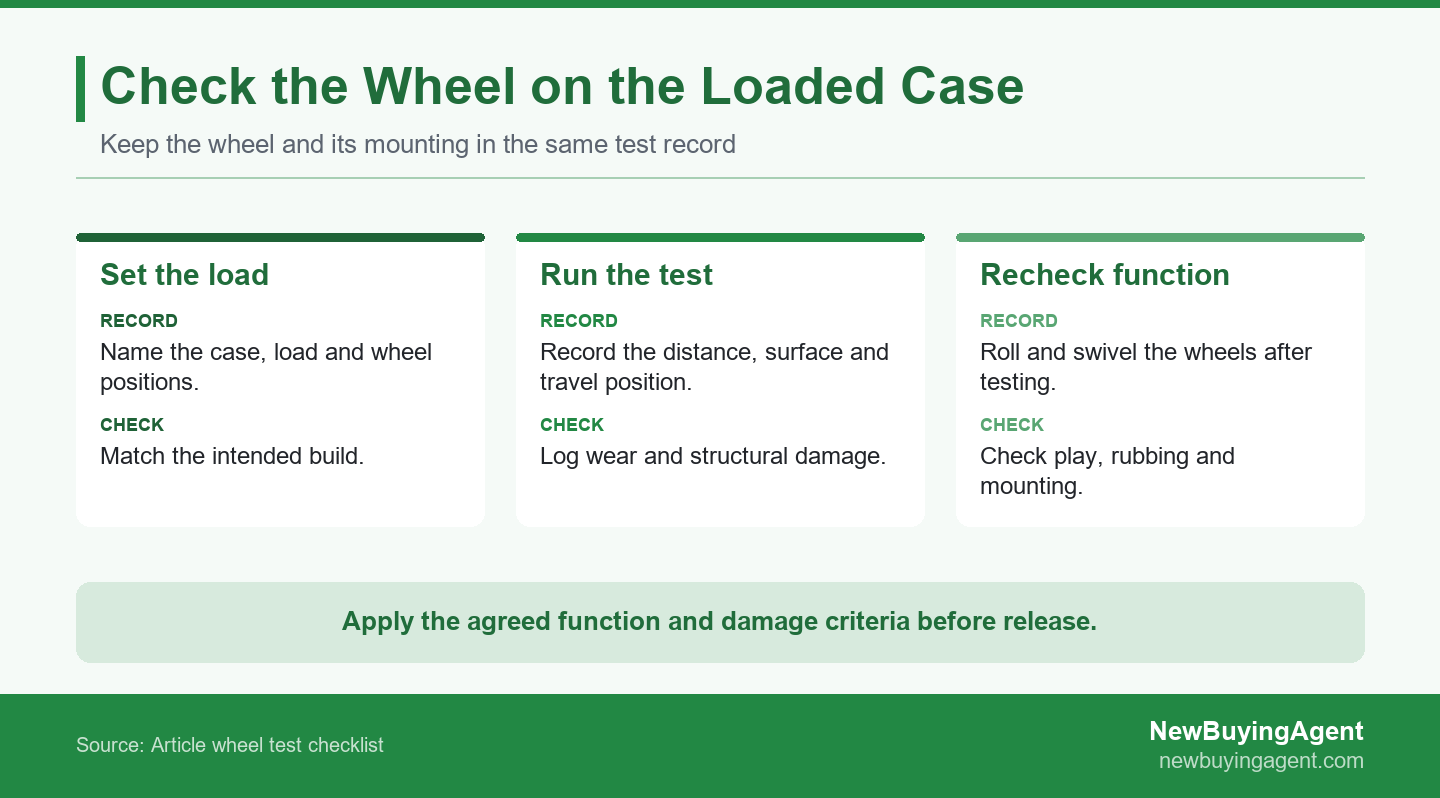
Record the wheel setup, rolling result and post-test function on the same case
Check Pull Handles and Carry Handles Separately
Set one set of requirements for the telescopic pull handle and another for the carry handles used to lift the case. For a locking pull handle, check extension, locking and retraction on the installed assembly. For lifting, specify which fixed or other intended carry handles and attachment points must withstand the selected loads.
SATRA TM245 on trolley handle collapse evaluates the collapsing strength of a locking pull handle under compression. Ask the lab to confirm the specimen, the extended and locked setup and the accepted result. Agree a separate operation check for the positions offered to the user. Record any inability to lock, unintended collapse, loose rails or binding after the specified use checks.
SATRA TM247 on repeated lifting assesses a handle and the case or bag structure when loaded luggage is repeatedly lifted. Specify which carry handle is tested, what the load represents and what damage stops acceptance. A top and side grip can have different attachment geometry. Check each relevant grip on the actual case, with its reinforcement and fastening method recorded.
If sideways loading or a sudden pull is a concern, describe that concern to the lab as its own task. Locking compression, repeated extension and lifting each stress different parts. Ask the supplier to identify the tube, locking hardware and mounting revision, then compare any change against the loads and modes it can affect.
For a handle that feels loose, write how the buyer measures acceptable play and in which position. Without a shared method, the factory can see normal clearance while quality sees an unfit sample. Identify which free movement matters to users, record its direction and check for a change after test. Keep the agreed reference with the production record.
Check the Zipper and the Sewn Closure
Approve zipper strength and operation for the proposed chain, slider, stops and tape, then check the zipper as sewn into the case. Define how full the sample should be, which corners or expansion sections the slider must cross, and what counts as failure. The sewn path and attachment can affect how a good closure behaves in use.
ASTM D2061 zipper strength methods covers strength tests for zippers and their parts. Give the lab the expected failure, such as separation across the chain or a problem at a stop or pull, so it can select an applicable strength check. Request the actual zipper revision and specimen setup on the report. Check the attachment to the luggage as a separate part of qualification.
ASTM D2062 zipper operability methods covers opening, closing and sticking at stops, among other characteristics. Use component evidence to check the supplied zipper, and agree how to evaluate the production case when the zipper must take tight corners or run across a curved shell. Record where drag appears, whether the slider stalls and any openings that appear behind it.
Check the sewn assembly with its final tape, seam allowance and corner geometry. Include the expansion zipper if that configuration is sold. Set a test condition for the loaded case so the factory and buyer inspect comparable closure tension. If a fault appears only at a corner, compare the radius, seam and tape fit with the approved sample before assigning the cause to the slider.
When a different zipper changes the quote, NewBuyingAgent's luggage sourcing and supply in China can use local cooperating factories to quote and supply the specified luggage, with quality control and logistics support. Send the actual case and closure specifications together. That gives the team the build to compare and the installed functions to verify for the order.
Specify the Case and Shipping Pack Drop Tests
Choose a loaded case drop to assess impact on the luggage and a shipping package drop to assess the protection of the packed shipment. Define the test unit and acceptance criteria for each. After impact, apply buyer-specified functional checks as well as the relevant method observations, especially at wheel mounts, handles and closure paths.
SATRA TM242 on loaded luggage corner drops covers impact strength of loaded luggage and describes visual examination of the corners, whole case and accessories. Tell the lab which case and load represent the order, and ask it to confirm the method and condition. As a buyer requirement, define acceptable cosmetic damage separately from function. Check for wheel rub or play, handle locking, zipper operation and shell alignment after the agreed impact sequence.
ISO 2248 on vertical impact of filled transport packages describes a drop method for complete, filled transport packages with predetermined conditions. Document the outer carton, inserts, orientation, pack count and mass for the unit being shipped. The distribution route may require additional tests. Ask the lab to select the suitable package procedure and agree what constitutes damage to the pack and product when opened.
| Impact question | Specimen to test | Readout to keep |
|---|---|---|
| Can the case withstand handling impacts? | Loaded finished luggage using the agreed product setup. | Impact locations, damage and post-test function. |
| Does the pack protect the shipment? | Actual closed shipping unit with its planned carton, inserts and contents. | Pack damage and condition of the case inside. |
| Should the result carry to a different build? | Compare case revisions, mounting changes and packing details. | Document the approved scope or repeat affected checks. |
Take photos of the specimens before testing and identify any existing marks or play. Record which parts were exposed and how defects appeared after each required check. If a carton looks intact, still open it and inspect the case under the agreed procedure. Keep the two results as separate entries, so the next buyer knows which specimen met which requirement.
Hold a Pilot With a Loose Wheel Mount
In a hypothetical spinner pilot, the packed unit passes the agreed shipping drop check. A separate loaded case develops play at one wheel mount after the corner drop and rubs when rolled. Hold cases represented by the failed product specimen and keep the pack result attached to its own configuration. Record the failed functional check before asking the supplier to investigate.
Mark the affected wheel and corner in the report. Confirm the case size, wheel housing, fasteners and reinforcement against the approved drawing. Compare an untested case from the same build with the failed specimen to see where the play appears. Look for loosened fasteners, housing movement or damage around the shell attachment. The visible rub tells the buyer where to investigate and leaves the cause open until the evidence is checked.
Ask the factory to identify which cases share the suspected mounting configuration. If the change came in during the pilot, request the first affected unit or lot and isolate the related cases. Agree which repair or design correction will be submitted on a new sample. Repeat the required loaded-case impact and post-test roll checks on the corrected build, and review whether the change also affects rolling endurance.
Revisit the packaging result if the correction changes the outside profile, clearance to the insert or how the pack supports the wheel. If the package remains qualified, record the basis and retain the existing result for that pack. When both decisions have been recorded, confirm the first eligible lot and carry its hardware and package identifiers into inspection.
Send the Factory a Test and Release Matrix
Send a test and release matrix for each case family you intend to buy. Name the sizes and configurations represented, the lab method and edition, the load and conditioning, the acceptance rule and who can approve a change. Have the factory tie each tested case or packed specimen to the actual revision planned for production.
| Approval item | Specify before the pilot | Keep for release |
|---|---|---|
| Wheels and mounts | [Wheel and housing IDs, rolling setup, load, distance and criteria.] | Position-specific wear, damage and function. |
| Pull and carry handles | [Assembly IDs, intended forces, positions and failure limits.] | Locking and operation results, and lifting or attachment evidence. |
| Zipper and sewn closure | [Chain, tape and slider IDs, load and sewn path checks.] | Strength evidence and installed operation observations. |
| Loaded case drop | [Case, fill, method, orientation and impact acceptance.] | Locations, damage and post-impact functions. |
| Shipping package drop | [Carton, inserts, contents, packing revision and route.] | Packing and product condition after opening. |
Before sampling, agree who selects the specimens, which size and condition they represent, and whether different tests need separate cases. Keep the test sequence on the record if a single sample is used for multiple checks. A wheel already loosened by an earlier impact can change a later rolling result. If the buyer wants a combined sequence, state the order and acceptance rules up front.
For bulk, compare the factory's component and package records with the accepted pilot. Agree which destructive checks will be sampled periodically and which production operations quality can verify routinely, such as rolling, locking or opening on selected cases. Keep a sign-off for substitutions, and check that labels and reports distinguish size variants that share an external style name.
NewBuyingAgent's manufacturing and quality-control background and cooperating factory resources can support repeat orders that need consistent hardware and packaging. Give the team a drawing, approved sample and applicable reports for the sizes you intend to reorder. That gives the factory a basis to identify changes and keeps the approved case tied to the actual product supplied.
To source luggage from China, send the luggage specification to NewBuyingAgent with the intended loads and use, quantities by size, destination, schedule, target price and test requirements. Include any wheel, handle, zipper or package detail that must stay fixed. The team can quote and supply the intended case with the applicable quality checks and logistics in scope.
Frequently Asked Questions
Does a rolling-road pass cover the impact on a luggage wheel?
Impact approval requires evidence from the relevant impact test on the mounted wheel and case. The rolling-road result describes behavior during prolonged wheeling under the stated conditions. For an impact concern, agree the case load, location and expected function afterwards. Record the wheel position and check whether it still rolls and swivels under the specified load.
Can the telescopic pull handle use the carry handle result?
The pull handle needs evidence for its own loading and locking functions. A carry handle lifting result covers the grip and structure that were loaded in that test. For a telescopic design, identify the positions that must lock and the force or operation checks that apply. Verify the handle against its actual rails, attachments and intended use.
Does a carton drop pass clear the suitcase for a handling drop?
Handling-drop approval requires evidence from a separate loaded-case test. The carton result covers the boxed shipment. For the case test, specify the fill, orientations and acceptance rules. Keep the outer pack record and loaded case record separate. Apply post-impact rolling, handle and closure checks where those functions matter to the approval.
When does a wheel housing change require a new test?
Retest the affected functions when a housing change puts the assembly outside the scope of the earlier evidence. Compare axle placement, fasteners and case attachment to see which rolling or impact checks are affected. Include the pack if the new housing changes how the insert supports the case. Record which lots use the changed configuration.
NewBuyingAgent
Recursos relacionados

Comienza hoy
Convirtamos tus objetivos de abastecimiento en realidadWeChat:+86 15157124615
WhatsApp:+86 15157124615
Dirección: Edificio 10 #39 Xiangyuan Road, Hangzhou, China
