

This is a buyer route ranking, not an official national production league table. China has no single public dataset that proves which ten cities are universally “best” for every pet SKU. The useful question is narrower: which local ecosystem gives a buyer the most credible starting route for a specific food, accessory, furniture, grooming, or connected-device requirement?
How to Use This List
A pet-product cluster is a local ecosystem of related production, materials, product know-how, and supporting services. It can make an early sourcing conversation more productive, but it cannot approve a factory for you. A recipe, washable bed, carrier, grooming tool, and automatic feeder all ask for different evidence. Read the ten entries as routes to investigate, then make the first sample brief fit the product family.
That distinction matters when buyers build a range. A city may be useful for multi-SKU accessories yet be the wrong first route for freeze-dried treats. Another location may offer a promising innovation setting while still needing proof of component control, firmware stability, and functional samples. The route is valuable only when it changes the question you ask before mass production.
- Use a cluster to narrow the first route, not to approve a factory.
- Set the evidence request by product family before comparing commercial options.
- Keep food, physical goods, and connected devices on their own release path.
What This Top 10 List Measures
The ten entries are ranked for published specialisation evidence, category usefulness, and the ability to write a verification brief. In plain language, a verification brief is the specific sample and evidence a buyer asks for before approving production. This method gives more weight to a documented category signal than to a broad “pet economy” headline, and it gives more weight to a route that can be tested than to a city name that merely sounds familiar.
The order is therefore a practical buyer ranking. Qingdao leads as a food-oriented starting route; Yantai adds a developing food direction to the practical buyer ranking. Tai’an adds an emerging freeze-dried direction. Zhejiang entries are more useful for different supply, range, and product-development situations. Shenzhen and Dongguan belong in the list because smart-pet projects often need an electronics-aware route, not because either location should be assumed to be the largest pet-product production base.
Every entry has the same limitation: local evidence does not prove a particular factory’s formula control, material consistency, capacity, compliance readiness, or delivery reliability. Use the cluster to frame the first conversation; use samples, specifications, production evidence, and product-market requirements to decide whether a supply route is workable.
Food and Treat Manufacturing Clusters
For a new product requirement, the city label is only one input. Once the food format, target customer, quantity, price range, destination, and timing are clear, buyers can turn a pet product brief into a China supply route that is built around the product rather than a generic location request. NewBuyingAgent uses local China factory resources and product/QC capability to turn the purchasing need into a supplied product route; the buyer does not need to navigate a public factory shortlist.
#1 Qingdao West Coast, Shandong: Food and Treat Starting Route
Qingdao is included as a food-route starting point, but buyers should require format-specific samples and evidence before treating a location as a production decision. It is a sensible first discussion for dry food, wet food, chews, freeze-dried formats, or treats when the buyer can state the recipe direction, target market, pack size, ingredient constraints, and expected order timing. The critical next step is not “find a Qingdao factory”; it is to define which product evidence must exist before the recipe and packing route can move forward. Confirm who owns each formula, sample, and packing decision before setting a production date.
#2 Yantai / Laishan, Shandong: Developing Food and Nutrition Route
Yantai's plan identifies a pet-food base and names staple food, treats, prescription food, and nutrition as intended directions. That makes the area relevant when a buyer’s brief is closer to a food, nutrition, or functional-treat concept than to a simple accessory program. The important qualifier is that this is development-plan evidence, not a current output league table. Buyers should ask what product format is already being made, what sample records exist, and how the target market changes ingredient, label, and packing requirements. Yantai's development plan is useful for the direction of travel, not for approving a factory.
#3 Tai’an, Shandong: Emerging Freeze-Dried Route
Tai'an announced a pet-food cluster project with a freeze-dried product direction. It earns a place in this list as an emerging route for buyers who want to explore freeze-dried or related formats and are prepared to validate maturity carefully. A project announcement is not proof of established capacity, so the first request should cover sample quality, raw-material handling, moisture and pack controls, batch traceability, and the actual production window. The Tai'an project announcement supports the emerging-cluster signal only. Confirm the actual production window and sample release owner before treating the route as ready.
Pet Supply and Accessory Clusters
#4 Pingyang, Wenzhou, Zhejiang: Pet Goods and Chew Ecosystem
A People's Daily report describes Pingyang's pet-product transition and nearly 100 local pet-product companies. For buyers, that is a useful ecosystem signal for goods, accessories, and category-adjacent product work—not a blanket food or quality claim. Start by separating the construction question from the commercial one: what material, hardness, odour, colourfastness, packing, and use-case evidence must the product show? The report on Pingyang's pet-industry shift supports the local transition and company signal. It does not replace a sample review for the buyer's own construction and market brief. Record the product's intended pet size and daily use before comparing materials.
#5 Deqing, Huzhou, Zhejiang: Pet-Supply Cluster Signal
A Zhejiang government notice lists Deqing pet supplies among candidate integrated development bases. Candidate status is exactly why the entry should be read with care: it points to a local supply direction, not a certificate that every item is production-ready. Deqing can be worth exploring for supplies when the buyer has a defined material, finish, safety, packaging, and price brief. The provincial candidate-base notice should be treated as a cluster signal, followed by SKU-level verification. A useful sample request names the exact use condition instead of relying on the designation.
#6 Yiwu, Zhejiang: Multi-SKU Discovery and Range Building
Yiwu is included for multi-SKU pet-supply discovery and range work, with every proposed item requiring separate production-capability verification. It can be practical when a buyer is shaping a broad accessories assortment—feeding, grooming, travel, cleaning, toys, or seasonal goods—and needs to reduce a long idea list into a coherent range. The risk is mistaking product visibility or range convenience for direct manufacturing proof. For each SKU, specify the material, dimensions, intended load, finish, packaging, and sample acceptance point before the commercial route is chosen. Keep colours, accessories, and retail pack variants aligned with the same baseline sample.
#7 Jiaxing, Zhejiang: Beds, Carriers, Cat Furniture, and Tools
A Jiaxing manufacturer lists scratching products, toys, cages, carriers, beds, and cleaning tools as production categories. This is a scoped example, not a city-wide census, but it shows why Jiaxing belongs in a buyer’s route map for cat furniture, carriers, beds, and related hard/soft goods. Ask for the evidence that matches use: load and stability for a cat tree, seam and wash durability for a bed, and closure, ventilation, and safe-edge checks for a carrier. The manufacturer's capability page supports the example only. Confirm the final carton load and retail-pack dimensions before scaling the item.
Smart Pet and Production-Support Clusters
#8 Shaoxing, Zhejiang: Emerging Product-Development Ecosystem
Shaoxing is included as an emerging product-development ecosystem where buyers should test category readiness rather than assume established mass-production scale. It is most relevant when a pet range needs fresh product direction, lifestyle positioning, or a close connection between consumer-goods design and the wider pet category. Treat it as a research and development route: request product drawings, material proposals, prototype timing, and a clear statement of what is already in production versus what still needs development. Define the sample revision owner and decision date before prototype work begins. This avoids turning a fresh product concept into an unpriced, untestable assortment.
#9 Shenzhen, Guangdong: Smart-Pet Product and Connected-Device Route
Shenzhen is included for smart-pet product development and connected-device sourcing, subject to component, firmware, and functional-sample verification. A connected feeder, tracker, camera, automatic litter product, or monitoring device cannot be evaluated like a textile bed or plastic bowl. The buyer needs a component list, power and charging requirements, firmware version control, app or connectivity assumptions, operating test conditions, and a plan for packaging that protects the product in transit. Define who controls version changes, error handling, and post-sample acceptance before tooling advances. Agree the test pass/fail condition before a functional sample becomes a purchase decision.
#10 Dongguan, Guangdong: Electronics, Plastics, Packaging, and Assembly Support
Dongguan officials reported research activity covering local pet-technology, pet-food, and pet-supply firms. The practical value of Dongguan in this list is not a claim that one local plant can make every pet product. It is a production-support route for projects that combine electronics, injection-moulded parts, plush or textile elements, packaging, and final assembly. Dongguan's industry-research report supports the ecosystem mapping; buyers still need project-specific component and assembly evidence. Map each component to its assembly, inspection, and packing owner before releasing the build. Confirm that the same ownership map is used for pilot samples and production handover.
Choose a Cluster by Product Route, Not a City Name
The first evidence request should follow the product family: formula and target-market evidence for food, material and load evidence for goods, and component, firmware, and test evidence for connected products. The table below is not a supplier-selection scorecard. It is a way to turn a broad China cluster signal into the first useful product brief.
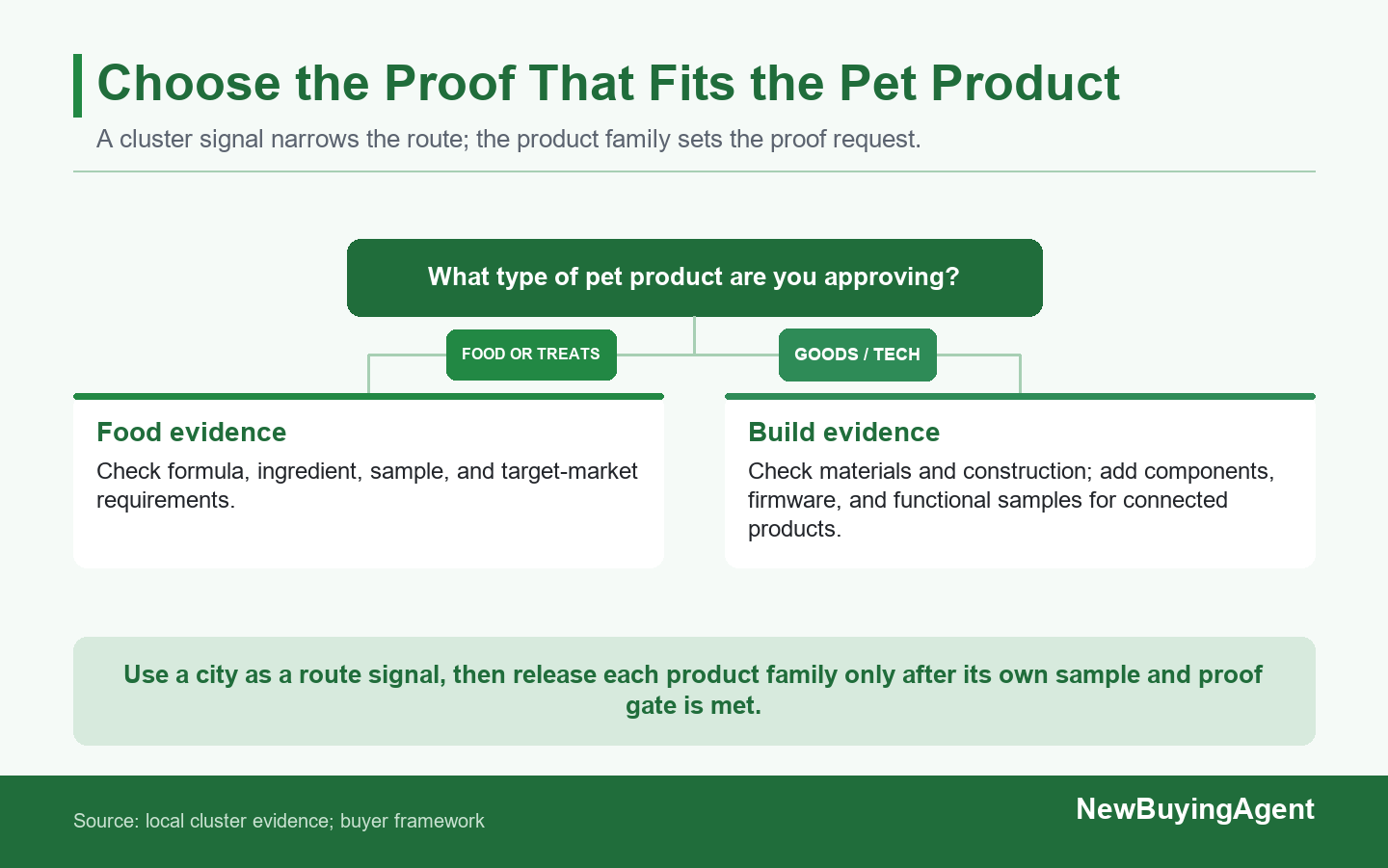
The product family—not the city name—should decide the first sample and evidence request.
| Product family | Useful first cluster route | First proof request | Do not assume |
|---|---|---|---|
| Food, treats, freeze-dried | Qingdao, Yantai, Tai’an | Formula or ingredient route, sample, pack, target-market requirements | A food cluster proves recipe or export readiness |
| Beds, carriers, toys, grooming, furniture | Pingyang, Deqing, Yiwu, Jiaxing | Material, construction, load, wash, safe-edge, pack evidence | A market route proves direct factory capability |
| Smart feeders, trackers, cameras, automated devices | Shenzhen, Dongguan | Components, firmware, power, function, assembly, transit protection | A device sample proves stable mass production |
| New range with mixed SKUs | More than one route may be appropriate | Separate sample and release criteria by product family | One city is automatically the lowest-risk answer |
A short brief built this way is more commercially useful than a request for “pet products from China.” It shows whether the buyer is looking for a repeat food format, a small assortment of physical goods, or a connected device with a different engineering path. It also gives the sourcing conversation a better chance of protecting product fit, quality, and delivery rather than optimising for a city name alone.
Illustrative: One Pet Range, Three Manufacturing Routes
An illustrative range containing treats, washable beds, and connected feeders should use product-family release criteria before commercial consolidation. The following example is not a client case; it shows how a seemingly simple “one China pet range” request can hide three very different production questions.
If one SKU is already with a China factory, the buyer can align an existing China factory with a pet product release plan while the other categories retain their own development route.
Illustrative Three-SKU Decision
The buyer releases each product family conditionally until its specific sample and evidence gate is complete. In this example, the buyer wants functional treats, a washable bed, and a connected feeder under one launch theme. The commercial team initially asks for one city to simplify coordination. That shortcut fails because food, textile, and electronics work do not share the same proof standard.
The food route needs a product-format and target-market check; the bed needs material, seam, wash, and fill-performance evidence; the feeder needs component, firmware, power, and functional testing. Each stream can be developed in parallel, but no stream should be treated as approved merely because another sample is ready.
The practical decision is conditional release: proceed with the product family whose sample and evidence meet the brief, while the others remain open until their own gates are complete. This is a range of 3 planned SKUs across 3 product families, so one approval cannot substitute for the other two.
This structure avoids a false choice between “one city” and “too many suppliers.” The buyer is choosing one commercial range with distinct technical release conditions, which is a more accurate way to protect the launch calendar.
Food, textile, and electronics products create different technical evidence needs.
A single city request would hide these different verification paths.
The correct route is not one city label but three product-family evidence streams that can later be commercially coordinated.
Release only the product families whose samples and evidence meet the respective brief; keep the others conditional.
Write separate food, textile, and connected-device sample briefs before asking for final commercial consolidation.
Formula or ingredient evidence for treats; wash and construction evidence for beds; component, firmware, and functional sample evidence for feeders.
Illustrative decision logic only; it does not represent a client outcome or guarantee a production result.
Turn the Cluster Signal Into a Sourcing Brief
NewBuyingAgent can turn a defined pet-product requirement into a China-sourced product route using local factory resources and product development and quality-control capability. The most useful starting input is not a request for a named city. It is a clear product need: product family, specification, intended use, quantity, target price, destination, timing, and the evidence that must be true before production is released.
That gives NewBuyingAgent a workable basis to use industrial-cluster sourcing access and local China factory resources for a complete product-supply route. For a pet-food idea, the brief should name the format and market requirements. For furniture or accessories, it should identify materials, dimensions, pack, and use conditions. For a smart device, it should identify function, power, connectivity, component expectations, and testing needs. When those inputs are ready, buyers can request a pet product sourcing quote with the cluster brief.
Frequently Asked Questions
FAQ answers retain product-family verification boundaries rather than treating a city name as factory approval.
Which city in China is best for pet food manufacturing?
Qingdao is the strongest practical starting route in this list for food and treats, but no city is automatically best for every formula, recipe, or export market. First decide whether the item is dry food, wet food, a chew, freeze-dried, or functional nutrition. Then ask for the product-specific sample, formula or ingredient evidence, packaging route, production controls, and target-market requirements that apply to that format.
Is Yiwu a pet-product manufacturing cluster or a trading market?
Yiwu is especially useful for multi-SKU pet supplies and range discovery, while the production capability behind each chosen item still needs separate verification. It can help a buyer focus a broad accessories idea, but that does not establish who makes the item or whether the material, construction, capacity, and packing are suitable. Treat the location as a discovery and coordination route, then verify each SKU against its own brief.
Can one factory make pet food, beds, and smart feeders?
One commercial partner may coordinate several categories, but buyers should not assume that one underlying production route has equal capability in food, textile goods, and connected devices. These products need different samples, materials or formula evidence, production controls, and release tests. A mixed range is safer when each product family has a clear approval gate before the buyer consolidates commercial decisions or launches the full assortment.
What should a buyer verify before ordering pet products from China?
Verify the product-specific sample, material or formula evidence, safety and target-market requirements, packing plan, production capacity, and delivery assumptions before approving mass production. Add the proof that the product family needs: a food item needs a different evidence route from a carrier, bed, scratching product, or smart feeder. The cluster can help shape the first route, but the product brief and approval evidence should determine the production decision.
NewBuyingAgent
Related Resources


Начните сегодня
Давайте превратим ваши цели по закупкам в реальностьWeChat:+86 15157124615
WhatsApp:+86 15157124615
Адрес: Здание 10 #39 Xiangyuan Road, Ханчжоу, Китай
