

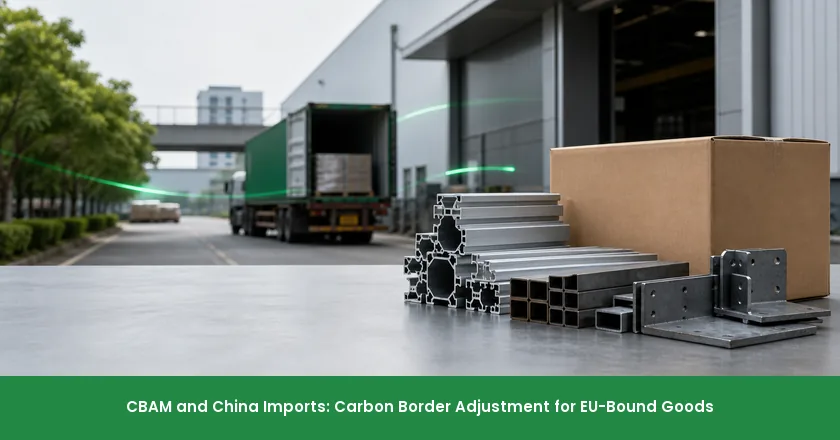
For an EU-bound purchase, CBAM is not a surcharge that can be added after a China quotation is approved. A usable purchasing file needs a product screen, a year-to-date mass view, a producer-data route, and a named EU-side owner. Those four decisions should be resolved in order. They turn a policy question into a controlled purchasing file without treating it as legal, customs, or carbon-accounting advice.
What EU-Bound Buyers Need to Decide First
CBAM entered its definitive regime on 1 January 2026, so a covered EU-bound purchase needs an importer-side process now rather than a future-policy question. The European Commission importer guidance also connects the current process to customs release and the account or application reference used at the border.
Carbon Border Adjustment Mechanism (CBAM) is the EU system that links certain imported goods to emissions reporting and financial obligations. For purchasing teams, the immediate task is to assign the first missing fact to an owner instead of waiting until the shipment is ready to move.
- Start with the goods. China origin alone does not tell you whether a product is within scope.
- Track the importer’s calendar year. A small first entry can be followed by a second entry that changes the annual path.
- Separate evidence from formal ownership. The producer can provide production information, while the EU-side declarant owns the formal CBAM process.
- Do not price an unknown. Certificate exposure and filing work belong after scope, data, and ownership are clear.
CBAM Scope Starts With the Goods, Not the China Origin Label
China origin alone does not determine the CBAM path; the goods, classification, importer position, and annual mass must be reviewed together. That distinction matters because a buyer can have a China-made product and an EU destination without yet knowing whether the exact item belongs in a CBAM workstream.
The practical first screen is a short product record: product form, material, intended EU destination, buyer or importer entity, expected net mass, and the customs classification question that still needs an answer. Keep this record beside the quote request. It prevents a broad label such as “aluminium parts” from becoming a substitute for an item-level decision.
Use the CN Code and Product Form as the First Filter
The European Commission identifies cement, aluminium, fertilisers, iron and steel, hydrogen, and electricity as the six initial CBAM sectors. The Commission’s sector guidance is a useful screen, but it is not an individual product ruling.
Ask for the relevant CN code, meaning the EU customs code used to classify the specific imported product, together with the product form and composition. A purchasing description may be commercially useful while still being too broad for customs analysis. The buyer should record who will obtain or confirm the classification before any CBAM cost estimate is used in a margin decision.
Track the 50-Tonne Rule Across the Calendar Year
Where the threshold applies, Regulation (EU) 2025/2083 treats the 50-tonne limit as cumulative net mass by importer and calendar year; exceeding it brings the year's covered goods into the obligations. The statutory text is available through EUR-Lex.
This is a buyer-control issue, not a freight-line issue. One team may split a programme into several entries, use different freight forwarders, or place follow-up orders later in the year. The mass view should still reconcile to the same importer and calendar year. Electricity and hydrogen have specific exceptions, so do not apply this screen without checking the current rule set for the product.
| Decision gate | Buyer question | Evidence to hold | Do not proceed until |
|---|---|---|---|
| 1. Scope | What exact goods and CN code are involved? | Product form, material, destination, classification review owner | The product screen is clear enough to choose the next route |
| 2. Data | Can the producer provide usable emissions information? | Installation contact, product link, reporting route, verification status | A generic carbon statement has been replaced by a controlled data request |
| 3. Owner | Who carries the EU-side formal process? | Importer or representative name, registry status, customs handoff | Factory and EU roles are not being confused |
| 4. Annual reconciliation | What must be tracked after entry? | Mass ledger, certificate assumptions, annual filing calendar | The commercial plan has a named reconciliation owner |
Use the CBAM Import-Readiness Framework Before You Price the Shipment
The CBAM Import-Readiness Framework has four gates: product scope, producer emissions data, EU declarant ownership, and annual certificate reconciliation. It is deliberately sequenced. A certificate estimate has little value if the product is not yet screened, the producer-data route is unknown, or nobody can use the record on the EU side.
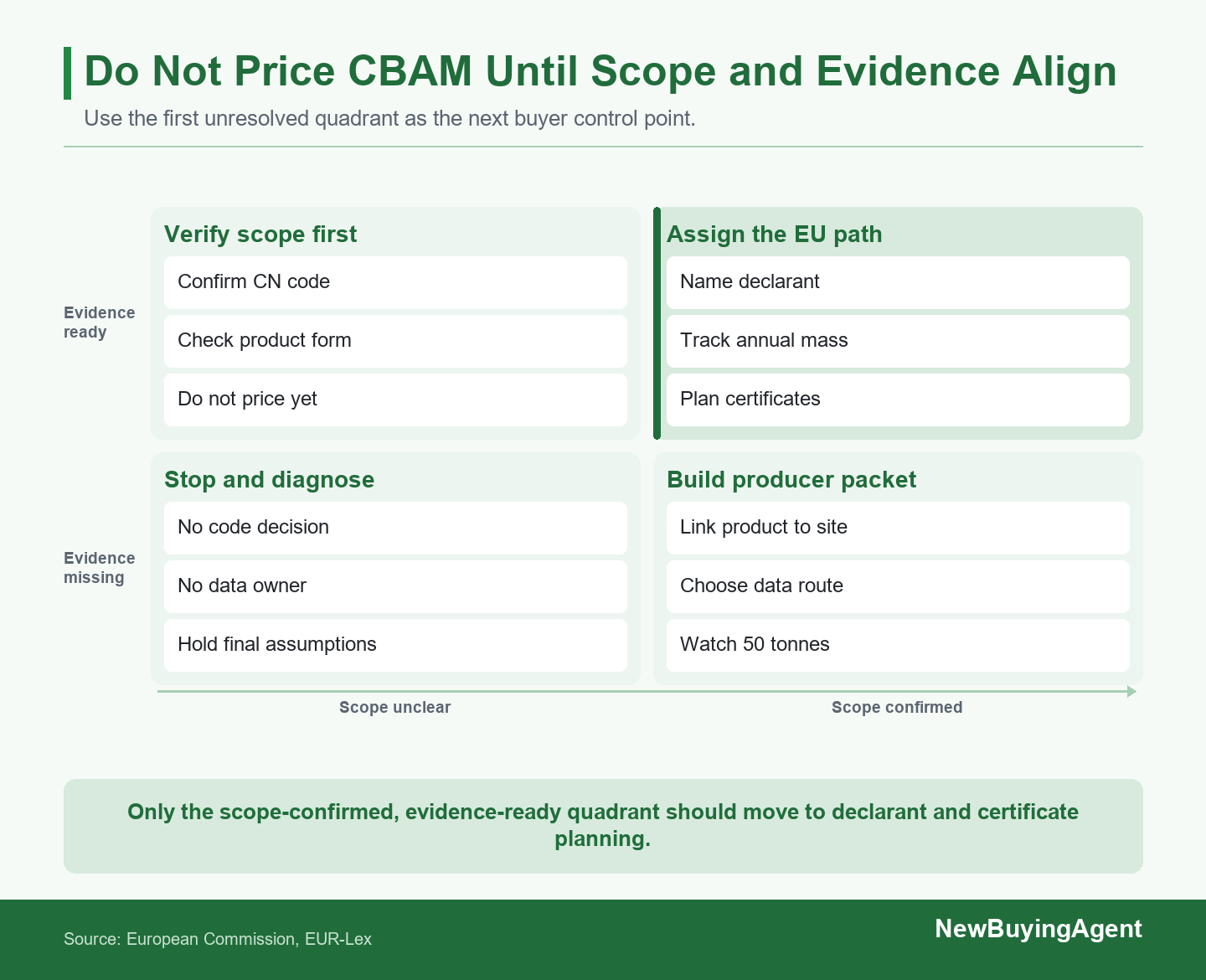
Move to EU declarant and certificate planning only after product scope and producer emissions evidence are both sufficiently clear.
The framework makes the CBAM evidence chain visible: first identify the product, then collect the right production evidence, then assign the EU importer process, and finally plan the annual declaration and certificate work. Resolve the first missing gate rather than sending every possible document to the factory at once.
Gate 1: Name the Product, Destination, and Scope Owner
A new EU-bound product brief should name the product form, destination, expected mass, and scope owner before its China supply path is priced. Buyers defining a new product requirement can compare the product-supply route for a new EU-bound requirement once those facts are present.
For a new requirement, the brief should also state whether the buyer is the EU importer, who will receive the goods, and whether the product’s classification has been confirmed or remains open. That gives the product team a clear question to carry into the sourcing discussion instead of asking a factory for a vague “CBAM document.” NewBuyingAgent can use the brief to shape the China product-supply path, while the formal EU determination stays with the appropriate importer and advisers.
Gate 2: Ask for Producer Data That Can Be Reconciled
The Commission's 2026 materials allow default values, while actual values require the producer to provide verified emissions data before they can replace a default approach. In this context, embedded emissions means emissions associated with making the imported goods under the applicable CBAM method. The Commission's current CBAM materials set that reporting boundary.
The useful request is therefore product-linked: identify the production installation, the covered product, the reporting period, the calculation route, the person who can answer follow-up questions, and whether verification is available. The Commission's definitive-period legislation hub shows that calculation, verification, default values, and customs information are separate pieces of the system.
A factory energy spreadsheet may help identify a next question, but it is not automatically a product-linked record that an EU-side reporting owner can reconcile. Keep the request modest and specific. The aim is to expose the data gap early, not to imply that a China producer must make a legal decision for the importer.
Gate 3: Confirm the EU Declarant and Customs Handoff
The Commission says the authorisation module serves applications by importers and indirect customs representatives in the Member State of establishment. Its registry guidance also describes the operator route for sharing installation and emissions information.
An authorised CBAM declarant is the EU-side importer or eligible indirect representative authorised to carry the relevant CBAM responsibilities. The producer’s role is different: it supplies the operational facts the declarant may need. Put the declarant’s name, contact, and decision authority into the same controlled packet as the producer contact. This prevents a late handoff where customs, the importer, and the factory each believe another party owns the next step.
Gate 4: Plan the Annual Declaration and Certificate Exposure
For 2026, certificate prices use quarterly EU ETS auction-price averages, and the first annual declaration covering 2026 imports is due by 30 September 2027. The Commission overview explains the 2026 price basis, while its 2026 communications identify the first filing date.
Do not turn this into a fixed supplier quote line. The quantity of certificates and cash exposure depend on the current method, the applicable emissions data, the buyer’s covered imports, and any recognised carbon price already paid during production. The right commercial action is to mark the assumption as conditional, name the annual reconciliation owner, and agree when the estimate will be refreshed.
Why China-Sourced Inputs Need a Controlled Data Handoff
When the buyer already uses a China producer, NewBuyingAgent can coordinate the local factory-management side of the product and evidence handoff without replacing the EU importer's formal role. When the factory relationship already exists, buyers can see when existing China factory management fits the data handoff.
The handoff works best when it has one recipient on each side. On the China side, identify the production contact, the installation, the product record, and any missing production data. On the EU side, identify the importer or authorised representative, the customs contact, and the person who decides whether the packet is complete enough to use. The key test is simple: can the recipient connect this factory record to this imported product and this importer’s calendar-year file?
NewBuyingAgent's local China resources and product, quality-control, and factory-management experience can help organise the operating side of the handoff. They do not replace customs classification, authorisation, verification, or the EU importer's official declaration.
A 57-Tonne Scenario: When Monitoring Becomes an Active Workstream
A two-entry calendar tests the annual importer threshold more accurately than treating each covered shipment as isolated. The following is illustrative, not a customer case or a customs determination.
The Second Entry Changes the Question
An EU importer buys aluminium components from an existing China producer for a European distribution programme.
The planned 2026 covered-goods mass is 42 tonnes in the first entry and 15 tonnes in the second entry.
This illustrative model covers 2 planned import entries and 1 EU importer record.
The commercial team has product specifications and freight timing, but no reconciled CN code, importer record, or producer-emissions packet.
The 42-tonne first entry is treated as if it settles the annual threshold question.
The 15-tonne follow-up entry arrives after production planning, while the producer has only a broad energy-use spreadsheet rather than a product-linked emissions record.
In this illustrative example, 42 tonnes plus 15 tonnes equals 57 tonnes, so the buyer must reassess the year-level CBAM path before the second entry proceeds.
The arithmetic does not decide classification, but it does reveal the weak assumption: a first entry cannot settle a calendar-year test. The buyer now needs to connect the goods, the mass ledger, the data request, and the EU-side owner before treating the second entry as routine.
Move from passive monitoring to a conditional release plan. Confirm the CN codes, assign the EU declarant, reconcile each entry, and request the producer data needed for the selected reporting approach.
Create one controlled packet containing product description, customs-code assessment, net mass by entry, importer or representative owner, producer installation contact, and emissions-data status.
Before the next covered entry is finalised, the EU-side owner reconciles the importer-level mass total and checks that the selected data route is usable in the current CBAM process.
The scenario is illustrative. A customs professional and the national competent authority should confirm product classification, authorisation status, and filing treatment for a real transaction.
Turn the Framework Into a Purchase-Control List
A complete EU-bound brief puts the product, expected volume, destination, timing, and missing evidence in one place before the China product-supply route is selected.
Use the CBAM Import-Readiness Framework as a brief review before approving a quotation, a production plan, or a second covered entry:
- Write the product form, proposed CN code, material, EU destination, and importer entity in one record.
- Maintain an importer-level ledger of expected and entered net mass for the calendar year.
- State whether the producer can provide product-linked emissions information and who will answer data questions.
- Name the EU declarant or customs representative and give that person the controlled packet.
- Mark any certificate estimate as conditional until scope, data, and ownership are reconciled.
For a new EU-bound product requirement, NewBuyingAgent can use the buyer's defined product, quantity, destination, timing, and CBAM evidence gap to shape the China product-supply path. If the buyer has an identified evidence gap, assemble the product specification, expected mass, EU destination, timing, existing-factory status, and missing evidence, then prepare a CBAM-ready product brief with NewBuyingAgent.
Frequently Asked Questions
CBAM buyer questions usually return to four boundaries: product scope, formal owner, producer evidence, and annual timing.
Do all China-sourced goods fall under CBAM?
No, China origin does not by itself put a good under CBAM; the legal screen turns on the exact goods and their customs classification. Start with the product form and CN code, then check the current sector and product rules. If the item is within the relevant scope, track the importer's annual net mass rather than deciding from one shipment alone.
Who carries CBAM duties at EU customs?
The EU importer or an eligible indirect customs representative acting as the authorised CBAM declarant carries the formal process. The China producer may supply installation and emissions information, but should not be assumed to own the EU registry, customs, certificate, or annual declaration work.
Can a producer use default values instead of verified emissions data?
Default values may be used where the current CBAM rules permit them, but they are not the same as actual producer values. If the buyer wants to use actual values, request product-linked and verified emissions information through the applicable official method, then let the EU-side owner confirm how it can be used. Do not treat a broad factory energy statement as a substitute for that route.
When is the first CBAM declaration for 2026 imports due?
For 2026 imports, the first annual CBAM declaration and the corresponding certificate surrender are due by 30 September 2027 under the Commission’s current materials. Put that date into the importer’s annual calendar, but refresh the filing plan against the official guidance for the relevant Member State and transaction.
NewBuyingAgent
Related Resources


Начните сегодня
Давайте превратим ваши цели по закупкам в реальностьWeChat:+86 15157124615
WhatsApp:+86 15157124615
Адрес: Здание 10 #39 Xiangyuan Road, Ханчжоу, Китай
