


A China furniture sourcing agent in Foshan is most useful when the buyer needs to connect three different decisions: what a furniture reference means commercially, whether the build can repeat, and what evidence is sufficient to release the order. Foshan is not one decision point. A showroom visit, a factory discussion, and a pre-shipment check answer different questions and should not be treated as interchangeable.
That distinction matters for a restaurant group, retailer, or project buyer. A compelling chair, table, or cabinet can start a conversation, but it is not yet an approved product. The buyer still needs a controlled path from the visible reference to a written item specification, dimensions, materials, finish, construction, packaging, destination requirements, and final approval.
Map Foshan by the Decision You Need to Make
Foshan is most useful when the buyer treats it as a map of reference, repeatable build, and delivery-proof decisions. Start with the question that is actually unresolved. If the buyer needs to compare a look, use a commercial reference. If the buyer needs to know whether the chosen construction and finish can be made consistently, move to build validation. If the order is already approved, ask what physical, documentary, and packaging evidence is required before release.
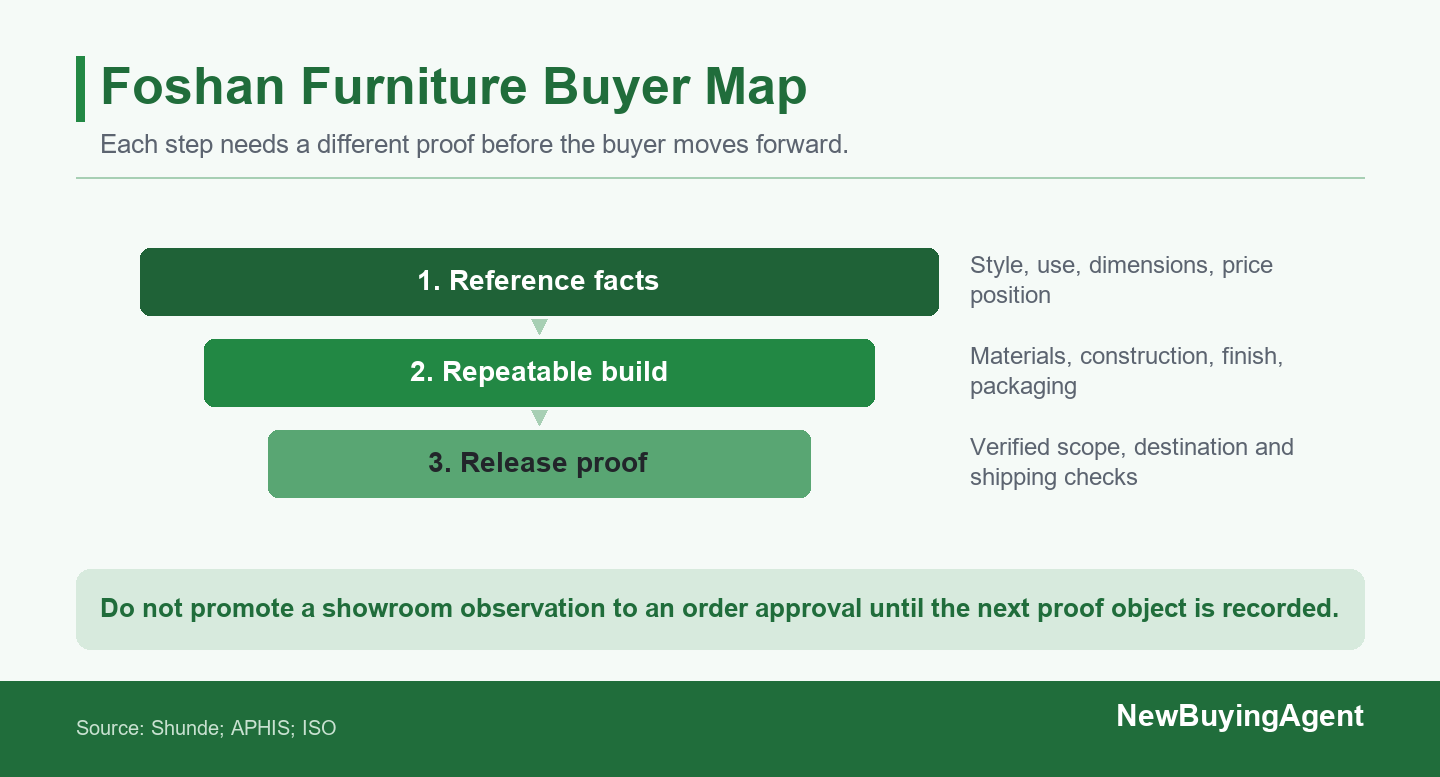
A buyer moves from a broad reference to a narrower set of production and release proofs.
This buyer map prevents two costly shortcuts. The first is treating a display as if it confirms the exact material, internal construction, carton method, and lead-time position of an order. The second is asking a factory-side contact to “check everything” when the buyer has not stated the decision that the check must support. A clear map gives every local action a purpose and keeps final product, commercial, and release approval with the buyer.
- Reference: identify the attributes worth carrying forward from a display or product sample.
- Build: confirm how those attributes will be reproduced in the approved order.
- Release: verify the bounded evidence needed for the shipment and destination market.
Read Foshan as Three Buyer Zones, Not One Furniture Market
Commercial comparison, repeatable build, and release evidence are distinct buyer jobs in a Foshan furniture program. The labels below are not rigid borders: a buyer can encounter related businesses across the area. They are a practical way to stop a product conversation from skipping straight from “I like this” to “please make it.”
Use the first zone to sharpen the reference, the second to test the production meaning of that reference, and the third as the handoff that follows the product wherever it is made. This sequence is more useful than trying to visit every showroom or asking for a quote before the decision criteria exist.
Lecong: Turn a Product Reference Into a Comparable Offer
Shunde's official profile presents Lecong as a major commercial furniture centre, making it useful for product reference and comparison. Read the official Shunde profile. A showroom reference is a displayed item used to clarify the desired look, function, or price position. It gives the buyer a better vocabulary for the next conversation; it does not, by itself, confirm the production specification.
Record the attributes that affect the buying decision: overall dimensions, visual proportions, intended use, finish character, upholstery or surface feel, assembly expectation, and the order quantity behind the price discussion. Photographs alone are weak records because they omit many of those variables. A simple comparison sheet is stronger when it separates what was observed from what still needs confirmation. For example, “oak-look dining table, 1600 mm, knock-down base, warm matte finish” is a useful reference; “same as photo” is not.
Lecong is therefore best used to make offers comparable. Ask which attributes are essential to the buying brief, which are only inspiration, and which would change the target price or carton configuration. Do not promote a display tag or verbal answer into an approved material or production claim without the next-stage evidence.
Longjiang: Test Whether the Build Can Repeat
Longjiang's official policy context identifies furniture design and manufacturing as a local role, relevant to repeatable-build questions. See the official Longjiang policy context. For the buyer, that context points to a different task: test whether the intended construction, material combination, finish, and assembly method can repeat in the order condition. It is not a capability promise for any particular factory.
Move from a visual reference to questions that can be verified. What is the frame or panel material? Which surface and finish are proposed? Which dimensions have a tolerance that matters to the installation? Is the item fully assembled, partially assembled, or flat packed? What needs to be protected in the carton? The answer should be linked to the same product version, not collected as an unrelated list of assurances.
This is also where a buyer should state the difference between a display-quality item and the intended order. A prototype may use a different hardware choice, fabric batch, veneer selection, or carton method. The useful check is not whether a sample looks good in isolation; it is whether the build, finish, and protection can be repeated under the required order conditions.
The Handoff: Record the Observation for Production
Trade guidance on China standards and conformity assessment supports linking a written product requirement to the applicable standards context. Read Trade.gov's China guidance. A product standard is the written record of approved dimensions, materials, finish, construction, and packaging expectations. It converts an observation into something the buyer and factory can review against the same order version.
Keep the record practical. It can include a reference image with annotations, a dimension sheet, material and finish callouts, approved tolerances, construction notes, assembly instructions, carton and marking expectations, and the destination market. Mark open points as open. A buyer is safer with a visible unresolved question than with a silent assumption embedded in an email chain.
The product standard also creates a change boundary. If a handle, fabric, panel, carton insert, or dimension changes, the record makes clear what must be reconsidered and which sample, photograph, or document is no longer the right evidence. This is the handoff that protects the buyer from treating a market observation as a production promise.
Choose a Foshan Route Based on Order Readiness
NewBuyingAgent publicly offers a China product-supply route for a defined furniture requirement. That route is most useful once the buyer can state what the item is, what has already been approved, how many units are needed, where they will go, and which decision still needs China-side work. The buyer retains the product and commercial approval; local coordination turns the defined requirement into an evidence-led production path. Buyers with that level of clarity can see how NewBuyingAgent supplies furniture from China.
Route A: The Product Is Defined but Needs a China-Side Build Path
A defined furniture requirement needs a written build path rather than more visual inspiration. Start here when the buyer already has a reference, dimensions, intended use, quantity, destination, and target price position. The immediate task is to translate the requirement into a product standard, clarify the material and packing questions, and obtain a quote that states the assumptions behind it. Include what remains open: a fabric code, panel construction, finish sample, assembly requirement, or carton limit. A quote is useful only when its material, packaging, and timing assumptions are visible enough for the buyer to approve or correct.
Route B: The Buyer Needs the Reference to Answer a Design Question
A showroom review is valuable when it resolves a named design or price-position question. Use a showroom or sample review as a structured comparison exercise when the buyer has a concept but has not fixed the form, finish, construction approach, or price position. Decide in advance what a visit must resolve. One buyer may need a compact dining-table footprint that ships efficiently; another may need to distinguish a veneer appearance from a solid-wood expectation. Set a decision owner for each open point and record the acceptable range, not only the preferred look. The output should be a sharper brief, not a loose collection of photos.
Route C: The Factory Relationship Exists but the Evidence Loop Is Weak
An existing furniture program may need local evidence coordination without changing the factory relationship. Use this route when the product and factory relationship already exist, but a production exception, packing question, sample change, or shipment handoff is not reaching the buyer in a decision-ready form. The task is local coordination around the agreed product standard: obtain the relevant evidence, identify the scope of the issue, document the corrective action, and return the decision to the buyer. Name the release trigger as well, such as a revised carton check, a material confirmation, or an updated sample record. It is not a reason to discard a working relationship merely because one check needs better structure.
The Foshan Buyer Map: Proof Needed Before the Next Decision
A reference, build, or release decision needs its own proof object before the buyer advances. The following map is an editorial operating tool, not a universal compliance checklist. Its purpose is to show the minimum object that should answer the current question before a buyer spends more travel time, approves a sample, or authorizes shipment.
| Buyer decision | Useful Foshan task | Proof object | Do not assume |
|---|---|---|---|
| Is this the right product direction? | Compare a showroom reference | Annotated reference and decision notes | A display is the approved production version |
| Can the order repeat the chosen look? | Confirm the intended build and finish | Product standard and representative sample evidence | A verbal material answer is enough |
| Can the order move toward shipment? | Review production, cartons, and destination gates | Dated evidence pack tied to the order scope | One photo clears every carton or market obligation |
The map also helps a buyer decide where a local sourcing partner adds value. If the unresolved question concerns the reference, the work is comparison and brief formation. If it concerns the build, the work is product and production confirmation. If it concerns release, the work is evidence coordination against a defined scope. In all three cases, the buyer's final decision remains the same; only the evidence needed to make it changes.
Build Release Evidence Around Materials, Packaging, and Destination
Material, wood-packaging, and product-safety obligations vary by destination market and must be checked against the order. A furniture sample can show the appearance of a panel, fabric, or finish, but it cannot by itself establish every market-specific requirement that may apply to the finished product, its packaging, or its import route.
For example, the U.S. Environmental Protection Agency publishes a compliance guide for importers, distributors, and retailers under applicable composite-wood formaldehyde standards. That is a U.S. material example, not a rule for every furniture order. It signals the right buying question: where applicable, can the order record identify the material context and the evidence the destination market requires?
Packaging deserves the same specificity. For wood packaging material entering the United States, APHIS explains that regulated WPM must be treated and certified under ISPM 15 conditions. A buyer using wooden pallets, crates, or dunnage should make the destination and packing method visible in the product standard and shipment brief rather than assuming the carton check covers the requirement.
EU-bound furniture has a separate context: the EU GPSR summary describes a product-safety framework and importer responsibilities for that market. The operational lesson is simple: use Foshan-side product and packing evidence to support the buyer's market review, not as a substitute for it. Confirm product-specific obligations with appropriate professional advice.
Worked Scenario: A Packaging Trend Changes the Release Boundary
A recurring carton-corner pattern can justify a bounded corrective action and repeat verification before release. Consider the following composite illustrative scenario, not a NewBuyingAgent customer result: it shows the trade-off between taking more time to verify a packaging trend and making a release decision no broader than the available evidence.
Use a Bounded Release, Not a Blanket Assumption
ISO external-provider guidance supports using defined criteria and monitoring for a repeatable externally provided process. Read the ISO external-provider guidance. Here, a conditional release is a release decision for a limited scope that has passed its stated verification gate. In this scenario, that principle supports a stated correction and repeat check; it is not a certification or legal conclusion.
A hospitality buyer is preparing an approved flat-pack dining-table program after a Foshan build and carton review.
The buyer has a 900-table order across 3 approved finish variants.
Product dimensions and finishes are approved, but the first pre-shipment packaging evidence is under review.
Several photos from one packing line show repeated compression at the same carton corner.
The packing record identifies the supplier scope but does not yet prove that the reinforcement method was repeated across the affected cartons.
The first review identifies 240 cartons in the affected supplier scope, while the remaining cartons cannot be cleared merely by their proximity to the same shipment.
The pattern indicates a process-level packaging question, not a cosmetic defect in a single image. The buyer needs to know whether the protection method changed, whether the change was recorded, and which carton scope can be connected to the revised method.
Use a conditional release: retain the unaffected supplier scope only after the corrected packing method is documented and rechecked. The buyer does not need to declare every carton acceptable or unacceptable before the evidence is separated.
Add corner protection, record the revised packing sequence, and separate the affected supplier scope from cartons with evidence of the revised method.
Repeat the packing check on the corrected supplier scope before authorizing its release. The returned evidence should show the approved corner protection, the carton identifier, and the scope inspected.
This is a composite illustrative scenario. It does not promise that the same observation or decision applies to every furniture order; the appropriate hold, correction, and market requirements depend on the actual product and destination.
This limited release is more disciplined than a blanket hold because it does not confuse unverified cartons with corrected cartons, and more disciplined than a blanket release because it does not treat a supplier explanation as proof. The buyer keeps authority to release, postpone, or request another corrective action.
Where NewBuyingAgent Fits in a Foshan Furniture Buy
NewBuyingAgent offers public paths for China product supply and existing China-factory supply-chain management. Buyers who already have a factory relationship and need visibility around production, quality, packing, or shipment coordination can explore NewBuyingAgent's China factory-management service. That support can organize local work; it does not remove the buyer's product, commercial, or final release approval.
For a new furniture requirement, a useful brief has six parts: the product reference or intended use, the dimensions and materials that matter, the quantity and target price position, the delivery destination, the timing, and the specific decision that is blocked. Add the current evidence state as well. For example, a buyer might have an approved chair silhouette but no agreed fabric and carton method; another might have a factory sample but need a destination-market material check. Both are clear starting points because they name what is known and what needs local confirmation.
For an existing program, state the current product version, the factory and production stage, the exception observed, the affected scope, the evidence already available, and the decision deadline. Ask for a defined return: dated photographs, a revised packing record, a sample comparison, a production answer, or a shipment-ready evidence pack. That level of clarity allows local China-side work to improve the buyer's decision instead of creating a second, vague reporting layer.
Before escalating an exception, agree who receives the evidence, who can place a scope on hold, and what condition clears that hold. This avoids an avoidable choice between overreacting to an isolated image and accepting an informal explanation. It also makes the handoff useful to a buyer working across time zones: the local check returns a named fact, the affected scope, and a decision point rather than another unstructured status update.
Once that brief is ready, a buyer can request a Foshan furniture sourcing review.
Frequently Asked Questions
Local support can organize evidence and coordination, but the buyer retains final destination-market obligations. These answers clarify how to use the map without confusing a commercial reference, a production check, and an importer responsibility.
Is Lecong a Furniture Factory Market for Buyers?
No, Lecong is a commercial furniture centre for comparison, not a factory market that confirms a production standard. Use the market to compare design direction, dimensions, use case, and price position; then carry the selected attributes into a written product standard for build confirmation. The goal is not to dismiss a showroom visit. It is to give the visit a defined output that can be tested in the order condition.
Should I Visit Foshan Before Asking for a Quote?
No, a buyer should visit Foshan only when a showroom, factory, or sample review will resolve a named product decision. If the buyer already knows the item, quantity, destination, and price position, the first useful step may be a requirement review rather than a broad visit. Visit when a physical comparison will resolve a real product question; do not visit merely to replace a missing brief.
What Is the Most Useful Furniture Sample?
The most useful sample is the one that represents the materials, dimensions, finish, assembly, packaging, and approved change state intended for the order. A visually attractive sample is insufficient if the carton method, hardware, fabric, panel construction, or dimensions will change in production. Ask the sample to answer a named decision, then record which attributes it represents and which still require a separate proof before release.
Can a Sourcing Agent Take Over Market Compliance?
No, local sourcing support can organize evidence and coordination but cannot take over the buyer's destination-market compliance obligations. The relevant duties can differ with the product, materials, packaging, and market. A local check may help the buyer collect a product record or packing evidence, but it does not replace the buyer's own market review or appropriate professional advice.
NewBuyingAgent
Related Resources

Начните сегодня
Давайте превратим ваши цели по закупкам в реальностьWeChat:+86 15157124615
WhatsApp:+86 15157124615
Адрес: Здание 10 #39 Xiangyuan Road, Ханчжоу, Китай
