

A pilot run and mass production answer two different questions, and the go or no-go gate is where the answers have to line up. A pilot shows whether the process can produce a conforming part under controlled conditions; mass production asks whether that same process can repeat the result across the whole order. Set the gate criteria before the pilot starts, and the decision at the end is a comparison against evidence the team already agreed to trust.
A pilot run is a limited production run made on the production tooling, line and process to qualify that process before full output. Mass production is the full order produced on the same process. The go or no-go gate is the pre-agreed decision rule — with pass, conditional-go and no-go thresholds — that decides whether the pilot evidence is strong enough to release mass production.
The buying question is therefore narrow: what must the pilot prove, and under what conditions, before the full order is released?
Set the Go or No-Go Gate Before the Pilot, Not After
Decide the go or no-go criteria, the pilot scope and the required evidence before the pilot starts, so the pilot produces a decision rather than a debate. When the gate is agreed in advance, the pilot result maps onto a threshold the team already accepted, and a conditional or no-go outcome is not a surprise. When the gate is improvised afterwards, a clean-looking pilot tends to be read as permission to start, and the questions that matter — production rate, capacity and drift — arrive only after the order is committed.
- Write the gate first. Agree the pass, conditional-go and no-go thresholds, the owners and the timing before the pilot begins.
- Run the pilot like production. Use the production tooling, line, operators and rate, or the result does not describe mass production.
- Require evidence, not an opinion. Ask for first-article dimensions, the process window, capacity data and a defect list with disposition.
- Release on the record. Mass production starts only when the gate is closed against the evidence the team agreed to collect.
What a Pilot Run Actually Proves — and What It Cannot
A pilot run qualifies the production process — tooling, fixtures, line setup, operators and measurement — at or near production rate; it does not by itself prove that the process will repeat across the whole order. That distinction decides what the pilot should measure and how the gate should read the result. The pilot is evidence about capability, while mass production is the test of repetition, so a pilot result only carries as far as the conditions it was produced under.
| Dimension | Pilot run | Mass production |
|---|---|---|
| Purpose | Qualify the process before full output | Deliver the whole order to the approved standard |
| Scale | A limited run sized to the evidence needed | The full order quantity and schedule |
| Tooling and process | Production tooling, line and operators | The same process, run continuously |
| Rate | At or near the quoted production rate | The quoted rate sustained across lots |
| Evidence produced | First-article dimensions, process window, capacity data | Inspection and control-plan records per lot |
| Release authority | The buyer, against the agreed gate | The buyer’s ongoing acceptance and escalation rules |
Read that table as a boundary rather than a ranking. The pilot is not simply a smaller version of the order; it is a different test with a different purpose. A pilot result should always be reported with the conditions it was produced under, and a gate that ignores rate or capacity is answering a question the buyer did not ask. In this context, the transferable lesson from the sources below is a boundary rather than a rule: a pilot is evidence about the condition it reproduced, and the buyer decides how strictly to apply that boundary to a particular product. The table therefore sets up the evidence request that follows, because each dimension it compares has to be represented by something the factory can hand over and the buyer can check.
The idea of qualifying a process before release is not unique to China sourcing. The FDA’s process validation guidance outlines the general principles it considers appropriate elements of process validation and states that all manufacturers can use those principles to validate manufacturing processes. The guidance is written for drugs and biological products, so its pharmaceutical procedure does not apply to a consumer-goods order; the transferable lesson is only that a process, not just the finished item, has to be shown capable. Buyers who want the surrounding manufacturing context can review the China manufacturing and product guide for more on China manufacturing terms.
The limits of extrapolating from a pilot are also well documented. A pilot experiment is a small-scale preliminary study that evaluates feasibility, duration, cost and adverse events and improves the design before a full-scale project; the same source notes that extrapolation from a pilot to large scale may not be assumed, partly because a pilot runs under exceptional and favourable conditions. In this context, the practical reading is that a pilot pass is evidence, not a guarantee, and the gate should ask how closely the pilot reproduced the production condition.
The Evidence a Go or No-Go Gate Should Require
Require first-article dimensions, the process settings used at production rate, capacity and cycle-time data, packaging and label checks, and a defect list with disposition, each dated and owned. These items answer the questions a release decision depends on: does the part meet the drawing, was it made under the production condition, can the line sustain the rate, and are the non-conforming pieces accounted for. A pilot that reports only a pass or fail leaves the buyer unable to separate a process that is ready from one that merely had a good day. The transferable lesson from process-validation practice is that quality cannot be assumed from final inspection alone; the buyer applies that lesson here as a professional recommendation rather than a rule.
A complete evidence request names the part and revision, the drawing features to measure, the process window recorded during the run, the rate and run length, and the person accountable for each record. It also asks what happened to every piece outside the specification, because a defect list with disposition shows whether the process is under control or whether the good result came from sorting.
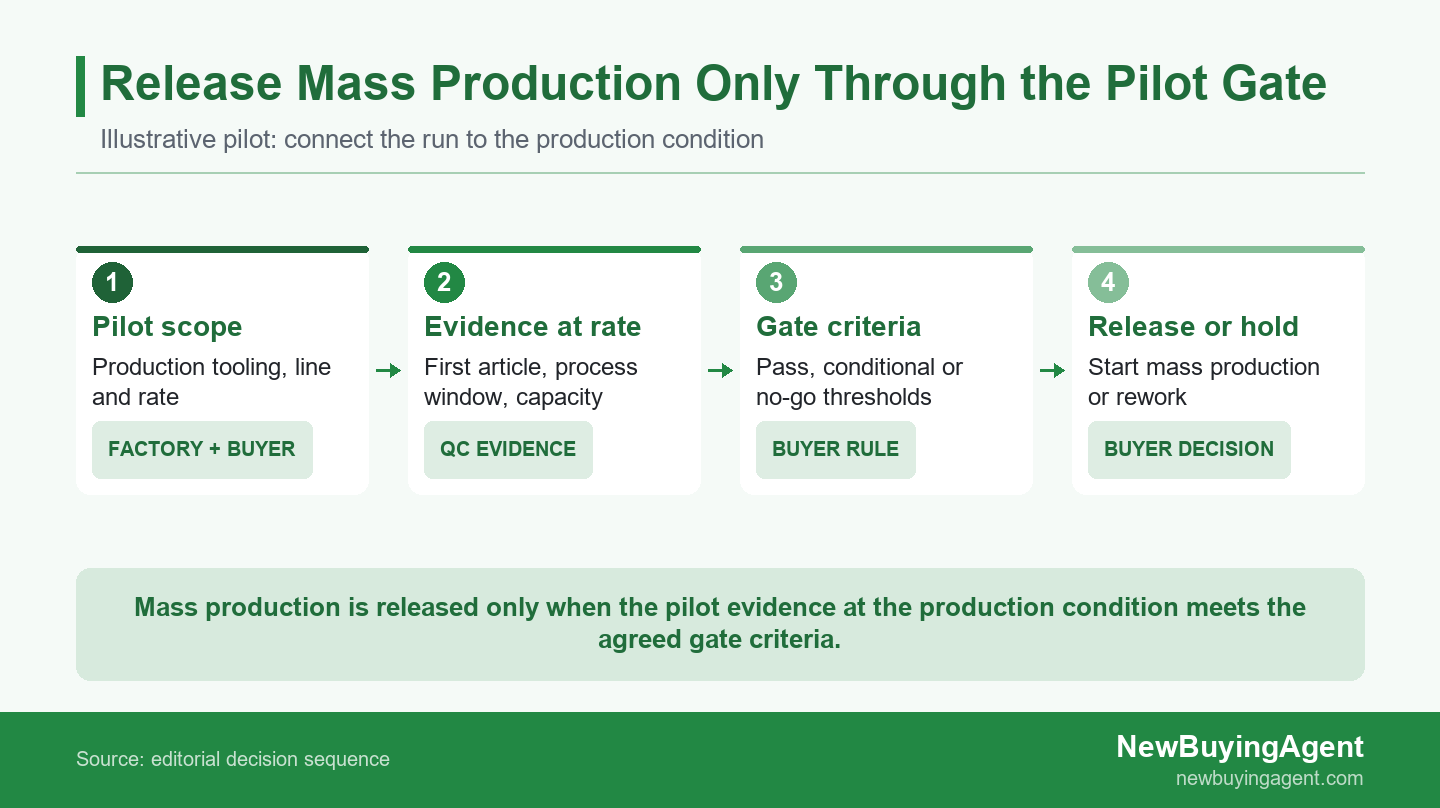
Four-stage sequence linking pilot scope, production-rate evidence and gate criteria to a release or hold decision
The reason to ask for process evidence rather than a final inspection is that process validation confirms a process can reliably output products of a determined standard, and quality cannot always be determined by finished-product inspection. The same overview describes a lifecycle of process design, process qualification and continued verification, with production able to begin after qualification. In this context, the pilot is the qualification step, which is why its evidence has to describe the process and not only the samples.
For a buyer sourcing a custom product, NewBuyingAgent’s local factory resources and product-development/QC capability can carry the pilot-gate requirement into the supply brief. Its product-supply service provides a route to source the product against the agreed pilot scope, evidence list and gate criteria, so the quotation is built around the decision the buyer has to make.
First-Article and Dimensional Evidence
First-article inspection verifies that the new or modified production process produces conforming parts against the specification, and it should cover all tooling and features rather than only the dimensions someone labelled critical. Narrowing the check to a short list is tempting when time is short, but it removes the buyer’s only evidence that the rest of the tooling is capable. The first-article record is also what makes a later dispute about drift answerable, because it fixes the approved baseline.
The scope of a first-article inspection is defined by the practice itself. A first article inspection is a production validation process for verifying that a new or modified production process produces conforming parts that meet the manufacturing specification, and it verifies all tooling used to produce a part. Typically the supplier performs the inspection and the purchaser reviews the report, which is why the buyer should agree the measured features and the reporting format before the run, not after it.
Process Settings, Rate and Capacity Evidence
Record the process window actually used at the quoted production rate; a slow trial that makes good parts does not show that the line can hold quality at the rate the order needs. The settings, cycle time and run length belong in the same record as the dimensional result, because a part made under different conditions is not comparable evidence. Capacity is part of the same question: a process that works at a comfortable pace may not hold when the schedule tightens. The transferable lesson is that approval evidence belongs under the production condition, not under a convenient one.
Established approval practice ties evidence to the production condition. AIAG’s PPAP manual is the industry standard for the production part approval process, which ensures engineering design record and specification requirements are consistently met during an actual production run at production rates. The standard comes from automotive part approval, so it is not mandatory for a consumer-goods order; the transferable lesson is that approval evidence should be produced under the production condition, and the buyer can apply that as a professional recommendation rather than a rule.
How to Size and Run a Pilot That Represents Mass Production
Size and run the pilot so it represents the production condition — production tooling, line, operators and rate — and treat engineering samples as a different activity that cannot substitute for the pilot. The quantity should follow the evidence the gate needs rather than a habit, and it should be large enough to show the process running at rate and to expose normal variation. A pilot that uses a different line or a hand-picked operator produces evidence about a process the buyer is not going to buy.
Where a reference quantity helps the conversation, the automotive standard offers one. A supplier PPAP handbook restating the AIAG definition describes a significant production run as a production quantity that totals a minimum of 300 consecutive parts, sampled from a production run using production equipment, tooling and operators. That figure is a reference point, not a universal pilot size: a small, simple part may need fewer pieces to show the process, while a multi-cavity or critical product may need more, and the buyer should size the run against the decision it has to support.
Setting the Go or No-Go Criteria Before the Pilot Starts
Write pass, conditional-go and no-go criteria with numeric thresholds, owners and timing before the pilot, so the decision is a rule the team agreed to rather than a judgment made under schedule pressure. Each criterion should name the measurement, the limit and the evidence that proves it, and each outcome should say who decides and by when. Without that, a borderline result becomes a negotiation in which the factory, the schedule and the buyer’s own optimism all push toward starting. The gate itself is a professional recommendation the buyer can scale to the product, not a requirement imposed by any standard.
Gated planning is established practice for taking a new product into production. AIAG’s APQP 3rd edition manual addresses how to improve new product launches and adds sections on sourcing, change management, program metrics, risk assessment mitigation plans and gated management. The manual is written for automotive programs, so its requirements do not apply to every consumer product; the transferable lesson is that a launch benefits from an agreed gate, and the buyer can adopt that as a professional recommendation sized to the product’s risk.
Go, Conditional Go, or No-Go: Decision Rules and Boundary Cases
Release mass production on a full pass; release conditionally with a control plan and a first-lot check when a non-critical gap remains; hold when a critical feature or the production rate fails. The three outcomes are not degrees of enthusiasm — they are different actions. A full pass needs no extra control. A conditional go attaches specific checks and limits to the remaining gap. A no-go returns the process to the factory with a defined corrective action and a re-test, not a request to try again.
Two boundary cases are worth stating because they are easy to get wrong. First, a cosmetic or non-functional gap can support a conditional go, but only if the buyer writes down which features are cosmetic and accepts them explicitly; otherwise the concession quietly becomes the new standard. Second, a low order quantity does not lower the requirement. A small run can still carry a critical assembly or sealing feature, and the gate should scale with the product’s risk rather than with the number of units.
Illustrative Example: A 2,000-Unit Pilot Before a 40,000-Unit Order
For an illustrative 2,000-unit pilot, a clean first-article result but an off-rate cycle time leaves the gate conditional until the line confirms capacity at the quoted rate.
In this illustrative example, a consumer brand is preparing a custom product for its first full production order. The plan is a 2,000-unit pilot ahead of a 40,000-unit order from a single production line. The tooling and the drawing are fixed, but the pilot cycle time is slower than the rate quoted for the order.
The first-article dimensions pass against the drawing. At the same time, the recorded cycle time is longer than the rate the factory quoted for the full order. The dimensional result answers one gate criterion, while the rate result leaves another open, because a part made at a slower pace is not evidence about the pace the order depends on.
The buyer’s decision is to keep the gate conditional. Mass production is released only after the line demonstrates the quoted rate with the same tooling and process. The factory runs a rate-confirmation run, records the process window and re-checks the first-off dimensions before the full order starts.
Before full release, the rate, the process window and the first-article dimensions are checked against the agreed gate; after release, the record stays with the first production lots so early drift can be seen. This example is illustrative: it claims no measured cycle time, capacity or yield result, and actual acceptance depends on the real product and the real process.
Handing Off to Mass Production Without Losing the Gate
Freeze the approved process settings, the first-article record and the control plan, name the owner and the escalation trigger, and report the first mass-production lots against them. The gate decision is only useful if the conditions that produced it survive into the order. If the settings drift, the approved sample is replaced, or no one owns the escalation, the buyer is back to discovering problems at final inspection, which is the outcome the gate was meant to prevent.
Regulated manufacturing treats that discipline as a system requirement. FDA’s Quality Management System Regulation requires a manufacturer to document a quality management system that complies with the applicable requirements of ISO 13485, which is incorporated by reference. The regulation governs medical devices, not consumer goods, but it shows the same principle: a documented, controlled process, not inspection alone, is what supports a release.
For buyers retaining an existing Chinese factory, the work shifts from setting the gate to following it. NewBuyingAgent’s existing-factory management service connects local follow-up and quality-control capability to the agreed settings, first-lot checks and escalation rules, while the buyer keeps the acceptance decision.
Put the Go or No-Go Gate Into the Sourcing Brief
Specify the pilot scope, the gate criteria and the required evidence in the sourcing brief, so competing factories answer the same question and the decision is comparable. The requirement belongs next to the quantity, price and delivery terms, not in a separate quality document that no one reads until there is a problem. It should state the run conditions, the measured features, the thresholds and the records the factory will hand over.
Write the brief so a factory can price the work honestly: say whether the pilot uses the production line, how long the run is expected to take, whether the first-article check is included, and what happens if the gate returns a conditional result. These are commercial scope questions, and they are easier to settle before the pilot than after it.
For a first production order, prepare the product specification and critical features, the drawing and tolerance requirements, the pilot quantity and target order quantity, the target price, the destination and the delivery timing. NewBuyingAgent can use its local factory resources and product/QC capability to build a pilot plan and quotation around the agreed gate. With that brief ready, request a pilot-gate sourcing brief from NewBuyingAgent.
Frequently Asked Questions
How many units should a pilot run be?
There is no single correct quantity; the pilot must be large enough to produce the gate evidence at the production rate. A useful reference from the automotive world is a significant production run of at least 300 consecutive parts, but that number assumes a stable, high-volume part. For a simple product, fewer pieces may show the process; for a multi-cavity or critical product, more may be needed. Size the run against the decision: enough units to expose variation, confirm the rate and support the first-article check.
Is a pilot run the same as a sample order?
No; samples are usually made for design, fit and appearance approval, while a pilot is a production run on production tooling and process. A sample can be produced on a bench or a trial line by a technician, which is useful for deciding what the product should be. A pilot is the step that shows whether the factory’s real line can make that approved product at the required rate, so a sample approval cannot stand in for it.
Can a pilot run replace a first-article inspection?
No; first-article inspection is the dimensional evidence inside the pilot, not a separate substitute for it. The pilot produces the parts and the process records; the first-article check measures those parts against the drawing and confirms that all tooling is capable. Treating the pilot as an alternative to first-article inspection usually means the dimensional evidence is missing exactly when the buyer needs to compare later production against an approved baseline.
What if the pilot passes but mass production starts to drift?
A well-set gate includes a control plan and first-lot verification, so drift is caught in the first production lots rather than at the end of the order. The gate decision should name the settings that were frozen, the checks that continue in production and the trigger that escalates a deviation. If drift appears, the buyer can compare the current parts against the approved first-article baseline and require a corrective action before continuing.
Does a small order still need a pilot run?
It depends on product risk rather than order size; a low-volume order can still carry a critical feature or a new process. If the product is simple, the process is proven and the features are non-critical, a lighter gate may be reasonable. If the tooling is new, the tolerance is tight, or the part has a sealing, safety or fit function, the pilot is worth running regardless of volume, because the cost of a failed order is not proportional to the number of units.
NewBuyingAgent
Related Resources


Начните сегодня
Давайте превратим ваши цели по закупкам в реальностьWeChat:+86 15157124615
WhatsApp:+86 15157124615
Адрес: Здание 10 #39 Xiangyuan Road, Ханчжоу, Китай
