

A factory can mark a prototype issue “fixed” while the buyer still lacks evidence that the current product requirement has been met. The missing link is often not another photograph: it is a record connecting the observation, the agreed correction and the person authorized to accept the result.
A sample deviation log is a controlled record of differences between a reviewed sample and its agreed requirements, together with the actions, evidence and decisions used to resolve them.
For China sourcing projects, the useful question is what each entry enables the factory to do—and what it enables the buyer to approve.
Keep the Deviation Open Until the Evidence Matches
A sample deviation log is useful when each issue identifies the current requirement, an accountable action owner and the evidence needed for closure. Keep the factory’s progress separate from the buyer’s acceptance decision, because a reply, a repaired part and a verified correction represent different stages of work. The record should make the next decision possible without reconstructing scattered messages.
- How it works: Connect the issue to a coded sample, product revision and specific requirement.
- Decision: Name the person responsible for the factory response and the person who can approve the result.
- Standard: Check the intended revision against the agreed criterion before recording closure.
- Risk: Carry changed requirements and scoped exceptions into the production documents so they are not lost.
Build a Log That Separates Observation, Action and Approval
Keep observed sample differences, factory actions and buyer approval in separate fields so a completed action is not mistaken for an accepted product. A spreadsheet can support this separation if each issue has a stable identifier and the latest status remains clear. The important control is the relationship between the fields, not the software used to hold them.
The ISO 9001 Auditing Practices Group’s documentation guidance separates audit evidence, the unmet requirement and the statement of nonconformity. It is educational audit guidance, not an endorsed standard or a mandatory prototype form. Its useful lesson here is to show both what was observed and what it was compared against.
| Field group | What to record | Decision it supports |
|---|---|---|
| Issue and sample identity | Issue ID, product code, sample code, receipt date, reviewed revision | Which physical item and record does this comment concern? |
| Requirement | Drawing or specification reference, revision, acceptance condition | What result was expected? |
| Observation and evidence | Location, measured result or described difference, method, photo or report reference | Can the factory reproduce and assess the finding? |
| Impact and disposition | Affected function or fit, approval restriction, clarification or change request | What work can proceed while this remains open? |
| Factory response | Cause status, proposed action, named owner, response and evidence dates | Who will do what, and when will there be something to verify? |
| Verification and decision | Returned sample revision, test result, reviewer, decision date, scope and linked approval | Is the issue verified, still open or covered by an authorized exception? |
Use distinguishable statuses such as open, action agreed, evidence submitted, verified closed and exception approved. These are practical working labels, not a prescribed standard. A factory can update action progress without acquiring the authority to change the buyer’s acceptance field.
The log should also identify its current owner and revision. Preserve previous observations and decisions when an entry changes; otherwise a later reviewer cannot tell whether the product improved, the requirement changed or the issue was simply relabeled.
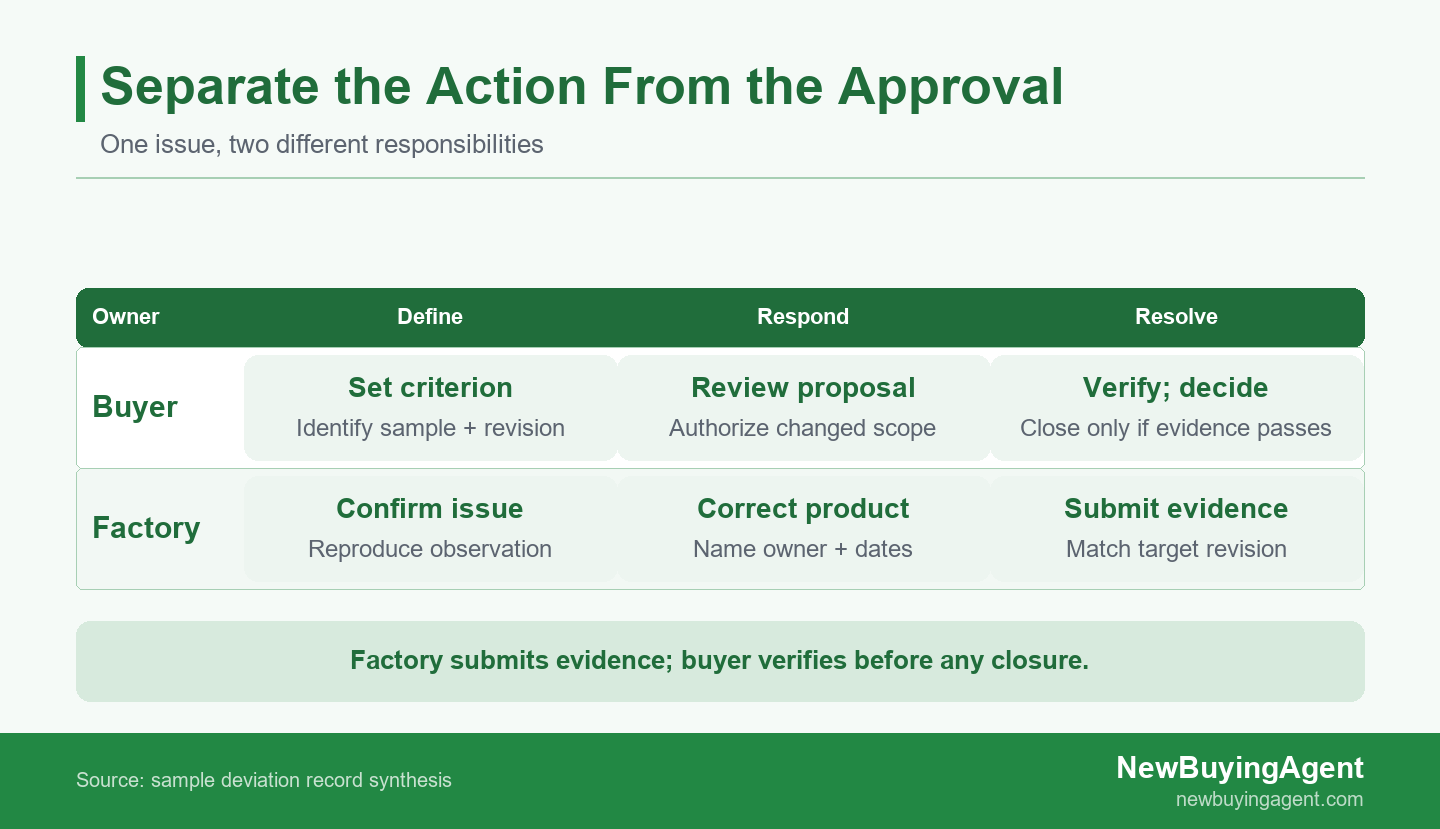
Buyer and factory responsibilities separate sample feedback, correction evidence and approval
Translate Prototype Feedback Into a Testable Requirement
Translate each sample comment into a located observation and an agreed acceptance condition before asking the factory to change the product. If the original brief does not define that condition, the first action is clarification rather than an unsupported instruction to “improve quality.” This protects both sides from correcting different interpretations of the same short message.
Record What Changed Without Guessing the Cause
Describe what was observed on the identified sample, separate suspected causes from confirmed causes, and record an investigation when the requirement is unclear. “The bracket does not align with the mounting points on the mating plate” describes a result. “The operator drilled it incorrectly” assigns a cause that the observation alone does not prove.
Attach an overall photograph showing the part’s orientation and a closer view identifying the feature. For a measurement, record the reference points, units and agreed method alongside the result. For appearance, identify the approved color or finish reference and the viewing condition. A photo taken under unknown lighting may help locate a concern without establishing whether the finish is acceptable.
NASA’s requirements checklist asks whether a requirement can be verified and whether its verification criteria can be stated. This is a transferable clarity principle, not a requirement to use aerospace qualification procedures for consumer products. If neither party can describe what a passing result looks like, the correction instruction is premature.
Do not invent a tolerance to make a row appear complete. Ask the responsible product owner to approve the missing criterion, recording any cost, fit or performance consequences. Until that decision exists, label the item as awaiting requirement clarification and identify which sample approval depends on it.
Bind Every Issue to the Sample and Drawing Revision
Bind an issue to the reviewed sample and the requirement revision, then identify the revision intended to resolve it. The sample code and drawing revision do different jobs: one identifies the physical object, while the other identifies the approved description against which it is judged. A date or the word “latest” cannot reliably replace either.
NASA’s configuration management guidance describes distinguishing product versions and keeping documentation consistent with the approved product. Applied to a sample log, this means retaining the original reference while linking the newly approved drawing, rather than overwriting the history of what failed.
For a new product combining bought-in components and a custom housing, conflicting drawings can become a product-fit problem before the order is placed. NewBuyingAgent’s local China factory network and product development/QC capability support sourcing products against a coherent purchasing brief. Its product-supply service provides the relevant route when the buyer needs China-sourced products, with unresolved sample requirements made visible in the commercial discussion.
Give the Factory One Action Owner and Two Dates
Assign a named factory action owner, a response date and a correction-evidence date for each sample issue, with a separate buyer decision owner for acceptance. The response date establishes when the factory will explain its proposed approach; the evidence date establishes when the buyer can evaluate the result. Neither date should be confused with permission to proceed into production.
The factory contact who forwards emails may not be the person responsible for the correction. Name the accountable technical or production owner, while keeping the commercial contact copied where scope or cost may change. Ask the factory to state whether it accepts the observation, can reproduce it, needs clarification or proposes a different remedy.
The ISO 9001 Auditing Practices Group’s review-and-closing guidance distinguishes correction, analysis of cause and corrective action, and asks auditors to verify the effectiveness of actions taken. Again, this is educational audit guidance, not a mandatory sample procedure. The distinction helps a buyer ask whether a replacement part fixes the immediate observation or whether the process that created it also needs attention.
Match the investigation to the problem. An isolated, understood handling mark may need a different response from repeated dimensional drift across revised samples. For a suspected recurring cause, ask what evidence supports the explanation and what control will prevent the same error on the next build. Avoid requiring an elaborate investigation merely because a spreadsheet has a root-cause column.
A proposed remedy also needs a boundary: what will change, what must remain unchanged and which checks will be repeated. Enlarging a hole may improve assembly while affecting strength or appearance. The buyer should approve the changed requirement through the appropriate technical review before the factory treats that remedy as an accepted design.
For buyers retaining an existing China factory, unclear correction ownership can delay the evidence needed to approve the product. NewBuyingAgent’s China-side team and quality-management capability support local supplier communication and production follow-up through its existing-factory management service. The buyer still needs to identify who can accept a product change; local follow-up and technical approval serve different purposes.
Verify the Correction Before Closing the Issue
Close a sample deviation only after relevant evidence from the intended revision satisfies the agreed criterion and the authorized reviewer records the decision. Start by confirming the returned sample’s identity, then evaluate the correction and any affected interfaces. A photograph of a changed part cannot answer a dimensional or functional question unless it provides the evidence that question requires.
NASA’s product verification guidance calls for recording results against individual requirements and notes that changes to a product may require verification again. The practical application is straightforward: the original failed check and the correction’s consequences both need consideration. This does not make NASA’s test procedures mandatory for the sampled product.
Illustrative Example: Returned Sample, Wrong Drawing Revision
Consider an illustrative China sourcing order for 1,800 desktop stands for a consumer-products brand. All 1,800 planned stands use the same mounting component. The buyer reviews six prototypes, finds a hole-spacing difference on two and leaves production approval open; this small development sample does not establish a production defect rate.
The filled record is DV-017: product DS-4, drawing B, samples S03 and S05, mounting-hole center spacing. Its agreed criterion is 80.0 ± 0.2 mm; the two observations are 80.6 mm, supported by measurement record M-017 and location photo P-017. The upper limit is 80.2 mm, so each observation is 0.4 mm beyond it. These are hypothetical project values, not recommended tolerances. A later factory response says “corrected,” but its return evidence identifies drawing A. The buyer has evidence about a different revision, not closure of DV-017.
The buyer keeps DV-017 open and records the next action: the factory’s named technical owner must check whether the sample, drawing and drilling fixture match revision B, correct any confirmed mismatch and supply a newly coded B-revision sample with measurement evidence. In this illustrative record, the agreed response is due September 16 and correction evidence September 21; these are project dates, not standard lead times. The buyer’s product engineer owns the acceptance decision. If the factory proposes changing the drawing instead, that proposal requires separate approval rather than a quiet edit to the original criterion.
The closure entry must identify the new sample code, drawing B, the repeated spacing measurement, affected assembly checks, reviewer and decision date. Only satisfactory results permit verified closure; another revision mismatch returns the item for clarification. This example ends with the required verification still outstanding. It shows why a plausible correction and a completed factory response do not establish readiness for the planned 1,800-unit order.
Keep Accepted Exceptions Separate From Verified Corrections
A documented sample exception may authorize a defined departure, but it does not prove that the original requirement was met or automatically change future orders. Record the accepted difference, the reason, the approving authority, the applicable sample or order and any expiry condition. Preserve the failed result rather than replacing it with a passing value.
Microsoft’s engineering-change documentation describes a request workflow that reviews and approves changes and identifies who must approve them. It is a software example, not a requirement to buy that system. The useful distinction is that proposing a change and authorizing it are separate acts.
For a noncritical appearance difference, the buyer might accept a specifically identified demonstration sample while requiring the production finish to follow the original reference. That approval does not cover other samples or bulk goods unless its scope says so. Where a difference could affect safety, required performance or an applicable obligation, route it to the competent reviewer rather than treating a purchasing sign-off as sufficient.
If the buyer actually wants a permanent design change, revise the controlled product documents and identify the checks the new design requires. Keep the change approval linked to the deviation record. Otherwise the next order may be manufactured against a standard that exists only in an old email.
Carry Sample Decisions Into the Production Handoff
Carry unresolved sample items, approved changes and scoped exceptions into the production handoff, together with the final product documents and approval authority. A closed issue is useful only if the factory can identify the specification it must now manufacture against. The handoff should also distinguish sample acceptance from any further production, testing or shipment decision that remains required.
Before releasing the next commitment, reconcile the log with the approved drawings, material specifications, artwork and packing instructions that apply to the product. Identify the retained reference sample by code and state what it represents. A finish reference should not silently become the authority for a dimension that is controlled by a drawing.
For an open item, name the blocked commitment and the next evidence needed. Some work may continue without prejudging the unresolved feature; other work may consume tooling or materials that cannot readily be changed. The buyer and factory should agree that boundary explicitly instead of relying on a general “sample approved with comments” message.
At the handoff meeting, ask the factory to identify the current revision and describe how the approved correction appears in its working instructions. This is a useful confirmation of understanding, not a substitute for inspection or product testing. If the explanation conflicts with the approved record, resolve the document mismatch before treating the handoff as complete.
When unresolved prototype issues affect a new China product purchase, prepare the current specification and revision, the deviation log with supporting photos, quantity, target price, destination and delivery timing. NewBuyingAgent is a one-stop China sourcing agent for global buyers, using local factory resources and product/QC capability to quote and supply products against the purchasing brief. To discuss a product quotation aligned with the required quality and delivery conditions, request a product quote from NewBuyingAgent.
FAQ
Is an email thread enough for a sample deviation log?
An email thread can carry evidence, but a controlled index is still needed to identify the current issue status and attachments. Link the relevant messages to stable issue IDs and record which version is current. Do not expect a new factory contact to infer acceptance from the last message when earlier messages contain unresolved conditions.
What if the factory disputes the measurement?
Keep the issue open while both sides align the measuring method, equipment and sample identity. Check reference points, units, measurement conditions and whether both teams tested the same revision. If the difference remains material, agree an appropriate repeat measurement or qualified third-party evaluation; a disputed result should not be resolved merely by choosing the more convenient number.
Should several comments about one part share a row?
Use separate rows when comments need different owners, acceptance conditions or closure decisions. A finish concern and a mounting-fit concern may concern one component but require different evidence. Conversely, several photographs of the same deviation can share one issue ID. Link related entries so a common correction is assessed across all affected requirements.
Can an accepted prototype exception apply to a repeat order?
Only if the approval explicitly covers that repeat order and remains valid for its specification and intended use. Check the named order scope, product revision and any expiry condition before relying on it. Where the repeat order changes a relevant material, component or requirement, seek a fresh decision rather than assuming an earlier exception follows the product indefinitely.
NewBuyingAgent
Related Resources

Начните сегодня
Давайте превратим ваши цели по закупкам в реальностьWeChat:+86 15157124615
WhatsApp:+86 15157124615
Адрес: Здание 10 #39 Xiangyuan Road, Ханчжоу, Китай
