

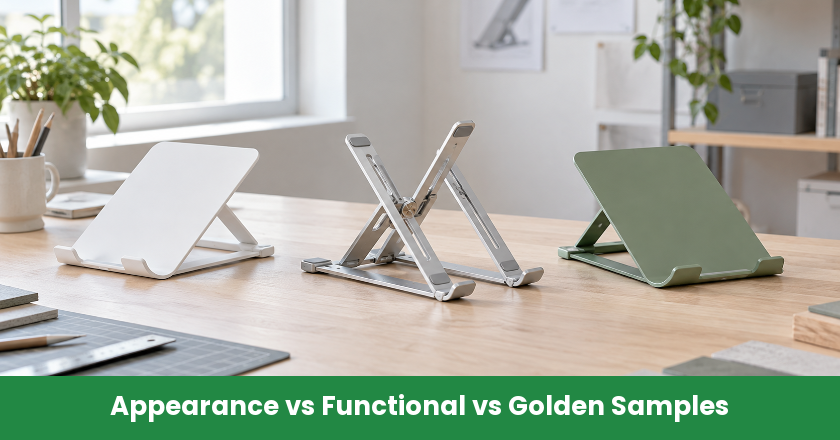
An appearance sample is a physical model for evaluating visual design and handling. A functional prototype is a build used to test specified functions. A golden sample is an approved physical reference for agreed production characteristics, used alongside written specifications and test requirements.
The mistake is treating these names as interchangeable versions of “approved.” A buyer can like the appearance, accept a functional test and still lack a sample that represents the product intended for production. For China sourcing projects, the useful question is what each approval actually permits the manufacturer to do next.
Approve the Purpose, Not Just the Sample
Appearance samples guide visual decisions, functional prototypes test specified behavior, and golden samples preserve an approved production reference. These roles differ in the evidence they provide, not simply in how finished the object looks. Buyers should connect each approval to a defined scope before it triggers tooling, material purchasing or production commitments.
- Definition: A sample name describes a role; it does not establish every product requirement.
- Common mistake: Accepting appearance and function on different builds without checking the combined product.
- Decision: State which attributes are accepted and which remain open.
- Risk: A golden sample remains a reference, not proof that every production unit matches it.
Compare What Each Sample Can Prove
Choose a sample by the question it can answer and the limits of its build, not by its finish or the name on its tag. Its purpose determines the useful approval scope: a polished shell might support a styling decision while leaving strength untested. An approval should therefore identify demonstrated attributes instead of granting permission for every subsequent manufacturing activity.
The comparison below covers three sample roles and production-lot inspection as a separate control activity, not a fourth sample type. It uses the same dimensions for each: purpose, what it does not establish, and the buyer decision it supports. Agree on these working distinctions with the manufacturer; they do not require every project to use three separate physical objects.
| Sample or control | Main purpose | Does not establish | Buyer approval |
|---|---|---|---|
| Appearance sample | Shape, visual direction and handling | Untested performance or production consistency | Accept specified visual attributes |
| Functional prototype | Behavior under defined test conditions | Results for a materially different build | Accept tested engineering findings |
| Golden sample | Agreed physical production reference | Acceptance of every later production lot | Approve the reference and its scope |
| Production-lot inspection | Check current goods against agreed requirements | Untested attributes or acceptance of future lots | Decide on the inspected lot within the agreed scope |
Based on this comparison, the right choice follows the unresolved question. Use an appearance sample when the uncertainty concerns the design people will see or handle. Use functional testing when the uncertainty concerns behavior. Establish a golden reference when the approved production characteristics are sufficiently settled to be reproduced and checked.
Ask the manufacturer to explain unfamiliar sample labels before ordering the sample. “Approval sample” may describe something awaiting a decision, while “golden sample” may describe its status after acceptance. A shared written description of purpose, construction and exclusions is more useful than assuming that both parties attach the same meaning to the label.
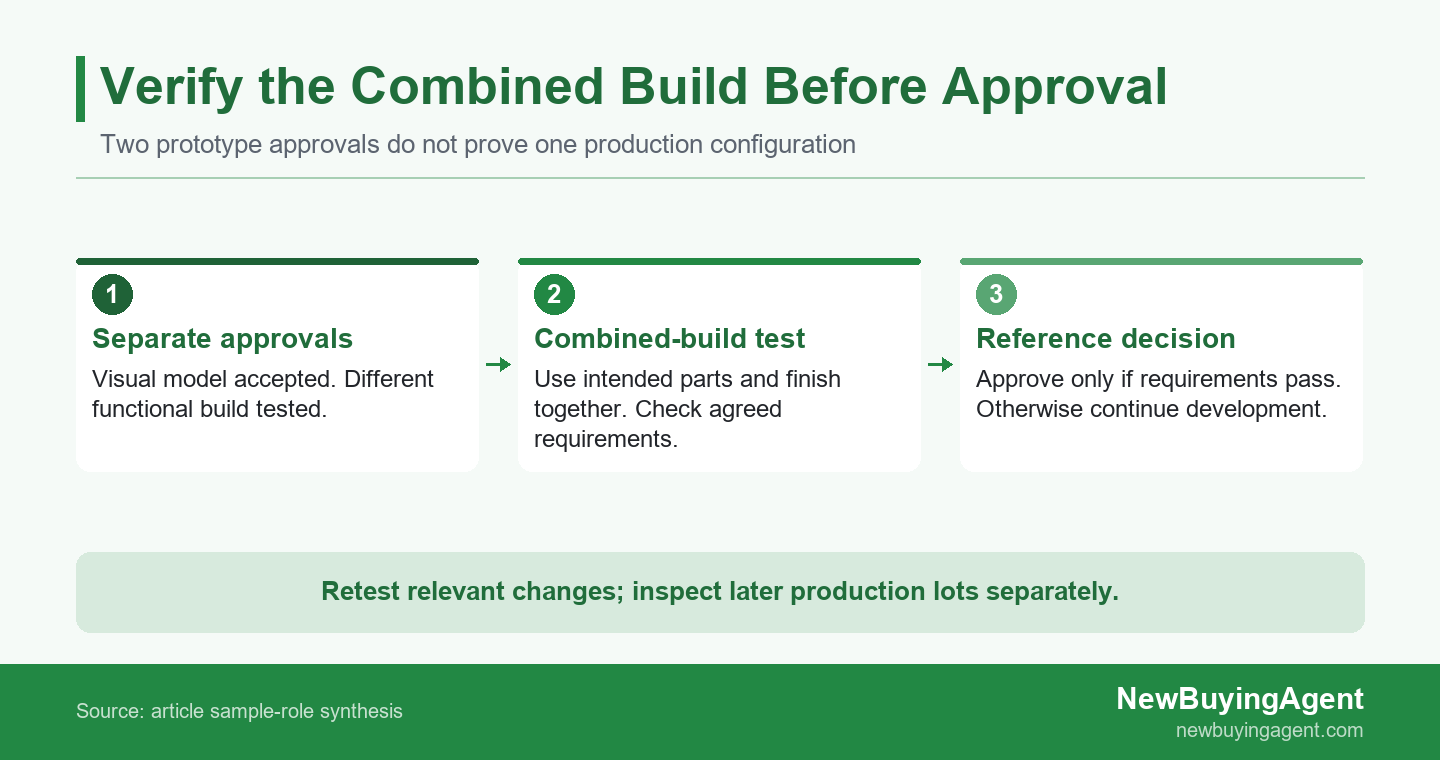
Separate appearance and functional approvals lead to a combined-build test before reference approval
Separate Appearance Approval from Functional Evidence
A prototype approval should identify the attributes accepted and the untested assumptions that remain. Early builds can be useful even when their materials or construction differ from the intended product, provided those differences are visible in the review. The buyer can then authorize the next development activity without implying that unresolved performance or manufacturing questions have been answered.
Before the sample is made, agree on the question, the necessary level of realism and the deliverable. A model for a color discussion needs different preparation from a unit intended for repeated folding tests. Defining that scope also makes the sample quotation and expected review time easier to interpret.
Appearance Samples: Set the Visual Direction
An appearance sample can establish visual direction without proving how the finished product will behave. It lets a buyer inspect proportions, visible details and the relationship between the product and the user's hand or workspace. That is valuable information when drawings and renderings leave uncertainty about size, reach or visual balance.
Formlabs separates looks-like concept work from functional prototyping and later product validation in its rapid-prototyping applications guide. The practical benefit is choosing a model that answers the present design question, rather than paying for unrelated detail or interpreting unfinished engineering as a failure of the visual review.
Record the features that matter to the product's appearance: silhouette, visible joints, logo position, surface texture and color direction. Distinguish a desired finish from a finish already demonstrated using the intended production process. A carefully painted model may communicate the design effectively while saying little about the result of coating or molding production parts.
Approval language can be narrow and useful: “Exterior proportions and control positions accepted; production finish and operating performance remain open.” If the review includes handling, note whether weight, balance and moving parts are representative. Otherwise, a comfortable lightweight model may conceal an awkward finished assembly. The review should establish the visual target without quietly accepting those differences.
Functional Prototypes: Test a Defined Claim
A functional result applies to the tested configuration and conditions; it does not automatically transfer to a different production build. Here, configuration means the actual parts, materials and construction used in the test. Record them alongside the behavior being assessed so a later material or mechanism change can be evaluated against the right evidence.
Kinscoter explains in its manufacturer guide to prototype stages that a functional prototype may have a rapidly produced enclosure whose behavior differs from final injection-molded parts. This is a specific molded-product example, not a universal testing procedure. It illustrates why buyers should ask what changed between the tested unit and the proposed production construction.
A test request should state the function, setup, conditions and acceptance criterion before the result is reviewed. For a folding mechanism, “it opens” answers a different question from whether it holds position through the agreed use test. Preserve failures and modifications in the record; a demonstration performed after an undocumented adjustment can otherwise be mistaken for evidence about the original design.
When a brand has a promising prototype but still needs a supplied product, NewBuyingAgent's local China factory resources and product development capability are relevant to the transition. Its product-supply service connects the purchasing brief to China-sourced products, including cost negotiation, quality control and delivery coordination. Include the prototype's tested functions and known construction differences so the product offer does not depend on an unverified assumption.
Make the Golden Sample a Controlled Reference
A golden sample should identify the approved production configuration and the specific characteristics it represents. It becomes useful when the manufacturer and buyer can connect the physical object to the same specifications, relevant test results and approval scope. A signature alone cannot supply missing dimensions, acceptance limits or evidence about an untested component concealed inside the product.
Before granting that status, check whether the sample was made with the intended materials, components and manufacturing methods. Record any special hand adjustment or finishing operation. If it was used to achieve the accepted result, determine whether that operation belongs in the production process or whether another representative sample is needed. Otherwise, the approved target may not describe the product being purchased.
NASA's product-verification guidance calls for results to be traceable to individual product requirements. The transferable lesson is record discipline, not imposing an aerospace process on consumer goods. For each important requirement, identify the supporting result and the build tested; do not rely on one general “sample passed” statement.
- Identity: sample ID, product variant, revision and approval date.
- Construction: relevant drawing and bill of materials, identifying the specified parts and materials.
- Accepted attributes: appearance, dimensions, workmanship and functions within the stated review scope.
- Supporting evidence: test records, measurement methods and documented acceptance limits.
- Custody: where the reference is kept and which matched references others will use.
Written requirements remain important wherever an object cannot communicate an allowable range. A sample shows one gap or shade, not automatically the full permitted variation. Resolve contradictions between the sample and specification before approval, including which reference controls a particular characteristic. Keep any separate limit samples clearly distinguished from the target sample so an acceptable extreme is not mistaken for the preferred result.
Resolve Conflicting Samples Before Approving Production
Separate samples can prove separate attributes, but the production configuration must combine those attributes successfully before final approval. A visual model and a working prototype may contain incompatible choices or different mechanisms. The buyer should identify the untested combination and request the evidence needed to close it, rather than assembling a fictional finished product from two separate approvals.
ASQ distinguishes specifications and quality planning from the appraisal work of checking products against requirements in its cost-of-quality guidance. Agreeing what the combined product should achieve is therefore only the first task. The next is checking that the intended build actually achieves it.
Illustrative Scenario: A Folding Laptop Stand
In an illustrative order for 3,000 folding laptop stands, all 3,000 stands depend on one approved pivot design. A consumer brand sourcing from China has accepted the proportions and muted green finish of an appearance model. A separate bare-metal functional prototype holds the selected angle in the agreed demonstration. Mass production has not been approved. This is a constructed purchasing example, not a NewBuyingAgent customer case.
The functional prototype uses a machined pivot, while the intended production design uses stamped pivot parts. When the first production-intent assembly is checked, the platform moves from its selected angle under the agreed test conditions. That observation does not invalidate the earlier visual decision. It shows that the earlier functional evidence did not establish performance for the stamped mechanism. Choosing the prettiest unit as the golden sample would conceal this gap instead of resolving it.
The buyer withholds final reference approval and mass-production authorization for the design. The manufacturer revises the pivot construction and prepares a new production-intent assembly with the accepted finish and intended mechanism together. The revised drawing, part specification and sample ID are linked so the team can distinguish it from the earlier prototypes. The visual approval is retained where applicable; the functional decision is reopened because the relevant construction changed.
The revised build must undergo the agreed holding and cycling checks, with results tied to that sample. If it satisfies those checks and the remaining agreed requirements, it can become the approved reference; if not, development continues. This decision authorizes another verification build, not mass production. The example specifies no universal load or cycle count, since those must follow the actual product requirements. Inspection of the later order remains a separate task even after reference approval.
Keep Production Inspection Separate from Sample Approval
A reference sample defines an agreed target; inspection of the current production lot addresses whether that lot meets the target. The distinction matters because later units can differ through material variation, assembly adjustments or workmanship. Buyers should use the golden sample to interpret relevant characteristics while obtaining evidence from the actual goods under review before making the lot decision.
NIST describes lot acceptance sampling as using a random sample from the lot to decide whether to accept or reject that lot. A specially selected development reference has a different purpose. It should not be counted as evidence that units selected from current production meet the agreed criteria.
Arrange checks that correspond to the product's risks and the purchase agreement. Appearance comparison may be appropriate for finish, while a dimension needs a measurement and a function needs its defined test. Record deviations against the applicable requirement rather than simply writing “different from sample.” That gives the buyer a basis for correction, further testing or acceptance within an already agreed limit.
For a buyer retaining an existing China factory, the difficulty may be getting the approved reference used consistently during production. NewBuyingAgent's existing-factory management service provides local production follow-up and quality-control coordination. Supply the reference IDs, current order status and inspection requirements so its China-side support can connect factory activity to the product standard and shipment schedule, rather than relying on old sample photos.
Write the Approval and Control Later Changes
Record what is approved, what remains excluded and which changes require another review before relying on the sample again. An approval should identify the object, the relevant evidence and the person authorized to make the decision. This keeps a styling decision from becoming an unintended instruction to purchase materials or start production simply because an email says “approved.”
For example, a development record might say: “Appearance sample A accepted for exterior proportions and logo location only. Functional performance and production finish remain open. This review does not authorize mass production.” For a golden reference, replace that limited scope with the actual approved characteristics and supporting document revisions; explicitly retain any exclusions and state the next activity authorized.
Microsoft's engineering-change guidance describes a workflow that identifies who must review and approve a change request. A buyer does not need that particular software to apply the principle. Name the product owner or other authorized approver, and route material, component, finish or process changes to that person before treating the old sample approval as applicable.
Review the effect of each change instead of automatically repeating every test or automatically accepting the substitution. A packaging-text correction may not affect a hinge test; a new pivot material may. Keep superseded samples identifiable and out of routine use, and update the references held by the factory and inspection team together. If a reference becomes damaged or altered, re-establish it against the approved records.
If the project needs a China-sourced product offer, prepare the specifications, quantity, target price, destination and delivery timing. Include sample IDs, accepted attributes and unresolved tests. NewBuyingAgent can use its local factory resources and product/QC capability to quote and supply against those purchasing needs, with the quality and delivery requirements included in the offer. With those inputs ready, request a product quote from NewBuyingAgent.
Frequently Asked Questions
Can one physical sample serve all three purposes?
One physical sample can serve several purposes if its construction and evidence support each purpose. A production-representative unit might be reviewed visually, tested functionally and then retained as the approved reference. Record those decisions separately, even when the object is the same. Do not require extra sample categories merely to complete a sequence, but do not skip an unresolved requirement because one unit already looks finished.
Can photos replace an approved physical golden sample?
Photos can document an approved sample, but they cannot replace every physical comparison. They do not let the reviewer handle the product, measure an interface directly or repeat a functional check. Use them to identify the reference and record visible details, while agreeing which decisions require a physical unit or test result. A remote approval should state its evidence limits instead of implying an unrestricted physical review.
How many golden samples should the parties retain?
Retain enough matched references for the people who approve, manufacture and inspect the product. There is no universal count that suits every product or custody arrangement. Identify each copy, verify that it represents the same approved version and record where it is held. If testing could alter a reference, arrange a separate test unit so routine checks do not gradually change the standard everyone relies on.
Who should pay for extra samples and revisions?
Sample and revision charges should be agreed as part of the development scope before work begins. Distinguish a buyer-requested design change from correcting a sample that missed the agreed brief, and identify any new testing or tooling work separately. Ask what the quotation includes, how additional work is authorized and whether any credit applies to a later order. Do not assume unlimited revisions or automatic refunds.
NewBuyingAgent
Related Resources

Начните сегодня
Давайте превратим ваши цели по закупкам в реальностьWeChat:+86 15157124615
WhatsApp:+86 15157124615
Адрес: Здание 10 #39 Xiangyuan Road, Ханчжоу, Китай
