


Sample consolidation is the collection of samples from several factories at one receiving point before they are organized, packed and sent onward together.
A lower international freight quote does not necessarily make consolidation the cheaper choice. Domestic deliveries, handling, a larger outer carton or waiting for a late sample can erase the difference. The useful decision is whether the required samples will reach the right reviewer, identifiable and intact, at a lower total cost within the available time.
Combine Samples Only When the Saving Survives the Whole Trip
Consolidation is a good cost decision when the full route is cheaper and the essential samples can still arrive before the review. Compare the same services on both routes, then test the proposed packing and dispatch date. A ready sample needed for an imminent decision should not automatically wait for an optional color variant from another factory.
- Cost comparison: Include China domestic freight, receiving, storage, repacking, international charges and destination costs.
- Common mistake: Fewer boxes do not guarantee lower chargeable weight.
- Timeline: Agree a cutoff and a separate plan for late arrivals before collection starts.
- Risk: Preserve each sample’s identity and required packaging; receipt confirmation is not product approval.
Compare the Complete Direct and Consolidated Costs
A useful cost comparison covers the same journey and service scope on both routes. Direct shipping includes each factory’s dispatch costs, while consolidation adds domestic movement and hub handling before the international leg. Sample purchase charges remain part of the project budget, and destination charges must be assessed for each route rather than assumed to disappear when packages are combined.
Consider this illustrative logistics budget for samples from three factories going to one buyer. All amounts are hypothetical USD figures, not carrier prices or a NewBuyingAgent quotation. The direct option totals $315 across three separately packed dispatches; the consolidated option uses one receiving point. Both estimates exclude sample purchase fees, optional insurance and destination duty, tax or clearance charges.
| Cost component | Direct dispatches | Consolidated dispatch |
|---|---|---|
| Factory-to-hub domestic freight | $0: no hub route | $30 |
| Hub receiving and handling | $0: no hub handling | $25 |
| Additional consolidation packaging | $0: factory packing included below | $15 |
| International transport and ordinary origin packing/pickup | $285 total | $150 |
| Quoted transport surcharges | $30 total | $20 |
| Illustrative logistics subtotal | $315 | $240 |
The consolidated subtotal is $30 + $25 + $15 + $150 + $20 = $240, leaving a provisional $75 logistics saving. If the same samples cost $180 to obtain, that cost belongs on both sides: $495 versus $420 before the excluded charges. Combining the samples does not recover their purchase price. If either route needs paid storage, an additional pickup or insurance, add it to that route before deciding.
Ask what the receiving fee includes: carton intake, item counting, photographs and repacking can be separate services. Confirm the free storage period and the charge after it expires. The $75 is a limit on additional cost, not a promised saving: different destination charges or a second dispatch can consume it, and a missed development decision may matter more than the freight difference.
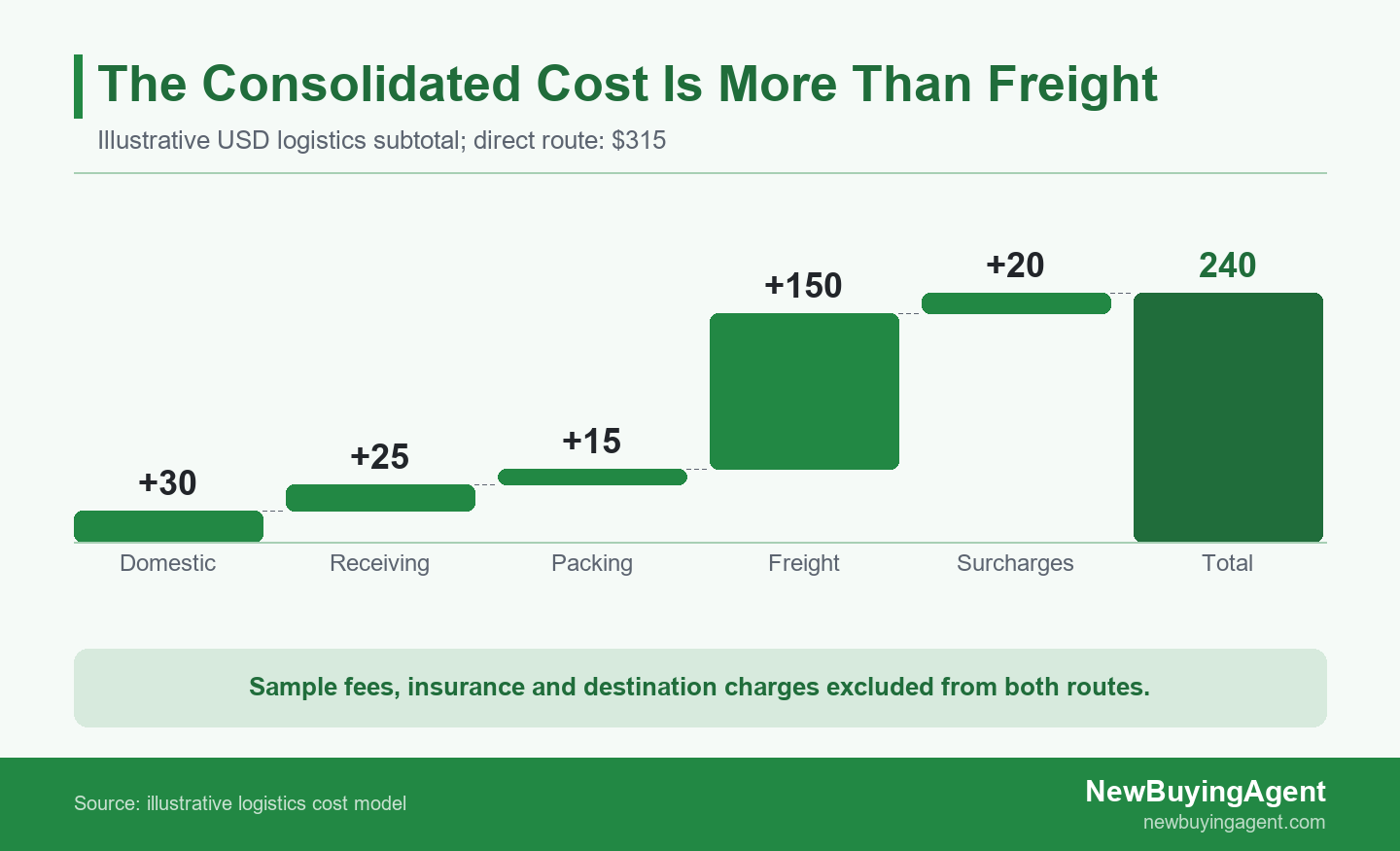
Illustrative consolidation costs add up before the direct-shipping saving can be assessed
Price the Packed Cartons, Not the Number of Samples
The final carton measurements matter more than the sample count when requesting a courier quote. A small metal part and a large, lightweight cushion create different packing and billing problems even if each is one sample. Compare measured packed weights and dimensions under the same service conditions, then check whether the combined outer triggers a different charge or handling requirement.
Check Each Carton’s Chargeable Weight
Calculate the applicable chargeable weight for each final carton before accepting a consolidated freight quote. Chargeable weight means the weight used to price transport, which may exceed the scale reading when the package occupies substantial space.
The DHL Express weight guidance uses the greater of actual or volumetric weight as chargeable weight and calculates each package separately for a multi-package shipment. Its published example calculates volumetric kilograms from length × width × height in centimeters divided by 5,000. Confirm the divisor, rounding and service limits for the actual booking; this is not a universal rule for every transport product.
For an illustrative packing check, three cartons measuring 40 × 30 × 10 cm each produce 2.4 kg of volumetric weight per carton using that divisor, or 7.2 kg combined. Putting them into a 50 × 40 × 30 cm outer produces 12 kg. If each original carton weighs 2 kg and the final outer weighs 7 kg, volumetric weight controls both examples before applicable rounding. Fewer parcels have increased the volume being priced. A tighter safe packing design may improve the result, but obtain its actual dimensions before replacing the quote.
Keep the Packaging That Protects the Review
Remove redundant transport packaging only with permission, while preserving protection and any packaging needed for the product review. A catalog may be disposable; a molded insert needed to assess retail presentation is not. Mark which items must remain sealed and which cartons may be opened before the hub starts work.
For multiple items in one package, DHL Express packing guidance recommends individual protective wrapping and separation with inserts or dividers. In a mixed kitchen sample set, the practical implication is to stop a heavy utensil moving against a ceramic surface. Saving a little carton space is not worthwhile if the reviewer cannot distinguish transport damage from a product defect.
For a brand developing a coordinated kitchen range, the sample review may cover material, finish and retail packing together. NewBuyingAgent’s local China factory resources and product development and quality-control capability support its product-supply service for that broader requirement. Specify which packaging features belong to the product being sourced so the quoted China-sourced offer reflects what the buyer needs to evaluate and ultimately sell.
Set a Dispatch Cutoff Before the First Factory Ships
The consolidation cutoff should be calculated backward from the date the reviewer needs the samples. Allow time for hub intake, packing, carrier collection, transport, possible customs delay and receipt at the destination. A factory’s promised completion date is not the same as hub arrival, and hub arrival is not the same as availability on the reviewer’s desk.
Illustrative Example: Ship the Review-Critical Set First
A consumer brand plans 2,400 kitchen accessories and needs 6 samples across 3 Chinese factories for a development review on business day 10. Four samples are essential to the material and fit decision; two are optional color variants. In this illustrative situation, the four essential samples reach the hub on day 4, while a revised factory schedule puts the optional pair at day 7.
The planner allows one business day for receiving and packing, followed by four business days for transport, clearance uncertainty and destination receipt. Waiting for everything gives day 7 + 1 + 4 = day 12: two days after the meeting. Using those same assumptions, day 5 is the latest intake date that could meet day 10, without additional margin. The four-day allowance is a hypothetical planning input, not a carrier or customs guarantee.
The development manager decides that the optional colors can be reviewed later and releases the four essential samples first. The hub removes the optional pair from the initial manifest, updates the first carton’s dimensions and obtains revised prices for both dispatches. The buyer must now compare that split cost with waiting or moving the review; the earlier $240 all-in-one logistics estimate cannot be reused unchanged.
Before dispatch, the hub confirms the four required sample IDs, approved packing and carrier acceptance. The revised plan gives day 4 + 1 + 4 = day 9 availability, one business day before the review, with actual progress still monitored. This illustrative example gives a feasible planning result, not evidence that a shipment arrived or that the samples passed. If the optional pair becomes essential to the decision, the team must revisit the meeting scope or transport plan instead of pretending the incomplete set is sufficient.
Separate Mandatory Samples From Optional Additions
Split an optional late sample from a ready review-critical set when waiting would jeopardize the decision date. The product owner, not the warehouse, should decide which samples are essential. Two matching components may need to be reviewed together even when only one is late; an extra finish option may not.
Record a latest arrival time, including the time zone, and the action if it is missed: exclude the item, arrange a separate shipment or seek a fresh decision. Agree who can authorize the extra freight and how much unapproved spending is allowed. The hub should not keep extending the cutoff because another parcel is “nearly there.”
Direct dispatch can be preferable when one sample is urgent, when factories are too dispersed for economical domestic collection, or when the contents require different transport arrangements. Group by review purpose and compatible handling needs, not simply by the fact that every item originates in China.
Preserve Sample Identity Through Receiving and Repacking
Sample control means knowing which factory and product revision each physical item represents after its original shipping carton is removed. Keep that identity through receiving, opening and outbound packing. A hub can confirm count and visible condition within its agreed scope, but a receipt photograph or a “received” status does not establish functional performance or authorize production.
Before factory dispatch, assign a project reference and a unique sample ID. Match each ID to the sending factory, product or component, revision, expected quantity, purpose and domestic tracking number. Put the ID on a removable tag or protective inner pack where it will not damage the sample. A label only on the outer carton is insufficient once several cartons are opened.
At receipt, request a dated record of the outer carton’s condition, actual item count and any mismatch with the expected list. Photographs should show the sample and its ID together. Missing identifiers, leaking contents or unexplained extra pieces need a recorded exception before repacking. An apparently identical replacement must not silently inherit the original item’s approval status.
The International Trade Administration’s packing-list guidance describes an itemized record of each package’s contents, weights and measurements. Apply that documentation principle to the outbound cartons: link the sample IDs to carton numbers and measured sizes, then reconcile the list with the physical contents. This gives the destination reviewer a way to identify what arrived, not merely how many boxes were delivered.
When buyers already work with Chinese factories but cannot obtain consistent readiness or sample records, NewBuyingAgent’s existing-factory management service provides a relevant China-side follow-up path. Local supplier communication and quality-control capability can support the agreed product checks and logistics handoff. Define the required checks and decision owner in that wider factory-management scope; counting samples alone should not be sold or accepted as a technical evaluation.
Resolve Customs Value and Restricted Contents Before Packing
Sample status does not automatically remove customs valuation, import conditions or transport restrictions. Identify the destination, responsible importer and actual contents before deciding which pieces can travel together. These requirements can change the suitable route and the cost comparison, so obtain current guidance from the carrier and destination customs broker rather than relying on the words “sample” or “not for resale.”
For UK imports, HMRC’s free-charge goods guidance explains how goods supplied without payment still need a customs valuation basis. A zero purchase price does not settle their customs value. Ask the broker how to document genuinely free samples and relevant transport costs; do not invent a nominal amount to make the paperwork easier.
Describe each type of item accurately, with its material, intended use, quantity, origin and supported value information as required for the destination. Combining several products into one carton does not turn them into one indistinguishable commodity. Have the exporter or agent reconcile the shipment documents with the final manifest, including any item removed after the cutoff.
Relief is a separate question from valuation. HMRC’s UK commercial-sample relief guidance sets conditions covering eligibility, acceptable preparation before importation and use to obtain future orders. It is not an automatic exemption for every prototype. Confirm eligibility without altering a technical sample in a way that compromises its intended evaluation; other destinations have their own rules.
Screen contents before domestic collection, particularly batteries, liquids, aerosols and other items that may need special handling. Obtain the relevant product details and ask qualified shipping personnel to determine classification, documentation and carrier acceptance. Do not add an undeclared item to an otherwise accepted carton.
For U.S. transport, PHMSA’s lithium-battery guidance identifies batteries as regulated hazardous materials, including those in battery-powered devices. That boundary matters even when the device is only a development sample. Confirm the actual battery configuration and current route requirements with the carrier; a general sample-consolidation instruction is not sufficient authorization to ship it.
Approve One Outbound Manifest and a Written Exception Plan
The final dispatch decision should bind the sample manifest, measured cartons, current quote and treatment of excluded items. One named buyer representative should approve that package of information before collection. This prevents a shipping instruction from referring to an earlier sample set while the warehouse acts on a later packing list or a quote based on different dimensions.
- Contents: Required IDs, revisions and quantities match the items packed.
- Condition: Exceptions and packaging changes have an explicit disposition.
- Cost: Included fees, exclusions, payer and quote validity are recorded.
- Timing: The route still supports the review, with tracking and receipt responsibility assigned.
- Remainders: Late or rejected samples have a return, hold or separate-dispatch instruction.
For a new China-sourced product range, include the essential sample set and review deadline in the purchasing brief alongside specifications, quantity, target price, destination and delivery timing. Buyers can request a product quote from NewBuyingAgent, a one-stop China sourcing agent for global buyers. Its local factory resources support a supplied-product offer aligned with price, quality and delivery requirements, with sampling needs considered before the project advances.
Frequently Asked Questions
Can one factory receive samples from the other factories?
A factory can be the receiving point if it agrees to the handling scope, confidentiality and responsibility for the other samples. Confirm that it can receive unrelated parcels and preserve their identity without using or sharing another factory’s designs. An independent receiving location may be preferable when competing products or confidential development work are involved.
Should samples going to a test laboratory be consolidated?
Follow the laboratory’s submission instructions before routing its samples through a consolidation hub. The lab may need specific quantities, unopened packaging, identification or accompanying paperwork. Confirm whether the hub may open the shipment and whether forwarding changes the required sample condition. Sending directly to the lab may remove an unnecessary handling step.
How should shared freight be allocated between projects?
Choose and record an allocation rule before dispatch rather than dividing the bill arbitrarily afterward. Chargeable weight may suit transport costs, while per-item or per-project allocation may better match handling work. Keep the method consistent and distinguish internal accounting from customs valuation; allocating freight between departments does not determine the correct declared goods value.
Should a duplicate reference sample stay in China?
Retain a duplicate when the review and production teams need the same reference and the buyer approves the extra sample and storage cost. Identify its revision, storage location and custodian, and record whether it is approved or still under review. A retained piece with an unclear status can create a conflicting reference instead of a useful one.
NewBuyingAgent
Related Resources


Начните сегодня
Давайте превратим ваши цели по закупкам в реальностьWeChat:+86 15157124615
WhatsApp:+86 15157124615
Адрес: Здание 10 #39 Xiangyuan Road, Ханчжоу, Китай
