

Export packaging and labeling from China is the work of protecting a product through its distribution journey and putting the right information on the right packaging level. Approve it through three separate questions: will the packed product survive the route, does the labeling meet the destination’s applicable requirements, and can the receiving channel identify and handle the shipment? Keep those answers tied to the same product and packaging revision. A strong carton can still carry the wrong label, while a readable barcode can still point to incorrect warehouse data.
Approve protection, market labels, and receiving readiness separately
For a China-sourced order, start with the product, destination, delivery route and sales channel before selecting a box or approving artwork. Agree the protection evidence with the packaging specialist or laboratory, have the responsible market owner approve applicable label content, and confirm receiving requirements with the retailer or warehouse. Freeze the complete pack configuration only when these decisions agree. The useful result is a production-ready specification with evidence attached, rather than a photograph of a sample carton.
- Definition: Distinguish the consumer unit, inner pack, master carton and pallet or other handling unit.
- Risk: Product labels, transport marks and retailer identifiers solve different problems.
- How it works: Test the actual packed configuration and check printed labels against approved content and receiving data.
- Decision: Close unresolved protection, compliance or channel issues before releasing the affected shipment.
Define each packaging level before choosing materials
Define each packaging level by what happens to it. The consumer unit is what the customer buys; an inner pack groups or protects units; a master carton consolidates them for handling; and a pallet can secure several cartons as one load. Some orders use fewer levels. A retail box may travel inside a protective shipping carton, or a suitable shipping pack may also be the sales unit.
Write down which arrangement applies so the factory knows what survives through delivery and what the warehouse removes. Create a simple label map alongside that structure. Identify where the product identity, approved safety or market information, carton contents and logistic-unit identifier belong. Record the physical location, artwork revision, data source and approving owner for each. Shipping marks help identify or handle a consignment; they do not automatically fulfill product-label obligations. Likewise, a pallet identifier does not describe every product on a mixed pallet unless the associated records provide that information. The map below illustrates these different jobs; its package counts and label positions are not prescribed specifications.
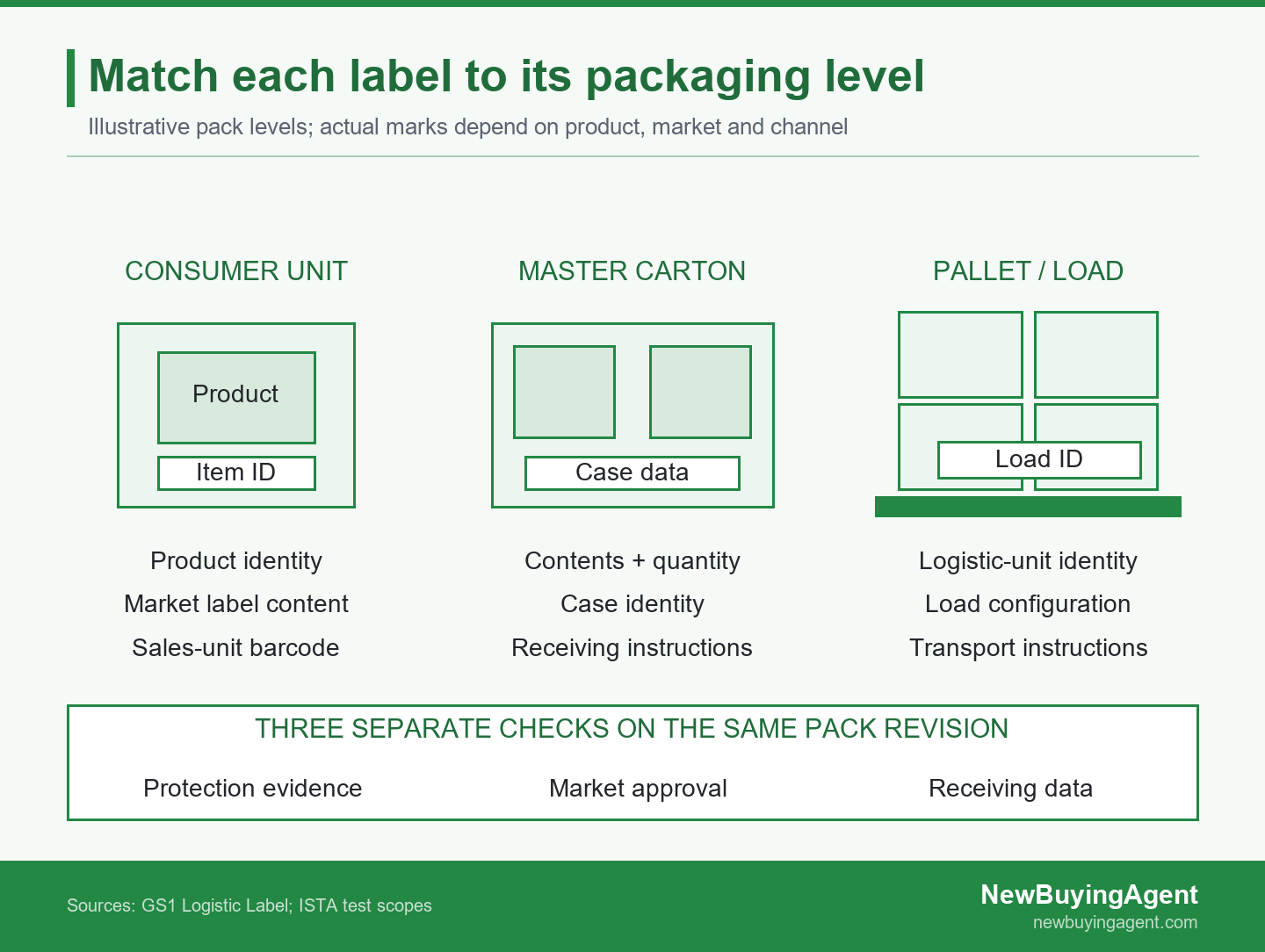
Consumer units, master cartons and pallet loads carry different identity information, while protection, market approval and receiving data need separate checks.
Engineer the pack around the journey and the product
Engineer the pack around the product’s vulnerable features and the hazards of the complete journey. A flat-pack shelf may need restraint against internal movement and protection at exposed corners; a glass item presents different breakage risks. Ask what will happen during collection, consolidation, loading, storage, unloading and final delivery. Identify whether the product stays palletized, is unpacked into mixed loads, or travels as an individual parcel.
- Specify the product’s packed orientation, mass, vulnerable surfaces, accessories and permitted contact areas.
- Describe carton construction and strength requirements, internal supports, cushioning, separators and closure method using agreed material specifications.
- Consider stack loading, storage duration and relevant humidity or temperature exposure, with assumptions recorded.
- Define acceptable product and package condition after evaluation, including function, appearance, containment and presentation where relevant.
Choose a test basis that fits that route. The ISTA 3A overview describes individual packaged products in parcel delivery, within its stated scope. It illustrates why a carton sent through individual handling needs an appropriate evaluation of the complete packed product. The public overview is not the full procedure: agree the current applicable procedure, revision, conditioning and acceptance criteria with the laboratory and channel before testing. “Drop tested” without those details gives the buyer little basis for approval.
Review freight efficiency with the same physical pack. Record final external dimensions, gross mass, units per carton and the proposed pallet arrangement, then request a quote for the actual service and route. A smaller box can improve space use, but it may remove essential restraint or protection. Compare the resulting product offer, handling costs and damage exposure rather than assume that a percentage reduction in carton volume creates the same percentage saving in freight. Pricing also depends on the carrier’s charging basis and other shipment conditions.
Match testing to the route and the approved pack
A unitized load means packages secured together for handling as one unit, often on a pallet; the ISTA 3E overview concerns similar packaged products in unitized loads for full-truckload shipment. That differs from an individual parcel journey. Neither selecting a familiar test number nor showing a pallet-test result establishes that every later distribution leg is covered. Ask the laboratory to identify the relevant scope and any additional hazards or channel requirements the selected evaluation will leave outside it.
Make the report traceable to the proposed production pack. It should identify the product and revision, packing materials and arrangement, closure, sample configuration, method and revision, conditioning, results and agreed acceptance criteria. Retain before-and-after photographs and relevant functional checks. If the factory changes a cushion, board specification, product mass or pack-out, ask the responsible specialist whether the existing evidence remains applicable and what retesting is needed. A report for a visually similar product is not automatically evidence for the pack you will receive.
Build a destination-specific product-label file
Build a destination-specific product-label file before printing. The importer or responsible market owner should identify the applicable product rules, required content and languages, permitted placement and supporting compliance evidence. Give the factory approved artwork and placement instructions rather than ask it to guess from another customer’s box. Separate the legal content decision from the print-conformity check: an inspector can compare a label with an approved file, but that comparison alone does not establish that the file contains everything the law requires.
For the United States, 19 CFR 134.11, the general rule requires the English country-of-origin name to be indicated to the ultimate purchaser, unless a legal exception applies. The applicable article and container rules matter. Do not assume a “Made in China” statement on the export master carton is sufficient when that carton will be removed before the ultimate purchaser receives the goods. Have the importer or customs adviser determine the correct marking approach and relevant exceptions for the actual product and transaction.
For EU sales, Your Europe’s CE-marking guidance explains that CE marking applies only to products covered by rules that require it; products outside those requirements must not use it. CE artwork is therefore not a general export-packaging approval. Determine the product category and relevant conformity obligations first. Separately check the applicable product identification, responsible-party information, warnings and language requirements, using the relevant product law and competent market advice. Keep those conclusions in the approval file instead of borrowing a label from an unrelated category.
Additional product-specific branches need review before artwork approval. Food, food-contact articles, children’s products, chemicals and battery-powered goods can bring additional requirements. Dangerous-goods transport needs its own competent classification and packing review. A general protective-pack test does not provide that approval. Identify these branches at the beginning, when the product and destination are known, so artwork and packaging choices can follow the applicable requirements.
Check packaging-material obligations before ordering
Packaging materials create obligations distinct from product labels. As checked in October 2026, the European Commission’s PPWR implementation notice states that the Packaging and Packaging Waste Regulation begins applying on a phased basis from 12 August 2026, with later measures following separate dates. Do not treat that starting date as the deadline for every harmonised label or design measure. For an EU order, have the responsible party identify the provisions, timing and national administration relevant to the actual packaging, including applicable producer-responsibility arrangements.
For pallets, crates and dunnage, identify every wood component. IPPC’s ISPM 15 covers raw-wood packaging and exempts packaging made wholly from processed wood such as plywood. A plywood crate with raw-wood runners is not wholly processed wood. Ask the logistics and phytosanitary specialists to confirm the destination’s applicable treatment and marking requirements and retain evidence for the components actually used. Keep pallet sourcing and any subsequent repairs under control; an old photograph of a different pallet does not identify the shipment’s wood packaging.
Keep a material list for the sales pack, protective components and transport pack. Request composition or other evidence needed for the intended market and any material claims you plan to print. “Recyclable,” “recycled content” and material-identification symbols communicate different things; one does not prove the others. Also review proposed material changes with the packaging specialist. Replacing a protective insert to meet a material objective can change cushioning, abrasion or restraint, so the revised design needs its own protection assessment before production approval.
Prove the receiving site can identify and handle the goods
Retail readiness means the actual channel can receive, identify, replenish or sell the configured goods under its current instructions. Obtain the retailer or warehouse’s current manual and order-specific requirements. Confirm case quantity, assortment, carton limits, pallet configuration, label placement and any display or opening features that apply. Store replenishment, marketplace fulfillment and direct-to-consumer delivery are different arrangements.
Keep identifiers at their correct level. In the GS1 Logistic Label system, the SSCC, or Serial Shipping Container Code, uniquely identifies a logistic unit and is the mandatory element within that system. It does not mean every export carton everywhere must carry an SSCC. Establish which product, case and logistic-unit identifiers the trading partners require, who allocates them and how the receiving records will match them. Never invent example numbers for production artwork or reuse a sample label’s identifiers.
Check the label as both printed information and connected data. A phone reading a barcode is a useful observation, but it does not prove the correct item and quantity will appear in the receiving system or that print quality meets the agreed specification. Review encoded content and human-readable text, use the required verification method, and check placement on the finished pack. Tape, folds, wrapping or adjacent obsolete labels can change the result after an artwork proof has been approved.
- Confirm that the scanned identifier resolves to the intended SKU, variant, pack quantity and destination record.
- Check the final applied label, not only a screen image or an unused loose label.
- Where required, reconcile case or pallet identifiers with the shipment data sent to the receiver.
- For shelf-ready formats, trial opening and replenishment with the intended unit arrangement and presentation.
Turn the requirements into a quoteable packaging brief
Turn the decisions into one quoteable brief using the proposed template below, a starting point for completion before ordering packaging rather than a universal acceptance standard. Add actual document references and values where indicated, and mark unresolved items as open with a named owner. The factory should be able to distinguish an approved requirement from a design assumption. Retain separate product and artwork revision identifiers if those files change independently, while the overall pack revision identifies the approved combination.
| Brief item | What to attach or confirm | Complete for this order |
|---|---|---|
| Order and route | Product/variant, destination, channel and handling legs | SKU ___; quantity ___; route ___ |
| Pack structure | Unit, inner, carton and load configuration; quantities | Levels ___; units/case ___ |
| Physical design | Material specifications, dimensions, restraint, closure and pallet plan | Drawing/material revision ___ |
| Protection evidence | Agreed method, revision, criteria, sample identity and report | Test basis ___; report ___; open issues ___ |
| Market-label file | Applicable requirements, approved text/languages, placement and owner | Market ___; artwork ___; approver ___ |
| Material obligations | Composition, relevant market obligations, wood components and evidence | Materials ___; evidence ___ |
| Channel identity | Required identifiers, allocation, receiving data and verification | Identifiers ___; channel manual revision ___ |
| Production control | Approved sample, component tolerances, substitutions and line checks | Pack revision ___; change owner ___ |
| Cost and release | Included packing, tooling, tests and rework; release evidence and authority | Quote inclusions ___; release owner ___ |
Ask the quotation to state whether printed packaging, tooling or plates, samples, transport testing and agreed packing labor are included. List assumptions affecting pack size and freight separately, and define who bears the cost of an approved change. This avoids comparing a bare product price with a product offer that already includes the intended sales and transport pack. Keep the approved physical sample alongside the controlled files; neither a sample without specifications nor a drawing without a production reference is sufficient by itself.
When product shape, accessories or presentation affect packaging, China-side product judgment matters early. NewBuyingAgent’s product-development and QC background describes local factory resources and product-development and quality-control capability. Those strengths are relevant to connecting the purchasing need with a feasible product-and-pack configuration. A buyer can incorporate packaging constraints into product sourcing rather than discover them after choosing the product. Specialist laboratory work and destination compliance decisions still need their appropriate competent owners; the company background is not a claim of packaging-laboratory accreditation.
One shelf order needs two different distribution packs
Consider an illustrative importer replenishing store and ecommerce channels with an order of 2,400 flat-pack shelves from China: 1,200 units will move on pallets to stores, while 1,200 will ship individually to online customers after warehouse receipt. Assume the buyer controls the product’s packaging approval. The buyer initially has one packaging design and evidence from a pallet trial, so the two routes need separate assessment before this pack is reused for replenishment. This is a proposed decision example, not a NewBuyingAgent customer case or a reported test result.
Illustrative example: revise the parcel pack
For this importer’s illustrative 2,400-shelf order, with 1,200 units in each channel, the agreed parcel handling trial damages a shelf corner. A receiving check also finds one physical unit against a two-unit warehouse record. The buyer previously had only pallet-route trial evidence. The packaging specialist reviews the damage and proposes revised corner protection and better restraint inside the parcel carton. The buyer holds the affected parcel configuration for evaluation of the complete revised pack against the agreed method and product-condition criteria. Changing the insert is a proposed remedy, not proof it works. The follow-up result determines whether to approve that revision or continue redesign, and the report identifies which shelf and pack were evaluated. The store configuration retains its own evidence and approval scope; it does not inherit an untested parcel change merely because both routes use the same product.
Clear the receiving problem independently
In this illustrative example, the receiving check reveals a separate problem: the physical carton contains one shelf, but the warehouse item record says two. The barcode can scan successfully and still produce the wrong inventory quantity. The channel-data owner corrects the record and checks it against the controlled carton artwork and packing quantity. A receiving trial then confirms that the final identifier resolves to the intended SKU and one-unit quantity. That closes the data discrepancy only; the revised protective pack still needs its own result. Both outcomes are recorded against the order’s approved pack revision so a successful scan cannot conceal an unresolved transport failure.
Keep the factory on the approved revision
Keep production on the approved packaging revision by confirming the material specifications, artwork files, pack-out instructions and reference sample at the work area before bulk printing and packing. Remove obsolete files and segregate old printed stock. During packing, check that the actual inserts, closure, quantity and applied labels match the approved combination. An apparently minor substitution can affect either physical performance or receiving, so require a change decision before it reaches the order rather than asking an inspector to accept it retrospectively.
- At setup, check the correct SKU and artwork at the line and verify the first completed pack.
- During production, check replenished packaging components and changeovers between variants or destinations.
- At final packing, reconcile carton quantities, label data, gross mass and dimensions with the order and shipment records.
- Record deviations by affected lot or packing period, then identify correction and recheck evidence before release.
For buyers already using Chinese suppliers, NewBuyingAgent’s existing-factory management service describes local communication, production follow-up, staged quality checks, reporting and logistics. With approved packaging requirements included in that work, its China-side team can help connect factory conditions and order evidence to the buyer’s decisions. This is particularly useful when production, printing and packing involve several local parties. The buyer should still make the scope explicit: checking conformity to an approved pack is different from issuing a destination-law opinion or certifying an unverified transport design.
Use a release check tied to the actual order
Release the actual configuration, using evidence the buyer can trace. Record the product, pack and artwork revisions; destination and channel; report or check references; unresolved deviations; and the person authorized to decide. A proposed release record can use the following completion prompts. “Open” should identify the missing evidence and owner, while “not applicable” should record why the requirement does not apply rather than hide an unanswered question.
- Protection: Tested configuration ___; agreed criteria ___; result and unresolved issues ___.
- Market: Applicable requirements reviewed by ___; final artwork/location ___; approval reference ___.
- Receiving: Manual/order revision ___; identifier and quantity check ___; required shipment-data confirmation ___.
- Factory and shipment: Actual materials/revision verified ___; quantities and load plan reconciled ___; deviation disposition ___; release decision ___.
For a product line you are sourcing or replenishing from China, include the packaging brief with the product specification, quantity, target price, destination, channel instructions, expected repeat-order needs and delivery timing when you request a China product-supply quote from NewBuyingAgent. Its local China factory resources and product/QC capability can support an offer for the supplied product with those requirements considered together. Resolve assumptions about printing, packing and testing before committing to the order so the price represents the product you intend to receive.
Questions about export-packaging approval
Is a five-ply carton enough for export shipping?
No, a ply count alone does not establish whether the packed product will survive its route. Board properties, carton dimensions, product mass, internal restraint, stack exposure and handling conditions all affect the design decision. Specify the actual material and construction, then agree the relevant evaluation and acceptance criteria. Because a heavier-looking box can still leave an unsupported corner or allow movement inside, ask for evidence tied to the complete pack rather than accept “export quality” as a specification.
Can we fix an incorrect label with a sticker?
Sometimes, if the correction is permitted for that requirement and the finished label remains accurate, durable and readable. Have the responsible market or channel owner approve the correction, its location and any treatment of obsolete information. Trial the applied label on the actual surface and check relevant scanning or print requirements. Reconcile corrected quantities and artwork revisions with receiving data. Relabeling addresses that label issue; it does not repair a weak pack or provide missing product-compliance evidence.
Can one packaging design serve several countries?
The physical construction can sometimes be shared, while label content and channel identifiers remain market-specific. Check the intended products, routes and receiving systems before standardizing. A multilingual sales pack may reduce variants, but it still needs enough space for accurate required information and a clear way to distinguish destination-specific stock. Keep separate artwork revisions where necessary. Treat any new market or channel as an applicability review rather than assume the first market’s approval covers it.
Who should approve the final packaging?
Assign separate approval responsibilities for protection, market compliance, channel data and factory conformity. A packaging specialist or laboratory addresses the agreed performance evaluation; the responsible manufacturer or importer and its competent advisers resolve applicable market duties; the retailer or warehouse confirms receiving rules. The purchasing team then authorizes the order’s configuration and release using those inputs. Name these roles in the brief so a factory’s sample approval is not mistaken for every other decision.
NewBuyingAgent
Related Resources


Начните сегодня
Давайте превратим ваши цели по закупкам в реальностьWeChat:+86 15157124615
WhatsApp:+86 15157124615
Адрес: Здание 10 #39 Xiangyuan Road, Ханчжоу, Китай
