

Corrugated box strength is not a single interchangeable rating. ECT measures how corrugated board resists edge compression; burst testing measures its response to pressure across the board face. Choose the requirement that answers your actual material question, then verify the finished box and packed product separately before approving the export packaging.
A quotation that says only “strong export carton” leaves too much unresolved. Even a numerical rating needs its test method, units and sample identity. When China suppliers offer different strength metrics, the purchasing requirement needs to identify which property matters and which evidence will demonstrate it.
Select the test for the failure you need to control
ECT and burst testing answer different questions about corrugated board, so start with the failure you need to control. Use ECT for an edge-compression requirement and burst for a hydraulic-burst requirement, with limits justified for the intended packaging. Neither material result establishes a finished-carton load limit or proves that the complete pack will withstand its distribution route.
- Risk: connect the board specification to finished-box compression evidence and the actual storage arrangement.
- Standard: retain the agreed burst requirement unless the requirement owner approves an evidenced change.
- Decision: align the requirements and evidence before comparing price or accepting a substitution.
What ECT and burst actually measure
ECT and burst differ in the direction of loading, the specimen response and the quantity reported. An upright coupon compressed along its flutes is experiencing a different test from board clamped across its face and loaded by hydraulic pressure. Reading the method and units together prevents a strength number from becoming an unsupported claim about how much a shipping carton can carry.
The Edge Crush Test (ECT) measures the edgewise compression resistance of corrugated board. ISO 3037:2022 describes a non-waxed-edge method with force applied in the direction of the flute axis. ECT is reported as force per unit length, commonly kN/m or lbf/in; it describes the tested board coupon, rather than an assembled box under a stated payload.
Burst testing loads the board differently. ISO 2759:2014 describes bursting strength under increasing hydraulic pressure. A flexible diaphragm presses across the clamped board face until rupture, producing a pressure result, commonly expressed in kPa or psi. This evaluates a material response under that loading arrangement, rather than the compression resistance of the carton walls.
Ask which method and edition the supplier used, not just which test name appears on the quotation. Specimen preparation and test execution belong to the applicable method. A packaging specialist or test laboratory should confirm the current procedure and its suitability for the material; the definitions here are not instructions for running either test.
Force per unit length and pressure are different quantities. An ECT rating is not a box load limit, and a burst value is not a gross-weight allowance. Converting units within the same quantity does not create a conversion between these properties: an ECT result cannot be turned into a burst result by changing the unit label. Request the missing measurement when the order requires it.
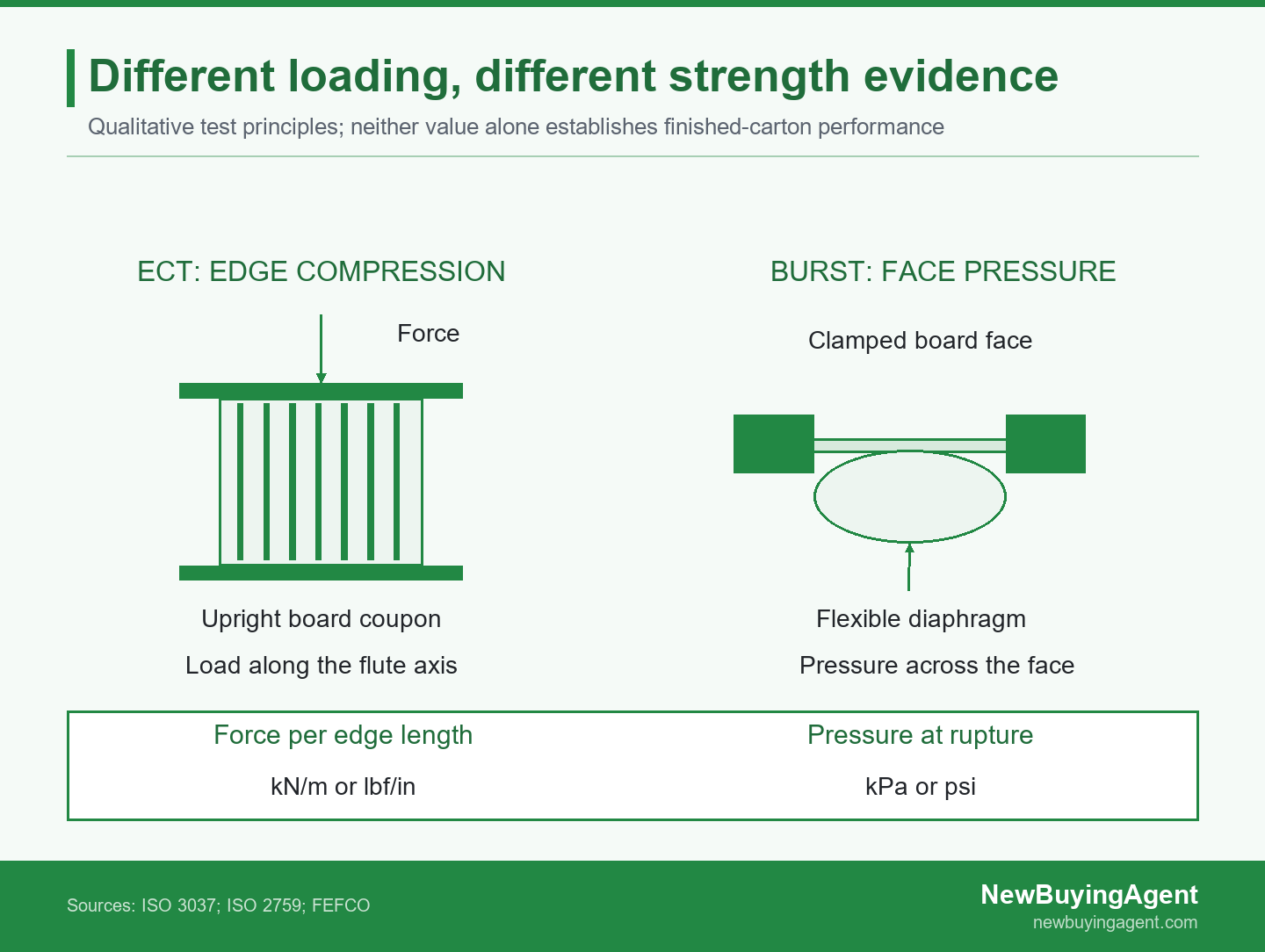
ECT compresses an upright board coupon along the flutes, while burst testing applies pressure through a diaphragm across the board face.
Compare evidence before choosing a carton grade
Compare ECT and burst by what they measure and what remains unproven, rather than ranking the size of their numbers. The table compares measurement scope and reported response, then adds finished-box compression and packed-product transport evaluation as scope checks. These latter evaluations are not alternative board grades; they show which purchasing questions a material rating leaves open.
| Evidence | Loaded object | Reported response | Still unproven |
|---|---|---|---|
| ECT | Board coupon; compression along flutes | Force per edge length | Finished-box and route performance |
| Burst | Clamped board face; hydraulic pressure | Pressure at rupture | Box compression and route performance |
| Finished-box compression | Identified assembled carton; specified configuration | Compression response under the selected method | Other distribution hazards |
| Packed-product transport evaluation | Product and complete packaging; selected hazard sequence | Performance against agreed acceptance criteria | Untested configurations or distribution conditions |
Based on this comparison, specify a justified ECT requirement when board edge compression is the design concern, and connect it to finished-box evidence. Retain burst when the approved order requires hydraulic-burst performance. If the question is whether the packed product will survive distribution, resolve the complete-pack evaluation too; neither board metric is a universal winner or a release decision on its own.
Avoid treating burst as a direct puncture measurement. The FEFCO testing-method index lists separate methods for bursting strength, puncture resistance, edgewise crush resistance and packaging compression. For a product with projecting metal edges or another localized damage concern, ask the packaging specialist which protective construction and evaluation address that mechanism instead of assuming a higher burst number settles it.
Check the finished box and the testing conditions
Finished-box compression evidence answers a question that board ECT and burst results cannot close by themselves. The public scope of ASTM D642-25 covers shipping-container compression with or without contents, including configurations where contents and interior packaging share the load. Identify whether the tested sample was empty or packed before using its result to support your own carton design.
A report on an empty box cannot silently stand for a different packed configuration. Record the carton dimensions, style, joints, closure and interior arrangement, along with the product or simulated contents used. Changes to that configuration should trigger a review of whether the previous evidence still applies, rather than automatic reuse of the earlier report.
Temperature and relative humidity also matter to the comparison. ASTM D4332-22 notes that packaging properties, especially those of cellulosic materials, can change with those conditions. Agree the conditioning and testing context with the laboratory under the applicable method, and retain it in the report. A dry laboratory result and a result from a different exposure history should not be presented as directly comparable without explanation.
Relate compression evidence to the actual stack arrangement, pallet support, storage duration and exposure expected for the order. A short compression test does not by itself settle every sustained-storage condition. Ask the packaging specialist to justify the design assumptions; do not invent a universal safety multiplier or a fixed humidity-loss percentage from a generic carton chart.
The practical output is a documented match between the tested configuration and the proposed use, plus a list of conditions still needing evaluation. If the report omits the sample identity or conditioning, obtain clarification before treating its headline result as approval evidence.
Put measurable carton requirements in the purchasing brief
A carton brief turns “export quality” into requirements that the supplier and buyer can interpret consistently. Record the construction, dimensions, applicable methods, acceptance criteria, sample origin, conditioning and traceability needed for your order. Have the responsible packaging specialist justify the limits, then agree the requirements before the supplier prices or produces the carton; a template cannot supply a safe grade for an unknown pack.
Use the following fields in the product specification or its controlled packaging attachment. Fill the acceptance values from the approved design and applicable buyer or channel requirements, rather than copying another product’s strength stamp.
- Pack identity: product reference, carton drawing and revision, internal dimensions, pack quantity, gross mass and interior protection.
- Material construction: agreed wall and flute construction, relevant material details and permitted tolerances.
- Material acceptance: ECT, burst or both where justified; method, edition, units and agreed acceptance criteria.
- Sampling and conditions: sample source, production lot, conditioning and test atmosphere, with the sampling plan agreed separately.
- Finished-pack evidence: tested configuration, compression or distribution evaluation required, and pass criteria covering product and packaging damage.
- Change control: who may approve substitutions, what evidence is required and which revision may be shipped.
Ask the supplier to return a compliance response against these fields. A blank or “equivalent” entry is a question to resolve, not a confirmed match. Keep quotations aligned to the same brief so an apparent price reduction can be traced to a genuine commercial difference or a proposed specification change.
For a China product purchase, packaging decisions need to fit the actual product and factory execution. NewBuyingAgent describes local factory resources and a product-development and QC background relevant to integrating these requirements into the supplied product. That context supports discussing the carton alongside the product specification; it does not replace specialist packaging design or laboratory evidence.
Resolve two unlike strength offers before ordering
Consider an illustrative importer buying metal kitchen organizers from China and comparing two carton offers before approving the order. The supplier descriptions use different strength metrics, while the final packing configuration has not yet been evaluated. This is a decision example, not a client case or a report of successful tests: the useful result is a clearer approval path, with the missing evidence made explicit.
Illustrative example: compare the missing evidence
For an illustrative order of 1,000 cartons of kitchen organizers, Offer A quotes 32 lbf/in ECT and Offer B quotes 200 psi burst. Neither supplier provides matched finished-box or route-evaluation evidence for the proposed pack. The importer is still assessing the offers, so the entire order remains under packaging review rather than being treated as ready for carton substitution.
The larger-looking number does not identify the stronger export pack: the values describe different material responses, and neither establishes performance for this product and carton configuration. The buyer holds substitution approval, identifies the actual design and contractual requirements, and asks both suppliers to respond against that same brief before selecting an offer.
If burst is already specified, Offer A needs evidence against that requirement or a formally assessed revision. If edge compression is required, Offer B needs the corresponding ECT evidence. Both responses should identify construction, method, units, sample source and testing conditions so the buyer can see what is actually being offered.
Verify the revised specification on the actual pack
The illustrative buyer next requests the selected material evidence and evaluation of the identified finished pack against agreed criteria before approving a revision. A passing material result alone does not close finished-box or route performance. The proposed verification uses the actual carton, interior protection and product arrangement, with any relevant stacking or distribution concerns addressed in the evaluation plan.
This illustrative example assumes no passing result or shipment outcome. If the evidence fails or does not match the intended configuration, the buyer revises the construction or packing arrangement and has the changed design reassessed. This keeps a proposed material substitution from becoming an unexamined change to the whole order.
Control board substitutions during China production
An approved carton specification is useful only if the production cartons remain traceable to it. Link the tested material and construction to the carton supplier, converting lot and packing operation, and assess substitutions before they are used. Otherwise, a report for one board construction may be presented alongside cartons made from another, leaving the buyer unable to connect the evidence to the shipped order.
At production follow-up, check the approved drawing revision, carton purchase specification and lot identification against the material actually received. Inspect the finished cartons for the construction and conversion features identified in the brief. Keep reports and retained samples tied to those lots; an unlabelled “approved carton” sample is difficult to use when a later deviation needs investigation.
When a buyer already has a China factory but needs local execution support, NewBuyingAgent’s existing-factory management service describes production follow-up, staged quality checks, reporting and logistics support. In this situation, the relevant application is carrying the approved product and packaging requirements through production and reporting deviations for disposition. The scope and any specialist testing arrangements should be agreed for the actual order.
If the factory proposes a different board because of availability, request the change before packing starts. Record what changes, which evidence remains applicable, which checks need repeating and who approved the revised specification. Keeping that decision visible is more useful than accepting a verbal assurance that the new carton is “the same strength.”
Close the remaining transport and order checks
Export-carton approval should connect material evidence to the complete pack, the production lots and the intended distribution route. ECT and burst results can close their specified material requirements while transport performance remains unresolved. Before release, separate missing evidence from accepted results and give each open deviation an owner, so a positive board test does not accidentally become approval of the entire shipment.
The ISTA 3A overview illustrates the different scope of a packaged-product evaluation for parcel distribution. A board coupon result cannot establish that complete-pack performance.
The linked overview is dated 2018; confirm the current procedure, edition and channel suitability with the laboratory rather than treating the overview as a universal export test or a substitute for the full procedure.
Keep a release record linking the approved carton revision to material results, required finished-pack evaluations, production conformity and deviation dispositions. Physical packaging performance, applicable destination labeling obligations and retailer or channel acceptance are separate questions. Check each requirement that actually applies to this order; an ECT or burst pass cannot establish compliance with the other categories.
If your China product purchase still needs a defined export pack, prepare the product specification, quantity, target price, destination and delivery timing, together with the carton brief and route information, to request a China product-supply quote from NewBuyingAgent. Its local factory resources and product/QC capability can support an offer that incorporates the packaging requirements into the supplied product. Use that offer to assess the purchasing path and agreed scope before committing the order.
Questions about specifying corrugated box strength
Does a strength stamp prove the carton is ready to export?
A strength stamp alone does not prove that a carton is ready for your export order. It may state a material rating, but it does not establish the performance of your product, interior protection and closure under the intended distribution conditions. Check what the stamp actually claims and link it to the applicable specification and production lot. Use the required finished-pack evidence and order checks to decide whether release is justified.
Should ECT samples come from sheets or finished cartons?
Use the sample source and preparation specified by the applicable test method and agreed acceptance plan. Ask the laboratory how the selected sample represents the material being accepted, and record whether it came from supplied sheets or converted cartons. Evidence from a sheet should not silently be treated as evidence from a finished carton with a different production history. If converting damage or a substitution is in question, identify that question explicitly when arranging the evaluation.
Can the supplier replace a burst requirement with ECT?
A supplier should not unilaterally replace an agreed burst requirement with ECT. The properties and units differ, so an ECT rating does not demonstrate that the stated burst criterion has been met. Ask the owner of the packaging requirement to assess the proposed change, including its design basis and supporting evidence, and obtain approval before use. If a destination customer or channel set the original requirement, resolve the change with that requirement owner as well.
Can wet cartons be accepted after drying and retesting?
A dry retest alone is not enough to accept a wet carton lot. Separate the cause and extent of exposure from the condition of the samples selected for retesting, and assess visible damage, traceability and suitability for the intended use. Ask the responsible packaging specialist to define the evaluation and disposition for that affected material. Do not use a recovered laboratory value as automatic permission to ship cartons whose condition or performance remains unresolved.
NewBuyingAgent
Related Resources


Начните сегодня
Давайте превратим ваши цели по закупкам в реальностьWeChat:+86 15157124615
WhatsApp:+86 15157124615
Адрес: Здание 10 #39 Xiangyuan Road, Ханчжоу, Китай
