

Introduction
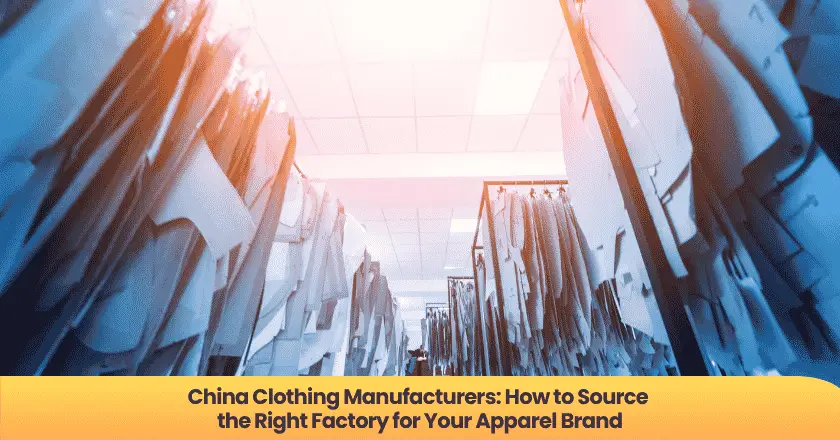
Your clothing manufacturer is not a vendor. It is, in a real sense, a co-author of your brand. The hand of the fabric, the cleanness of the stitching, the consistency from one production run to the next, all of it reaches your customer as your brand, even though another company made it. This is why sourcing the right China clothing manufacturer is one of the most consequential decisions an apparel brand makes, and why picking the first factory that says yes, as so many new brands do, is a quiet way to outsource your reputation to a stranger.
China offers apparel brands a depth of manufacturing found almost nowhere else, but that depth is precisely the difficulty. There is no single type of clothing factory, only thousands specialized by product, scale, and capability, and the one that is perfect for a knitwear startup is wrong for a denim brand scaling fast. Finding the right manufacturer is not about locating a clothing factory, since those are everywhere, but about matching the specific factory whose specialization, scale, and standards fit your particular brand and stage.
This guide is about making that match. Understanding the apparel factory landscape and its specializations, matching a manufacturer to your brand's product and stage, finding strong candidates, and evaluating them to choose the one that fits. The goal is to help an apparel brand source a manufacturing partner deliberately, rather than settling for whichever factory happened to answer first and hoping it works out.
Key Takeaways
• A clothing manufacturer effectively co-authors your brand, since the fabric, stitching, and consistency reach customers as your product, making the choice of factory one of the most consequential decisions an apparel brand makes.
• Apparel factories specialize heavily by product type, scale, and capability, so the right manufacturer is not just any clothing factory but the one whose specialization genuinely matches your specific garment and brand.
• Matching the factory to your brand's stage and volume matters, because a small, flexible factory suits an emerging label while a larger one fits an established brand, and the wrong scale creates friction either way.
• Whether a factory offers OEM or ODM shapes the relationship, since OEM builds to your design while ODM offers existing designs, and knowing which you need narrows the search considerably.
• Choosing well combines specialization, capability, communication, and a strong sample, so an apparel brand should evaluate candidates against its real needs rather than defaulting to the cheapest quote or fastest reply.
The Apparel Factory Landscape
To find the right clothing manufacturer, you first have to understand that there is no generic one. Apparel factories are specialized operations, and knowing the landscape is what lets you search for the specific kind that fits your product.
Specialization by Product
Clothing factories specialize deeply by product type. A knitwear factory, a woven-garment factory, a denim specialist, an activewear maker, and a structured-outerwear producer use different machines, materials, and skills, and few do all of them well. The short answer is that the most important match is between your specific garment and a factory that makes that exact category every day, because a factory experienced in your product already has the equipment, the skilled workers, and the know-how your garment needs. A factory stretching outside its specialty to win your order is a risk dressed as flexibility.
This specialization runs deep enough that it should drive your search from the start. Rather than looking for a clothing factory in general, look for a factory that specializes in your exact product, whether that is performance leggings, tailored shirting, or chunky knit sweaters. The narrower and more accurate your search, the better the match, since a specialist in your category will outperform a generalist on quality, cost, and reliability nearly every time.
OEM, ODM, and Scale
Factories also differ in how they work with you. An OEM (original equipment manufacturer) builds garments to your own designs and specifications, which suits a brand with its own creative vision. An ODM (original design manufacturer) offers existing designs you can adjust and brand, which suits a buyer wanting speed over originality. Worth knowing: knowing whether you need OEM or ODM narrows your search immediately, since the two are different kinds of factory serving different kinds of brand. Scale matters too, with smaller factories suiting emerging labels and larger ones fitting established volume.
Expert Tip: Define your garment category and the way you want to work before searching, then seek a factory that specializes in exactly that. Searching for a specialist in your specific product, rather than a clothing factory in general, is the single biggest lever on match quality, because a true specialist brings equipment and skill a generalist has to improvise.
Matching the Factory to Your Brand
With the landscape understood, the task becomes matching a factory not just to your product but to your brand, namely its stage, its volume, its quality positioning, and how it wants to work. The right fit is specific to you.
Stage, Volume, and Quality Tier
Match the factory to where your brand actually is. An emerging label ordering modest quantities needs a smaller, flexible factory that welcomes the business and accepts a workable MOQ (minimum order quantity, the smallest batch a factory will run), while an established brand with steady volume fits a larger operation built for it. A factory whose typical order dwarfs yours will treat you as minor, and one too small for your volume will struggle to scale, so the size match shapes your whole experience. Real talk: being a valued customer at a right-sized factory beats being a rounding error at a giant, especially for a growing apparel brand.
Quality tier matters just as much as size. A factory producing fast-fashion basics is the wrong home for a premium brand, and a high-end atelier is overkill and overpriced for a value label. Match the factory's quality level to your brand's positioning, since a manufacturer accustomed to your tier already works to the standard your customers expect. The closer a factory's normal output sits to your brand's quality promise, the less you fight to get what you need.
How You Want to Work
Consider the working fit, not only the product fit. A brand that needs hand-holding, frequent iteration, and patient support is better served by a factory willing to provide it, often a smaller one, than by a high-volume operation that wants clean, finished specs and no fuss. Think about how much guidance you will need, how often you will iterate, and how closely you want to collaborate, then favor a factory whose way of working matches yours. A technical and cultural fit in how you communicate is part of what makes a manufacturing relationship succeed.
Common Mistake: Choosing a clothing factory on price alone without weighing specialization and fit. The cheapest quote often comes from a factory outside its specialty or mismatched to your scale, and the savings vanish into quality problems, delays, and friction. Weigh the match, namely product specialty, size, and quality tier, ahead of the quoted price, because a good fit is cheaper over time than a low number.
Where to Find Clothing Manufacturers
Knowing what you are looking for, the next step is finding strong candidates. Apparel has its own well-worn channels, each surfacing a different slice of the manufacturing base, and the best search uses several.
The Main Channels
Several routes lead to clothing manufacturers. Online B2B marketplaces list thousands of apparel factories and traders, offering wide reach but demanding heavy vetting to separate real makers from resellers. Trade shows and apparel-focused fairs let you meet manufacturers, feel fabrics, and see samples in person. The apparel clusters, with Guangzhou especially deep in garments, fabric, and the full clothing supply chain, concentrate factories by region. And referrals from other brands deliver pre-vetted leads, often the highest-quality way to find a factory that already serves someone like you.
Each channel suits a different need. A marketplace is good for building a broad first list, a trade show for evaluating shortlisted candidates in person, a cluster for depth in a category, and a referral for trust. The strongest approach combines them rather than relying on one, since no single channel reaches every good factory, and an apparel brand searching seriously casts across several to find the specialist it needs.
Common Mistake: Judging a clothing factory by how polished its marketplace listing looks. A slick storefront often signals a trading company investing in sales, while a serious garment factory may have a plain online presence because its order book is full. Look for evidence of real production in your category, namely similar garments and detailed construction knowledge, not marketing gloss.
Vetting Apparel Factories Specifically
As you find candidates, vet for apparel-specific signals. Confirm the factory genuinely makes your product type rather than claiming broad capability, ask to see examples of similar garments they have produced, and check that their machinery and workforce fit your product. A factory that speaks fluently about the construction of your specific garment, and can show similar work, is far more likely to be the specialist you want than one offering everything to everyone. The depth of a factory's apparel knowledge, not the breadth of its claims, is the signal to follow.
Evaluating and Choosing the Right One
With candidates in hand, the final step is evaluating them and committing to the best fit. This is where the sample becomes decisive, and where 2026 gives apparel brands better ways to choose than ever.
The Sample and the Final Decision
Nothing reveals a clothing factory like a sample. Provide a clear tech pack (a detailed spec sheet of measurements, materials, and construction) and request a sample, then judge the factory on how well it executes, how closely it hits your spec, and how it communicates through the process. A factory that produces a strong sample, asks intelligent questions, and meets your standard is showing you what working together will be like. Weigh the sample, the communication, the specialization, and the price together, rather than letting any single factor decide, since the right manufacturer scores well across all of them.
Remember that the cheapest or fastest option rarely wins. The factory that quotes lowest may cut corners your customers will notice, and the one that replies fastest may be a trader rather than the maker. Choose the manufacturer whose specialization, sample quality, communication, and price together make the best overall fit for your brand, because the relationship you are starting is meant to last across many seasons, not just one order. A deliberate choice now saves a costly switch later.
Choosing in 2026
Finding and evaluating apparel factories keeps getting easier. Through 2026, AI-assisted supplier matching helps surface factories that specialize in your exact garment, live video tours let you inspect a clothing factory floor remotely, and digital sampling and production tracking speed the path from search to a confirmed partner. These tools make it more practical to identify and verify the right specialist without crossing the world to do it.
The judgment that matters most still rests with you, though. Deciding which factory truly fits your brand, reading a sample for the quality your customers will feel, and sensing whether a manufacturer will be a reliable partner remain human calls no tool makes for you. The strongest apparel brands in 2026 use the technology to find and screen candidates faster, then trust their own judgment, or an experienced partner's, to choose the manufacturer their brand will be built on.
Your Apparel Factory, Sourced by NewBuyingAgent
Finding the one clothing factory that genuinely fits your brand, out of thousands, is far easier with a partner that can match you across a vast network. NewBuyingAgent is a strong partner for global sourcing from China, backed by 30 years of expertise in trade, manufacturing and quality control. That breadth is what turns finding a specialist in your exact garment from a needle-in-a-haystack search into a real match: it draws on its 50,000+ cooperated partner factories—with no language, region, or time zone barriers—and its local reputation gets you full factory cooperation. And the legwork of finding, contacting, and coordinating apparel factories is carried for you, not added to your plate, since NewBuyingAgent handles all factory communication—ideal for multi-category buyers—freeing up your time to focus on expanding your local market sales. Get a free queto.
Frequently Asked Questions
How do I find the right clothing manufacturer in China?
Start by defining your exact garment, volume, and quality tier, then search for a factory that specializes in your specific product rather than a clothing factory in general. Use marketplaces for breadth, trade shows and apparel clusters like Guangzhou for depth, and referrals for trust. Combine channels, vet for genuine apparel specialization, and judge candidates on a sample before committing.
Why does factory specialization matter so much for apparel?
Because clothing factories use different machines, materials, and skills by product type, and few do all of them well. A knitwear specialist, a denim maker, and an activewear factory are genuinely different operations. A factory experienced in your exact garment already has the equipment and skilled workers it needs, so it outperforms a generalist on quality, cost, and reliability nearly every time. Specialization is the single biggest match factor.
What is the difference between OEM and ODM for clothing?
An OEM builds garments to your own designs and specifications, suiting a brand with its own creative vision. An ODM offers existing designs you can adjust and brand, suiting a buyer wanting speed over originality. They are different kinds of factory serving different kinds of brand, so knowing which you need narrows your search immediately and points you toward the right type of manufacturer from the start.
What size factory should my apparel brand use?
Match the factory to your stage and volume. An emerging label ordering modest quantities needs a smaller, flexible factory that accepts a workable minimum, while an established brand with steady volume fits a larger operation. A factory whose typical order dwarfs yours will treat you as minor, and one too small will struggle to scale. Being a valued customer at a right-sized factory beats being a rounding error at a giant.
How do I evaluate a clothing factory before committing?
Provide a clear tech pack and request a sample, then judge how well the factory executes, how closely it hits your spec, and how it communicates. Weigh the sample, communication, specialization, and price together rather than letting one factor decide. The cheapest or fastest option rarely wins, since a low quote may mean cut corners and a fast reply may signal a trader rather than the maker.
Where are clothing manufacturers concentrated in China?
Apparel clusters by region, with Guangzhou especially deep in garments, fabric, and the full clothing supply chain, making it a major hub for brands. Other regions specialize in particular categories. Beyond clusters, you can find manufacturers through B2B marketplaces, apparel trade shows, and referrals from other brands. Combining a regional cluster's depth with other channels gives an apparel brand the widest, best-vetted set of candidates.
Conclusion
Sourcing a clothing manufacturer in China is not about finding a factory, since those are everywhere, but about finding the right one for your apparel brand. The fabric, stitching, and consistency a factory produces reach your customer as your brand, which makes the manufacturer a co-author of your reputation and the choice too important to leave to whichever factory replied first. The right match is specific, namely a factory that specializes in your exact garment, fits your stage and volume, works at your quality tier, and collaborates the way you need, and finding it takes a deliberate search rather than a hopeful one.
The brands that source well define what they need before they look, search for a true specialist rather than a generalist, use several channels to find strong candidates, and choose on the whole fit, namely sample quality, communication, specialization, and price together, instead of the lowest number. Treat the manufacturer as a long-term partner your brand will be built on, lean on those who can match you to the right specialist from a wide field, and the clothing factory you choose stops being a gamble and becomes the dependable foundation a growing apparel brand needs to deliver, season after season, exactly what its customers expect.
NewBuyingAgent
Related Resources
Начните сегодня
Давайте превратим ваши цели по закупкам в реальностьWeChat:+86 15157124615
WhatsApp:+86 15157124615
Адрес: Здание 10 #39 Xiangyuan Road, Ханчжоу, Китай
