

Introduction
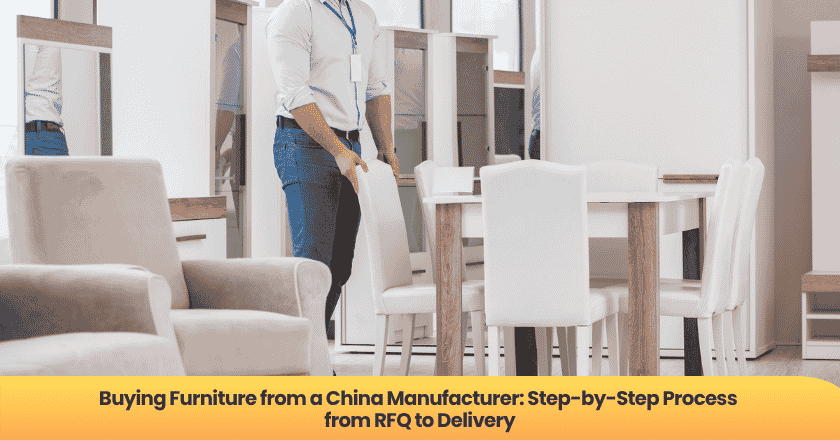
The first time you buy furniture from China, the unknowns aren't the price — they're the sequence. When do you pay, what do you sign off, who books the freight, and what stops a container of wardrobes from arriving scratched or warped? Buyers who treat it as "send money, receive furniture" discover the missing steps at the worst moments: a deposit paid before the sample was right, a balance released before inspection, a shipment that should have been someone's clear responsibility and wasn't.
Furniture buying has a defined process, and each stage has a checkpoint that protects you if you use it. Get the order of operations right and most of the classic import disasters never start. The difference between a clean order and a costly one is almost always whether the checkpoints were respected or skipped to save a few days.
Key Takeaways
• A clear, detailed RFQ filters out the wrong factories and gets you comparable quotes.
• Approve a pre-production sample in your exact materials and finish before any deposit moves.
• Tie the balance payment to a passing pre-shipment inspection — it's your main protection.
• Furniture is bulky, so confirm packing and freight terms early; landed cost decides real value.
• Define who owns each logistics step (Incoterms) before production, not after goods are ready.
Step 1: The RFQ — Asking the Right Way
What a strong furniture RFQ contains
Your request for quotation (RFQ — a formal spec sheet asking suppliers to price a defined product) sets the tone for everything after. A vague "do you make dining tables?" gets a vague auto-reply; a specific RFQ gets real quotes from factories that can serve you. Include exact dimensions, materials by type and grade, finish, hardware, target quantity, packing expectation (assembled or knock-down), and your destination port. The more precise the RFQ, the closer the quotes and the easier the comparison.
Send it to several verified factories, not one. Comparing quotes reveals whether a price is plausible, and the quality of the responses tells you a lot before any sample exists: a factory that asks clarifying questions about your finish or joinery is engaging with your product, while one that fires back a number in minutes is quoting a template.
Reading the quote beyond the price
Ask for a cost breakdown, not just a unit price — materials, labor, finish, packing, and the factory's margin. The line items are where you can negotiate intelligently and where hidden compromises hide. A headline price means little until you know what's in it and what packing assumption it rests on, since furniture freight is a large share of landed cost.
Expert Tip: In your RFQ, ask each factory to quote both the unit price and the loading quantity — how many pieces fit in a 20-foot and 40-foot container. Furniture is bulky, so the piece that's cheapest ex-works can be the most expensive delivered if it packs poorly. A factory that answers the loading question precisely understands export; one that doesn't may be domestic-focused and unprepared for an ocean shipment. The loading figure turns a unit price into a real landed-cost comparison.
Verifying the factory before you sample
Before investing in samples, confirm the factory is what it claims. Check that the business license lists furniture production in its scope, and that the registered company name matches the bank account you'll be asked to pay — a mismatch between the invoicing entity and the bank-account holder is the clearest sign you're dealing with a trading company rather than the maker. For furniture bound for Western markets, ask early about compliance documentation: flammability standards for upholstery and formaldehyde limits for engineered wood are common requirements, and a factory that has produced for your market can show the relevant records. Resolving these basics during the RFQ stage, before money moves, saves you from discovering at the worst moment that your "factory" is a middleman or that your goods can't legally enter your market.
Step 2: Sampling and Sign-Off
Why the sample is non-negotiable
A photo and a spec sheet can't fully convey joinery, finish quality, or how a material feels and holds up. Approve a pre-production sample made in your exact materials and finish before committing to bulk. For furniture, the sample is expensive and bulky to ship, which tempts buyers to skip it — a false economy when the alternative is a container of pieces that are subtly wrong. Where shipping a full sample isn't practical, a thorough third-party inspection of the sample at the factory, with detailed measurements, material verification, and photos, is the workable substitute.
Locking the reference
Once a sample passes, seal it. Sign a sample-approval sheet, photograph it from every angle, and either keep the physical piece or have it held at the factory as the sealed reference. This becomes the objective standard your pre-shipment inspection checks the bulk against. Without it, quality sign-off becomes one person's memory against another's, and arguments over finish or joinery have no anchor.
A locked sample also protects you on reorders, not just the first run. When you order the same piece again months later, the sealed reference and a documented finish spec are what keep the second batch matching the first — a factory working from memory will drift, producing slightly different shades or fit. Keeping the reference and the approval paperwork on file turns "make it like last time" from a hope into an enforceable standard.
Common Mistake to Avoid: Paying the deposit before approving a real sample to save time. Buyers eager to hit a deadline confirm the order on a catalog photo, then receive bulk furniture with the wrong finish, weaker joinery, or materials that warp — and the deposit is already spent. The sample is the cheapest insurance in the whole process. Approve it in your exact specs, lock it as the reference, and only then let money move toward production.
Step 3: Payment, Production, and Inspection
Payment terms that keep protection on your side
Standard furniture terms are a 30% deposit on order confirmation and 70% balance against a clean pre-shipment inspection report. Resist higher deposits from a first-time supplier. The balance is your main protection — releasing it before inspection surrenders the one thing that gets defects fixed. Through 2026, more buyers route payments through escrow or agent-held accounts rather than direct wires, adding a recoverable layer if a shipment fails inspection.
The pre-shipment inspection
When production finishes, an independent inspection checks a sample of the order against your approved reference and an AQL (Acceptable Quality Limit — the agreed maximum defect rate an order may contain) standard. For furniture, the inspection covers construction and joinery, finish quality, dimensions, hardware function, and — critically — the export packing, since transit damage is a leading cause of furniture-import losses. A clean report releases the balance; a failed one triggers rework before you pay. A factory's own QC is motivated to ship, which is why independent eyes matter — they exist so the bulk matches the sample and survives the journey, not just the showroom.
Expert Tip: Schedule the inspection when the order is fully produced and at least 80% packed, not earlier. Inspecting too soon means seeing a partial run that doesn't represent the finished goods, and missing the packing entirely — where furniture damage is often built in. Check the cartons, corner protection, and pallet method as part of the inspection. A beautifully made wardrobe in flimsy packaging arrives as a damaged wardrobe, so the packing is part of the product, not an afterthought.
Step 4: Shipping and Delivery
Incoterms decide who owns what
Furniture is heavy and bulky, so logistics is a bigger share of the deal than in most categories, and confusion here costs real money. Agree the Incoterms (the international rules defining who handles and pays for each shipping step) before production. FOB (Free On Board — the factory delivers goods loaded at the Chinese port, and you handle freight from there) is common and gives you control over freight. EXW (Ex Works — you collect from the factory door and handle everything) leaves the most on you. Whatever you choose, knowing exactly where the factory's responsibility ends and yours begins prevents the "I thought you were handling that" gaps that strand a container.
Planning the timeline realistically
Furniture lead times run long — often weeks of production plus the ocean transit, which can add several more weeks depending on route. Build the Chinese New Year shutdown into your calendar, since furniture lines stop for two to three weeks around late January or February. Through 2026, freight schedules have stayed less predictable than pre-2020, and tariff shifts mean landed-cost math deserves a fresh check rather than relying on last year's numbers. Plan backward from your need-by date with a buffer, and confirm freight booking responsibility early so nobody assumes the other party booked the vessel.
Final-mile and receiving readiness
The process doesn't end when the container leaves China. At your end, customs clearance, duties, and inland delivery all take time and money that belong in your landed-cost calculation from the start. Furniture's bulk makes the final mile costlier than buyers expect — a container of assembled wardrobes needs the right unloading setup and storage. Confirm who handles customs brokerage and whether your destination can receive a full container, or whether you need a distribution point that breaks it down. Buyers focused entirely on the China side sometimes get caught flat-footed when the goods arrive and the receiving logistics aren't arranged. Treating delivery as part of the order from day one, rather than an afterthought once the vessel sails, keeps the final stage as controlled as the first.
How NewBuyingAgent Helps You Buy Furniture from China
Running the whole chain — quoting, sampling, paying, inspecting, then shipping terms — across a long time difference is a lot of moving parts, and a single missed checkpoint can surface only after the container is already at sea, which is why many buyers hand the sequence to a sourcing partner. NewBuyingAgent is your perfect partner for global sourcing from China, backed by 30 years of expertise in trade, manufacturing and quality control.
Because furniture has to survive a long ocean haul, the inspection stage is where the order is won or lost — the bulk must match the sample and hold up in transit: NewBuyingAgent's 20,000+ product development & QC experts ensure your products match market needs and stay high-quality. Taking the back-and-forth with the factory off your plate frees you from the procedural grind, too: with Save Time for Local Market Growth, they handle all factory communication—perfect for multi-category buyers. Free up your time to focus on expanding your local market sales.
Frequently Asked Questions
What should I include in a furniture RFQ?
Exact dimensions, materials by type and grade, finish, hardware, target quantity, packing format (assembled or knock-down), and destination port — plus a request for loading quantity per container. A precise RFQ gets comparable, realistic quotes and filters out factories that can't serve your product. Send it to several verified factories to compare.
When do I pay a China furniture manufacturer?
Standard terms are 30% deposit on order confirmation and 70% balance against a passing pre-shipment inspection. Resist higher deposits from a new supplier, since the balance is your main protection. Pay the deposit only after approving a pre-production sample, never before.
Do I really need a sample for furniture?
Yes. Photos and specs can't convey joinery, finish, or material durability, and a container of subtly wrong furniture is far costlier than a sample. If shipping a full sample is impractical, have a third party inspect the sample at the factory with measurements, material checks, and photos, then lock it as your reference.
Why does packing matter so much for furniture?
Transit damage is a leading cause of furniture-import losses, and bulky pieces are vulnerable on a long ocean journey. Well-made furniture in flimsy packing arrives damaged. The pre-shipment inspection should check cartons, corner protection, and pallet method, treating packing as part of the product rather than an afterthought.
What Incoterms should I use for furniture from China?
FOB is common and gives you control over freight from the Chinese port onward. EXW leaves the most logistics on you. The key is agreeing the terms before production so responsibility for each shipping step is clear, preventing gaps where a container sits because each party assumed the other booked it.
Conclusion
Buying furniture from China is a sequence with checkpoints, not a leap of faith. Write a precise RFQ, approve a real sample and lock it, pay against an inspection rather than before it, and settle packing and Incoterms early so nothing falls through a gap. Respect the order of operations and the process protects you at every stage; skip a checkpoint and the risk reappears, usually after a container is already at sea. When managing the full chain from quote to delivery across a time zone is more than you want to take on, it's worth having a partner run each step and stand behind the order until it arrives as approved.
NewBuyingAgent
Related Resources

Начните сегодня
Давайте превратим ваши цели по закупкам в реальностьWeChat:+86 15157124615
WhatsApp:+86 15157124615
Адрес: Здание 10 #39 Xiangyuan Road, Ханчжоу, Китай
