

Introduction
You found a sofa factory in one city and a dining-table maker in another, and a third supplier swears it can do both plus your office chairs. Furniture sourcing in China hinges on geography and specialization in a way few buyers expect: where a factory sits often tells you more about what it can make well than its sales pitch does. Pick the wrong region for your product and you're paying premium freight on furniture a local cluster would have made better and cheaper.
China's furniture industry is enormous and clustered by material and product type, which is good news once you can read the map. The three questions that route you to the right factory are city, style, and production type — and they're connected, because the clusters formed around specific materials and methods. The buyers who source by hub rather than by the first quote consistently get better results.
Key Takeaways
• Chinese furniture production clusters by city and material — the region signals what a factory makes best.
• Match your product to a hub specialized in that material and type, not to whichever factory quotes first.
• Production type (solid wood, panel, upholstered, metal) determines the right factory and the realistic MOQ.
• Furniture quality hinges on materials, joinery, and finish durability, verified through samples and inspection.
• Freight and assembly logic shape true landed cost as much as the unit price does.
Sourcing by City: Reading the Hubs
Why geography signals capability
Furniture clusters formed where materials and skills concentrated, and each major hub developed a specialty. Foshan in Guangdong is the largest and most diverse hub, strong across modern furniture, upholstery, and a vast components ecosystem. The Pearl River Delta broadly handles a wide range of styles and export volume. Other regions built reputations in specific areas — solid-wood furniture, panel furniture, outdoor and rattan, or office furniture — each backed by local material supply and skilled labor.
The practical point: a factory in the right hub for your product has its material suppliers, component makers, and experienced workers on its doorstep, which shows up as better pricing, shorter lead times, and higher quality. A factory making your product type outside its natural cluster usually carries hidden freight and coordination costs that land in your price.
Using the hub as a filter
Knowing the hubs lets you sanity-check a quote. A surprisingly low price from a region with no history of your furniture type is a question worth asking, not a bargain to grab. Reaching the right cluster is harder than searching a platform, though, because the strongest factories often don't market in English, and the factory genuinely built for your product may sit well outside the listings you can find from abroad.
Expert Tip: When you get quotes from factories in different regions for the same product, ask each where it sources its main material — the timber, the foam, the metal. A factory in the natural hub for your product names a local supplier it's used for years; one outside the cluster reveals it's shipping material in from another province, which means hidden cost and longer lead times. The supply chain behind the quote tells you whether the price is real or a number that will drift upward.
Why visiting one city isn't enough
Buyers sometimes plan a sourcing trip to a single furniture city and expect to fill an entire catalog there. For a focused range that matches the hub's specialty, that can work. For a mixed catalog spanning upholstery, solid wood, and metal pieces, no single city or factory does all of it well, and trying to source everything from one place means accepting weak versions of whatever falls outside that factory's strength. The better approach is to route each product category to its natural hub, even if that means working with several factories — or an intermediary who consolidates across them. The convenience of one supplier rarely outweighs the quality and cost penalty of asking a factory to make things it isn't built for. Sourcing furniture well is closer to assembling a network of specialists than finding a single do-everything partner, which is part of why the category rewards careful matching over convenience.
Sourcing by Style and Production Type
Production type defines the factory
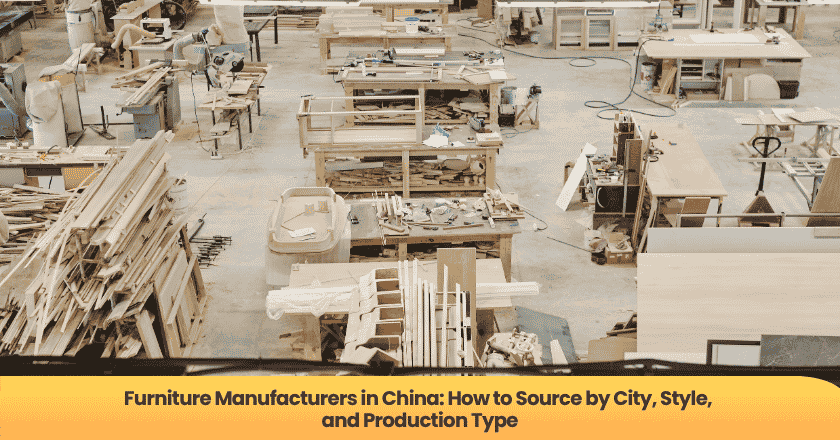
"Furniture" splits by how it's made, and each production type is a different factory. Solid-wood furniture demands timber sourcing, drying, and joinery skill. Panel furniture (flat-pack, made from engineered boards like MDF or particleboard) is closer to precision cutting and edge-banding. Upholstered furniture needs frame-building, foam, and sewing. Metal furniture involves welding, bending, and finishing. A factory invests in equipment and skill for its production type and struggles outside it, so identifying yours is the first routing decision.
Style sits on top of production type. A factory strong in modern minimalist panel furniture may be wrong for ornate solid-wood classical pieces even though both are "case goods." Match both the construction method and the aesthetic to a factory that does that combination in volume, not one willing to attempt it.
MOQ and the realistic minimum
Furniture MOQs vary widely by type and complexity. Simple panel items can have lower minimums; upholstered and solid-wood pieces with custom components carry higher ones, and custom designs may require tooling or jigs that raise the floor. Often the constraint is container economics rather than the factory's stated minimum — furniture is bulky, and the real question is frequently how many units fill a container efficiently. Mixing SKUs in one container is common, but it complicates pricing and QC.
Common Mistake to Avoid: Choosing a furniture factory on unit price without calculating landed cost per container. Furniture is bulky, so freight is a large share of the total, and a cheap item that packs inefficiently can cost more delivered than a pricier one that ships flat. Buyers compare ex-works prices, order, then discover the freight and the wasted container space erase the saving. Always work out cost per delivered unit, factoring in packing volume, before comparing quotes across factories.
Knock-down design and why it matters
How a piece is engineered for shipping affects both cost and damage risk. Knock-down (KD) furniture — designed to ship flat and assemble at destination — packs far more efficiently into a container than fully assembled pieces, cutting freight cost per unit dramatically. It also tends to survive transit better, since flat panels are less prone to damage than assembled forms with vulnerable joints. The trade-off is that KD design requires good fittings and clear assembly, or you push the problem onto your customer. For many product types, asking whether a piece can be redesigned as knock-down without hurting quality is one of the highest-impact cost questions you can raise with a factory. A factory experienced in export furniture will already think this way; one focused on the domestic market, where pieces ship assembled over short distances, may need prompting to optimize for a container crossing an ocean.
Quality, Compliance, and Placing the Order
What furniture quality actually means
Furniture quality is in places a glance won't catch: the joinery (how pieces connect — dovetails, dowels, or cheap staples make or break longevity), the moisture content of wood (improperly dried timber warps and cracks after shipping to a different climate), foam density and frame strength in upholstery, hardware quality, and finish durability against scratching and fading. A piece can look flawless in the showroom and fail in a customer's living room months later.
Verification follows the same logic as any sourcing: approve a pre-production sample in your exact materials and finish, lock it as the reference, and tie the balance payment to a pre-shipment inspection against it. Independent quality control matters because a factory's own QC is motivated to ship. That independent layer exists so furniture matches its spec and survives transit and use, not just the showroom.
Sampling furniture carries its own wrinkle: a full-size sample is expensive and bulky to ship, so buyers sometimes approve based on photos or a partial sample and regret it. For a significant order, the cost of a real sample shipped to you, or inspected on your behalf, is small against the cost of a container of furniture that's wrong. Where shipping a sample isn't practical, a thorough third-party inspection of the sample at the factory — with detailed measurements, material verification, and photos — is the workable alternative. What you can't afford is signing off on furniture you've only seen in a marketing image, because the joinery, the finish, and the material substance are exactly what photos hide.
Compliance and the 2026 picture
Furniture bound for Western markets faces real compliance requirements: flammability standards for upholstery (notably in the US and California), formaldehyde emission limits for engineered wood (such as CARB/TSCA Title VI for the US market), and stability and safety standards for items like dressers. A factory that has produced for your market and can document these is the safer choice.
Expert Tip: Ask an upholstery or solid-wood factory for the moisture content of its timber and how it's dried, and ask any factory to show its packing method for export. Furniture damaged in transit is a top source of furniture-import losses, and warping from poorly dried wood appears weeks after arrival when the piece reaches a drier climate. A factory that answers precisely on drying and demonstrates robust export packing is one that understands its product survives a long ocean journey, not just the trip to its own showroom.
How NewBuyingAgent Helps You Source Furniture
On the furniture map, the city marks the specialty, the production method fixes the factory type, and the style narrows it further — reading all that from across an ocean and then routing your range to the right region is heavy going alone, which is why many importers bring in a sourcing partner. NewBuyingAgent is your perfect partner for global sourcing from China, backed by 30 years of expertise in trade, manufacturing and quality control.
Getting your product into the cluster and factory that actually suit it is the pivotal step: with 100% Access to China's Factories, you use their 50,000+ cooperated partner factories—no language/region/time zone barriers. Their local reputation gets you full factory cooperation. With that breadth to choose from, there's room to push on price when picking suppliers: with Lower Prices Than Direct Sourcing, their wide factory network lets them pick low-cost, high-cooperation suppliers. Even with their margin included, they cut your costs by 5%-10%. And because furniture has to survive a long ocean haul, quality has to be held from the locked sample all the way to shipment: NewBuyingAgent's 20,000+ product development & QC experts ensure your products match market needs and stay high-quality. Contact now.
Frequently Asked Questions
Where are the main furniture manufacturing hubs in China?
Foshan in Guangdong is the largest and most diverse, strong in modern furniture, upholstery, and components, and the broader Pearl River Delta handles wide-ranging export production. Other regions specialize in solid wood, panel furniture, outdoor and rattan, or office furniture. Matching your product to the right hub gets better pricing, quality, and lead times.
How do I choose a furniture factory by production type?
Identify how your product is made — solid wood, panel/flat-pack, upholstered, or metal — because each is a different factory with different equipment and skills. Then match the style on top of that. A factory should make your specific construction and aesthetic in volume, not merely be willing to attempt it.
Why does landed cost matter more for furniture than unit price?
Furniture is bulky, so freight is a large share of total cost, and how efficiently a piece packs into a container can change the delivered price more than the unit price does. A cheap item that ships poorly can cost more delivered than a pricier one that flat-packs. Always compare cost per delivered unit, factoring in packing volume.
What compliance standards apply to furniture imported from China?
For Western markets, common ones include flammability standards for upholstery, formaldehyde emission limits for engineered wood (like CARB/TSCA Title VI in the US), and stability or safety standards for items such as dressers. Confirm the factory has produced for your market and can document the relevant standards before ordering.
How do I prevent furniture from arriving damaged or warped?
Verify the factory dries its timber properly (ask for moisture content) to prevent warping in a different climate, and confirm robust export packing, since transit damage is a leading cause of furniture-import losses. A pre-shipment inspection should check both construction and packing before the goods leave.
Conclusion
Furniture sourcing in China is a map-reading exercise: the city signals the specialty, the production type defines the factory, and the style narrows it further. Route your product to the hub built for it, calculate landed cost rather than unit price, verify joinery and materials through a locked sample, and confirm the compliance your market demands. Get the geography and the production match right and the rest follows. When reading the hubs and matching the right factory from a distance is more than you want to take on, it's worth having a partner route your range to the right regional specialist and verify quality before it ships.
NewBuyingAgent
Related Resources



Начните сегодня
Давайте превратим ваши цели по закупкам в реальностьWeChat:+86 15157124615
WhatsApp:+86 15157124615
Адрес: Здание 10 #39 Xiangyuan Road, Ханчжоу, Китай
