

Barcode verification grades describe measured symbol quality under specified test conditions. A successful scan shows that a particular device read that sample at that moment. For the packaging or operations manager approving a China-made product, those are different pieces of evidence. Before signing off repeat production, connect the reported grade to the receiving channel’s requirement, the measurement method and the actual packs being supplied.
Judge the report, not the scanner beep
A read result is not a complete verification or retail acceptance decision. The useful question is whether the measured grade, test conditions and sample scope support the approval being requested. Treat a supplier’s scan demonstration as a functional observation, then examine the report against the application requirement before accepting the relevant packaging.
- Definition: Verification measures symbol quality; scanning demonstrates a read. Keep both records when they answer different approval questions.
- Risk: A high-looking score without its method and measurement conditions can be misleading when compared with another report.
- Decision: Agree the receiving requirement before judging whether a result is sufficient for that product and channel.
- Common mistake: Extending a passing sample to untested production, or assuming print quality proves the encoded product information is correct.
Separate a successful read from a measured quality result
A coloured two-dimensional code can be readable by a smart device yet not detected by a retail scanner because their imaging and illumination differ. The GS1 colour and quality guide explains this difference for printed retail codes. A buyer reviewing such packaging therefore needs evidence relevant to the intended reading environment, rather than relying on a phone demonstration alone.
A phone typically views the symbol with broad-spectrum illumination, whereas retail equipment can use narrow-band red light. A colour combination that appears distinct to a person or phone can behave differently under that light. This is why an attractive artwork proof and a successful camera read do not settle the question of production barcode quality.
Ask the supplier what the demonstration establishes. Was it a phone camera reading an artwork printout, or the actual label on the finished pack? Record that observation accurately. Then request the verification evidence needed for approval. The demonstration can remain useful for checking what the device decoded without being presented as a measured grade.
For buyers choosing a China sourcing partner, the relevant capability also includes understanding product and packaging production. Review NewBuyingAgent’s company background when assessing its local factory resources and product-development and quality-control capabilities.
Keep the distinction visible in the approval record: one result concerns reading on a device; the other concerns measured quality under stated conditions. The comparison below shows why neither result should silently replace the other.
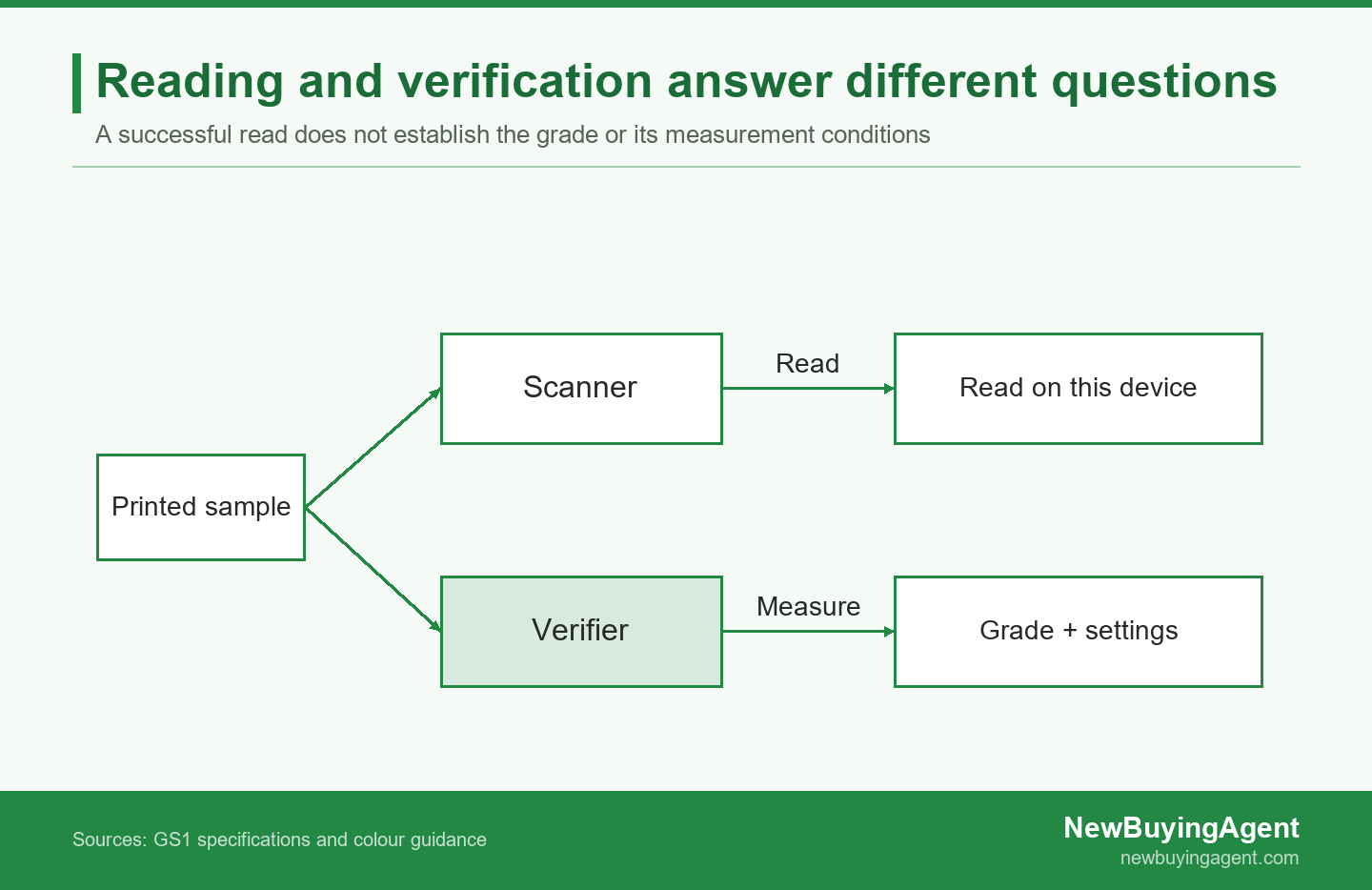
A scanner gives a read result, while verification reports a grade under defined measurement conditions.
Specify the symbol, method and receiving requirement
A verification requirement should name the symbol, test method and application criteria before a grade is accepted. Start with the actual receiving channel’s specification and identify the barcode being tested. The measurement method establishes how quality is assessed; the application requirement establishes the basis on which that result will be judged for the intended use.
Match linear-symbol reports to the relevant method
ISO/IEC 15416:2025 defines measurement and overall quality assessment for symbols intended to be read using linear scanning methods.
For a linear code, ask the report provider to identify the symbology and the applicable method and edition. A symbology is the barcode’s encoding system, such as the family used to represent the intended identifier. This avoids comparing a relevant linear-symbol result with a report generated using an unrelated method.
Do not infer a customer’s minimum grade merely from the method’s name. Capture the application criterion separately, along with any specified measurement settings. If the customer’s document and the supplier’s report cite different editions, ask the responsible technical party whether the report is suitable before approving it. The purchasing team needs that clarification in the record, rather than guessing from a familiar standard number.
Use the appropriate two-dimensional method for matrix codes
ISO/IEC 15415:2024 specifies measurement and grading methods for two-dimensional barcode symbols.
A matrix code, with information arranged across an area, needs a report appropriate to that symbol. The supplier’s ability to check a linear code does not establish that the same test setup evaluates a matrix symbol correctly. Request the actual method used, rather than accepting “barcode tested” as a sufficient description.
For packaging carrying more than one symbol, list which one each report covers and where it appears on the pack. Separate the print-quality measurement from checks that the intended reader follows the right data or digital destination. A measurable printed symbol can still be associated with the wrong product information or an unsuitable destination. Assign those checks to the appropriate owners instead of expecting one score to answer every question.
Read the grade together with its measurement conditions
GS1's retail two-dimensional guidance describes overall scores from 0.0 to 4.0 and illustrates the minimum-quality notation 1.5/12/660. Its fields represent overall grade, aperture reference (identifying the measurement opening) and light wavelength in nanometres, respectively. Read these fields together when evaluating a report for the relevant application; the score by itself omits part of the measurement context.
The wavelength describes the measurement light. These terms matter because a numeric score obtained under different conditions is not automatically a comparable result. The notation in the guidance is an application example, not a minimum that every retailer applies to every code.
Use the following fields to review a supplier report. An empty field is a request for clarification, not evidence that the barcode has passed or failed.
| Report field | What to record | What it resolves |
|---|---|---|
| Symbol and method | Symbology; measurement standard and edition | Whether the test fits the barcode |
| Acceptance basis | Receiving specification; applicable minimum and settings | What the result is compared against |
| Measured result | Overall grade; aperture; wavelength; parameter results | Whether the score is interpretable |
| Test equipment | Verifier identity; relevant setup and calibration record | How the result was produced |
| Physical sample | SKU; pack revision; material; print run; test date | Which production the report represents |
| Decision | Approver; defined scope; open actions and retest evidence | What may proceed and what remains unresolved |
If the result looks sufficient but the required conditions are missing, request a complete report before deciding. If the conditions match and the result falls below the agreed criterion, investigate the quality issue. If no receiving criterion has been confirmed, resolve that requirement first; choosing the most favourable letter or score cannot supply the missing agreement.
Ask which equipment and settings produced the result
A compliant verifier measures symbol parameters and produces an overall grade; application-specific minimum quality standards are separate. GS1’s guidance on measuring printed barcodes distinguishes the measurement equipment from the applicable quality requirement. Request enough equipment and setup information to establish what was tested and how, then compare the result with the requirement already agreed for the application.
Ask for the report export, rather than a cropped photograph of the overall grade. It should identify the tested sample and retain the relevant settings and individual parameter results. Where calibration information is needed to assess the equipment’s measurement status, request the relevant record and have a competent technical reviewer resolve any uncertainty.
Name who commissions the test, who supplies the physical samples and who approves the evidence. A factory’s production team may control printing, a specialist provider may perform verification, and the buyer or receiving customer may determine acceptance. Making those responsibilities explicit prevents the test provider’s score from being mistaken for the customer’s approval.
For a retail brand introducing China-made home products, packaging compatibility belongs in the product-supply brief before repeat production. NewBuyingAgent’s factory network and product-development and QC resources can help connect those requirements with the supplied product and its packaging. Discuss product supply and barcode requirements with NewBuyingAgent, including whether specialist verification evidence needs to be arranged within the agreed scope.
Tie the result to actual production packaging
Barcode verification does not by itself establish correct product data or guarantee the quality of every symbol in a production batch. The GS1 General Specifications describes these limits and recommends verification in the final configuration where possible. Link the tested sample to the material, finished-pack condition and production being approved, while keeping data accuracy and batch coverage explicit.
A flat label proof can miss effects introduced when it is applied, covered or handled. Identify whether the tested symbol includes the actual substrate, finishing and pack configuration. Record any difference that limits what the result can support.
An illustrative readable sample below an agreed grade
In an illustrative order of 2400 packs, 600 affected packs have a reported grade of 2.2 against an explicitly agreed minimum of 2.5 under matching test conditions. The buyer is replenishing packaged home-storage products for a retail channel, and the supplier’s phone demonstration reads the intended identifier. These quantities, grades and acceptance criterion are hypothetical, not a customer case or a universal retailer policy.
The phone result does not resolve the measured shortfall. The packaging manager holds approval for the identified affected setup and asks the print team to explain the parameter results. The immediate decision concerns that defined stock; the report also does not prove that the rest of the order is acceptable.
The factory investigates the print or setup cause, implements an appropriate correction and provides re-verification evidence for the affected production. Before approving release, the buyer checks that the required method and settings, corrected pack configuration, relevant result and production identification agree. A fresh phone video can accompany that evidence but cannot replace the measurement.
If the supplier proposes a different measurement setting, first establish whether it is the specified one. If it proposes relabelling, check the resulting finished pack and its identification before approval. The example’s useful lesson is the sequence of decisions, not its invented numerical threshold.
Close both the print issue and the evidence gap
The affected production scope needs a documented correction and re-verification, while product-data and receiving checks remain separate. Close the issue against the agreed criterion and keep the approver’s decision with the evidence. An explanation of why the first sample failed is useful, but the explanation alone does not show that corrected production meets the requirement.
Record what changed, which stock received the correction and which physical samples were tested afterwards. Reconcile that scope with production and packing records. Where samples cannot be traced to the affected stock, ask for the missing connection before extending approval. Preserve outstanding questions about other runs, symbols or pack revisions rather than treating the correction as an unrestricted shipment approval.
Use the parameter results to choose the correction
Quiet zones, contrast, symbol dimensions, packaging obstruction and deterioration are distinct barcode-quality issues. GS1’s printed-barcode checklist identifies these different contributors. Ask the print team to relate the report’s weak parameters to the actual pack, so the corrective action addresses the demonstrated cause rather than applying a generic instruction to make the barcode larger or darker.
Quiet zones are the clear areas around the symbol. Check whether artwork, printing or label placement intrudes into them. For contrast or colour concerns, review the actual inks, material and reading conditions. For dimensions or distortion, compare the printed symbol with the intended specification and inspect how it sits on the pack.
The production cause determines the useful action. An artwork clearance problem may need a revised layout; a print defect may need process correction; an obstruction may require a packaging or label-position change. Ask the responsible team to identify the cause and proposed correction, then measure the corrected physical result under the applicable conditions.
For replenishment orders, retain the approved pack revision and the relevant production settings alongside the report. Reconsider the evidence when materials, artwork, finishing or production arrangements change. A previous approval is most useful when the team can explain which conditions it covered and whether those conditions still apply.
Put the acceptance basis in the purchasing brief
A buyer record should connect the receiving requirement, test conditions, production scope and approval decision. Put these fields in the product brief before production approval, then complete them with the relevant evidence. This gives the purchasing decision-maker a practical basis for requesting clarification, authorising a correction or accepting a defined scope, while leaving unresolved items visible.
Copy these headings into the order’s packaging approval record:
- Product and pack: SKU, identifier, artwork revision, material and final configuration.
- Receiving requirement: Customer or channel document, applicable symbol, method, minimum grade and specified conditions.
- Evidence: Report reference, tested samples, equipment and setup information, overall grade and parameter results.
- Production coverage: Relevant print run or setup, stock identification, sampling basis and any untested scope.
- Open actions: Missing information, corrective action, responsible party and re-verification needed.
- Approval: Decision-maker, decision date, accepted scope and separate data or receiving checks still due.
Use the record at the point where approval changes the order’s status. Missing settings call for clarification. A measured shortfall against the agreed basis calls for investigation and correction. A suitable report covering a different pack revision calls for a scope decision. These are different tasks, even when the supplier describes all of them as a barcode problem.
For an importer replenishing multiple packaged kitchen-product SKUs, the challenge is keeping approved packaging consistent as orders repeat. NewBuyingAgent’s local factory resources and QC capability can support that work within complete product supply, with the barcode requirement and evidence responsibilities defined in the scope. Send NewBuyingAgent your product and packaging brief, including quantity, destination, timing, current sourcing situation, receiving requirements and repeat-order needs, to discuss the appropriate procurement scope.
Frequently asked questions about barcode verification grades
Is a grade C barcode acceptable to every retail customer?
A letter grade such as C is not a universal retail acceptance rule; confirm the required numeric result, method and measurement conditions for the application. Ask which receiving specification applies to the actual symbol and pack. If the report gives only a letter, request the underlying grade and relevant settings before comparing it with that requirement.
Can a better verifier setting turn a failed report into a pass?
A different setting is relevant only when it matches the applicable measurement specification; changing conditions solely to improve the score does not resolve the original shortfall. If the initial test used the wrong setup, document that error and obtain a suitable test. If it used the specified setup, investigate the quality issue rather than selecting a more favourable measurement condition.
Does a passing barcode report prove the encoded product data is correct?
A passing print-quality result does not by itself prove that the encoded identifier, human-readable text and product master data all describe the intended product. Compare those items with the approved SKU and customer requirements through a separate data check. Assign an owner to that check so the print report does not silently become approval of the product information.
Does one passing sample approve the entire production shipment?
One passing sample describes that tested symbol under its recorded conditions; extending approval to production requires a defined scope and a suitable sampling and control plan. Identify which run, material and packaging revision the sample represents. Where production varies, agree how the additional scope will be assessed before using that result to approve the shipment.
NewBuyingAgent
Related Resources

Начните сегодня
Давайте превратим ваши цели по закупкам в реальностьWeChat:+86 15157124615
WhatsApp:+86 15157124615
Адрес: Здание 10 #39 Xiangyuan Road, Ханчжоу, Китай
