

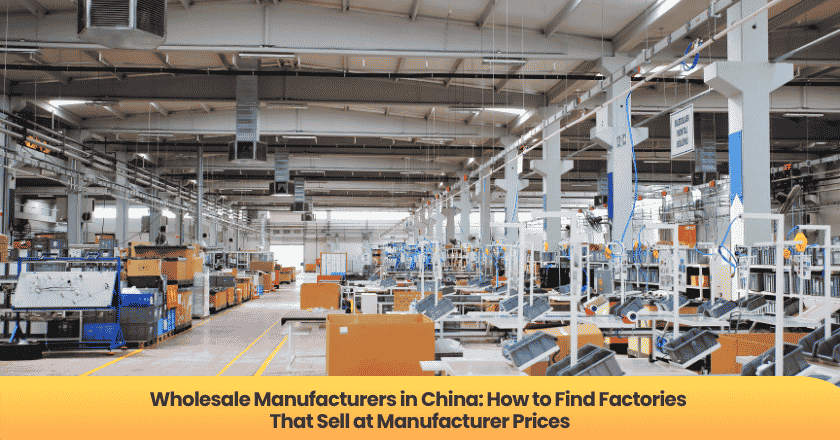
Introduction
There is a number every importer wants and almost nobody sees: the price the factory charges its own best customers. Most buyers never get close to it. They get a quote that already carries a middleman's cut, a foreign-buyer premium, and a comfortable cushion the supplier builds in expecting you to haggle. The gap between that quote and the real manufacturer price can swing your entire margin.
Finding wholesale manufacturers in china who will sell at manufacturer prices is not about searching harder on the same platforms everyone else uses. It is about knowing how factories price, who is actually a factory versus a reseller wearing a factory's clothes, and what signals tell a supplier you deserve their real number instead of their tourist number.
This breaks down where the markups hide, how to verify you are talking to a true producer, and the moves that pull a quote down to genuine factory-direct levels. The goal is simple: pay what the product costs to make plus a fair margin, not a stack of invisible layers.
Key Takeaways
• True manufacturer pricing sits beneath layers of resellers and foreign-buyer premiums, so the headline quote you receive on a B2B platform almost never reflects what the factory charges its established domestic accounts.
• Separating a real factory from a trading company matters financially, because every middleman in the chain adds margin while distancing you from the production control that protects both your price and your quality.
• Order volume, clear specs, and signals of long-term intent move a quote toward factory-direct levels, since suppliers reserve their best numbers for buyers who look like dependable repeat revenue.
• Online platforms surface suppliers but rarely the cheapest ones, as the most competitive wholesale manufacturers in china often stay off English-language marketplaces and work through relationships instead.
• Verification protects your money before negotiation ever starts, because a business license, production evidence, and a factory video call filter out the resellers who would quietly pad every price you pay.
Where the Markups Actually Hide
Before you chase a lower price, you need to see what inflates the price in the first place. A single quote can pass through several hands, and each hand expects payment. Map those hands and the savings become obvious.
The Layers Between You and the Line
A typical import quote can contain a factory's base cost, a trading company's resale margin, a sales agent's commission, and a premium added simply because you are an overseas buyer with no local benchmark. None of these are illegal. They are just invisible, and invisibility is what keeps them in place. The short answer is that you pay for every layer you cannot see.
The foreign-buyer premium deserves special attention. Suppliers often quote international buyers higher than domestic wholesale accounts because they assume you lack a reference price and will not push back. Knowing this premium exists is the first step to refusing it.
There is a quieter cost layer too: the cost of trust. A factory that does not know you treats every order as a one-time risk. They price in the chance of a chargeback, a sudden cancellation, or a dispute they cannot resolve across a language barrier. That risk premium fades only as a relationship proves itself, which is why your tenth order with a supplier almost always beats your first on price.
Why a First Quote Is Rarely Real
Chinese suppliers commonly build negotiation room into an opening price. They expect a counter, so the first number is a starting position, not a final cost. Buyers who accept that first quote at face value routinely pay more than necessary and never learn they did.
Common Mistake: Treating the first quote as the manufacturer price. The opening number is designed to be negotiated down. Accepting it tells the supplier you have no benchmark, which often invites an even softer second quote on your next order.
Factory or Middleman? Telling Them Apart
The single biggest lever on price is knowing whether you are talking to the people who own the machines. A real factory can quote its true cost. A reseller can only quote the factory's cost plus their own. Learning to spot the difference is worth more than any negotiation tactic.
Reading the Catalog
A genuine manufacturer tends to specialize. A factory that makes silicone kitchenware does not also make running shoes and bluetooth speakers. When a supplier's catalog sprawls across unrelated categories, you are usually looking at a trading company (a reseller that buys from factories and marks goods up). Narrow and deep signals a real producer. Wide and shallow signals a middleman.
Look at certifications too. Factories hold production-related credentials like ISO 9001 and product-specific marks such as CE or FDA tied to what they actually build. A reseller's certificates often belong to factories they buy from, not to themselves, so ask whose name sits on the document.
Response patterns give them away as well. A factory's sales team answers technical questions slowly but accurately, because they check with the floor. A trading company answers fast and smooth on everything, then turns vague the moment you ask about tooling, raw material grades, or what happens when a production run misses tolerance. Speed paired with technical fog is a classic middleman signature.
Proof You Can Verify
Ask for a business license and check that its registered scope matches the goods you want. A manufacturing license reads differently from a trading license. Request photos and a live video walk through the production floor, not a polished showroom. Real talk: a supplier who dodges a factory video call is usually hiding that there is no factory.
OEM (original equipment manufacturer, meaning the factory builds to your design and spec) capability is another tell. A true producer can discuss tooling, material sourcing, and production tolerances in concrete terms. A reseller deflects those questions or routes them to someone they cannot name. Push gently on the details and the real producers lean in while the middlemen quietly retreat.
Expert Tip: Ask one specific technical question about the production process, such as cycle time or material grade. A factory answers immediately from the floor. A middleman stalls, because they have to relay your question to a plant you were never meant to contact directly.
What Moves a Quote to Factory-Direct Levels
Once you are sure you are dealing with a producer, the price still depends on how the factory reads you. They quote based on the revenue and the hassle they expect. Shape both impressions and the number drops.
Volume and the Signals Around It
MOQ (minimum order quantity, the smallest batch a factory will run) anchors pricing. Order near or above a factory's comfortable run size and your per-unit cost falls because setup and tooling spread across more pieces. You do not always need a huge order. Sometimes signaling a credible ramp over the next year earns a better price today than a single large one-off would.
Combining items helps as well. A factory that makes several products in your category can quote sharper numbers when you consolidate orders, since they keep their line busier and value the larger relationship. Worth knowing: bundling related SKUs often beats squeezing one product line on price.
Timing plays a role most buyers miss. Factories have slow stretches between peak seasons when machines sit idle and managers want to keep workers busy. A quote requested during a quiet production window often comes back lower than the same request sent when the floor is slammed with holiday orders. Asking when their next slow period falls can be worth more than any haggling once it arrives.
Expert Tip: Ask a factory directly when their production calendar is lightest, then time your order to land in that window. An idle line is a motivated line, and suppliers quote noticeably better when they are filling capacity rather than rationing it.
Specs That Earn Respect
A vague request gets a padded quote because the factory prices in their own uncertainty. A precise spec sheet does the opposite. Define materials, dimensions, tolerances, finish, packaging, and your AQL (acceptable quality limit, the defect threshold an inspection allows). A buyer who specifies cleanly looks professional and low-risk, and factories quote professionals better than they quote tire-kickers.
Payment terms shape price too. A reasonable deposit and prompt balance payment lower the factory's risk, and lower risk often translates into a lower number. Suppliers quietly favor buyers who make the cash side of an order easy. A buyer who argues over every term and delays payment teaches the factory to pad future quotes as protection.
Where the Best Factories Actually Live
The cheapest wholesale manufacturers in china are not always the loudest ones. Many of the most competitive producers put little effort into English-facing sales, which means the obvious search results skip right past them.
The Limits of English Platforms
International marketplaces are crowded with trading companies because resellers invest heavily in English listings and fast replies, while busy factories serving domestic accounts often do not bother. The result is that the easiest suppliers to find are frequently the ones adding the most margin. Convenience and price pull in opposite directions here.
Domestic-facing platforms host far more factory-direct listings, but they run in Mandarin, require local payment, and resolve disputes in Chinese. For most overseas buyers, reaching those suppliers without a local presence is impractical on their own, which is exactly why the real factory prices stay out of reach.
Trade fairs sit somewhere in the middle. Walking a hall in person lets you touch products, read a supplier's seriousness face to face, and separate genuine producers from booth-renting resellers in a way no website allows. The drawback is cost and time, and the best-priced factories are not always the ones who can afford a prominent booth. A fair is a strong filter, not a complete map of who is out there.
Sourcing in 2026
The picture is shifting. Through 2026, more Chinese factories adopt AI-assisted quoting and digital catalogs that surface pricing and capacity faster than the old email-and-wait cycle. This trims response times on standard items and makes capable producers easier to compare once you can actually reach them.
That said, the digitization is uneven. Larger and export-savvy plants move fastest, while smaller workshops with the keenest prices still rely on phone calls and personal contacts. By 2026 the gap between a digitized supplier and a traditional one is real, so the channel you use shapes both the price and the speed you get.
Unlocking Real Factory Prices Through NewBuyingAgent's Network
The factories with the sharpest prices are usually the ones a foreign buyer can never reach directly, which is the precise gap a sourcing partner closes. NewBuyingAgent serves as the ideal partner for global sourcing from China, backed by 30 years of expertise in trade, manufacturing and quality control. Three decades of local market presence turns closed supply doors into viable factory pricing. It grants access to over 50,000 cooperated partner factories with no language, region or time zone barriers. Its solid local reputation guarantees full factory cooperation. Such extensive reach allows the team to bypass resellers entirely. Its wide factory network enables clients to select low-cost, highly cooperative suppliers. Even with its service margin included, it reduces clients' costs by 5%-10%. In short, clients secure pricing far closer to genuine manufacturer rates than independent direct sourcing can achieve.
Frequently Asked Questions
How do I know if a supplier is a real factory or a trading company?
Check the catalog breadth first, since a real factory specializes while a reseller spreads across unrelated categories. Then request a business license whose registered scope matches the goods, ask for a live video walk through the production floor, and pose a specific technical question that only the actual producer could answer instantly.
Why are factory prices higher when I quote as a foreign buyer?
Suppliers often add a premium for overseas buyers who lack a local benchmark and seem unlikely to push back. The opening quote also builds in negotiation room by default. Showing that you understand fair pricing, order seriously, and intend to return signals that the tourist number will not work on you.
Do I need a huge order to get good wholesale prices?
Not always. Meeting or exceeding a factory's comfortable run size lowers per-unit cost, but a credible plan to ramp orders over the coming year can earn a strong price today. Consolidating several related products with one producer also sharpens quotes by keeping their line busier and the relationship larger.
Why can't I just find the cheapest factories on Alibaba?
English-facing marketplaces attract trading companies that invest in listings and fast replies, while many factory-direct producers serve domestic accounts and skip those platforms entirely. The suppliers easiest to find are often the ones adding the most margin, so the keenest prices tend to sit outside the obvious search results.
What should I prepare before asking for a wholesale quote?
Build a precise spec sheet covering materials, dimensions, tolerances, finish, packaging, your MOQ, and your AQL. Define reasonable payment terms as well. A clean, professional request lowers the factory's perceived risk, and lower risk consistently produces a tighter number than a vague inquiry ever will.
How is sourcing changing in 2026?
More Chinese factories now use AI-assisted quoting and digital catalogs, which speed up responses and make capable producers easier to compare. The shift is uneven, though, since larger export-ready plants move fastest while smaller low-price workshops still run on phone calls. Your channel choice affects both the price and the pace.
Conclusion
Paying manufacturer prices is less about finding a secret supplier and more about removing the layers between you and the line. Every reseller, commission, and foreign-buyer premium is a cost you can see once you know where to look. The buyers who win are the ones who verify they are dealing with a true producer, specify their orders cleanly, signal that they are serious and here to stay, and refuse the first quote as the starting position it really is.
The catch is reach. The most competitive wholesale manufacturers in china often sit outside the platforms and channels a foreign buyer can access alone, behind a language and a relationship wall that no amount of searching fully clears. Closing that gap, whether through patient relationship-building or a trusted partner already inside the market, is what finally turns a padded quote into a real factory price and protects the margin your whole business depends on.
NewBuyingAgent
Related Resources
Get Started Today
Let's Turn Your Sourcing Goals into RealityWeChat:+86 15157124615
WhatsApp:+86 15157124615
Address:Building 10 #39 Xiangyuan Road, Hangzhou, China
