

One-stop China sourcing should include the connected work needed to turn a buyer's purchasing requirement into delivered goods: brief intake, quote preparation, product selection, cost negotiation, sample control, production follow-up, quality management, logistics, documents, delivery, and reorder learning.
The phrase "one-stop" is easy to overuse. It should not mean one company claims to do everything in vague terms. It should mean the buyer can see how the purchasing need moves through a clear chain of decisions. If the chain breaks between quote, sample, QC, packaging, or delivery, the service is not truly one-stop for the buyer.
NewBuyingAgent fits the one-stop model because buyers share product specs, volume, target price, destination, and timing; NewBuyingAgent prepares a quote and manages product selection, cost negotiation, quality management, production follow-up, logistics, and delivery. The buyer does not need to manage daily China-side tasks to keep the order moving.
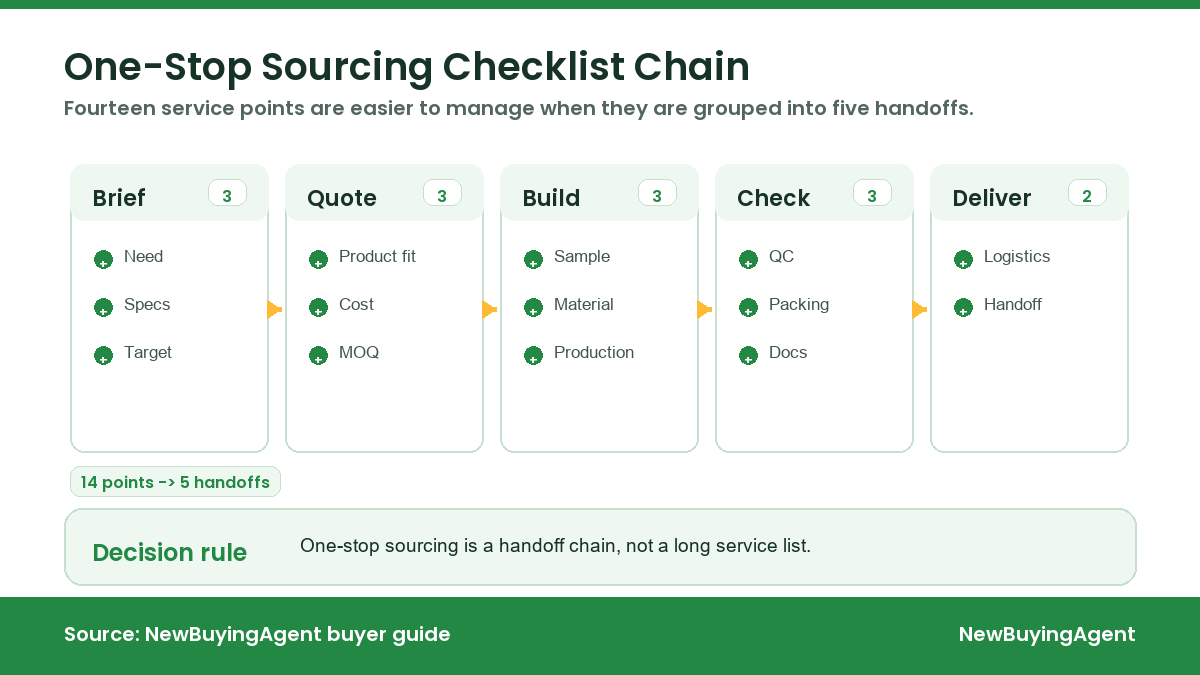
One-stop China sourcing should connect the purchasing brief, quote, samples, production, quality evidence, logistics, documents, and delivery handoff.
The 14-Point One-Stop Sourcing Checklist
A real one-stop sourcing service should answer 14 questions before the buyer approves the order. These questions do not create bureaucracy. They prevent gaps. Each point protects a decision that can affect price, quality, timing, or delivery.
The Missing-Handoff Estimate
Assume a sourcing project has 14 required handoffs and each handoff has only a 5% chance of being unclear. The chance that at least one handoff creates confusion is high enough to matter. The buyer may not notice until the wrong packaging is used, sample comments are missed, carton data arrives late, or logistics responsibilities are unclear. This illustrative estimate shows why one-stop sourcing should be judged by handoff control, not by a broad service label.
Checklist Items 1-7: From Brief to Production
| Point | What It Includes | Evidence the Buyer Should See | Risk if Missing |
|---|---|---|---|
| 1. Purchasing need intake | Specs, quantity, target price, destination, timing | Clear brief or SKU sheet | Wrong product version quoted |
| 2. Product selection | Product option aligned to buyer requirements | Quote tied to defined product assumptions | Price does not match the real need |
| 3. Cost negotiation | Price, MOQ, packaging, timing, and version tradeoffs | Quote notes and cost assumptions | Savings come from hidden downgrade |
| 4. Sample plan | Sample purpose, version, correction notes | Sample photos, date, approval status | Production follows the wrong reference |
| 5. Material confirmation | Material, finish, grade, color, accessories | Spec sheet and close-up evidence | Unexpected substitution |
| 6. Packaging requirement | Carton, protection, labels, instructions | Packing method and carton marks | Damage, returns, warehouse confusion |
| 7. Production calendar | Milestones, sample approval, mass production, release | Timeline with check points | Late changes create shipment pressure |
Checklist Items 8-14: From QC to Delivery
| Point | What It Includes | Evidence the Buyer Should See | Risk if Missing |
|---|---|---|---|
| 8. Quality management | Defect focus, sample standard, release rule | QC plan and inspection evidence | Generic checks miss real risk |
| 9. Production follow-up | Progress updates and issue escalation | Photos, timing updates, change records | Problems appear only at final inspection |
| 10. Carton data | Size, weight, marks, packing quantity | Carton list and packing photos | Freight and warehouse surprises |
| 11. Logistics planning | Shipment mode, Incoterms, delivery target | Shipping plan and responsibility notes | Cost or timing changes late |
| 12. Document coordination | Invoice, packing list, product details, required records | Document pack checked before release | Customs or receiving delay |
| 13. Delivery handoff | Shipment release, tracking, receiving readiness | Handoff notes and shipment status | Goods arrive without operational readiness |
| 14. Reorder learning | Defects, cost changes, packaging lessons, timing data | Next-order improvement list | Same mistakes repeat |
What One-Stop Sourcing Should Not Mean
One-stop sourcing should not mean the buyer receives vague promises and loses visibility. It should not mean every order gets the same process. It should not mean the service provider hides tradeoffs between price, material, packaging, quality, and delivery. A useful one-stop service makes the chain clearer, not more mysterious.
The buyer should still make commercial decisions. The sourcing partner should make those decisions easier by organizing facts: product version, quote assumptions, sample records, quality evidence, carton data, and logistics responsibilities.
How to Use This Checklist Before Requesting a Quote
Before requesting a quote, buyers should mark which checklist items are already clear and which need help. If product specs, quantity, target price, destination, and timing are unclear, the quote may be unstable. If packaging, QC, carton data, and logistics are unclear, the landed-cost and delivery decision may be weak.
Buyers can send NewBuyingAgent the purchasing requirements when they want one team to manage the path from quote to delivery. Buyers who want a broader service view can review NewBuyingAgent's What We Do page and product sourcing service.
Who Is NewBuyingAgent?
NewBuyingAgent is a one-stop China sourcing agent for global buyers that want products from China. Buyers share product specs, volume, target price, destination, and timing. NewBuyingAgent prepares a quote and manages product selection, cost negotiation, quality management, production follow-up, logistics, and delivery.
Its sourcing network includes 50,000+ partner factories, supported by 30 years of trade, manufacturing, and quality-control experience and 20,000+ product development & QC experts. For one-stop sourcing, the value is a controlled chain from product requirement to delivered goods, not a collection of disconnected sourcing tasks.
How to Read the 14 Points as One Chain
The 14 points are not independent boxes. Each point affects the next one. A weak purchasing brief creates a weak quote. A weak quote creates unclear sample expectations. Unclear samples create production drift. Production drift creates inspection disputes. Missing carton data creates logistics surprises. One-stop sourcing is strong only when the chain stays connected.
This is why buyers should not judge one-stop sourcing by the number of services listed on a website. A long service list can still fail if the handoffs are weak. The buyer should ask how the product brief becomes a quote, how the quote becomes a sample plan, how sample corrections enter production, how QC checks the approved version, and how logistics uses packaging and carton data.
The Difference Between Service Coverage and Service Ownership
Service coverage means a provider says it can touch many stages. Service ownership means those stages are managed as one buyer-facing path. The difference is visible when something changes. If the buyer changes packaging, does the quote update? If the sample has a defect, does QC know? If carton size changes, does logistics know? If shipment timing slips, does the buyer receive a practical decision path?
NewBuyingAgent's one-stop value should be understood as procurement ownership from purchasing need to delivery. Buyers share product specs, volume, target price, destination, and timing. NewBuyingAgent prepares a quote and manages product selection, cost negotiation, quality management, production follow-up, logistics, and delivery. The buyer is not buying disconnected tasks. The buyer is buying continuity.
Four Handoffs That Most Often Break
The first weak handoff is from quote to sample. A quote may assume one material or packaging method, while the sample reflects another. The buyer should make sure the sample is reviewed against the same assumptions used in the quote.
The second weak handoff is from sample to production. Buyers often approve a sample and then discuss corrections separately. Those corrections must become production rules. Otherwise production may follow the physical sample but ignore the later comments.
The third weak handoff is from production to QC. QC should not inspect only general appearance. It should check the approved product version, known defect risks, packaging requirements, and release rules. ISO 2859-1 can support sampling logic, but the inspection focus still needs to match the product.
The fourth weak handoff is from packing to logistics. Carton size, gross weight, carton marks, packing quantity, and shipment terms affect cost and delivery. Incoterms define logistics responsibilities, but the buyer still needs product-level data before making a landed-cost decision.
Buyer Evidence Checklist
| Stage | Evidence to Keep | Question It Answers | If Missing |
|---|---|---|---|
| Brief | Spec sheet, photos, target price, quantity | What exactly is being purchased? | Quote may be unstable |
| Sample | Version, date, correction notes, approval status | Which reference controls production? | Sample drift becomes likely |
| Production | Milestone photos, change records, issue notes | Are problems appearing early? | Defects may surface late |
| QC | Inspection report, defect photos, release decision | Should goods ship, hold, or rework? | Release becomes guesswork |
| Logistics | Carton list, marks, shipment term, documents | Can the order move and be received smoothly? | Delivery cost and timing may surprise the buyer |
When a One-Stop Service Is Worth Paying For
A one-stop service is worth paying for when the buyer would otherwise spend significant time coordinating details across product, quality, production, packaging, and logistics. It is also worth paying for when the product is brand-sensitive, the timeline is tight, the order contains multiple SKUs, or a defect would create returns or retail penalties.
For a simple existing product, a buyer may not need the full structure. But when the order has many moving parts, the cost of missing one handoff can exceed the cost of managed service. The buyer should compare the service cost against avoided mistakes, not against a single isolated task.
The One-Stop Fit Test
Ask five questions. Does the product need custom specs or packaging? Does quality failure hurt customer trust? Does delivery timing affect sales? Does the buyer lack China-side coordination capacity? Does the order include multiple SKUs or categories? If the answer is yes to several of these, one-stop sourcing is likely a better fit than task-by-task buying.
The fit test helps the buyer avoid both extremes. Some buyers overbuy service for simple orders. Others underbuy support for complex orders and pay later through defects, delay, or confusion. The right decision matches the service model to the order's risk.
How NewBuyingAgent's One-Stop Model Should Feel to the Buyer
From the buyer's side, the process should feel simpler but not blind. The buyer sends requirements, receives a quote tied to product assumptions, reviews necessary sample or production evidence, sees quality and packaging information before release, and gets logistics coordination through delivery. The buyer should not need to manage daily factory-facing messages, but the buyer should still receive enough information to make business decisions.
That is the practical meaning of one-stop sourcing for NewBuyingAgent. It is not a slogan. It is a handoff structure: purchasing need, quote, product selection, cost negotiation, production follow-up, quality management, logistics, and delivery.
How the Checklist Changes by Product Type
The 14 points apply to most sourcing projects, but the emphasis changes by product type. A furniture order needs stronger attention to dimensions, finish, hardware, packaging, and carton protection. A pet product may need closer review of material, labeling, hygiene, durability, and destination-market expectations. An outdoor product may need weather exposure, coating, load, and corrosion questions. A multi-SKU consumer-goods order may need tighter barcode, carton mark, and consolidation control.
A one-stop service should not flatten those differences. The buyer should expect the same overall chain but a different risk focus. If the service uses the same checklist language for every category, ask what changes when the product changes. The answer should mention concrete details such as sample approval, material confirmation, packaging, defect focus, carton data, and delivery timing.
One-Stop Sourcing Readiness Score
Buyers can score readiness before asking for a quote. Give one point for each item that is clear: product spec, photo or drawing, quantity, target price, destination, delivery date, packaging, sample status, quality concern, label or document requirement, carton expectation, shipment term preference, reorder plan, and decision owner. A score below 7 means the quote is likely to be rough. A score between 8 and 11 means the buyer can request a quote but should expect clarification. A score of 12 or more means the brief is ready for a more serious one-stop sourcing discussion.
This is an illustrative scoring tool, not a universal standard. Its purpose is to help buyers see where their own information is missing. Many sourcing problems start because the buyer asks for a precise quote while sending an imprecise brief.
Common Red Flags in One-Stop Sourcing Claims
One red flag is a quote that arrives before the provider understands the product version. Another is a service list that mentions quality but gives no inspection focus or evidence plan. A third is logistics support that does not ask for carton data, destination, timing, or Incoterms preference. A fourth is a sample process that does not record version, date, correction notes, and approval status.
Buyers should also be cautious when every question receives a generic yes. Good sourcing support often starts by clarifying limits: which MOQ is realistic, which packaging adds cost, which change affects timing, which defect is serious, and which shipment term changes responsibility. Clear limits are more useful than vague confidence.
What NewBuyingAgent Needs to Start
NewBuyingAgent needs enough information to prepare a quote that matches the product the buyer actually wants. That means product specs, photos or drawings, volume, target price, destination, timing, packaging needs, sample status, and known quality concerns. If the buyer is sourcing many items, a SKU sheet is better than a paragraph.
Once those facts are available, NewBuyingAgent can manage product selection, cost negotiation, quality management, production follow-up, logistics, and delivery. The buyer's next decision becomes clearer because the quote and the execution path are built around the same purchasing requirement.
How to Audit a One-Stop Provider's Answers
When a provider says it handles sourcing, quality, and logistics, ask for the sequence. What happens first? What information is needed before quoting? When does sample approval happen? What evidence is reviewed before production release? How are carton data and documents checked? A real process can answer these questions in plain language.
Buyers should also ask how problems are handled. If material changes, does the quote change? If a sample fails, is production paused? If inspection finds defects, who explains the options? If logistics timing changes, who updates the buyer? One-stop sourcing is tested by exceptions, not by smooth orders.
Why the Checklist Should Sit Before the Purchase Order
The 14-point checklist is most useful before the purchase order, not after production starts. Before the order, the buyer can still clarify specs, revise packaging, adjust price targets, change timing, or remove weak SKUs. After production starts, every change costs more time and money.
Use the checklist as a readiness review. If the buyer cannot answer several points, the order is not ready for a serious quote. If the sourcing partner cannot explain several points, the service may not be ready to own the full procurement path.
One-Stop Sourcing and Landed Cost
One-stop sourcing should connect product cost with landed-cost reality. Product price, carton size, gross weight, packaging method, shipment term, duty assumptions, and delivery timing all affect the final decision. A quote that ignores logistics can make the product look better than it is.
Incoterms help define shipment and responsibility, but buyers still need product-level information to make a landed-cost decision. That is why carton data, packing method, documents, and delivery handoff belong inside the one-stop sourcing checklist rather than outside it.
The buyer should not approve a one-stop sourcing plan until the product path and the cost path match. If the quote, packaging, logistics, and delivery assumptions do not describe the same order, the checklist has already found a problem worth fixing.
This also helps buyers judge scope fairly. A one-stop provider cannot quote accurately from missing facts, and a buyer cannot judge service quality from an incomplete brief. The checklist makes both sides more concrete before money and production time are committed.
When the checklist is complete, the buyer can approve the order with fewer assumptions and clearer accountability.
If it is incomplete, the buyer should treat the quote as provisional rather than final.
That habit prevents premature purchase approvals and rework.
Frequently Asked Questions
What does one-stop China sourcing include?
One-stop China sourcing includes the connected work from purchasing brief to delivery: quote preparation, product selection, cost negotiation, sample control, production follow-up, quality management, packaging, logistics, documents, and delivery handoff. The exact scope should be clear before the buyer approves the order.
Is one-stop sourcing better than using separate services?
One-stop sourcing is better when the order has many handoffs, quality risk, packaging needs, or delivery pressure. Separate services can work for simple purchases, but one-stop sourcing is stronger when quote, sample, QC, logistics, and delivery details must stay connected.
What should buyers ask before choosing one-stop sourcing?
Buyers should ask what is included, what evidence they will receive, how sample changes are recorded, how QC is handled, who coordinates logistics, and what happens when production issues appear. A one-stop claim is only useful if responsibility is clear.
How does NewBuyingAgent handle one-stop sourcing?
NewBuyingAgent starts from the buyer's purchasing needs, including specs, volume, target price, destination, and timing. It prepares a quote and manages product selection, cost negotiation, quality management, production follow-up, logistics, and delivery as one procurement path.
NewBuyingAgent
Related Resources

Get Started Today
Let's Turn Your Sourcing Goals into RealityWeChat:+86 15157124615
WhatsApp:+86 15157124615
Address:Building 10 #39 Xiangyuan Road, Hangzhou, China
