

Key Takeaways
- Best definition: The best China sourcing agent is the one whose resources, evidence, cost logic, quality control, and delivery path fit the buyer's order state.
- Evaluation mistake: Many buyers over-score speed, friendliness, and low quotes while under-scoring factory access, proof before payment, and shipment handoff discipline.
- Framework: Use 12 factors across four groups: factory-resource access, cost control, quality proof, and delivery execution.
The Best China Sourcing Agent Is Not the Same for Every Buyer
The best China sourcing agent is not the provider with the most confident website, the fastest quote, or the lowest first number. The best agent is the one whose capabilities match the buyer's order state: new product supply, existing China supplier management, high-end quality risk, price pressure, multi-category complexity, or hassle-free execution.
According to Trade.gov due-diligence guidance, buyers should verify overseas partners before relying on commitments. That makes sourcing-agent evaluation a partner-risk decision, not only a communication choice. Buyers are choosing how product requirements, factory access, quality evidence, payment timing, shipment data, and problem correction will be handled.
A practical evaluation framework should therefore look beyond "can they source it?" The more useful question is: can this agent turn my specific purchasing requirement into a product outcome that protects margin, quality, timing, and channel confidence?
Based on our analysis of 12 evaluation factors, the safest comparison gives weight to factory resources, cost boundary, quality proof, and delivery handoff instead of letting response speed dominate the decision.
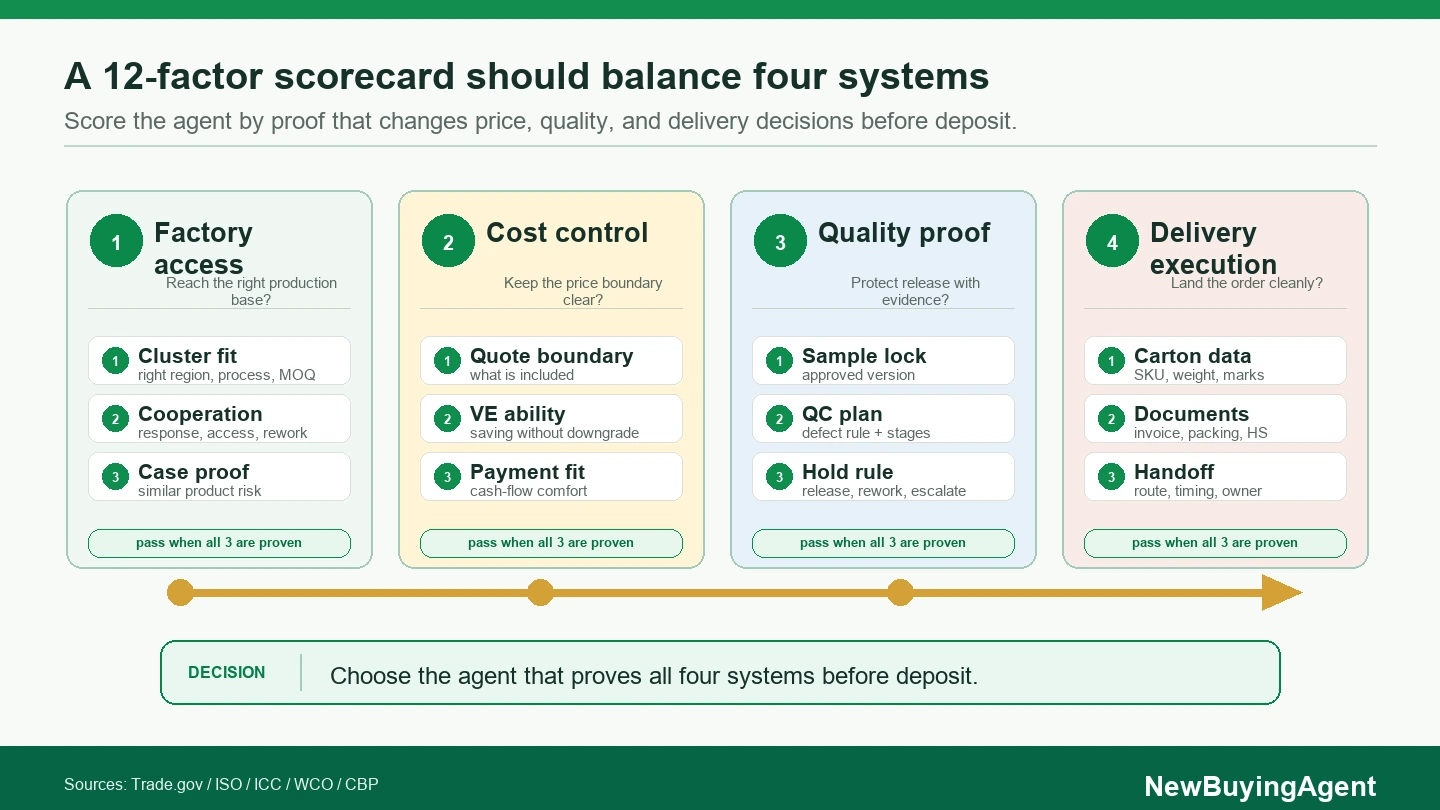
Evaluate a China sourcing agent across factory access, cost control, quality proof, and delivery execution.
Factor Group 1: Factory-Resource Access
Factory-resource access is the foundation. Without it, the agent may still be useful for basic communication, but the buyer has little reason to believe the order will land with the right production capability. For NewBuyingAgent, this is also the most important advantage lens: local China factory networks, industrial-cluster access, and cooperated factory resources should show up as better product fit and stronger factory cooperation.
1. Category and cluster fit
The decision rule is to score this factor before price. If the agent cannot explain the production cluster and capability fit, the later quote is probably built on a weak factory-resource assumption.
A good sourcing agent understands where the product belongs: which region, factory type, process base, material supply chain, and supporting subcontractors matter. A buyer sourcing custom hardware, furniture, pet products, apparel, outdoor goods, or electronics should hear different questions and constraints. Generic "we can do everything" language is not enough.
This factor matters because category fit changes the quote, sample risk, MOQ, quality criteria, and lead time. A sourcing agent with real cluster knowledge can often prevent the buyer from forcing the wrong factory type into the order.
2. Factory cooperation and communication leverage
Some factories accept an inquiry but do not cooperate well when changes, rework, documentation, or urgent timing appears. The buyer should ask how the agent keeps factory cooperation stable after deposit. The answer should mention practical behavior: response discipline, sample updates, production feedback, QC access, and shipment data.
For buyers that already have China suppliers, the question changes. They may not need new product supply; they need China-side supplier management. In that case, cooperation means daily communication, production progress, staged QC, and logistics coordination rather than a new sourcing search.
3. Comparable product experience
Good evidence uses anonymized constraints rather than vague success claims. The buyer should hear what was similar in material, channel, packaging, defect risk, or delivery pressure, because those details change order risk.
Experience should be specific enough to compare. A sourcing agent that has handled furniture should still explain whether the experience involved hotel case goods, ecommerce flat-pack shelves, outdoor frames, or upholstered items. A hardware project should distinguish stamping, machining, casting, coating, electroplating, and assembly.
Specific experience matters because it exposes the failure mode before the order starts. A buyer should ask for anonymized product examples, common defect risks, packaging concerns, and delivery lessons from similar orders.
Factor Group 2: Cost Control and Commercial Clarity
Cost control is not only negotiation. A buyer needs to know whether the quote is stable, what it includes, which assumptions can change, and whether a lower price protects the product. This is where price-driven buyers often separate a useful sourcing agent from a low-number broker.
4. Quote boundary and Incoterms clarity
The decision rule is to score higher when the agent separates factory price from delivery responsibility. If the cost boundary is unclear, the buyer cannot compare competing offers honestly.
According to ICC Incoterms 2020 rules, delivery terms define responsibilities and risk transfer. A sourcing-agent quote should make the cost boundary clear: product price, packing, inspection, inland freight, export handling, international freight, duty, delivery, and receiving risk should not be blurred into one attractive number.
The buyer should ask what the quote includes and what remains outside it. A quote that looks cheaper may become more expensive when freight, packaging, customs data, or delivery handoff is added later.
5. Value-engineering ability
A useful test is whether the agent can name both the saving and the protected value. If cost drops by changing material, process, or packaging, the buyer should also see the quality and delivery guardrails.
The best agent can reduce cost without shrinking the product value. That means proposing material, process, packaging, MOQ, or design adjustments while keeping function, quality, and delivery protected. A sourcing agent that only asks factories to discount may create hidden downgrade pressure.
According to NIST MEP value-stream mapping guidance, teams can use process mapping to identify waste, delay, and unnecessary steps. In sourcing, value engineering should remove waste while preserving customer-visible value.
6. Payment and cash-flow fit
This factor should be measured as buyer leverage, not only convenience. Better payment fit is useful when it preserves cash flow while still keeping inspection, release, and shipment evidence in the right order.
Payment terms can change the real cost of sourcing. A buyer may pay less per unit but suffer cash-flow pressure if the payment schedule is rigid. A better sourcing agent explains deposit, balance, inspection timing, shipment release, and any flexible payment support in a way the buyer can plan.
NewBuyingAgent's brandkit includes flexible payment support and case experience. In evaluation, buyers should treat that as a commercial-fit factor: can the order path reduce cash-flow pressure without hiding quality or delivery risk?
Factor Group 3: Quality Proof Before Payment
Quality proof is where many sourcing-agent evaluations become too soft. A buyer should not ask only whether the agent "does QC." The buyer should ask what proof exists before balance payment and what decision follows if the proof is weak.
7. Quality-management discipline
The buyer should ask what evidence exists before balance payment. A quality-management claim becomes useful only when it creates sample records, defect criteria, production checks, and a release decision.
According to ISO 9000 family guidance, quality is managed through systems, processes, evidence, and improvement, not only final inspection. The sourcing agent should explain how sample approval, production checks, defect definitions, and release rules connect.
The buyer does not need every factory to be certified, and certification alone is not enough. The key evaluation question is whether the agent can turn quality expectations into factory action and release evidence.
8. Inspection method and defect rule
The useful proof is not that inspection happens, but that inspection changes the buyer's next action. Defects should connect to hold, rework, release, replacement, or escalation rules.
According to ISO 2859-1 acceptance sampling, lot inspection decisions can be structured through defined sampling rules. In practice, the buyer should ask how the agent defines critical, major, and minor defects for the product, what sample size or inspection scope is used, and what triggers rework or hold.
A report without a defect rule is weak. Photos without a release decision are also weak. The best sourcing agent makes quality evidence actionable before payment or shipment.
9. Sample and change control
This factor deserves extra weight when the order is private-label, repeatable, or brand-sensitive. A small unapproved change can turn a good sample into a bulk-production dispute.
Sample control protects the buyer from silent drift. The agent should lock the approved version, record changes, and prevent the factory from treating a cost change as permission to alter material, finish, packaging, or accessories. This is especially important for private-label, brand-sensitive, and repeat-order products.
The buyer should ask whether a change log exists and who approves version changes. If the answer is informal, the risk will usually appear in bulk production.
Factor Group 4: Delivery and Handoff Execution
A sourcing agent can perform well on price and sample but still fail at delivery. Shipment handoff requires carton data, product identity, documents, routing, timing, and destination requirements to describe the same order. This factor group turns sourcing from a factory transaction into a delivered product outcome.
10. Packing, carton, and SKU identity
The buyer should score this factor higher for multi-SKU, ecommerce, retail, or project orders. Those channels punish carton and identity mistakes through chargebacks, delays, returns, or receiving confusion.
Carton identity is not administrative detail. It affects receiving, warehouse handling, damage control, customs data, and customer service. The agent should connect SKU map, carton marks, counts, dimensions, weights, and packaging protection before shipment.
According to the WCO Data Model, structured trade information reduces ambiguity across shipment handoffs. Buyers can apply the same discipline by expecting clean product and carton data before shipment release.
11. Import and document awareness
The decision rule is not to make the agent a customs adviser, but to prevent avoidable sourcing-side document errors. Clean product identity helps the buyer's broker or importer work with better data.
According to CBP importing guidance, entry information, classification, valuation, marking, and compliance responsibilities cannot be treated as afterthoughts. Even when the buyer uses a customs broker, the sourcing agent should help prevent product and document mismatches before goods leave China.
This does not mean the sourcing agent replaces the buyer's customs professional. It means the agent should not create avoidable document confusion through vague invoice descriptions, mismatched packing lists, or missing product identity.
12. Problem correction and escalation behavior
This factor separates a cooperative agent from a passive communicator. The buyer should know how evidence, responsibility, rework, and schedule impact are handled before the first serious problem appears.
The final factor is what the agent does when something goes wrong. A useful agent escalates early, documents the issue, explains options, and protects the buyer's release decision. A weak agent waits until the problem becomes expensive and then presents it as unavoidable.
This is where service capability matters. The buyer should ask for the agent's correction habit: who is contacted, what evidence is collected, how rework is verified, and how delivery impact is communicated.
Score the 12 Factors Before Choosing an Agent
The table below turns the 12 factors into a practical pre-hiring scorecard. The buyer does not need a perfect score; the buyer needs to know where the order is most exposed. A simple 1-5 score per factor is enough to reveal whether the agent is strong where the product is risky.
| Factor group | Score 1 when... | Score 5 when... |
|---|---|---|
| Factory resources | Answers stay generic across categories. | The agent explains cluster, process, and factory cooperation fit. |
| Cost control | The quote is low but unclear. | The agent explains cost boundary, value engineering, and payment fit. |
| Quality proof | QC is promised but not tied to decisions. | Sample, defect rule, inspection, and release evidence are clear. |
| Delivery execution | Shipment details appear late. | Carton data, documents, Incoterms, and handoff are aligned before release. |
The scorecard also prevents a common mistake: choosing a sourcing agent because one factor looks excellent. A very responsive agent with weak QC proof may still be risky. A strong factory network with unclear delivery handoff may still create receiving problems. The best China sourcing agent performs well across the order's real risk profile.
Buyers can also weight the scorecard by order risk. A brand-sensitive product may give quality proof and sample control twice the weight of response speed. A price-driven bulk order may give cost boundary, value engineering, and payment fit more weight. A multi-category order may weight carton identity, SKU discipline, and shipment handoff. The framework should not force every buyer into the same answer; it should make the buyer's real risk visible before the first deposit.
Calculated from a 100-point agent scorecard, a buyer can give 25 points each to factory resources, cost control, quality proof, and delivery execution. This means a provider that scores 20 points on speed but only 8 points on quality evidence should not win a brand-sensitive order.
Where NewBuyingAgent Fits in the 12-Factor Framework
NewBuyingAgent should be evaluated as a one-stop China sourcing agent service provider backed by local factory resources and service capability. Its public strengths include 30+ years of trade, manufacturing, and QC experience, 50,000+ cooperated factory resources, 20,000+ product development and QC experts, AI hot-product analysis, flexible payment support, and multi-industry case experience.
Those strengths matter most when they improve a buyer decision: better category-fit product selection, more realistic cost negotiation, clearer quality evidence, stronger delivery coordination, or reduced buyer workload. New buyers can review NewBuyingAgent's product-supply path when they want requirements turned into China-sourced products. Existing-supplier buyers can review NewBuyingAgent's factory management path when they need China-side communication, production progress, QC, and logistics support.
If the buyer is still exploring market fit, NewBuyingAgent's trending-products support can inform what to source before a full order brief is locked. Once the order state is clear, submitting the purchasing requirement is the natural next step because the evaluation factors only become real when they are tested against a product, quantity, target price, destination, and timeline.
Frequently Asked Questions
What is the most important factor when choosing a China sourcing agent?
The most important factor is fit with the buyer's order state. A new product order needs factory-resource access, quote clarity, product-fit judgment, QC proof, and delivery coordination. An existing-supplier order needs China-side communication, production progress, staged inspection, and logistics follow-up.
Should buyers choose the sourcing agent with the lowest quote?
No. A low quote matters only if the product version, material, packaging, QC scope, Incoterms, freight, and delivery handoff are clear. Buyers should compare total order risk, not only the first visible unit price.
How many sourcing agents should a buyer compare?
For a serious order, comparing three to five agents is usually enough if the buyer uses a structured scorecard. Comparing too many providers can create noise unless the buyer has clear specs, quality expectations, and decision criteria.
Can one China sourcing agent handle multiple categories?
Yes, but only if the agent has real category resources and can adapt quality, packaging, cost, and delivery controls by product type. Multi-category capability should be proven through cluster knowledge and order evidence, not broad claims alone.
NewBuyingAgent
Related Resources



Get Started Today
Let's Turn Your Sourcing Goals into RealityWeChat:+86 15157124615
WhatsApp:+86 15157124615
Address:Building 10 #39 Xiangyuan Road, Hangzhou, China
