

Key Takeaways
- Core idea: Value engineering is not asking the factory for a cheaper version; it is redesigning cost drivers while protecting function, quality, packaging, compliance, and delivery.
- Sourcing-agent role: A good agent turns factory-resource knowledge, product development, QC, and cost negotiation into practical options the buyer can approve.
- Decision rule: Approve a value-engineering change only when the visible saving survives quality risk, tooling cost, packaging impact, and shipment consequences.
Value Engineering Starts by Separating Waste From Value
Value engineering for China-made products should not begin with "make it cheaper." That instruction invites shortcuts. A better starting point is to separate what the customer values from what only adds cost, delay, damage, rework, or unnecessary complexity. The sourcing agent's job is to make that separation practical inside the factory network.
According to NIST MEP value-stream mapping guidance, value-stream mapping helps teams see how work, waiting, and waste move through a process. For sourcing, the same logic applies to the product and the order: map material, process, finish, packaging, inspection, freight, and receiving requirements before asking where cost can be removed.
The strongest value-engineering result is not the lowest unit price. It is a lower total product cost that still protects the function buyers sell, the quality customers notice, and the delivery promise the channel expects. That is why a sourcing agent needs factory access and product/QC capability, not only negotiation confidence.
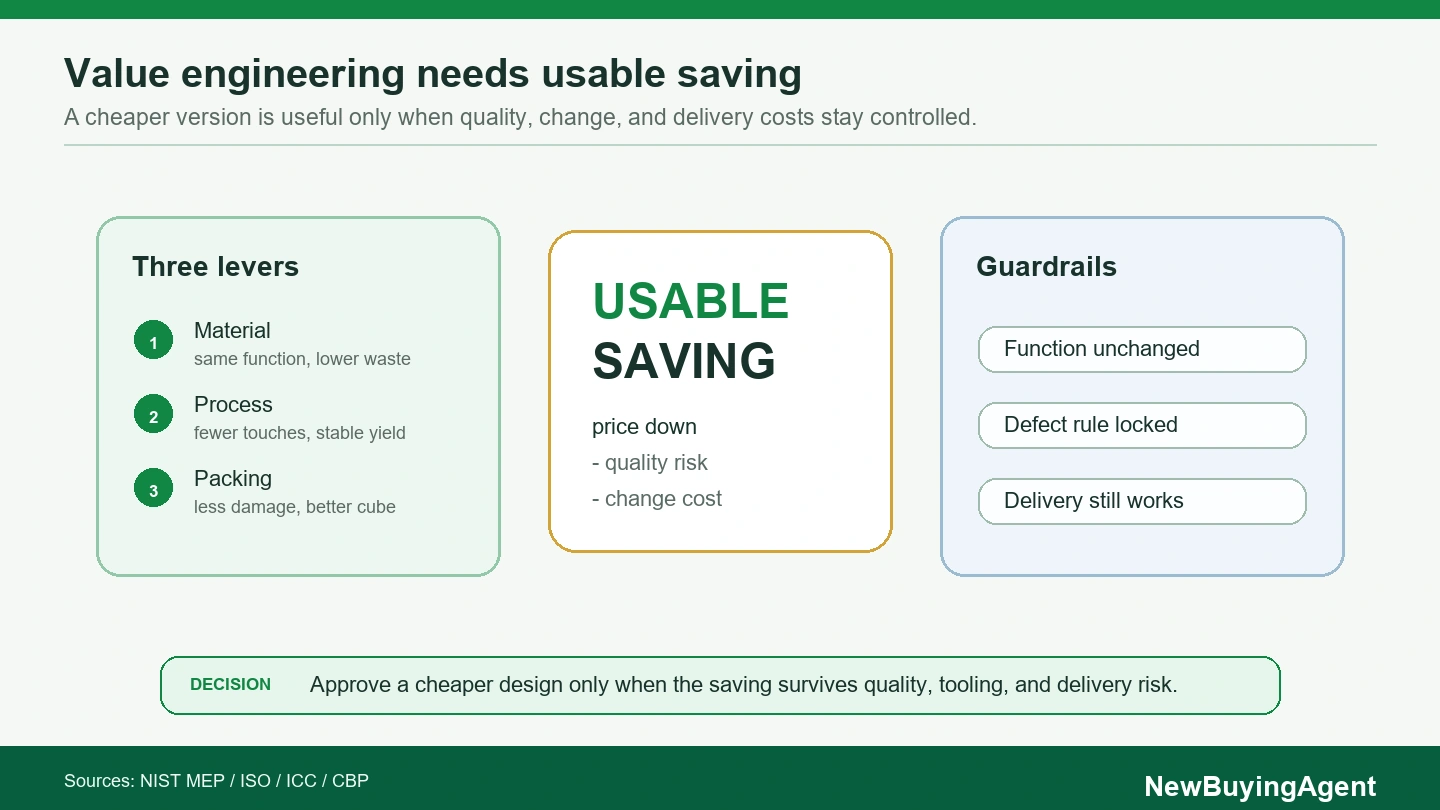
A value-engineering saving is usable only after quality, change, and delivery costs are subtracted.
Where a Sourcing Agent Finds Real Cost Levers
A sourcing agent can find cost levers that are hard for a remote buyer to see because the agent can compare factory capabilities, material availability, processing habits, and packaging assumptions across local resources. The useful levers are not random discounts. They come from changing the design or order logic without damaging the buyer's offer.
Material substitution that keeps the product promise
Material substitution is useful only when it preserves the product's real promise. A pet product may need chew resistance, a bathroom accessory may need finish durability, and outdoor furniture may need weather performance. The buyer should ask which performance standard or customer expectation will remain unchanged after the material change.
According to ISO 9001 quality management requirements, material and process changes should be controlled inside a quality system rather than treated as informal factory improvisation. The sourcing-agent lesson is that any cheaper material should be linked to a sample, test expectation, defect rule, and release condition before approval.
Process simplification that improves yield
Some cost is hidden in unnecessary processing: too many surface treatments, manual touch points, inefficient assembly, high scrap, or avoidable rework. If the factory can reduce process complexity while keeping the same use value, the buyer may gain both cost and consistency. That is a stronger result than bargaining down a margin.
According to NIST MEP lean manufacturing guidance, process improvement should focus on reducing waste rather than applying simple price pressure. A sourcing agent can apply that mindset by asking whether the product can be produced with fewer unstable steps, more standard tooling, cleaner assembly, or a simpler finish stack.
Packaging redesign that protects landed cost
Packaging is often treated as a detail, but it can drive carton cube, freight class, damage rate, receiving labor, and return risk. A cheaper product with weak packaging can become more expensive after freight and customer complaints. A better value-engineering option reduces unnecessary packaging cost while keeping the product protected through the actual channel.
According to Trade.gov shipping guidance, transport choices affect cost, timing, and handling. That means packaging decisions should be made with freight and destination handling in mind, not only factory packing cost. A sourcing agent should test whether carton strength, dimensions, and labels still work after any change.
MOQ and batch planning that reduce setup waste
Factories often price around setup time, line change, minimum material purchase, and batch efficiency. A sourcing agent with category knowledge can sometimes lower cost by adjusting color count, batch timing, accessory standardization, or carton configuration instead of forcing the factory into a loss-making MOQ.
The buyer should ask which MOQ change is a real efficiency gain and which one simply pushes risk to quality or timing. If the agent cannot explain the factory's cost structure in plain terms, a lower MOQ may only mean the order has become less attractive to the factory.
The Four Guardrails That Stop Value Engineering From Becoming Downgrading
The most common value-engineering failure is confusing a lower price with a better product decision. The buyer approves a change, the factory reduces cost, and the finished goods no longer match customer expectations. Guardrails prevent that outcome.
Guardrail 1: Keep the customer-visible function unchanged
The first guardrail is function. If the customer buys the product for strength, comfort, finish, capacity, waterproofing, safety, or style, that value cannot be sacrificed silently. The sourcing agent should identify which features are customer-visible and which features are cost-only. Only cost-only features should be easy candidates for change.
For example, reducing a hidden bracket thickness may be acceptable if load testing and assembly fit remain stable. Reducing a visible coating thickness may be unacceptable if it changes appearance or corrosion resistance. The difference must be written into the sample and quality criteria.
Guardrail 2: Lock the sample after every meaningful change
Every meaningful value-engineering change should create a new sample or version record. Without that lock, the factory may treat the change as permission to keep adjusting. The buyer should know which sample version represents the approved cost structure and which later changes require approval.
According to ISO 19011 auditing guidance, evidence becomes useful when it is planned and evaluated. In this context, the evidence is not only an audit report. It is the sample, change log, material note, inspection rule, and production photo trail that prove the cheaper version is still the approved version.
Guardrail 3: Recheck the inspection rule after the change
The decision rule is to inspect the new risk created by the change, not only the old defects from the original product. That keeps value engineering tied to evidence instead of hope.
Value engineering can shift defect risk. A thinner material may create warping, a different finish may scratch more easily, a simpler assembly may change fit, and a cheaper carton may increase damage. The inspection rule should be updated to catch the new risk, not merely copied from the old version.
According to ISO 2859-1 acceptance sampling, lot decisions can be structured through acceptance sampling, but the buyer still needs the right defect definitions for the changed product. A sourcing agent should translate the change into what inspectors photograph, count, accept, hold, or reject.
Guardrail 4: Check landed cost before celebrating unit savings
The decision rule is to approve the change only after product cost, packing, freight, duty exposure, and receiving risk are seen together. A cheaper factory price can still be the more expensive landed decision.
A unit-price saving is not the same as a landed-cost saving. If the change increases carton volume, damage rate, inspection time, rework, documentation risk, or shipment delay, the apparent saving may disappear. Buyers should compare the change across product cost, packing, freight, duty, handling, and receiving risk.
According to ICC Incoterms 2020 rules, delivery terms define cost and risk responsibilities. According to CBP importing guidance, importers must also account for entry data, valuation, classification, and compliance responsibilities. Value engineering should therefore be tested against both factory cost and import reality.
A Simple Scenario: When a 6% Unit Saving Is Not a 6% Saving
Assume a buyer orders USD 80,000 of China-made products. A value-engineering change reduces the unit price by 6%, creating USD 4,800 of visible factory-price saving. If the change also creates USD 1,200 in new tooling or sampling, USD 1,000 in packaging adjustment, and USD 1,500 in higher freight or damage risk, the usable saving falls to USD 1,100.
The calculation is not meant to predict every order. It gives the buyer a decision habit: subtract change cost and risk cost before approving the cheaper version. In this example, the usable saving is only 1.4% of the original order value, not 6%. If the quality risk is brand-sensitive, the buyer may decide the saving is not worth the exposure.
| Cost item | Example amount | Decision meaning |
|---|---|---|
| Visible unit saving | USD 4,800 | The factory quote looks 6% cheaper. |
| Tooling / sample update | USD 1,200 | The change needs proof before production. |
| Packaging adjustment | USD 1,000 | Carton and protection change the real cost. |
| Freight / damage risk | USD 1,500 | Landed impact reduces the usable saving. |
| Usable saving | USD 1,100 | Approve only if quality and delivery remain protected. |
The table shows why value engineering needs sourcing judgment. A remote buyer may see only the first line. A sourcing agent with local factory resources and QC capability should help expose the remaining lines before the change is approved.
What to Prepare Before Asking for Value Engineering
The buyer should not ask for value engineering with only a product photo and a target discount. The agent needs enough information to separate waste from customer value. Useful inputs include current product specification, approved sample, target market, customer complaint history, packaging channel, annual volume, target price, required delivery date, and any quality or compliance requirement the product cannot violate.
If the buyer already knows where cost pressure exists, the brief should name it: material cost, labor-intensive assembly, high scrap, oversized cartons, damage returns, slow production, or cash-flow pressure. That lets the sourcing agent look for the right lever instead of negotiating blindly. A factory-resource advantage becomes valuable only when it is pointed at a real cost driver.
The buyer should also define what cannot change. For a premium product, the no-change list may include surface finish, load capacity, color accuracy, or packaging feel. For a price-driven product, the no-change list may be safety, basic function, carton protection, and delivery date. A clear no-change list prevents value engineering from becoming a slow quality downgrade.
Finally, the buyer should decide who approves each type of change. A sourcing agent can coordinate samples, factory feedback, cost options, and QC evidence, but the buyer should keep approval authority over customer-visible function, compliance-sensitive details, and channel-critical packaging. This approval map keeps the project fast without letting the factory interpret every cost-saving idea as an open permission to modify the product.
How NewBuyingAgent Applies Value Engineering Without Shrinking the Product
NewBuyingAgent fits value-engineering work when the buyer wants a China-sourced product that protects market fit, margin, quality, and delivery. The advantage is not merely process follow-up. It comes from local factory resources, product development and QC capability, cost negotiation experience, AI-driven hot-product analysis, flexible payment support, and multi-industry case exposure.
For a new product, the buyer can use NewBuyingAgent's product-supply service to turn product requirements into a quoted China product path, with value-engineering questions built around the product promise. If the buyer already has factories but needs China-side control over changes, staged quality checks, and logistics, NewBuyingAgent's factory management service is the more relevant path.
When product-market fit is uncertain, value engineering should not start by cutting cost. It should start by choosing a product version the market is likely to accept. That is where NewBuyingAgent's Bestseller Market Analysis support can inform product selection before cost engineering begins. Once the buyer has a realistic target product, sharing the order brief with NewBuyingAgent lets the team price the change against function, quality, and delivery rather than treating it as a discount request.
Frequently Asked Questions
What is value engineering in China sourcing?
Value engineering in China sourcing means reducing unnecessary product or order cost while preserving the function, quality, packaging performance, compliance needs, and delivery requirements that matter to the buyer's market. It is not the same as asking for a cheaper material or pushing the factory for a lower margin.
Can value engineering reduce quality?
It can reduce quality if changes are approved without guardrails. Buyers should require a revised sample, material note, defect rule, inspection plan, and landed-cost check before approving any value-engineering change. A useful change removes waste; a risky change removes customer value.
Who should approve value-engineering changes?
The buyer should approve any change that affects customer-visible function, material, finish, packaging, compliance, or delivery risk. The sourcing agent can propose options and coordinate proof, but the decision should be based on sample evidence, cost impact, QC criteria, and channel requirements.
When is value engineering most useful?
It is most useful before production is locked, when the buyer can still adjust materials, process, packaging, batch planning, and delivery assumptions without creating rework. It is less useful after the factory has purchased materials or completed bulk production.
NewBuyingAgent
Related Resources
Get Started Today
Let's Turn Your Sourcing Goals into RealityWeChat:+86 15157124615
WhatsApp:+86 15157124615
Address:Building 10 #39 Xiangyuan Road, Hangzhou, China
