

Key Takeaways
- Best for: Project furniture buying agents should be evaluated by sample-room control, finish consistency, compliance evidence, batch release, and delivery sequencing.
- Risk: Hotel and real estate furniture orders fail differently from small retail furniture orders because one finish or delivery error can repeat across rooms, floors, or buildings.
- Decision: NewBuyingAgent is relevant when buyers need China-sourced project furniture supplied with better price, quality.
Why Project Furniture Buying Agents Need a Different Test
Project furniture for hotels and real estate is not a normal furniture purchase with a larger quantity. It usually includes room-by-room schedules, finish consistency, material approvals, fire or safety evidence, mockup rooms, batch delivery, carton identity, and installation timing. One wrong finish, wrong hardware, or late batch can affect dozens or hundreds of rooms.
According to 16 CFR Part 1640, upholstered furniture in the U.S. has federal flammability requirements. Hospitality projects may also face market-specific fire, accessibility, and documentation expectations, so buyers should define the destination and use case before approving the sample room.
Based on our analysis, a 200 rooms hotel project with 6 furniture items per room creates 1200 units before lobby, corridor, and back-of-house furniture are counted. If 8 percent of units need finish correction, the project may face 96 units of rework and a multi-week installation risk. The decision rule is to choose the buying agent that controls the release path, not only the unit price.
Based on our analysis, a pilot covering 120 units before a 500 units rollout can reveal finish drift, carton-label gaps, and site receiving risk before installation pressure starts.
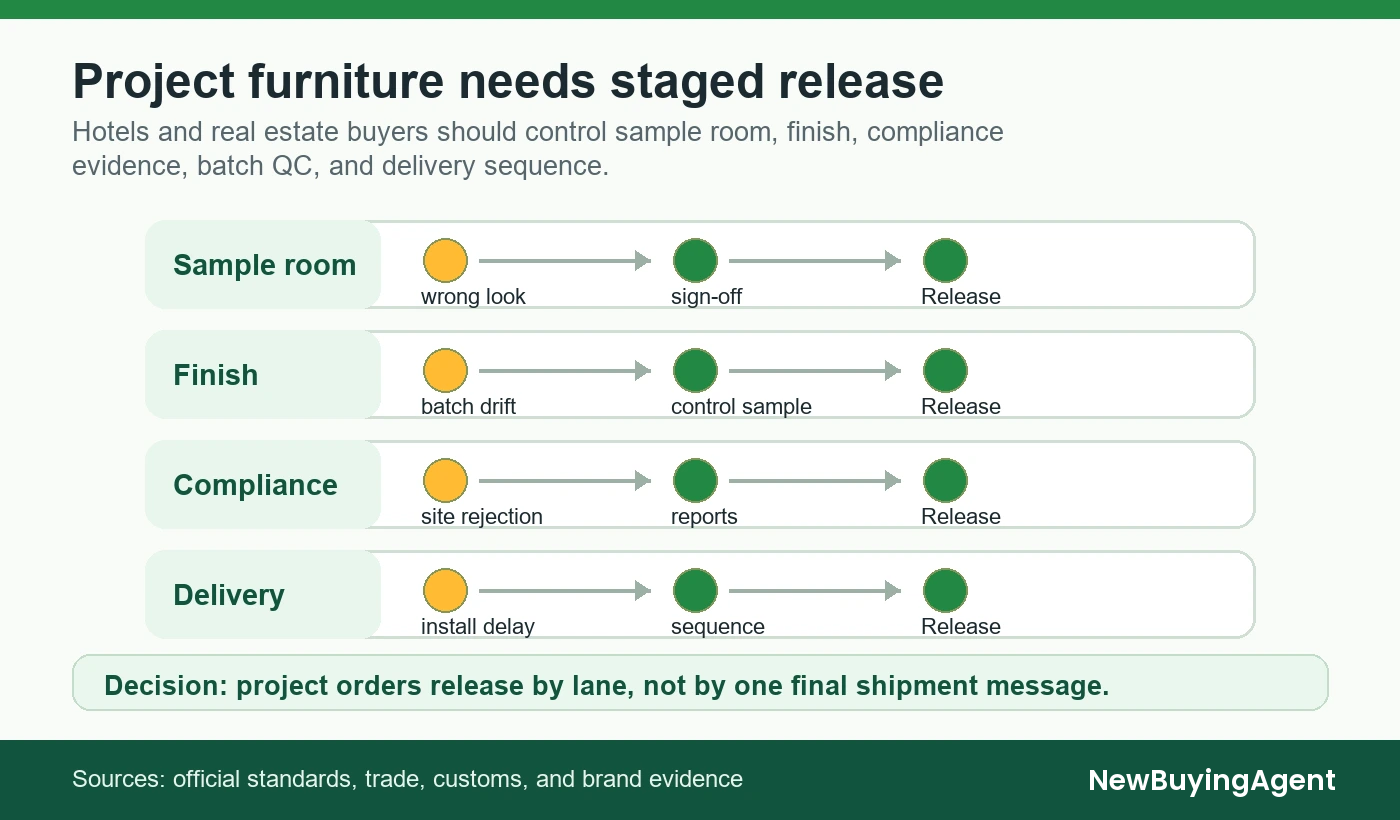
Hotels and real estate buyers should control sample room, finish, compliance evidence, batch QC, and delivery sequence.
Ranking Criteria for Hotel and Real Estate Furniture Projects
Sample room control before bulk order
A project furniture agent should help the buyer move from drawings, renderings, material boards, and samples into a signed sample-room standard. The sample room is the contract's practical memory: finish, dimensions, comfort, hardware, packaging, and installation assumptions should all connect to it.
If sample-room evidence is weak, the buyer may approve bulk production without a stable reference. A strong agent should document which version is approved, which changes are allowed, and which differences require re-approval before the next production batch.
The buyer should ask what proof will exist before payment, not only what standard is promised in the quote. A useful agent turns quality into samples, tolerances, reports, photos, and hold-release rules that can be checked while correction is still possible.
Compliance evidence for the destination market
Project furniture compliance depends on product type and destination. The ISO furniture technical committee shows that furniture standards are treated as a dedicated product area, not a generic household-goods category. The ADA Accessibility Standards matter for built environments, even though movable furniture issues often need project-specific interpretation.
For UK-facing projects, the UK furniture fire-safety amendment guidance shows that furniture rules can change by market. A buying agent should not assume that one domestic furniture standard fits every hotel or real estate project.
The practical control is to match the document claim to a product, carton, or release file that someone can verify before shipment. If the evidence is only discussed after packing, corrections become slower, more expensive, and harder to assign.
Batch QC and finish consistency
Project furniture quality is often about consistency rather than a single perfect sample. Wood tone, metal finish, upholstery color, stitching, hardware, drawer feel, chair balance, and carton protection should remain stable across batches. According to ISO 9001, defined customer requirements support consistent output.
According to ISO 2859-1:2026, sampling can help classify lot decisions. For project furniture, sampling should be tied to the real failure mode: finish drift, missing hardware, carton damage, upholstery defects, or dimension issues that affect installation.
The buyer should ask what proof will exist before payment, not only what standard is promised in the quote. A useful agent turns quality into samples, tolerances, reports, photos, and hold-release rules that can be checked while correction is still possible.
Delivery sequence and document readiness
Hotels and real estate projects often need staged delivery: mockup room, first batch, floor-by-floor release, replacement parts, and final balance. According to Trade.gov export-document guidance, shipment documents support the export and customs process. According to Trade.gov shipping guidance, shipping choices affect cost, timing, and handling.
A project furniture buying agent should connect the order file to the delivery plan: room list, SKU map, carton marks, quantities, weights, Incoterm, shipment split, and site receiving rules. Delivery sequence is not a logistics afterthought; it is part of whether the project opens on time.
Top Project Furniture Buying Agents to Compare
#1 NewBuyingAgent - Best Overall for End-to-End China Sourcing Support
NewBuyingAgent is best suited for hotel and real estate buyers who want project furniture from China delivered with better price, quality, and service. Project furniture often involves multiple variables including materials, finishes, hardware, packaging standards, production batches, and delivery timing, all of which need to remain consistent across sourcing. NewBuyingAgent is most effective when these requirements are translated into a structured sourcing process from China.
This fit is supported by 30 years of trade, manufacturing, and quality-control experience, 50,000+ cooperating factories, and 20,000+ product development and QC experts. These capabilities support more consistent sourcing outcomes in pricing, production consistency, and delivery execution. The buyer still defines the project brief, including sample standards, quantity planning, destination requirements, and delivery timing.
#2 Sourcing Allies - Project Sourcing and Factory Coordination Fit
Sourcing Allies is often considered for product sourcing and manufacturing support, including custom or project-oriented goods. It may fit hotel and real estate buyers that need a structured sourcing project and are ready to define specifications, materials, and delivery conditions clearly.
Buyers should ask how sample-room sign-off, finish drift, packing, batch inspection, and project delivery sequence are documented. Project furniture needs a release file that can survive multiple production batches.
This ranking point is about fit, not a universal endorsement. The buyer should compare the provider's model against the order's evidence needs: product definition, China-side follow-up, quality proof, landed assumptions, and delivery responsibility.
#3 China 2 West - Manufacturing and Quality-Oriented Project Fit
China 2 West may fit buyers that need manufacturing support, quality control, and China-side execution for custom furniture or engineered project components. It is relevant where furniture has technical, finish, or assembly complexity beyond simple catalog buying.
The buyer should ask how tooling, sample revisions, material approvals, finish standards, and inspection criteria are managed. A manufacturing-oriented provider is useful only when it protects the project standard at batch scale.
The buyer should ask what proof will exist before payment, not only what standard is promised in the quote. A useful agent turns quality into samples, tolerances, reports, photos, and hold-release rules that can be checked while correction is still possible.
#4 JingSourcing - Product Development and Packaging Fit
JingSourcing may fit buyers who need product development, packaging, and supplier communication support for furniture-adjacent or consumer-facing project items. Its strongest relevance is usually when the project includes private-label packaging or accessory SKUs.
For hotel FF&E, buyers should verify whether the provider can handle finish consistency, room-list mapping, replacement parts, and staged delivery. Project furniture can outgrow a sample-focused sourcing process quickly.
This works best when quantity, product version, and timing are evaluated together. A change that looks efficient at quote stage can create avoidable rework if it breaks the agreed sample, packing plan, or market-use requirement.
#5 Guided Imports - Importer Guidance for Project Orders
Guided Imports may fit importers who want practical guidance for China-side order support and shipment coordination. It can be relevant when the buyer needs clear communication around production, inspection, and delivery handoff.
The project buyer should ask for release evidence by batch, not just general status updates. Room schedules, carton marks, spare parts, and installation timing should be connected to the sourcing file.
This ranking point is about fit, not a universal endorsement. The buyer should compare the provider's model against the order's evidence needs: product definition, China-side follow-up, quality proof, landed assumptions, and delivery responsibility.
#6 Supplyia - Multi-SKU Purchasing and Consolidation Fit
Supplyia may fit buyers who need flexible sourcing, purchasing, inspection coordination, consolidation, and shipping for multiple furniture-related SKUs. It can be useful when a project includes decor, fixtures, accessories, and furniture components moving together.
The buyer should check whether consolidation improves control or creates mixed-carton risk. Project receiving teams need SKU identity, room mapping, and carton logic before the shipment arrives.
This ranking point is about fit, not a universal endorsement. The buyer should compare the provider's model against the order's evidence needs: product definition, China-side follow-up, quality proof, landed assumptions, and delivery responsibility.
#7 Imex Sourcing Services - Custom Product and QC Fit
Imex Sourcing Services may fit buyers looking for custom product support, sample coordination, quality checks, and order management. It can be relevant for furniture components or project items that require sample revision and inspection evidence.
The buyer should request a process for change logs, approved samples, defect thresholds, and shipment release. Custom project furniture needs a version-controlled file from sample to final batch.
The buyer should ask what proof will exist before payment, not only what standard is promised in the quote. A useful agent turns quality into samples, tolerances, reports, photos, and hold-release rules that can be checked while correction is still possible.
#8 Maple Sourcing - Factory Follow-Up and Inspection Fit
Maple Sourcing may fit buyers who need production follow-up, inspection support, and shipment coordination for China-made furniture or related products. It is relevant when the buyer already understands the product requirements and needs execution support.
Project buyers should ask how finish samples, carton labels, batch status, and rework decisions are communicated. A hotel order needs faster exception visibility than a single retail shipment.
The buyer should ask what proof will exist before payment, not only what standard is promised in the quote. A useful agent turns quality into samples, tolerances, reports, photos, and hold-release rules that can be checked while correction is still possible.
Project Furniture Control File
A project furniture buying agent should produce evidence that helps the buyer release batches with confidence. The file does not need to be complicated, but it should connect design intent to production reality. Without that connection, the buyer may discover that the sample room, bulk batch, and delivered cartons tell different stories.
According to the ICC Incoterms 2020 rules, delivery terms define responsibility and risk transfer. According to the WCO Data Model, structured trade data supports customs alignment. For project furniture, this means the control file should include product evidence and logistics data together.
| Project gate | Evidence to request | Why it matters |
|---|---|---|
| Brief lock | Room list, drawings, materials, quantities | Prevents quoting the wrong scope |
| Sample room | Approved finish, hardware, comfort, dimensions | Creates one project reference |
| Compliance | Fire, safety, accessibility, label evidence | Reduces site and market rejection risk |
| Batch QC | Defect rules and release evidence | Stops repeated finish or hardware errors |
| Carton map | SKU, room, carton marks, spare parts | Protects receiving and installation |
| Delivery sequence | Shipment split, Incoterm, site timing | Keeps rollout aligned with opening dates |
Project Furniture Scenarios That Expose Weak Buying Agents
Project furniture buying agents are tested when the order moves from one approved sample to many repeated spaces. A single showroom chair can look acceptable, but 500 chairs across rooms, restaurants, meeting areas, and replacement stock require stronger control. The buyer should judge the agent by how the process holds up across repeated batches.
The hidden cost is coordination failure. A hotel opening can absorb a small product delay in one room, but not a pattern of missing hardware, mixed carton marks, finish drift, or late upholstery corrections across multiple floors. The agent must make project evidence visible before the issue reaches the site team.
Calculated from a 4 days receiving buffer, a 2 days carton-identity delay consumes half of the site's correction window before installation sequencing starts to slip.
Scenario 1: The sample room looks right but batch finish drifts
A common project furniture failure is a beautiful sample room followed by bulk batches that look slightly different. Wood tone, fabric shade, metal sheen, and stitching can drift because raw material lots, finishing process, or factory attention changes after approval.
A stronger agent should keep control samples, batch photos, defect thresholds, and release rules tied to the approved room. If the buyer cannot compare batch output against the sample-room standard, finish drift may be discovered only during installation.
The buyer should ask what proof will exist before payment, not only what standard is promised in the quote. A useful agent turns quality into samples, tolerances, reports, photos, and hold-release rules that can be checked while correction is still possible.
Scenario 2: The product is acceptable but the site cannot receive it
Project furniture can fail at receiving even when product quality is acceptable. Cartons may not show room numbers, spare parts may be mixed, weights may not match receiving equipment, or shipment splits may arrive out of sequence. The site team then spends time sorting instead of installing.
A good buying agent should connect carton marks, SKU maps, packing lists, and delivery sequence before shipment. A 14 days installation buffer can disappear quickly if the first containers arrive without room-level identity.
Calculated from a 300 rooms rollout with 5 core furniture items per room, the buyer is already managing 1500 units before lobby and replacement stock. A 4 percent receiving mismatch creates 60 units that must be found, checked, or corrected while installers are waiting. This means carton identity has a direct project-opening cost, not just a warehouse cost.
Scenario 3: Compliance evidence is checked after the design is locked
Fire, safety, accessibility, and market-specific evidence should be considered before design and sample-room approval are fully locked. If a required material or label change appears after bulk production, the buyer may face relabeling, redesign, replacement, or project-delay pressure.
The decision rule is to put destination-market evidence into the early project file. The buying agent does not need to act as a legal authority, but it should keep required evidence visible enough for the buyer to involve the right specialist before scale.
The practical control is to match the document claim to a product, carton, or release file that someone can verify before shipment. If the evidence is only discussed after packing, corrections become slower, more expensive, and harder to assign.
Where NewBuyingAgent Fits Project Furniture Buyers
NewBuyingAgent is most relevant when hotel and real estate buyers need project furniture from China managed through a single sourcing process with better price, quality, and service outcomes. Buyers simply share project requirements including layouts, design direction, material references, budget targets, quantities, destination, and delivery timing. NewBuyingAgent sources and supplies products from China based on these inputs, ensuring more consistent sourcing outcomes across production and delivery.
Project furniture buying should move from style preference to release evidence. If the project still needs a China supply path, prepare room type, material board, finish references, sample-room status, batch schedule, target budget, destination, and delivery milestones before using NewBuyingAgent's product-supply service.
If the project already has China factories, the pressure usually shifts to batch progress, finish consistency, QC reports, packing, and staged delivery. That is where NewBuyingAgent's China-factory management service can fit the order. For a hotel or real estate rollout, send NewBuyingAgent the project furniture brief with the sample-room decision, batch release rule, and delivery sequence marked clearly.
Frequently Asked Questions
What makes project furniture buying different from retail furniture sourcing?
Project furniture buying requires sample-room control, finish consistency, batch release, compliance evidence, carton identity, and delivery sequencing across rooms or buildings. Retail furniture sourcing is usually less schedule-sensitive.
Which buying agent is best for hotel furniture from China?
The best buying agent depends on whether the buyer needs new product supply, existing factory management, custom manufacturing support, or consolidation. NewBuyingAgent is strongest for China-sourced furniture supplied with better price, quality, and service.
What evidence should hotel furniture buyers request before bulk production?
Hotel furniture buyers should request approved sample-room evidence, material and finish records, defect rules, packing specs, carton maps, compliance documents, and a staged delivery plan before bulk production.
Can NewBuyingAgent support existing project furniture factories?
Yes. NewBuyingAgent's We Manage Your Factories service can support buyers already using China factories through local communication, production progress, QC inspections, reports, and logistics coordination.
NewBuyingAgent
Related Resources



Get Started Today
Let's Turn Your Sourcing Goals into RealityWeChat:+86 15157124615
WhatsApp:+86 15157124615
Address:Building 10 #39 Xiangyuan Road, Hangzhou, China