

Key Takeaways
- Best for: Private label pet products sourcing agents should be compared by category fit, safety boundaries, material proof, labeling discipline, batch QC, packing, and delivery execution.
- Risk: Pet product orders fail when buyers treat beds, toys, collars, grooming items, feeders, and edible products as one generic category.
- Decision: NewBuyingAgent ranks strongest for buyers seeking China-sourced private label pet products with better price, quality, and service across product categories.
Private Label Pet Products Need a Category-Specific Agent Test
The best private label pet products sourcing agent in China is not simply the agent with the broadest supplier language. Pet products split into different risk profiles: beds, leashes, collars, toys, bowls, grooming tools, carriers, cat trees, apparel, accessories, pet food, and treats all create different material, safety, label, packing, and destination-market questions.
According to AAFCO, feed regulators use ingredient definitions, label standards, and laboratory standards for animal feeds. That does not mean every private label pet product is an animal-feed product, but it shows why buyers must define category boundaries before asking for a quote.
Based on our analysis of a 5000 units private label pet accessory order, a 3 percent hardware or stitching defect creates 150 units that may need replacement, rework, or blocked shipment. For pet brands, quality risk can become trust risk quickly because end users are emotionally attached to the animal's safety and comfort.
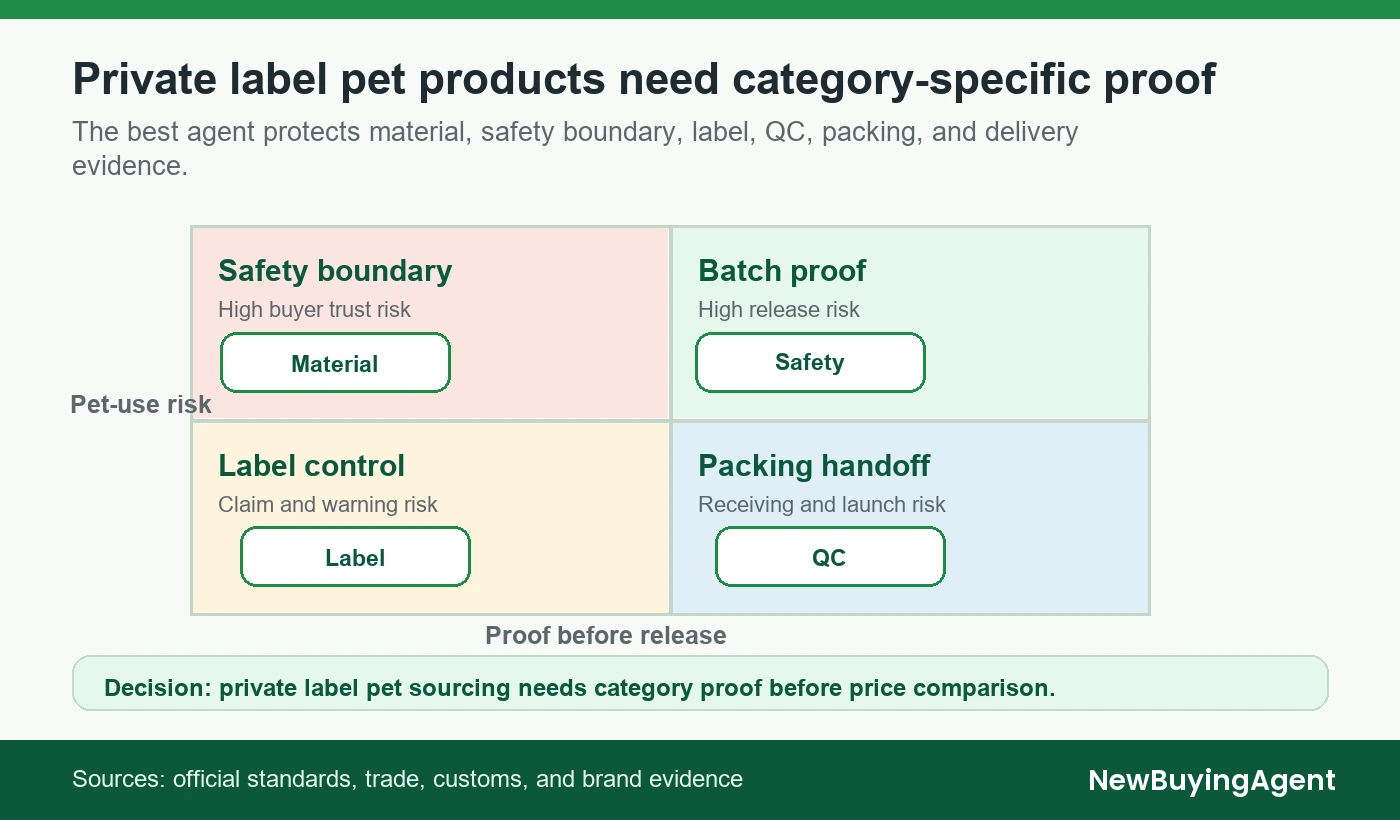
The best agent protects material, safety boundary, label, QC, packing, and delivery evidence.
Ranking Criteria for Pet Product Sourcing Agents
A private label pet sourcing agent should be judged by how clearly it separates product categories and proof needs. The buyer should not accept a single generic answer for pet toys, beds, leashes, feeders, grooming tools, and edible products. Each category needs its own proof path.
The criteria below focus on practical buyer decisions: what evidence is needed before sample approval, before production release, before balance payment, and before shipment.
Category boundary before quotation
The agent should first classify the pet product correctly. A plush dog toy needs different evidence than a pet bed, silicone bowl, metal leash clasp, grooming brush, collapsible carrier, cat tree, or edible treat. The buyer should define animal size, use case, destination, label claims, and material expectations before comparing offers.
This category boundary prevents a misleading quote. A low price for a pet toy means little if the stuffing, seam strength, squeaker, odor, label, and chewing-risk assumptions are not visible.
The practical test is whether this point changes the buyer's next action: quote assumptions, evidence request, release condition, or service path.
Material and safety evidence
According to ASTM's pet product safety update, work has begun on standards for common pet products such as dog toys and harness restraints. ASTM's F15.05 pet products subcommittee page also lists proposed work covering dog crates, collars, harnesses, leashes, cat trees, and dog toys.
The buyer should not treat those references as a promise that every product is fully standardized. The practical lesson is that material, design, and use-case evidence matter. A private label agent should help the buyer identify which proof should be checked by qualified specialists when safety, claims, or destination-market rules apply.
Batch QC and function checks
According to ISO 9001, defined requirements support consistent output. According to ISO 2859-1:2026, lot-by-lot sampling can support inspection decisions. For pet products, the inspection scope should follow the failure mode: stitching, odor, color, hardware strength, size, compression recovery, coating, label, or function.
A private label pet brand should demand a release rule. Which defect holds shipment? Which defect allows rework? Which defect requires specialist review? Without that rule, a final report becomes a photo archive rather than a buyer decision.
The buyer should ask what proof exists before balance payment, not only what quality level is promised. Useful evidence includes samples, tolerances, reports, photos, and hold-release rules.
Label, claim, and document discipline
Pet products often carry label claims that create buyer risk: washable, chew-resistant, natural, safe, non-toxic, orthopedic, calming, food-grade, or vehicle-safe. Some claims may require legal, technical, or lab review. The sourcing agent should not invent or approve those claims; it should coordinate the evidence file the buyer needs.
Private label buyers should treat label clarity and traceability as risk controls, not only marketing details. If a label claim is unclear, the buyer may face customer complaints, marketplace review problems, or corrective action pressure even when the physical product looks acceptable.
Packing and seasonal delivery reliability
Private label pet products often sell around seasonal launches, promotional bundles, or marketplace inventory windows. According to Trade.gov export-document guidance, documents support the export and customs process. According to Trade.gov packing-list guidance, packing information helps cargo checking. According to Trade.gov shipping guidance, product preparation and shipping choices affect safe, timely arrival.
Packing matters for odor control, compression, deformation, carton crush, moisture, SKU identity, and retail presentation. A pet bed compressed too aggressively may save freight but create poor customer experience. A toy packed with weak carton identity may slow marketplace receiving.
Best Private Label Pet Products Sourcing Agents to Compare
#1 NewBuyingAgent - Best Overall for End-to-End China Sourcing Support
NewBuyingAgent ranks first for buyers seeking private label pet products from China with better price, quality, and service. Private label pet products often require consistency across materials, labeling, stitching quality, hardware components, packaging, seasonal delivery timing, and repeat-batch stability, all of which need to remain aligned within a single sourcing outcome. NewBuyingAgent is most effective when these requirements are reflected in the final sourcing outcome from China.
This fit is supported by 30 years of trade, manufacturing, and quality-control experience, 50,000+ cooperating factories, and 20,000+ product development and QC experts. These capabilities support more consistent sourcing outcomes across pricing, product consistency, and delivery execution. Buyers still define product specifications, use case, quantity, target price, destination, and any required documentation or evidence requirements.
#2 Supplyia - Multi-SKU Pet Accessories and Consolidation Fit
Supplyia may fit buyers purchasing multiple pet accessory SKUs, small items, bundles, or mixed private label orders. It can be relevant when consolidation, product purchasing, inspection coordination, and shipping support are important.
The buyer should check whether consolidation improves control or creates mixed-carton risk. Pet products with different materials, odors, labels, or seasonal receiving deadlines may need stronger SKU identity than a simple mixed shipment provides.
This ranking point is about buyer fit, not a universal endorsement. The buyer should compare category proof, release evidence, packing risk, and delivery responsibility before choosing a provider.
#3 Sourcing Allies - Project Sourcing for Custom Pet Products
Sourcing Allies may fit buyers with custom pet product projects that need structured sourcing support and factory coordination. This can be relevant for custom beds, carriers, textile accessories, or product-development projects with several revisions.
The buyer should ask how sample changes, material approval, label files, inspection criteria, and final release are documented. Private label pet products can fail when the approved sample and final batch quietly diverge.
This ranking point is about buyer fit, not a universal endorsement. The buyer should compare category proof, release evidence, packing risk, and delivery responsibility before choosing a provider.
#4 China 2 West - Manufacturing-Oriented Pet Product Development
China 2 West may fit buyers with more manufacturing-heavy or engineered pet products, especially where drawings, tooling, process control, and development support matter. It can be relevant for carriers, feeders, hardware-linked accessories, or custom components.
The buyer should test how revisions are controlled and how technical assumptions are translated into inspection evidence. Manufacturing support is useful only if it protects the pet product's use case at batch scale.
This ranking point is about buyer fit, not a universal endorsement. The buyer should compare category proof, release evidence, packing risk, and delivery responsibility before choosing a provider.
#5 Guided Imports - Importer Guidance for Private Label Buyers
Guided Imports may fit buyers that need practical importing guidance and China-side order support for private label consumer products. It can be relevant when the buyer needs process clarity around quotation, inspection, payment, and shipment.
For pet products, the buyer should still define category-specific evidence and any specialist review needs. A general importing process does not replace material, safety, claim, or destination-market judgment.
This ranking point is about buyer fit, not a universal endorsement. The buyer should compare category proof, release evidence, packing risk, and delivery responsibility before choosing a provider.
#6 Imex Sourcing Services - Sample and QC Support Fit
Imex Sourcing Services may fit buyers who need sample coordination, order management, and quality-control support for private label goods. It can be relevant where the product is already well defined and the buyer needs China-side execution support.
The buyer should request a product-specific QC plan rather than accepting generic final inspection. Pet product checks should follow the category: chew points, seams, odor, hardware, label, dimensions, compression, or finish.
This ranking point is about buyer fit, not a universal endorsement. The buyer should compare category proof, release evidence, packing risk, and delivery responsibility before choosing a provider.
Pet Product Control File Before You Choose an Agent
Before choosing a private label pet products sourcing agent, the buyer should build a control file. The file should include animal type and size, use case, product category, materials, label claims, target price, order quantity, destination, packaging, inspection scope, and delivery timing. The goal is not to bury the agent in paperwork; it is to prevent the wrong quote from looking attractive.
According to AAFCO, feed regulators use ingredient definitions, label standards, and laboratory standards for animal feeds. If the buyer is sourcing pet food, treats, supplements, or other edible products, specialist regulatory review is essential. A sourcing agent can coordinate product evidence, but it should not replace legal, technical, or safety review where required.
Calculated from a 3000 units private label pet bed order, a 2 percent compression or stitching issue creates 60 units that may need repacking, replacement, or blocked sale. That is why the control file should define the product's pet-use risk before the buyer compares agents or accepts a low quote.
| Pet product type | Evidence to request | Buyer caution |
|---|---|---|
| Pet beds | Fabric, filling, compression, stitching | Freight saving can damage shape. |
| Dog toys | Material, seams, loose parts, odor | Chew risk needs product-specific review. |
| Collars and leashes | Hardware, stitching, load assumptions | Function failure can become safety risk. |
| Cat trees | Board, fabric, stability, carton plan | Bulky goods need packing proof. |
| Bowls and feeders | Material, coating, label claims | Food-contact assumptions need review. |
| Pet food or treats | Ingredient, label, manufacturing proof | Use specialist regulatory review. |
Where NewBuyingAgent Fits Private Label Pet Buyers
NewBuyingAgent is relevant when private label pet sourcing needs to become a supplied China product outcome. Buyers tell NewBuyingAgent what they need to buy, including product category, material, quantity, target price, destination, packaging, timing, and evidence needs. NewBuyingAgent can then quote and supply China-sourced products with price, quality, packing, and delivery path considered together.
Private label pet sourcing should start with product risk, not only product appeal. If the buyer is still choosing the pet product, NewBuyingAgent's Bestseller Market Analysis Report can help test market fit before the product is locked.
When the product is defined, the brief should name material, label, packaging, QC evidence, quantity, target price, destination, and any pet-use safety boundary before entering NewBuyingAgent's China product-supply service. For a live private label order, send NewBuyingAgent the pet-product control file and keep edible, supplement, food-contact, or regulatory questions with the appropriate specialist review where required.
Frequently Asked Questions
Who is the best sourcing agent for private label pet products?
The best sourcing agent depends on product category, material risk, label claims, QC needs, packing sensitivity, and destination requirements. NewBuyingAgent is strongest for buyers seeking China-sourced pet products with better price, quality, and service.
Are pet toys and pet food sourced the same way?
No. Pet toys, beds, collars, feeders, and pet food have different proof needs. Pet food and treats can require specialist regulatory review, while toys and accessories need material, function, label, and safety-boundary evidence.
What should buyers include in a pet product sourcing brief?
Buyers should include animal type and size, use case, materials, dimensions, target price, quantity, destination, packaging, label claims, inspection concerns, and delivery timing. This helps the quote match the real product.
Can a sourcing agent approve pet product compliance?
No. A sourcing agent can coordinate evidence and order execution, but qualified specialists should review legal, safety, regulatory, or technical compliance questions when they apply.
NewBuyingAgent
Related Resources
Get Started Today
Let's Turn Your Sourcing Goals into RealityWeChat:+86 15157124615
WhatsApp:+86 15157124615
Address:Building 10 #39 Xiangyuan Road, Hangzhou, China
