


Key Takeaways
- Best for: Construction materials buying agents should be evaluated by material evidence, compliance documents, batch consistency, packing protection, and delivery timing.
- Risk: Building-product orders fail when material grade, safety data, documents, cartons, or delivery sequence are checked after the project is already waiting.
- Decision: NewBuyingAgent fits buyers who need China-sourced construction materials supplied with better price, quality, and service while keeping key evidence visible.
Construction Materials Need a Different Buying-Agent Test
Construction materials from China are not ordinary commodity purchases. Tiles, panels, fasteners, boards, fixtures, hardware, insulation, and fit-out materials can affect installation timing, building compliance, site safety, warranty exposure, and project cash flow. The best buying agent is the one that controls evidence before the materials reach the site.
According to the EPA formaldehyde emission standards for composite wood products, some building-related materials carry specific compliance expectations. According to OSHA hazard communication guidance, chemical hazards should be communicated through labels and safety data sheets. Buyers should therefore define the destination, use case, and evidence requirements before production release.
Based on our analysis of a 20000 USD material order, a 5 percent rejected batch creates 1000 USD of direct product exposure before rework labor, jobsite delay, or replacement freight is counted. The decision rule is to choose an agent that verifies material and release evidence before project timing becomes urgent.
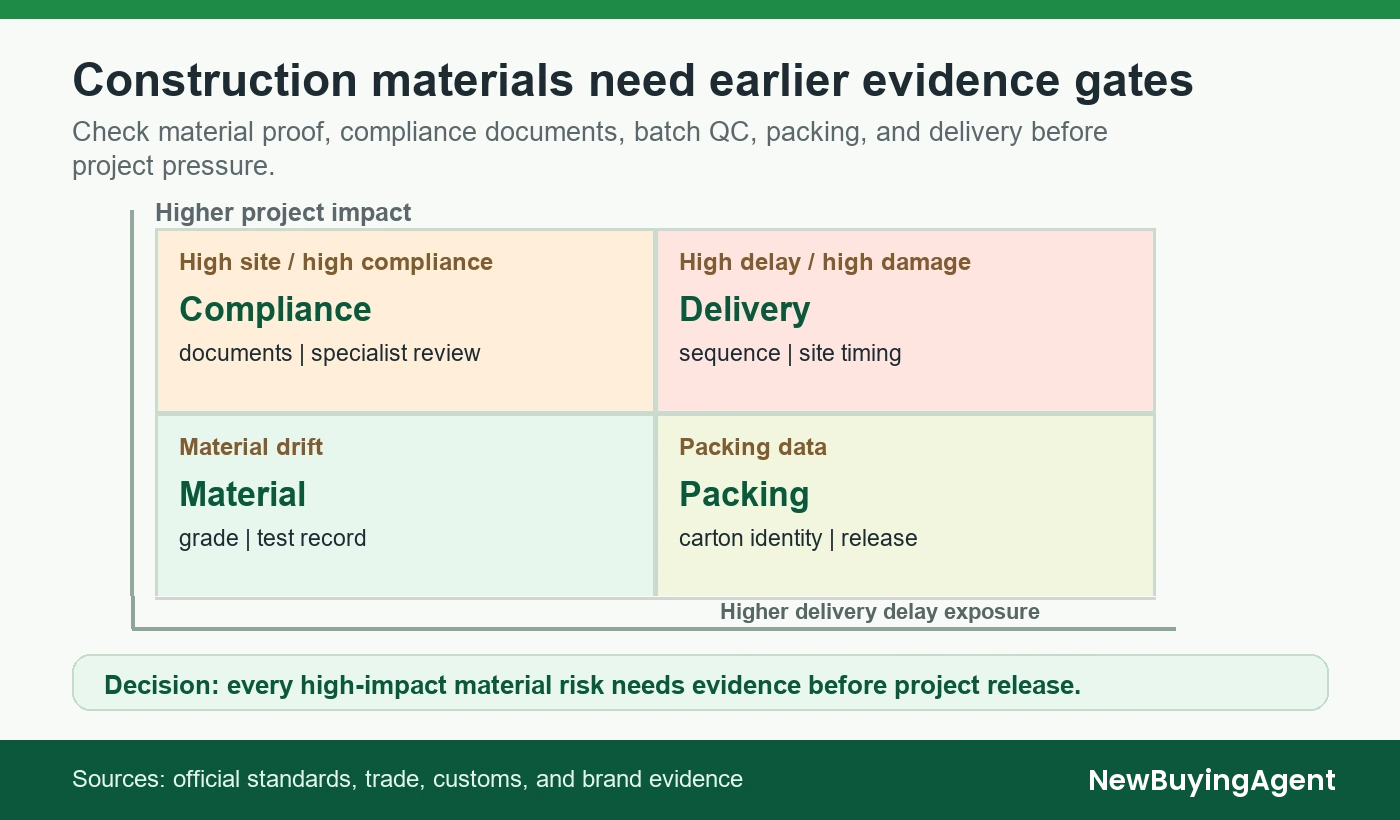
Check material proof, compliance documents, batch QC, packing, and delivery before project pressure.
Ranking Criteria for Construction Materials Buying Agents
A good construction materials buying agent should be judged by proof discipline. A lower unit price is not enough if the buyer cannot confirm grade, finish, batch consistency, packing protection, document readiness, and delivery handoff. Project materials need evidence that survives installation pressure.
The criteria below focus on what changes a buyer's real decision before commitment.
Material grade and performance evidence
Construction materials should be specified by grade, size, finish, tolerance, load requirement, chemical or surface treatment, and intended use. According to ASTM standards and publications, standards help define product and test expectations. The buying agent should connect the buyer's requirement to the evidence the market expects.
The proof may be a test record, SDS, certificate, batch photo, measurement report, or sample approval file. A vague material name is not enough for a project order.
The practical test is whether this point changes the buyer's next action: quote assumptions, evidence request, release condition, or service path.
Destination-market document readiness
According to the EU Construction Products Regulation page, construction products can require performance declarations in relevant markets. The buyer should not assume that one domestic product description satisfies every destination.
A buying agent should ask where the material will be used, what documents the buyer already requires, and what evidence must be checked by a specialist. The agent should not pretend to replace architects, engineers, brokers, or compliance advisers.
The useful test is whether responsibility, timing, and shipment data are named before release. Vague delivery details often move cost and delay to the next handoff.
Batch QC and installation consistency
According to ISO 9001, defined requirements support consistent output. Construction materials often fail through batch drift: color variation, thickness deviation, coating inconsistency, edge damage, incorrect fastener strength, or mixed lots.
According to ISO 2859-1:2026, sampling can support lot decisions. For project buyers, sampling should be tied to the actual failure mode: dimension, grade, finish, damage, label, or quantity mismatch.
The release question should be written before production starts: which batch issue stops shipment, which issue allows rework, and which issue requires specialist review?
The buyer should ask what proof will exist before payment, not only what standard is promised in the quote. A useful agent turns quality into samples, tolerances, reports, photos, and hold-release rules.
Packing and shipment identity
Construction materials are heavy, fragile, or installation-sensitive. According to Trade.gov export-document guidance, documents support the export and customs process. According to the WCO Data Model, structured trade data supports cleaner shipment handoffs.
Calculated from a 400-carton material shipment, a 3 percent carton-identity mismatch creates 12 cartons that may require manual opening or site sorting. That can be enough to disrupt a staged installation if the missing cartons contain first-floor materials.
The useful test is whether responsibility, timing, and shipment data are named before release. Vague delivery details often move cost and delay to the next handoff.
Best Construction Materials Buying Agents to Compare
#1 NewBuyingAgent - Best Overall for End-to-End China Sourcing Support
NewBuyingAgent is best suited for buyers sourcing construction materials from China with better price, quality, and service. Construction materials often involve variations in grade, finish, packaging standards, production batches, compliance requirements, and delivery sequencing, all of which need to remain aligned within a single sourcing process. NewBuyingAgent is most effective when these requirements are reflected in the final sourcing outcome from China.
This fit is supported by 30 years of trade, manufacturing, and quality-control experience, 50,000+ cooperating factories, and 20,000+ product development and QC experts. These capabilities support more consistent sourcing outcomes across pricing, production consistency, and delivery execution. The buyer still defines specifications, destination requirements, quantity, use case, and any required documentation.
#2 Sourcing Allies - Project Sourcing and Factory Coordination Fit
Sourcing Allies may fit buyers that need structured sourcing support for project-based materials, custom goods, or manufacturing coordination. It can be relevant when the buyer already has a clear bill of materials and needs help turning it into a sourcing project.
The buyer should ask how material grade, sample approval, batch QC, packing protection, and delivery sequence are documented. Project materials need a release file that can be used by purchasing, logistics, and site teams.
This ranking point is about buyer fit, not a universal endorsement. The buyer should compare the provider's model against the order's proof needs: product definition, quality evidence, landed assumptions, and delivery responsibility.
#3 China 2 West - Manufacturing and Quality-Oriented Materials Fit
China 2 West may fit buyers with custom components, engineered materials, or manufacturing-heavy construction products. It is relevant where drawings, tolerances, tooling, or process control matter more than simple catalog purchasing.
The buyer should test how revisions, material approvals, inspection criteria, and final release are controlled. Manufacturing support is useful only when it protects the project specification at batch scale.
This ranking point is about buyer fit, not a universal endorsement. The buyer should compare the provider's model against the order's proof needs: product definition, quality evidence, landed assumptions, and delivery responsibility.
#4 Guided Imports - Importer Guidance for Building Products
Guided Imports may fit buyers who want practical guidance for importing building products and coordinating China-side order support. It can be relevant when the buyer needs clearer process control around quotation, inspection, and shipment handoff.
The buyer should still define which technical and compliance questions belong to qualified specialists. A buying agent can coordinate evidence, but it should not replace engineering or legal review.
This ranking point is about buyer fit, not a universal endorsement. The buyer should compare the provider's model against the order's proof needs: product definition, quality evidence, landed assumptions, and delivery responsibility.
#5 Supplyia - Multi-SKU Materials and Consolidation Fit
Supplyia may fit buyers purchasing multiple material SKUs, accessories, fixtures, or fit-out items that require purchasing support, inspection coordination, consolidation, and shipping. It can be useful when a project has many smaller line items.
The buyer should check whether consolidation improves control or creates mixed-carton risk. Materials receiving depends on SKU identity, carton logic, and installation sequence.
For project materials, consolidation is valuable only when the receiving team can identify every carton without opening and sorting the shipment on site.
This ranking point is about buyer fit, not a universal endorsement. The buyer should compare the provider's model against the order's proof needs: product definition, quality evidence, landed assumptions, and delivery responsibility.
#6 Imex Sourcing Services - Custom Product and QC Fit
Imex Sourcing Services may fit buyers who need custom product support, sample coordination, quality checks, and order management. It can be relevant for construction-adjacent components that require sample revision and batch inspection.
The buyer should request a change log, approved sample, defect thresholds, and shipment release conditions. Custom materials can fail when the final batch quietly differs from the approved sample.
This ranking point is about buyer fit, not a universal endorsement. The buyer should compare the provider's model against the order's proof needs: product definition, quality evidence, landed assumptions, and delivery responsibility.
Construction Materials Control File
Before placing a construction materials order, the buyer should build a control file. The file should not be a bureaucratic archive. It should answer practical questions: what material is being bought, what proof is required, what defect stops release, how cartons are identified, and how delivery supports the project schedule.
According to Trade.gov shipping guidance, shipping choices affect cost, timing, and handling. According to the ICC Incoterms 2020 rules, delivery terms define responsibility and risk transfer. Based on our analysis of a 14 days site buffer, a 4 days materials delay consumes almost 30 percent of the correction window before installation sequencing is affected.
| Control point | Evidence to prepare | Release question |
|---|---|---|
| Material | Grade, finish, size, use case | Is this the exact product the site needs? |
| Compliance | SDS, certificate, destination evidence | Does specialist review need to happen before scale? |
| Batch QC | Inspection report, photos, defect rule | Can the buyer hold or rework before shipment? |
| Packing | Carton marks, pallet plan, damage check | Will receiving identify every material quickly? |
| Delivery | Incoterm, split, sequence, documents | Will materials arrive in installation order? |
Where NewBuyingAgent Fits Construction Materials Buyers
NewBuyingAgent is relevant when construction materials sourcing needs to become a supplied China product outcome. Buyers tell NewBuyingAgent what they need to buy, including product specs, quantity, target price, destination, and timing. NewBuyingAgent can then quote and supply China-sourced products with the right price, quality, and delivery path.
Construction Materials Scenarios That Expose Weak Buying Agents
Weak buying agents are exposed when construction materials move from sample approval to project delivery. A single tile, board, fastener, or fixture can look acceptable, but repeated batches must match the material standard, packaging plan, and installation sequence. The buyer should judge the agent by how the process holds up at project scale.
Calculated from a 100-room fit-out with 8 material groups per room, the buyer may be managing 800 material-location relationships before spare stock is counted. A 2 percent mismatch creates 16 locations that may require checking, replacement, or installation resequencing.
Scenario 1: sample approval does not protect the final batch
A material sample can pass visually while bulk production drifts in color, thickness, edge quality, coating, or hardware specification. The buying agent should connect the approved sample to batch photos, measurement checks, defect thresholds, and hold-release rules.
If the agent cannot explain how the factory will control repeat batches, the buyer may discover the problem only when installation teams are waiting. Sample approval is a starting point, not the end of quality control.
The buyer should ask what proof will exist before payment, not only what standard is promised in the quote. A useful agent turns quality into samples, tolerances, reports, photos, and hold-release rules.
Scenario 2: documents arrive after the site needs the product
Construction materials often require evidence that another stakeholder must review. That stakeholder may be a broker, engineer, architect, safety team, or compliance adviser. The buying agent should not wait until shipment week to ask what documents are needed.
Based on our analysis of a 14 days site buffer, a 3 days document delay consumes more than 20 percent of the correction window. If the material is on the installation path, the delay can affect multiple trades at once.
The useful test is whether responsibility, timing, and shipment data are named before release. Vague delivery details often move cost and delay to the next handoff.
Construction materials should be briefed by use case, not only by product name. Material grade, finish, tolerance, project location, document needs, packing, installation timing, and delivery milestones should be visible before a buyer uses NewBuyingAgent's China product-supply service.
If the buyer already has China factories but project pressure is exposing weak batch evidence, late documents, or uncertain logistics, the fit moves toward NewBuyingAgent's factory management service. For a live materials project, send NewBuyingAgent the product requirements with each compliance, QC, packing, and delivery item marked confirmed, estimated, or needing specialist review.
Frequently Asked Questions
Which buying agent is best for construction materials in China?
The best buying agent depends on material type, evidence requirements, batch risk, packing sensitivity, and delivery timing. NewBuyingAgent is strongest for buyers seeking China-sourced products at better price, quality, and service.
What evidence should buyers request for construction materials?
Buyers should request material grade, sample approval, SDS or relevant documents, inspection report, packing data, carton identity, Incoterm, and shipment sequence before release.
Can a buying agent replace compliance or engineering review?
No. A buying agent can coordinate product evidence and order execution, but qualified specialists should review legal, engineering, architectural, or destination-market compliance requirements when they apply.
Why is packing important for construction materials?
Packing is critical because materials are often heavy, fragile, or installation-sequenced. Poor carton identity or protection can delay receiving, sorting, and installation even when product quality is acceptable.
NewBuyingAgent
Related Resources

Get Started Today
Let's Turn Your Sourcing Goals into RealityWeChat:+86 15157124615
WhatsApp:+86 15157124615
Address:Building 10 #39 Xiangyuan Road, Hangzhou, China
