

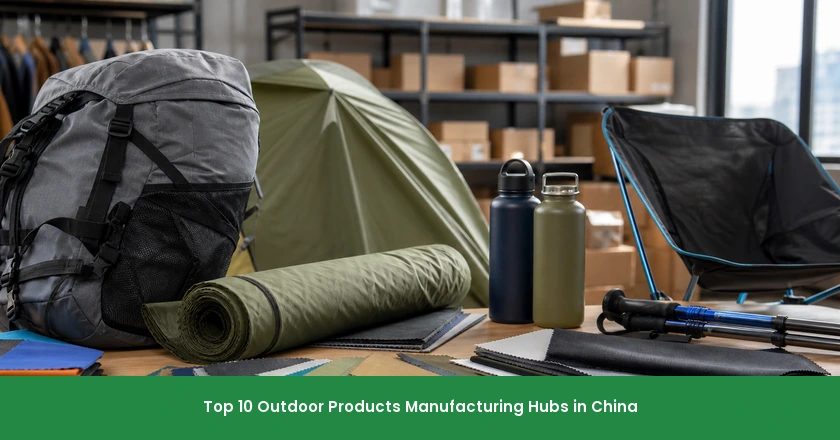
The best outdoor products manufacturing hub in China is not simply the city with the most factories; it is the place where the product's risk profile meets the strongest nearby capability. A camping tent, a hiking shoe, a folding chair, a headlamp, and a seasonal outdoor bundle all belong to the same broad category, but they require different materials, tooling, testing, packing, and export execution.
This ranking uses a buyer decision lens. It looks at where each hub is strongest, what outdoor product categories fit that hub, what hidden risks buyers should check before production, and when a sourcing agent should use cluster access to turn a product brief into a reliable supplied product from China.
Key Takeaways
- Best for: Buyers who need to match outdoor products with China manufacturing hubs by material, function, packaging, and export risk.
- Ranking logic: The strongest hub depends on the product's main risk: textile repeatability, metal strength, electronics safety, carton volume, or seasonal delivery.
- Evidence rule: Cluster reputation helps only when the factory can prove current product specs, testing basis, production control, packing method, and shipment readiness.
- NewBuyingAgent fit: NewBuyingAgent is relevant when buyers need local China factory resources, product/QC capability, and market-fit sourcing to convert an outdoor product idea into quoted China-supplied inventory.
What Makes an Outdoor Manufacturing Hub Worth Ranking?
A manufacturing hub earns its place when it reduces a real sourcing risk. China's outdoor sports policy context matters because it shows category momentum: a January 2025 government release said China planned to build high-quality outdoor sports destinations and around 100 such destinations by 2030, while calling for upgraded outdoor sports products and services. A later government news release said China's outdoor sports industry was expected to exceed 3 trillion yuan by the end of 2025 and noted that sports equipment manufacturing output value had grown from 1.12 trillion yuan in 2015 to more than 1.5 trillion yuan.
Those signals do not make every outdoor product easy to source. They make the decision more important. Buyers should rank hubs by the evidence they can help produce: material control for clothing and bags, construction proof for tents, load testing for chairs and carts, battery and label evidence for lighting, and carton efficiency for bulky seasonal goods. For camping tents, ISO 5912:2020 gives buyers a safety and performance reference point. For sleeping bags, ISO 23537-1:2022 is a reminder that temperature claims and labels need evidence, not only marketing language.
In practical sourcing, the ranking is a filter, not a final answer. A hub should help the sourcing agent ask better questions: which process controls the product promise, which evidence is missing, which component drives cost, which carton drives freight, and which delivery window cannot slip. That is the real reason a hub ranking helps buyers.
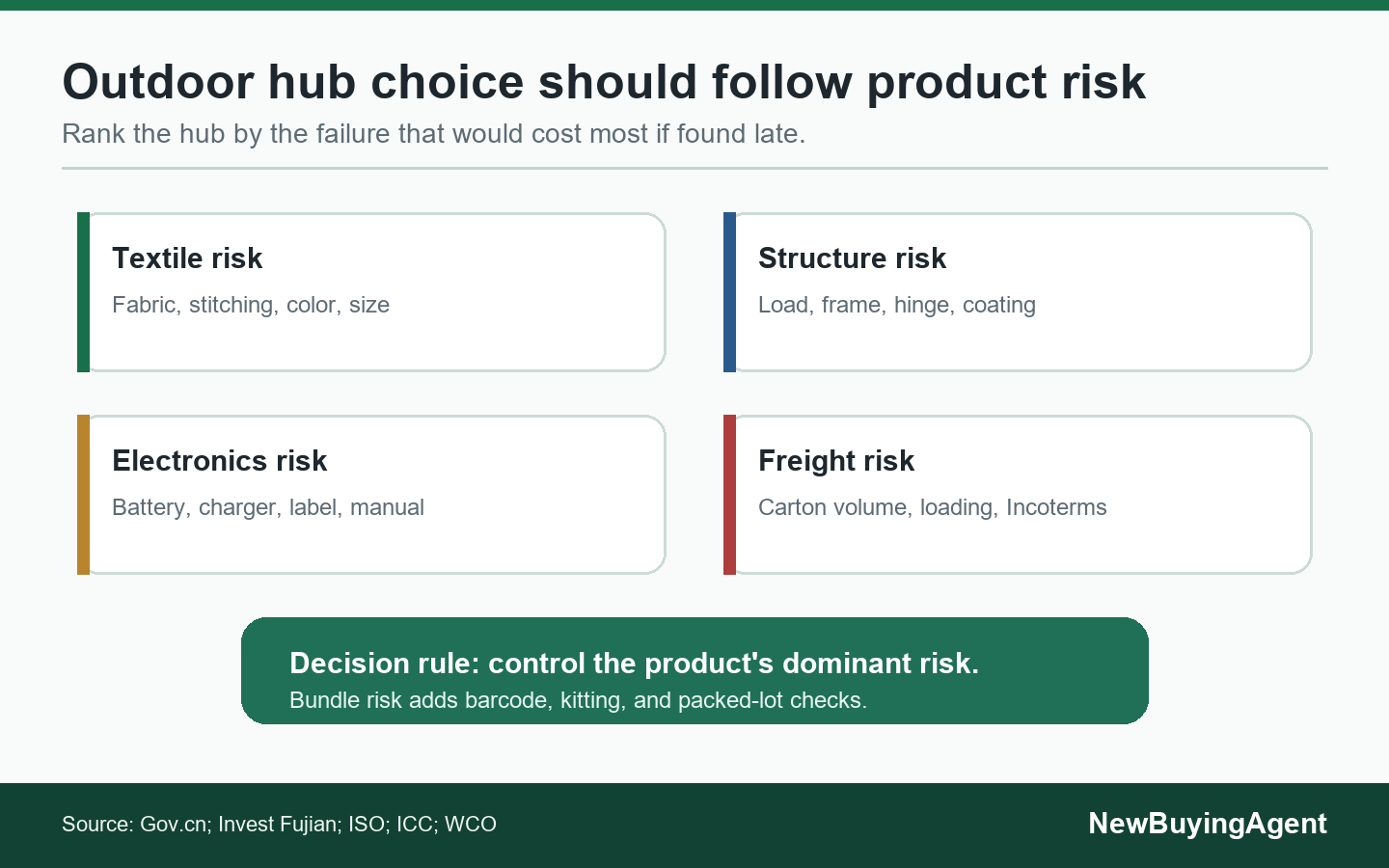
The best outdoor hub is the one that matches the product's dominant risk: textile, structure, electronics, bulky freight, or seasonal bundle control.
Top 10 Outdoor Products Manufacturing Hubs in China
1. Quanzhou and Jinjiang, Fujian: Sports Footwear and Apparel Depth
Quanzhou and Jinjiang rank first for outdoor products that depend on sports footwear, performance apparel, textile accessories, and soft goods. An Invest Fujian article says the Quanzhou Modern Sports Product Cluster focuses on leisure sports, with textile footwear and apparel at its core, and integrates petrochemical fibers, machinery and equipment, sports equipment, textiles and clothing, leather shoe manufacturing, and sports services. The same source says the cluster's output value exceeds 800 billion yuan and that more than 100 production elements can be assembled within a 50-kilometer radius centered on Jinjiang in three days.
For buyers, this hub is strongest when the product depends on material variety, stitching, upper construction, trims, light sports equipment, and repeated style development. The risk is overconfidence: a shoe or jacket that looks good in a sample still needs size consistency, color control, seam strength, packaging discipline, and claim evidence before volume production.
2. Shenzhen: Outdoor Electronics, Lighting, Power, and Smart Gear
Shenzhen is a top hub for outdoor products that behave like electronics: headlamps, lanterns, portable fans, solar chargers, pumps, heated accessories, smart trackers, and rechargeable campsite devices. The buying risk here is different from a fabric product. Battery type, charging port, PCB design, plastic housing, warning labels, manuals, transport restrictions, and after-sales failure patterns can decide whether the product is commercially usable.
Shenzhen is useful when the buyer's outdoor idea needs fast electronics iteration, component access, and product-style experimentation. It is less useful when the product is mainly a bulky frame, heavy textile item, or low-tech accessory. Buyers should avoid treating every outdoor gadget as a simple promotional item. If electricity, batteries, waterproof claims, or heat are involved, the sourcing path needs stronger test evidence and clearer destination-market documentation.
3. Dongguan, Guangdong: Assembly, Components, and Export Manufacturing Discipline
Dongguan ranks high for outdoor products that combine multiple materials and require assembly discipline: lighting accessories, plastic housings, soft goods with hardware, compact furniture, insulated bags, tool kits, and channel-specific bundles. An Invest in Dongguan article describes Dongguan as a manufacturing city with 34 of China's 41 industrial categories and more than 60,000 product types, which explains why it can support cross-material product work.
For outdoor buyers, Dongguan is valuable when the product is not one clean manufacturing process. A camping bundle might need fabric, plastic, metal, packaging, barcode control, and accessory kitting. The risk is coordination drift: each component may be acceptable alone, but the final packed product can fail on assembly fit, carton strength, label control, or delivery timing.
4. Ningbo, Zhejiang: Export Logistics, Plastic Goods, and Outdoor Convenience Products
Ningbo is strong for outdoor convenience products, plastic goods, small appliances, hardware-adjacent accessories, and export-friendly supply chains. Its value increases when carton volume, port access, and delivery reliability matter as much as unit price. Outdoor storage boxes, coolers, light furniture, simple camping accessories, and garden/outdoor living products often depend on a practical balance of molding, packing, container loading, and logistics execution.
The main buyer risk is freight economics. A low unit price can become a weak offer when the product ships with excessive air, weak cartons, or poor loading efficiency. ICC Incoterms 2020 clarifies cost, risk, and responsibility in trade contracts; for bulky outdoor goods, those terms should be checked before the quote is treated as comparable.
5. Yongkang and Jinhua, Zhejiang: Hardware, Metal Parts, and Durable Outdoor Tools
Yongkang and the wider Jinhua area fit outdoor products where metal, tools, frames, cookware, small hardware, and durable accessories matter. Camping cookware, portable stands, racks, simple grills, stakes, hand tools, garden/outdoor utility products, and parts-heavy accessories can benefit from a hardware ecosystem. Yiwu, also in Jinhua, supports small accessory consolidation and mixed-SKU bundle logic.
This hub deserves a high rank because outdoor products often fail at the "small hard part": a weak hinge, a rust-prone screw, a poor coating, a loose connector, or a handle that does not survive transport. Buyers should ask for material specs, coating information, joint checks, functional testing, and carton protection rather than judging the product only by visible shape.
6. Foshan and Shunde, Guangdong: Outdoor Furniture and Patio Living
Foshan and Shunde are useful for outdoor furniture, patio sets, folding tables, garden living products, rattan-style furniture, metal-frame furniture, and bulky home-and-outdoor crossover items. The hub's strength is not only furniture style; it is access to furniture-related materials, showrooms, finishing options, packing patterns, and project-oriented order handling.
Outdoor furniture buyers need to be careful with surface treatment, frame strength, fabric weather resistance, hardware, carton volume, and replacement-part logic. If a product sells through retail or e-commerce, the instruction manual, carton drop risk, and customer assembly experience can be as important as the frame itself. Furniture-like outdoor goods should be sourced as a quality and logistics problem, not just a style purchase.
7. Guangzhou, Guangdong: Bags, Apparel Accessories, and Channel Variety
Guangzhou remains important for outdoor-adjacent goods that involve bags, accessories, apparel-linked products, trade-market visibility, and mixed category exploration. It is useful for buyers who are still defining a range: backpacks, waist packs, caps, gloves, rain accessories, travel/outdoor crossover items, and promotional outdoor kits.
The advantage is speed of discovery and variety. The danger is weak product depth. A broad market view can make a product look easy before material, stitching, load, coating, colorfastness, and packing needs are defined. Buyers should use Guangzhou as a market-reading and category-development hub, then convert promising ideas into disciplined product specs and production evidence before scaling.
8. Yangzhou and Nantong, Jiangsu: Tents, Soft Structures, and Travel Goods
Jiangsu cities such as Yangzhou and Nantong can fit tents, travel goods, soft structures, textile outdoor products, and channel-ready seasonal items. This hub type is especially relevant when the product depends on fabric cutting, sewing, coating, poles, carry bags, and repeatable packing. For tents and shelters, buyers should connect the sourcing brief to safety and performance expectations instead of treating the item as a simple textile product.
The risk is claim inflation. A tent can be called waterproof, wind-resistant, lightweight, or family-sized without enough proof. Buyers should request material specifications, seam details, pole information, packed size, warning labels, and realistic use boundaries before volume production.
9. Qingdao and Shandong Coastal Areas: Water, Leisure, and Bulky Outdoor Goods
Qingdao and nearby coastal manufacturing areas can fit outdoor leisure products that involve water use, coastal recreation, large cartons, molded goods, and export logistics. The hub is useful when the buyer needs product categories such as inflatables, beach/outdoor leisure accessories, cooler-related items, large seasonal goods, or products where port access and export handling matter.
The main risk is destination-market proof. Water-related or child-adjacent outdoor products may face stronger safety expectations than ordinary seasonal goods. Buyers should avoid vague performance claims and ask for material, inflation, pressure, valve, label, age-grade, and packaging evidence where relevant.
10. Yiwu, Zhejiang: Small Outdoor Accessories and Bundle Fillers
Yiwu is best for low-complexity outdoor accessories, promotional items, travel add-ons, seasonal bundle fillers, small tools, compact gifts, and test-market SKUs. It should not be treated as the default home for technical outdoor gear. Its strength is variety, small accessory availability, quick market exploration, and bundle support.
The buyer risk is assuming that a low-risk accessory has no risk. Even simple items need material checks, labeling, packaging, barcode accuracy, color consistency, carton data, and channel suitability. Yiwu can be useful for range building, but technical performance claims should be kept modest unless supported by stronger product evidence.
Hub Ranking Table for Buyer Decisions
| Rank | Hub | Best outdoor fit | Risk to verify |
|---|---|---|---|
| 1 | Quanzhou / Jinjiang | Sports footwear, apparel, soft goods | Material, stitching, size, color, repeat quality |
| 2 | Shenzhen | Lighting, power, smart outdoor gear | Battery, labels, manuals, test reports |
| 3 | Dongguan | Assembly, bundles, plastic and metal combinations | Component fit, packing, final-lot control |
| 4 | Ningbo | Plastic goods, outdoor living, export-friendly products | Carton volume, loading, freight economics |
| 5 | Yongkang / Jinhua | Hardware, tools, frames, accessories | Metal grade, coating, hinge durability |
Based on this comparison, the strongest hub is the one that reduces the product's most expensive uncertainty. Textile-heavy products need repeatability. Electronics-heavy products need safety evidence. Bulky furniture-like products need carton and freight control. Bundle products need final packed-lot discipline.
How to Use the Ranking Without Overbuying Risk
The ranking should start a sourcing conversation, not end it. A buyer can shortlist the wrong hub if the product brief is incomplete. The safer order is product risk first, hub second, quote third, sample fourth, and production evidence before shipment release. Trade.gov's China standards guidance shows why standards and conformity assessment remain part of China trade decisions, while the WCO Harmonized System overview reminds buyers that product classification affects tariffs and trade documentation.
Consider a scenario estimate. A buyer wants a car-camping bundle with a folding chair, light, storage pouch, pegs, and printed carton. If the buyer saves 6% on the chair frame but loses two weeks because the light packaging and carton barcode were not coordinated, the lower frame price may not matter. Under a $60,000 trial order, a 6% frame saving on half the order value is $1,800. A two-week delay that misses a seasonal promotion can cost more than that through markdowns, rework, air-freight pressure, or lost channel placement. The decision implication is clear: rank the hub by the risk that would cost most if discovered late.
Logistics deserves the same discipline. The World Bank logistics performance tracking indicator links logistics performance to shipment tracking and supply-chain connectivity. For outdoor goods, the buyer should ask not only whether the product can be made, but whether it can be packed, labeled, classified, consolidated, and dispatched before the selling window closes.
Where NewBuyingAgent Fits in Outdoor Hub Sourcing
NewBuyingAgent fits when buyers need hub knowledge translated into a supplied product offer, not just a map of possible regions. The buyer provides the outdoor product idea, specification, quantity, target price, destination, and timing. NewBuyingAgent can then use its local China factory network, industrial-cluster sourcing access, 50,000+ cooperated factory resources, product development and quality-control capability, AI-driven hot-product analysis, and China-side execution team to shape a practical sourcing path.
For a new outdoor product, that may mean using AI market-fit analysis before the buyer commits to a style, bundle, color, or price tier. For an existing product, it may mean checking whether the current China-side production, inspection evidence, packing, and logistics still match the buyer's sales channel. Buyers can start with NewBuyingAgent's product-supply service when they need China-sourced outdoor products quoted and supplied, or review Trending Products when the bigger question is which outdoor SKU deserves development.
The practical action is to send a product brief that names the dominant risk: textile durability, weight limit, battery safety, packed size, water exposure, seasonal launch date, or target landed cost. That gives NewBuyingAgent enough context to use local resources for the supplied product outcome: better price, quality, market fit, and delivery execution from China.
Frequently Asked Questions
Which China hub is best for outdoor products?
Quanzhou and Jinjiang are strongest for sports footwear, apparel, and soft outdoor goods, but no single hub is best for every outdoor product. Shenzhen fits electronics-heavy outdoor gear, Foshan fits outdoor furniture, Yongkang and Jinhua fit hardware, and Ningbo fits export-friendly plastic and outdoor living goods. Match the hub to the product's main risk before comparing quotes.
Are China's outdoor hubs officially ranked?
No single official ranking covers all outdoor product hubs by buyer usefulness. This ranking is a sourcing decision framework based on product capability, cluster evidence, export practicality, and quality-risk fit. Official and standards sources help validate specific parts of the decision, but the final hub choice still depends on the product brief, destination market, and evidence required.
What evidence should buyers request from an outdoor product hub?
Buyers should request evidence tied to the product promise. For tents, check material, seams, poles, labels, and safety basis. For sleeping bags, check temperature claims and labeling support. For furniture-like goods, check load, corrosion, hardware, carton protection, and assembly instructions. For electronics, check battery, charger, label, manual, and test documentation.
How can NewBuyingAgent help choose an outdoor sourcing path?
NewBuyingAgent helps buyers turn product requirements into quoted China-supplied outdoor products. Its role is useful when a buyer needs local factory resources, product/QC capability, AI market-fit analysis, and delivery coordination to decide whether the right path is footwear, textile goods, electronics, furniture, hardware, accessories, or a mixed outdoor bundle.
NewBuyingAgent
Related Resources


Get Started Today
Let's Turn Your Sourcing Goals into RealityWeChat:+86 15157124615
WhatsApp:+86 15157124615
Address:Building 10 #39 Xiangyuan Road, Hangzhou, China
