


A defect disposition matrix is a decision aid for controlling identified nonconforming goods and choosing hold, rework, acceptance or rejection based on requirements, risk, evidence and approval authority.
This matters when an inspection report arrives just before a shipping cutoff. Holding the goods protects an unresolved decision; approving rework tells the factory what it may change. Neither instruction, by itself, tells the loading team that the goods may ship. The final status needs to identify the goods, the evidence and the person authorized to decide.
Hold, rework, accept or reject: what changes the decision?
Choose hold, rework, accept or reject according to the condition of the goods and the evidence available, rather than the pressure to ship. Hold when an important question is unresolved, and consider rework when the applicable requirements can be restored and checked. Accept eligible goods with the right approval; reject where the requirements or an acceptable recovery route cannot be satisfied.
- Control: Hold prevents unintended use or shipment while the decision remains open.
- Correction: Rework needs a defined method and verification against the affected requirements.
- Authority: Acceptance of conformity differs from permission to accept a specified departure.
- Scope: One order can contain separately controlled groups with different outcomes.
Compare the four defect disposition routes
Compare the four routes below for a defined group of goods before shipment, using the same dimensions: suitability, time and cost exposure, and the evidence or approval needed. This is a qualitative decision matrix, not a price benchmark or a universal inspection standard. Hold and rework can lead to a later accept-or-reject decision, so the rows describe different control functions rather than four interchangeable final outcomes.
| Route | Use when | Time / cost | Evidence gate |
|---|---|---|---|
| Hold | Scope or evidence unresolved | Storage and delay continue | Named check and decision owner |
| Rework | Conformity can be restored | Correction, checking and repacking | Verified result; release approval |
| Accept | Conforming or permitted departure | Residual obligations remain | Eligible scope; authorized decision |
| Reject | No acceptable recovery route | Return, replacement or disposal | Blocked stock; agreed instructions |
Based on this comparison, hold the affected goods if eligibility or scope is unresolved, then select the route that can produce a justified outcome. Rework is useful only where the requirements can be restored and verified. Acceptance needs evidence and authority; rejection needs instructions that keep rejected stock out of the shipment. A lower recovery cost cannot make an ineligible product acceptable.
Keep the level of the decision clear. NIST’s acceptance-sampling guidance explains that sampling principally supports a decision about the acceptability of the inspected lot, rather than an estimate of its quality. A sample finding, a lot result and the disposition of an individual defective item answer different questions. Record which one your decision covers, and avoid treating a favorable sample result as proof that every unit is defect-free.
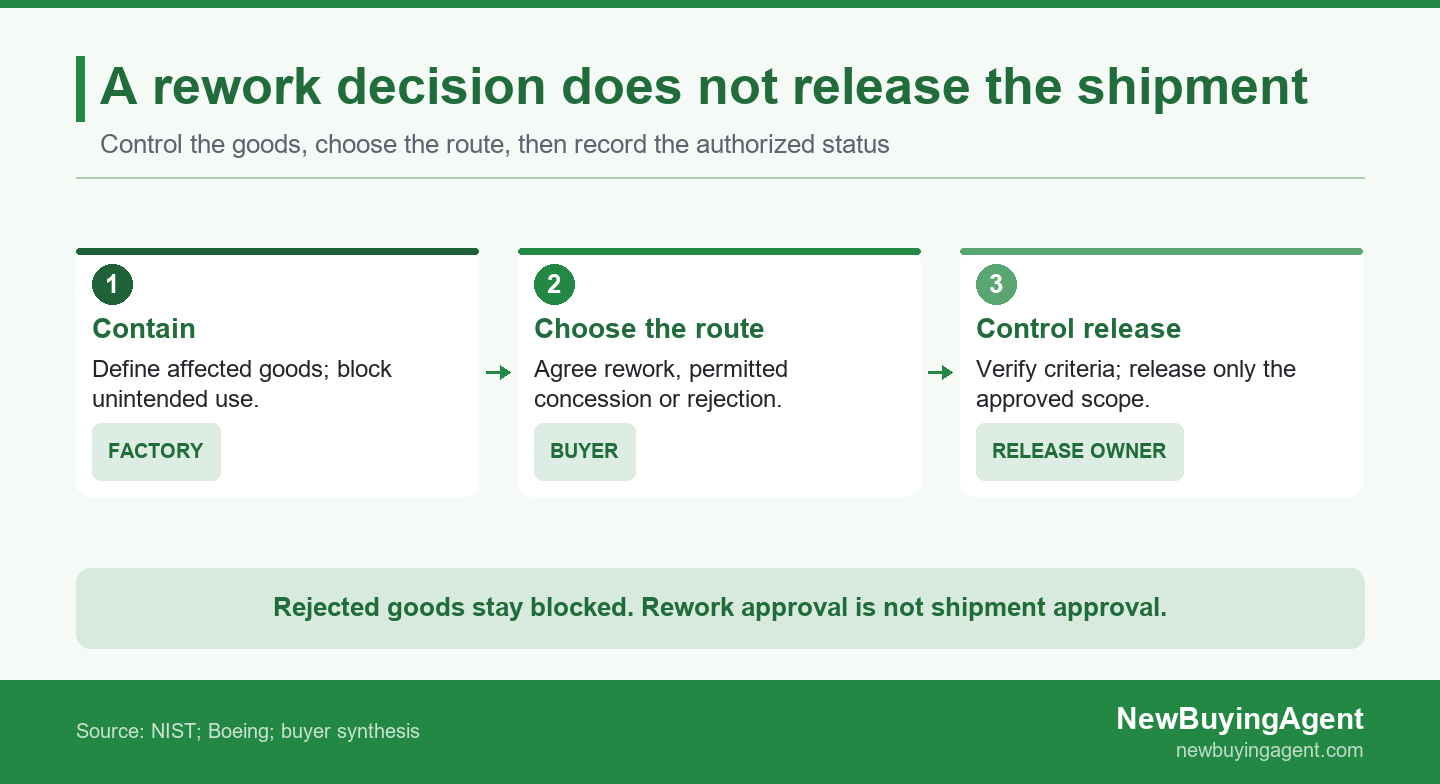
Holding goods or approving rework does not authorize shipment; release needs evidence and an authorized decision.
Define the goods and evidence covered by the hold
Define the affected goods before narrowing a hold, using records that connect the defect to an identifiable population. The GS1 Global Traceability Standard distinguishes product-class identification from batch/lot and individual-instance identification. A product name alone may therefore be too broad for a partial release, while a carton label alone may be too weak if its contents were mixed. The boundary needs to remain meaningful in the physical stock.
Tell the factory which stock is blocked, where it is stored and which packing or loading activities are restricted. Ask for quantities, locations and identifying records that another person can check. If the goods were mixed after inspection, revisit the boundary rather than relying on the original photograph. A hold also needs an owner and a review point; otherwise it becomes delayed inventory without a route to resolution.
Capture the requirement and the actual departure: what was specified, what was observed, where and how it was checked, and what remains unknown. Use the China manufacturing and product guide for broader manufacturing context, then agree the order-specific drawing, approved sample or test criterion. A photograph may show a scratch clearly but say little about strength, material identity or electrical safety. Match the evidence to the characteristic being decided.
Authorize rework only with a verification method
Authorize rework when a defined method can restore the applicable requirements and the result can be checked. An archived JPL disposition clause illustrates the distinction: rework makes a nonconforming item conform to specification, while repair can make it usable outside the original specification. The clause is historical aerospace terminology, not current authority over a private importer’s order. The transferable lesson for the buyer is to ask what the proposed fix will actually achieve.
Write the method around the defect and the characteristics it could affect. A coating touch-up may improve appearance while changing adhesion; replacing a component may change fit, function or markings. Establish who approves the method, which goods it covers and what evidence is needed before full-scale work. Sorting separates conforming and nonconforming units; it does not repair a defective unit. Keep those quantities and actions distinct.
Check the result after the relevant work and handling steps. Boeing’s nonconforming-material clause requires re-verification after rework or repair to demonstrate conformity and ensure that another nonconformity was not introduced. That is an aerospace contract requirement in its own context; the transferable lesson is to check both the original departure and the affected characteristics. For an importer, the applicable specification, inspection method and release authority still need to be agreed for the actual product.
For buyers retaining existing China suppliers, NewBuyingAgent’s factory management service provides local supplier communication, production and quality management, staged inspections and reporting. Its China-side presence and product/QC capability can help turn a rework instruction into observations the buyer can review while the factory is working. Agree on the inspection scope and report content, and keep the inspector’s findings distinct from the buyer’s technical acceptance decision.
Separate conforming acceptance from a concession
Accept against the agreed requirements and decision rules, rather than changing the test after seeing an unfavorable result. NIST describes a lot acceptance sampling plan as a sampling scheme with rules for deciding what happens next. Some plans specify additional sampling; that differs from repeatedly drawing fresh samples until one passes. Where sampling is used, preserve the original findings and follow the applicable plan for the defined lot.
A concession is documented permission to accept a specified departure where the responsible parties have authority and the product remains legally eligible. It is different from concluding that the goods meet the original requirement. State the exact deviation, quantity, intended use, permitted duration or order scope, and approving role. The factory’s description of a defect as minor does not establish that authority or settle its effect on the customer.
Apply the destination’s product-safety requirements before considering a commercial concession. For UK consumer products, official OPSS advice says compliance with product-safety regulations should be appropriately demonstrated before sale, with product-specific rules and differences between Great Britain and Northern Ireland. A buyer’s discount agreement does not itself establish compliance. If safety or a mandatory characteristic is unresolved, keep the relevant goods controlled while the appropriate technical assessment determines the next step.
Compare recovery costs before rejecting or accepting
Compare the commercial options after establishing which technical routes are eligible, and use the actual contract to determine the parties’ obligations. Bosch’s published North American non-mobility purchase terms explicitly separate payment from acceptance of nonconforming goods. Those terms are an example of a documented buyer arrangement, not rights automatically available under another importer’s contract. Record the quality decision and the financial settlement separately, with the relevant terms checked by the responsible commercial team.
Compare the additional costs of each feasible route: sorting, replacement components, rework labor, verification, repacking, storage, replacement supply and delay. Use current quotations and realistic completion dates rather than counting only the factory’s repair charge. Rejecting goods does not by itself settle a refund, return, replacement or disposal arrangement. Agree what happens to the rejected stock, who handles it and which written instruction prevents it from being packed again.
If rejection creates a replacement purchasing need, NewBuyingAgent’s product supply service can discuss supplying China products against the buyer’s specification, quantity, destination and timing. Its local factory network and product development and quality-control capability support that sourcing and supply task. Include the failed requirement and the evidence that matters for the replacement, so a different source is evaluated against the actual product need rather than simply the fastest promised delivery date.
Worked example: mixed lids in a storage-box order
A mixed-lid storage-box order shows why several disposition routes may be needed within one shipment. The following hypothetical example is not a NewBuyingAgent client incident or a recommended sampling plan. It illustrates how traceability and later verification change a buyer’s decision, including why a successful product correction can still leave the reworked stock on hold before loading.
A traceable split changes the hold
An importer has a hypothetical order of 7,200 household storage boxes packed at a Chinese factory. Inspection finds that some boxes have mismatched lids that do not close as specified. The buyer initially holds the order because the packing scope is unclear. Production and packing records then identify a suspect group of 1,800 units and a separately traceable group of 5,400 units, with their locations and carton references preserved.
The records justify reviewing the two groups separately; they do not prove that either group meets every requirement. The buyer considers the 5,400-unit group for acceptance only after its applicable checks and authorization, while keeping the 1,800-unit group blocked. For that group, a discount is unattractive because the lid still fails the specified function. The buyer authorizes a controlled lid replacement, with agreed fit, relevant product checks and packing verification before any release.
A successful lid change still needs the right release record
In this hypothetical case, the factory fits the correct lids and demonstrates the revised method on the agreed verification basis before continuing the work. The product checks support the lid change, but the later packing check finds that the reworked cartons still carry an incorrect product identifier. The buyer keeps that group on hold and asks the factory to correct the carton identification, reconcile the quantity and preserve the link between the rework record and the physical goods.
Release of the reworked group remains conditional on the relevant product criteria and corrected packing identities being verified, with the authorized decision recorded for those goods. If that evidence is satisfactory, the buyer can approve the defined group; if the correction remains unsuccessful, rejection or another approved recovery route remains open. The hypothetical outcome does not release the stock automatically or establish a universal inspection quantity. It shows why fit verification, stock identity and final approval have to agree.
Record the decision and give the factory usable instructions
Give the factory a disposition instruction that another person can execute and verify against the same goods. Name the current status, the approved action, the evidence needed and the person who can change that status. A report marked with comments is too ambiguous if the warehouse cannot tell which stock is blocked, which work is authorized and which goods may be loaded.
- Goods: Order ____; product/revision ____; quantity ____; carton or batch references ____; location ____.
- Finding: Requirement ____; observed departure ____; report/sample reference ____.
- Current status: Hold / rework authorized / accepted / rejected ____; affected scope ____.
- Next action: Method or disposition instruction ____; owner ____; completion/review point ____.
- Verification: Characteristics ____; method/criteria ____; actual results and evidence ____.
- Authority: Decision owner ____; approved scope ____; concession reference if applicable ____.
- Stock control: Released goods ____; goods still blocked ____; packing/loading instruction ____.
Run prevention work alongside the lot decision where the cause may recur. Siemens’ manufacturing problem-solving explanation distinguishes interim containment from permanent corrective action. Releasing eligible goods does not prove that the underlying process problem has been removed, while a cause investigation alone does not answer which current cartons may ship. Keep the current disposition record and the follow-up cause/action record connected, with separate evidence for what each one establishes.
Share the product specification, quantity, inspection findings, supplier response, destination and shipment timing to discuss an appropriate factory follow-up scope. NewBuyingAgent can discuss local supplier communication, production follow-up and inspection reporting through its existing-factory management service. Agree on the reporting needed and who retains technical acceptance authority before relying on the results. Contact NewBuyingAgent about the order and inspection follow-up.
Frequently Asked Questions
What if the defect is found after the container is loaded?
If the container is loaded but has not departed, identify and stop the affected shipment where possible while the finding is assessed. Establish which cartons were loaded and whether earlier segregation remains valid. If it has already departed, escalate the response around the goods’ actual location and exposure, including any applicable safety obligations; departure does not turn the finding into an acceptance decision.
Can the factory ship if the buyer misses the approval cutoff?
A missed approval cutoff does not by itself authorize shipment. Follow the decision and escalation arrangement already agreed for the order, including the named substitute if the main reviewer is unavailable. If no valid authorization covers the goods, retain the applicable hold and document the schedule consequence. Avoid asking a factory or inspector to infer approval from an unanswered message.
Should rejected goods be destroyed before the dispute is resolved?
Preserve the evidence and resolve applicable retention needs before authorizing destruction of rejected goods. Agree on identifying records, photographs, retained samples where appropriate and the person permitted to issue disposal instructions. Then document what was actually destroyed and reconcile the quantities. Rejection, financial settlement and physical destruction are separate decisions, especially while a technical investigation, contract dispute or safety response remains open.
How should destructive testing affect the release quantity?
Account for destructively tested units separately from deliverable goods and agree how the remaining quantity will be assessed. A test consumes evidence and may reduce the stock available for shipment; those units cannot be counted as intact finished products. Preserve the test identity and results, define any replacement quantity, and confirm the release basis for the remaining goods rather than silently changing the inspected population.
NewBuyingAgent
Related Resources



Get Started Today
Let's Turn Your Sourcing Goals into RealityWeChat:+86 15157124615
WhatsApp:+86 15157124615
Address:Building 10 #39 Xiangyuan Road, Hangzhou, China
