

Corrective-action closure is documented acceptance that a supplier has implemented a cause-related change and demonstrated its effectiveness within a defined scope. To verify it, connect the original problem to the cause evidence, the actual factory change, the effectiveness results and the authorized closure decision.
This matters when a Chinese supplier sends a completed report while your next order is approaching production. A polished response can leave the failure mechanism untouched. The checks below help quality and procurement teams decide what to accept, what to observe and what evidence still needs to be collected.
Supplier corrective-action closure: key takeaways
A defensible closure decision rests on evidence of both implementation and effectiveness, with the accepted scope clearly stated. Review the supplier’s explanation against production records, check the changed control in use and evaluate results from the conditions relevant to the failure. Keep product disposition separate: accepting a corrective action and deciding whether particular goods may ship answer different questions.
- Cause: Ask what evidence explains both the defect and the control that missed it.
- Implementation: Confirm the new method is actually used, with obsolete instructions or settings removed.
- Effectiveness: Review a pre-agreed test that covers the failure conditions and subsequent relevant operation.
- Closure: Record the reviewer, accepted scope, evidence references and any remaining controls.
What counts as verified corrective-action closure?
Verified closure goes beyond accepting a supplier’s response: it establishes that the response addresses the cause and works within the reviewed scope. The ISO/IAF Auditing Practices Group guidance on audit nonconformity closeout separates cause analysis, correction and corrective action, alongside effectiveness review. This is educational audit guidance rather than an additional certification requirement; the useful buyer distinction is between fixing identified goods and preventing recurrence.
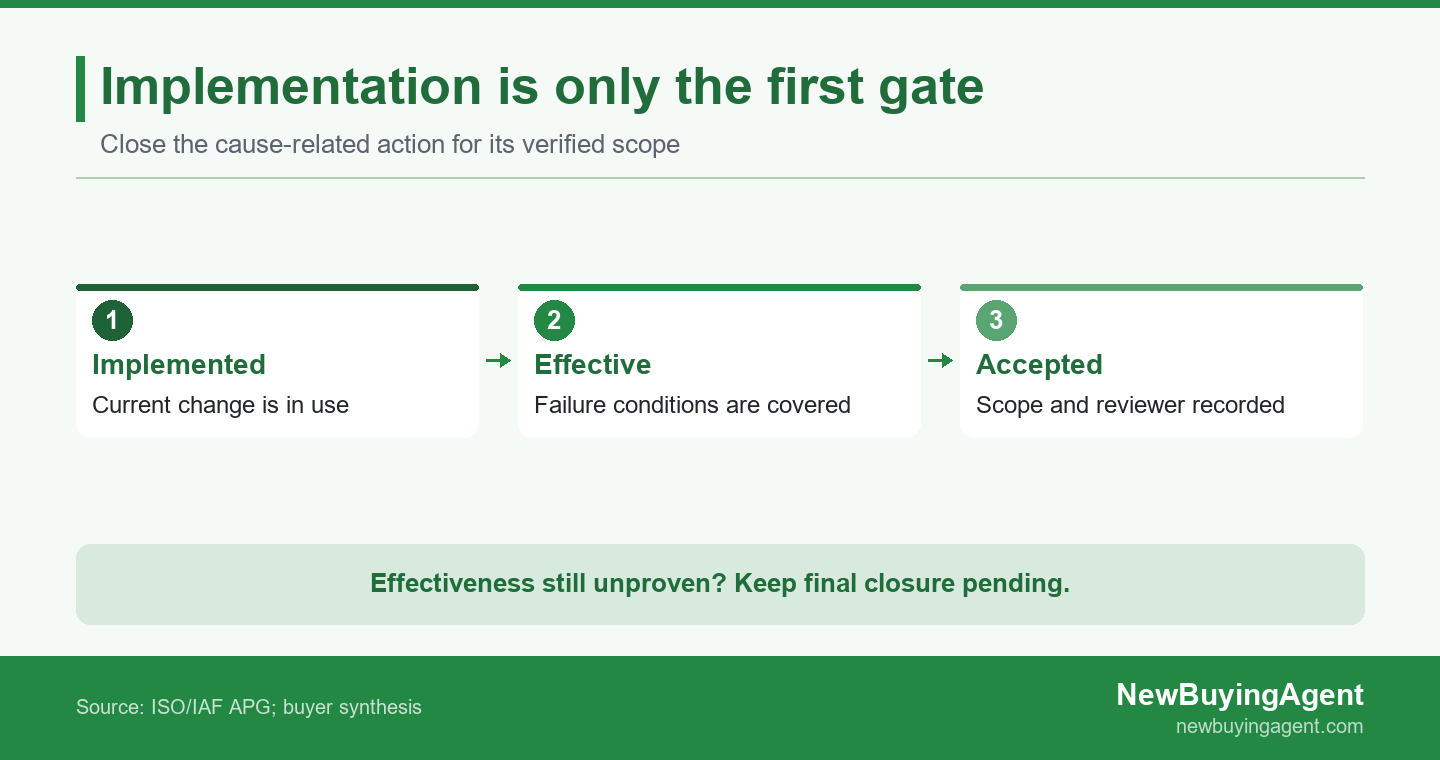
Three verification gates link an implemented factory change to cause-relevant effectiveness evidence and authorized closure.
Start with the original requirement and the observed nonconformity. Identify the product, specification revision, order, factory process and affected production window, then state the closure criterion. “Wrong SKU printed after printer restart” gives the supplier something testable; “improve label quality” does not. Attach the original inspection record or photographs so later reviewers can tell whether the response addresses the same problem.
A replacement batch, a credit note and a reworked carton can resolve immediate consequences. None explains, by itself, why the defect happened or whether the cause-related change works. Likewise, a certificate describes its certified scope; it does not verify this particular action. Keep the original finding open enough to capture new evidence, while controlling revisions so the supplier cannot quietly redefine the problem after an unsuccessful check.
Match the fix to the cause and the missed control
Match each action to the cause it is supposed to remove, including any separate failure in detection. Siemens’ explanation of the 8D method distinguishes the occurrence cause, which explains why the problem happened, from the escape cause, which explains why it reached the customer. That distinction helps a buyer spot a response that improves final checking while leaving the process that creates the defect unchanged. Broader product and manufacturing context is available in the China manufacturing and product guide.
Ask the supplier to show how the proposed cause fits the observations. Useful support might include equipment logs, retained samples, material records or a safely controlled test. If the explanation is “operator error,” ask what allowed the error and why the detection control missed it. A training signature may confirm attendance, but the buyer still needs to understand the specific behavior or control that will change.
Check alternatives before accepting an easy explanation. If the supplier blames a material batch, do affected and unaffected production records support that boundary? If several products share the same setting, were those products reviewed? The closure investigation still needs evidence from the actual process and specification.
Verify the change is in use on the factory floor
Verify that the approved change is operating at the point where the problem occurred, rather than existing only in a report. Bosch’s problem-solving guidance treats implementation, documented effectiveness checks and unintended negative consequences as connected work. For a buyer, this means requesting evidence of the change in use, then checking whether it creates a different quality problem or leaves an old route available.
Compare the approved revision with the instruction at the workstation and the operator’s actual method. For a setting change, check the saved value, permissions and restart behavior; for a fixture, confirm the correct version is installed. Ask what happened to obsolete labels, programs or instructions. A dated photograph is useful context, but a photograph alone cannot show that every relevant shift uses the changed control.
For future purchases, make these evidence expectations part of the purchasing needs shared with NewBuyingAgent. Its product supply service uses a local China factory network and product development and quality-control capability to support sourcing and supplying products. Give the team the required specification, quantity, destination and quality concerns so verification expectations can be discussed before production, rather than after a supplier has declared a problem closed.
Test effectiveness under the conditions that matter
Agree on the effectiveness criterion before judging the result, and make the check capable of exposing the original failure. The MDSAP corrective-action procedure published by FDA distinguishes implementation from documented effectiveness assessment and calls for acceptance criteria within that program’s quality management system. Applied as a buyer practice, the lesson is to specify what would demonstrate success before selecting convenient evidence; the program’s rules are not a general mandate for consumer-goods factories.
Write down the characteristic to check, the acceptance criterion, the operating conditions and the observation window. Link them to the verified cause: startup, changeover, a particular material, a shift handover or another relevant condition. Distinguish a controlled challenge of the changed mechanism from monitoring during subsequent production. Both can contribute, but they answer different questions and should not be silently substituted for one another.
For count data, retain the number checked and the number failing, together with when and how the checks were made. For a measured characteristic, retain the actual readings and measurement method. Confirm that the inspection or test can distinguish conforming from nonconforming output reliably. A summary saying “all passed” is difficult to evaluate when it omits the population, conditions or acceptance rule.
Look at results in time order where process behavior matters. NIST’s process-stability guidance describes using observations over time with scatter plots or control charts to assess process stability. For closure review, this supports examining the sequence of relevant production evidence instead of merging it into one favorable average. Choose the study and observation window for the actual characteristic, failure mechanism and risk, with the technical reviewer justifying the coverage.
If a check fails, record the failure and revisit the cause or the chosen action. Do not change the target after seeing the data simply to obtain a pass. If the check succeeds, state exactly which conditions and production it covered, then determine what further monitoring or controls remain appropriate.
Choose remote review or a targeted factory check
Use remote review for evidence that remains traceable and understandable on screen, and arrange a targeted factory check when the decision depends on physical observation. APG remote-auditing guidance advises identifying processes that could not be remotely audited and needed onsite review. That guidance concerns management-system audits, but the practical limitation matters here: unavailable observation remains a gap, even when the rest of the supplier’s file is complete.
During a remote review, ask for observation of the current records in their original context and follow a traceable example from order to output. A live walkthrough can help connect a revised instruction to the workstation, operator and production record. Agree on what will be observed in advance, and note interruptions, inaccessible areas and any evidence the camera cannot establish. Screenshots selected by the supplier are narrower evidence than observing the relevant operation.
When existing China suppliers need local follow-up, NewBuyingAgent’s factory management service offers China-side communication, production and quality management, with inspections at pre-production, in-process and final stages. Its public reporting approach includes real-time inspection information and an official report. Buyers can use that supported service context to discuss an observation brief tied to the defect, while agreeing the necessary technical scope and who will make the closure decision.
For a physical check, specify the process, revision and failure condition to observe, not merely “visit the factory.” Ask the observer to preserve the relevant evidence and distinguish what was witnessed from what the supplier reported. Product-specific laboratory testing or specialist assessment may be needed when ordinary observation cannot establish the required performance.
Worked example: a label problem that returns after restart
An illustrative restart-dependent label problem shows why clean samples may leave the decisive condition untested. The following hypothetical situation is a teaching example, not a NewBuyingAgent client case or a prescribed inspection plan. Its point is to show how the buyer’s decision changes when evidence identifies a specific failure trigger, and how the revised verification then needs to address that trigger.
Why the first closure request fails
A retailer’s quality lead reviews a hypothetical order of 7,200 fabric drawer organizers across two SKUs. Packing records trace 1,800 units to a suspect packing run after incorrect SKU labels were found. The supplier asks to close the action after relabeling stock, training the operator and submitting photographs plus clean normal-run checks. That traced quantity is the suspect scope, not a finding that every unit is defective.
The buyer notices that the clean checks were taken after steady production had begun. Printer logs and a controlled investigation establish a template fallback after restart; the first-off check had not compared the full SKU against the order. That evidence explains both occurrence and escape. Because the submitted checks never covered restart, the buyer keeps effectiveness pending and manages the suspect stock under a separate disposition decision.
What the revised verification must show
In this illustrative example, the supplier controls the approved template at restart and adds an independent first-off SKU comparison. Before rechecking, the parties define the relevant restart conditions, the correct label reference, how results will be captured and the acceptance criterion. The verification includes an agreed controlled restart check followed by defined production observations. It also checks that the revised control does not block a legitimate SKU change or introduce another labeling error, with any later closure limited to the recorded scope.
If the recorded restart and subsequent production evidence meet the agreed criterion, the authorized reviewer can accept closure for that recorded scope. A failed restart means further investigation rather than another training signature. The result does not automatically clear the 1,800 suspect units, prove the rest of the order acceptable or establish performance across every future SKU. Those boundaries require their own evidence and decisions in this hypothetical example.
Copy this supplier corrective-action closure checklist
Use this closure checklist as a working review record, replacing the prompts with your product references and evidence IDs. Each row pairs a supplier evidence request with something the reviewer can actually verify, then leaves space for the decision. An incomplete row identifies the next task; the table is a buyer aid, so adapt its criteria to the contract, product and severity of the issue.
| Check | Request | Verify | Record |
|---|---|---|---|
| Problem and scope | Requirement, revision, finding and affected production references | Does the response address the original issue and justify the scope? | Evidence IDs: ____; gap: ____ |
| Cause and escape | Investigation evidence and cause-to-action explanation | Do observations support the cause and the missed detection control? | Supported / return; reason: ____ |
| Implemented change | Current instruction, settings, training and usage records | Is the approved change in use, with old routes controlled? | Observed / records only; date: ____ |
| Effectiveness | Agreed criterion, conditions, method and actual results | Did verification cover the failure trigger and relevant production? | Met / failed / pending; IDs: ____ |
| Related exposure | Review of shared products, lines, shifts or subcontracted work | Was the cause checked wherever it could plausibly apply? | Included / excluded; basis: ____ |
| Final decision | Reviewer, accepted scope, residual controls and reopening trigger | Is closure authorized, with shipment disposition recorded separately? | Accept / keep open; signer: ____ |
Keep the evidence with the closure record, using filenames or record references that another reviewer can retrieve. Where coverage remains incomplete, name the missing check and its owner rather than writing a broad “closed with monitoring” statement that conceals unfinished effectiveness work.
Record closure separately from shipment release
Record corrective-action closure and shipment release as separate decisions, even when the same meeting considers both. NIST’s explanation of acceptance sampling distinguishes deciding the disposition of the immediate inspected lot from longer-run quality control. A lot acceptance sampling result therefore addresses that lot under its plan; it does not, on its own, establish that a supplier’s cause-related process change is effective.
The closure record should identify the issue and accepted scope, evidence references, reviewer and review date. State whether effectiveness met the agreed criterion, which controls remain and what will trigger reassessment. If implementation is complete but a necessary production check has not occurred, record that status accurately and keep the effectiveness task open. A supplier’s sales contact should not be left to decide technical acceptance by default.
For the goods themselves, use the applicable contract, inspection criteria and authorized disposition process. Rework approval, a concession or additional inspection may affect whether a particular lot can ship without completing the longer corrective-action review. Record any such decision explicitly, including its scope and limits; a delivery deadline does not supply missing technical evidence.
Share the product and order details, defect records, supplier response, production timing and the observation scope you need. NewBuyingAgent can discuss suitable factory communication, production follow-up and inspection reporting within its management service. Agree on the work and reporting scope, while keeping the buyer’s technical acceptance criteria and closure authority explicit. Contact NewBuyingAgent to discuss China-side production and quality follow-up.
Frequently Asked Questions
Can a corrective action close when the product is no longer being made?
If relevant production has not occurred, mark implementation accepted and effectiveness pending rather than treating inactivity as proof. Consider whether a justified controlled trial can establish some of the needed evidence, and define what remains for the next production opportunity. Record any alternative basis and its limits. A quiet period with no comparable work does not exercise the changed process.
What if the supplier changes the process after closure?
Assess whether the process change invalidates the earlier evidence, and reopen or reassess the affected scope when it does. Changes to materials, equipment, software, subcontracted work or the control method can alter the conditions previously verified. Record the change and its relevance before assuming the previous result transfers. A minor unrelated update may need documentation rather than a complete new investigation.
How can I verify a fix without receiving confidential factory records?
Agree on protected access to the necessary evidence instead of requesting unrestricted copies of confidential factory records. IAF’s ICT rules for conformity assessment address agreement on security and confidentiality within that assessment scope; buyers can adopt this safeguard as a practical principle. Controlled viewing, limited extracts or an agreed independent reviewer may help, provided the arrangement still establishes the facts needed for closure.
Does closure always need an independent third-party auditor?
Use a third-party auditor when the applicable contract or requirements call for one; risk may instead warrant an independent laboratory or technical specialist. Choose a reviewer with relevant technical competence, evidence access and decision authority, then consider the independence needed for the risk and any contract requirements. Supplier self-verification can provide useful evidence, but it does not automatically satisfy buyer approval. Seek specialist review where the consequence or technical question exceeds the appointed reviewer’s capability.
NewBuyingAgent
Related Resources



Get Started Today
Let's Turn Your Sourcing Goals into RealityWeChat:+86 15157124615
WhatsApp:+86 15157124615
Address:Building 10 #39 Xiangyuan Road, Hangzhou, China
