

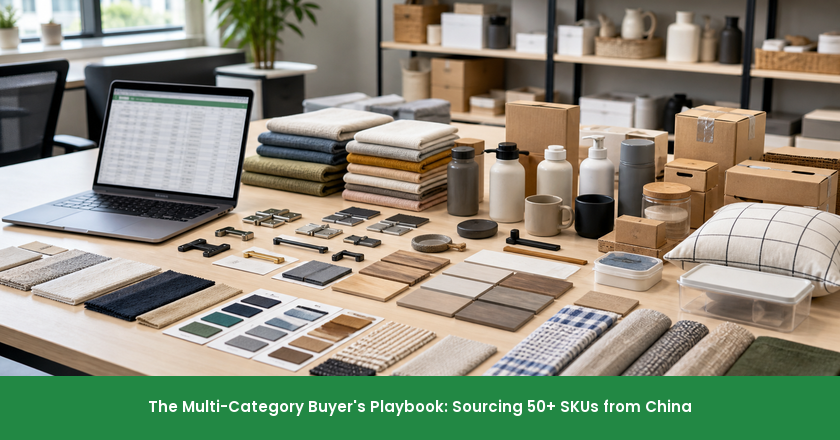
Sourcing 50+ SKUs from China is not just a bigger sourcing project; it is a portfolio-control problem where product grouping, SKU-level specs, quote assumptions, sample records, QC evidence, packaging, and logistics must stay organized together.
A buyer handling five SKUs can often keep details in memory. A buyer handling 50 SKUs cannot. Similar products start to blur. Sample comments get lost. Packaging assumptions become inconsistent. Freight planning changes after carton data appears. A small defect in one category may be harmless, while the same defect in another category may trigger returns or safety concerns.
NewBuyingAgent is relevant because multi-category buyers often need one managed procurement path rather than dozens of disconnected conversations. Buyers share product specs, volume, target price, destination, and timing; NewBuyingAgent prepares quotes and manages product selection, cost negotiation, quality management, production follow-up, logistics, and delivery.
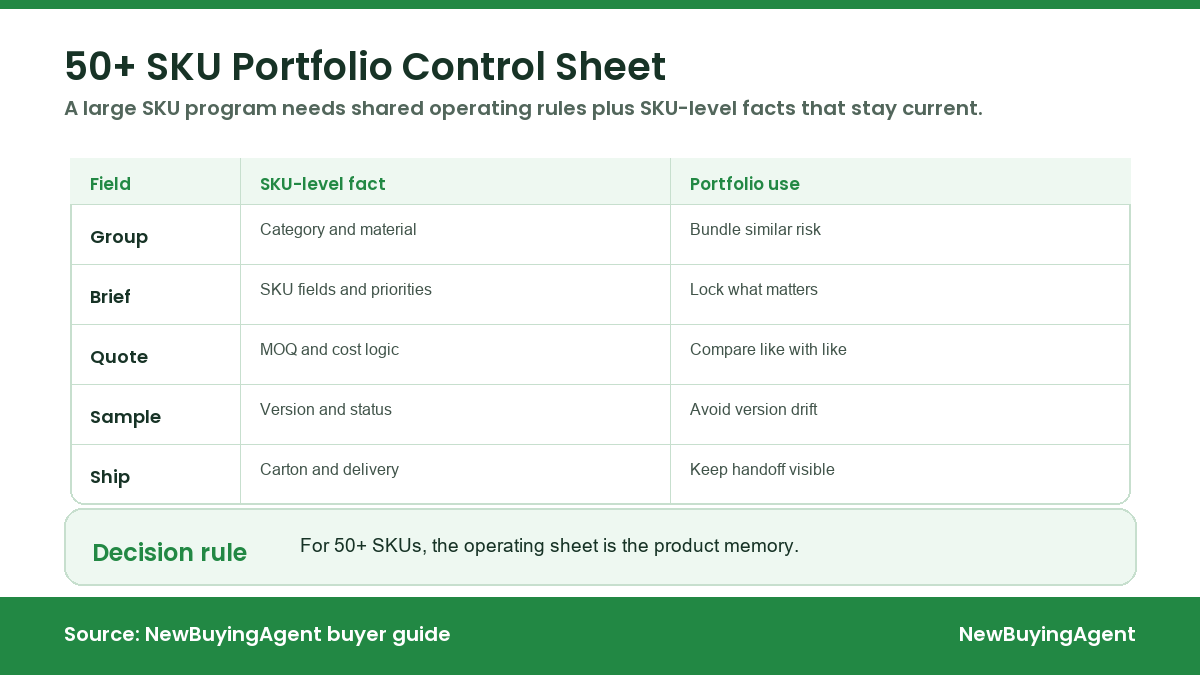
A 50+ SKU China sourcing program needs portfolio grouping, SKU-level specs, sample control, QC evidence, and logistics planning working together.
The 50-SKU Coordination Problem
The biggest challenge in a 50+ SKU program is not finding many products. It is keeping the right details attached to the right SKU at the right time. A quote for one SKU may depend on material, finish, packaging, carton size, MOQ, delivery date, and destination. Multiply that by 50 and the buyer is no longer managing a simple order. The buyer is managing a system.
When the system is weak, mistakes look random. One SKU ships with the wrong label. Another has different packaging. Another misses a sample correction. Another arrives late because its carton data was not ready. These problems are connected by the same cause: the program had no shared control structure.
The 300-Field Brief Estimate
If each SKU needs only six fields before quoting, 50 SKUs create 300 fields: SKU name, photo, material, quantity, target price, and destination requirement. That is before packaging, sample status, defect concerns, carton data, and compliance notes. If even 10% of those fields are missing or ambiguous, the buyer has 30 weak points before the first quote is approved.
This estimate explains why multi-category sourcing must start with structure. The buyer does not need a complicated system. The buyer needs a clear SKU sheet, shared rules, category-specific notes, and a process for updating changes without losing the approved version.
Step 1: Group SKUs Before Quoting
Do not start with one long unorganized list. Group SKUs by category, material, packaging, defect risk, delivery timing, and market destination. A furniture SKU, a pet accessory, a building-material item, and an outdoor product should not be treated as if they share the same QC and logistics risk.
Grouping helps the buyer see where effort belongs. Similar SKUs may share packaging or inspection logic. High-risk SKUs may need more sample control. Low-risk SKUs may only need basic confirmation. The buyer should not give every product the same attention; the buyer should give every product the right attention.
Step 2: Build a SKU-Level Brief
A 50+ SKU brief should combine shared rules and SKU-specific fields. Shared rules include target market, brand standard, packaging style, label rules, preferred Incoterms, delivery window, and inspection approach. SKU-specific fields include material, size, color, finish, quantity, target price, sample status, and defect concerns.
The brief should also show priority. Some SKUs are hero products, some are add-ons, and some are test items. If the hero product fails, the whole program may suffer. If an add-on has a minor issue, the buyer may have more flexibility. Priority helps the sourcing team decide where to spend time first.
Step 3: Quote by Product Reality, Not Spreadsheet Neatness
A neat spreadsheet can hide messy assumptions. A buyer may list 50 SKUs with one target margin, but the products may have different material costs, MOQs, packaging volume, freight impact, and QC requirements. The quote process should make those differences visible.
Buyers should expect some SKUs to need revision. A target price may be unrealistic for a material. A packaging design may push freight cost too high. A low-volume SKU may not support customization. The quote should help the buyer improve the assortment, not only accept or reject prices.
Step 4: Control Samples Without Creating Chaos
Sample control becomes difficult when many SKUs move at once. The buyer should record sample version, date received, correction notes, approval status, photo evidence, and whether the sample is approved for appearance, function, packaging, or all three. A sample can be approved for one purpose and not another.
Without this detail, the buyer may approve production from the wrong sample. The problem may not appear until final inspection, when correction is expensive. For multi-category buyers, sample records are not paperwork. They are the product memory of the program.
Step 5: Design QC by Category
ISO 2859-1 supports AQL-indexed sampling as a recognized inspection approach, but AQL alone does not define what matters for each SKU. A pet product, furniture item, outdoor product, textile, hardware item, and consumer accessory need different defect focus. The buyer should define defect examples by category before inspection.
For a 50+ SKU order, the buyer should avoid one generic QC checklist. Use shared release rules, then add category-specific defect lists. The result is simpler and stronger: the sourcing team knows what matters across the program and what matters for each product group.
Step 6: Keep Packaging and Logistics in the Same File
Packaging and logistics are where multi-category programs often become expensive. A product with low unit cost can become unattractive if its carton is oversized. A fragile product may need more protection. A mixed shipment may require cleaner carton marks, SKU labels, packing lists, and delivery instructions.
Incoterms help define who is responsible for shipment, insurance, documentation, customs clearance, and logistics tasks. For 50+ SKUs, the buyer should not leave these questions until the end. Carton data, packing method, and delivery terms should feed back into the sourcing decision.
Multi-Category Control Table
| Control Area | Portfolio Rule | SKU-Level Detail | Risk if Missing |
|---|---|---|---|
| Brief | Shared market, brand, delivery, packaging rules | Material, size, color, quantity, target price | Wrong assumptions across many products |
| Samples | One approval status system | Version, date, correction notes, photos | Production follows the wrong reference |
| QC | Shared release rules | Category-specific defect focus | Generic inspection misses real risk |
| Logistics | Delivery window and Incoterms preference | Carton size, weight, marks, packing method | Freight surprise or warehouse confusion |
Where NewBuyingAgent Fits in a 50+ SKU Program
NewBuyingAgent is useful when the buyer wants one procurement path for a multi-category program instead of separate product-by-product management. The buyer sends requirements by SKU and product group. NewBuyingAgent prepares quotes and manages product selection, cost negotiation, quality management, production follow-up, logistics, and delivery.
This does not remove the buyer's responsibility to define the assortment. It reduces the China-side coordination load and helps keep SKU details connected. For a buyer managing sales, channels, and inventory planning, that can be the difference between a scattered buying project and a controlled procurement program.
What to Send Before Requesting a 50+ SKU Quote
Buyers should send a SKU sheet, product photos, specs, quantity by SKU, target price, priority level, packaging notes, destination, delivery timing, and known quality concerns. If some SKUs are optional, mark them clearly. If some products must ship together, state that early.
Buyers planning a multi-category order can ask NewBuyingAgent to review the SKU list. Buyers still building their sourcing structure can review NewBuyingAgent's service scope and China sourcing guide.
Who Is NewBuyingAgent?
NewBuyingAgent is a one-stop China sourcing agent for global buyers. Buyers share product specs, volume, target price, destination, and timing. NewBuyingAgent prepares a quote and manages product selection, cost negotiation, quality management, production follow-up, logistics, and delivery.
Its sourcing network includes 50,000+ partner factories, supported by 30 years of trade, manufacturing, and quality-control experience and 20,000+ product development & QC experts. For 50+ SKU programs, the value is not only product access. It is keeping SKU details, quote logic, production follow-up, QC, packaging, logistics, and delivery aligned across the whole assortment.
How to Prioritize 50+ SKUs Without Losing Control
Not every SKU deserves the same attention. A 50+ SKU program needs priority tiers. Tier 1 SKUs are commercially important, brand-visible, high-volume, or risky. Tier 2 SKUs are important but less exposed. Tier 3 SKUs are low-risk add-ons or test items. The buyer should mark these tiers before quote approval because priority changes how time is spent.
For Tier 1 SKUs, buyers should demand stronger sample records, clearer packaging review, and more careful QC evidence. For Tier 3 SKUs, the buyer may accept a lighter process if the downside is small. This does not mean low-priority SKUs can be ignored. It means the buyer uses effort where the business risk is highest.
NewBuyingAgent can use priority tiers to manage the procurement journey more effectively. The buyer provides the SKU list and commercial priorities; NewBuyingAgent manages product selection, cost negotiation, production follow-up, quality management, logistics, and delivery with the right level of attention for each group.
The Multi-Category Quote Review
Quote review for 50+ SKUs should not be a single pass/fail price check. The buyer should ask what each quote assumes about material, packaging, MOQ, lead time, sample need, freight impact, and quality risk. If one SKU is cheaper because packaging is weaker, that saving may not be real. If another SKU has a higher unit price but lower carton volume, the landed-cost result may be better.
Buyers should also review quote dependencies. Some products may be efficient only when ordered together. Some may have packaging or color options that affect several SKUs. Some may need a longer lead time. A good review turns the SKU list into an assortment decision rather than a pile of prices.
| Quote Question | Why It Matters | Portfolio Signal | Buyer Action |
|---|---|---|---|
| Is the material fixed? | Material changes can alter quality and cost | Many SKUs share the same material risk | Lock shared material rules early |
| Is packaging included? | Packaging affects freight and damage | Carton assumptions differ by category | Request packaging notes before approval |
| Which SKUs drive MOQ? | Low-volume SKUs may distort the order | Assortment may need trimming | Separate must-have from optional SKUs |
| Which SKUs are timing risks? | One delayed SKU can hold a shipment | Seasonal goods need priority | Set separate milestone checks |
The Sample Room Problem
With 50+ SKUs, samples can become a mess even when every individual sample is manageable. Samples arrive on different dates, revisions are discussed in different threads, and approval notes live in different places. A buyer may approve a product photo but forget that the physical sample had a packaging issue. Another SKU may be approved for function but not color.
The fix is to give every sample a status. "Not received," "received," "needs revision," "approved for appearance," "approved for function," "approved for packaging," and "approved for production" are different states. A sample should not move into production just because one person liked how it looked.
How to Prevent Logistics From Breaking the Assortment
Multi-category buyers often discover logistics problems late because carton data arrives after sourcing decisions. Fifty SKUs can create many carton sizes, weights, marks, packaging methods, and delivery needs. If the buyer waits until production is finished, there may be little room to improve cost or handling.
Logistics should be considered when the quote is still being shaped. Ask for expected carton size, gross weight, packing quantity, special handling needs, and delivery timing. For bulky or fragile goods, packaging and freight can decide whether a product belongs in the assortment at all.
Reorder Learning for Multi-Category Programs
The first 50+ SKU order should create a better second order. Record which SKUs had price pressure, sample delays, packaging problems, defect issues, freight surprises, or customer complaints. Then update the SKU sheet before reordering. If the buyer repeats the same file without learning, the program will repeat the same mistakes.
A practical reorder file includes product status, defect history, packaging changes, cost changes, shipment notes, and next-order priority. This turns a complex sourcing project into an improving system. Without it, every reorder becomes a fresh coordination problem.
How to Build a 50+ SKU Operating Sheet
The operating sheet should be simple enough to use and detailed enough to prevent confusion. A practical version includes SKU code, product photo, category, material, dimensions, target quantity, target price, sample status, packaging note, carton data, QC focus, delivery timing, and priority tier. If a field is unknown, mark it as unknown instead of leaving it blank. Blank cells create assumptions.
The sheet should also separate shared rules from SKU-specific notes. Shared rules might include brand label placement, carton mark format, delivery window, preferred Incoterms, and general packaging style. SKU-specific notes should capture the details that make one product different from the rest. This prevents the buyer from repeating the same instruction 50 times while still preserving product-level control.
NewBuyingAgent can work more efficiently when the buyer sends a structured sheet. The service team can prepare quotes, manage product selection, negotiate cost, follow production, organize QC evidence, and coordinate logistics with fewer unclear assumptions. The buyer gets a cleaner decision file instead of a long chain of scattered messages.
What Can Go Wrong by Category
Furniture SKUs can create dimension, finish, hardware, assembly, and carton-protection issues. Pet products can raise material, labeling, chew resistance, hygiene, or packaging questions. Outdoor products may need coating, weather exposure, hardware, and load-use review. Building materials can involve size, shade, surface, breakage, and pallet planning. Light consumer accessories may look simple but still require color, logo, barcode, and packing accuracy.
The buyer should not panic about every possible defect. The point is to match controls to category. A 50+ SKU program becomes manageable when the buyer knows which risks are shared and which risks belong only to one product group.
Portfolio Decision Rules
Use three decision rules before approving production. First, do not approve any SKU that lacks a defined product version. Second, do not approve any high-priority SKU without a sample or clear reference evidence. Third, do not approve shipment planning without carton data for the SKUs that drive volume or damage risk.
These rules may slow the first order slightly, but they protect the program from large-scale confusion. With 50+ SKUs, one weak rule can create dozens of downstream decisions. Strong rules make the buyer faster later.
When to Split a 50+ SKU Program Into Phases
Some 50+ SKU programs should not launch all products at once. If the assortment contains new categories, uncertain materials, untested packaging, or products with different lead times, phasing can reduce risk. The buyer might approve Tier 1 SKUs first, then move lower-priority products after sample and quote assumptions are cleaner.
Phasing also helps when cash, warehouse space, or internal review capacity is limited. A phased program can test packaging, quality, and customer response before the buyer commits to the whole assortment. The tradeoff is timing: phasing may delay full catalog launch, but it can prevent one weak product group from slowing the entire shipment.
How NewBuyingAgent Can Receive the Handoff
The best handoff is not a folder of random files. It is a structured package: SKU sheet, product photos, required specs, target quantities, target prices, destination, delivery window, sample status, packaging expectations, and known concerns. If the buyer has previous order history, include defect photos, customer complaints, carton problems, and late-delivery notes.
NewBuyingAgent can then prepare quotes and manage the connected procurement work. The buyer still approves the assortment and commercial decisions, but the China-side execution has a clearer operating file.
What Good Looks Like After Delivery
A successful 50+ SKU program does not end with delivered cartons. It leaves behind a clean record of what worked, what failed, which SKUs should scale, which need revision, and which should be dropped. The buyer should be able to answer: which products protected margin, which created service issues, which packaging survived, and which categories deserve more sourcing attention next time.
If the first order creates that learning, the next order becomes faster and smarter. If it does not, the buyer has only imported complexity.
A good final review should happen within two weeks of delivery. Waiting longer makes the team forget which problems came from sourcing, packaging, production, inspection, or logistics. Fast review turns delivery into useful procurement memory.
The review should also name the decision for each SKU: scale, revise, pause, replace, or drop. Without that decision, the next buying cycle begins with old uncertainty. With it, NewBuyingAgent or any procurement team can focus effort where the assortment has the best chance to improve.
For large assortments, this decision record is as important as the quote sheet because it tells the buyer where future margin and quality gains are likely to come from.
It also prevents low-priority SKUs from consuming attention that should go to the products driving revenue.
Frequently Asked Questions
How should buyers organize 50 SKUs before sourcing?
Buyers should organize 50 SKUs by category, material, packaging type, defect risk, delivery timing, and market destination. A clear SKU sheet should include photos, specs, quantity, target price, sample status, packaging notes, and priority level for each product.
Why is multi-category sourcing harder than single-product sourcing?
Multi-category sourcing is harder because every SKU has different assumptions for material, MOQ, packaging, QC, carton size, and delivery timing. A small mistake can repeat across the assortment or stay hidden until shipment planning exposes it.
Should every SKU use the same QC checklist?
No, every SKU should not use the same QC checklist. Buyers can use shared release rules, but defect focus should change by category. Furniture, pet products, outdoor goods, textiles, and hardware each need different inspection priorities.
What does NewBuyingAgent need for a multi-SKU quote?
NewBuyingAgent needs a clear SKU list with product photos, specs, quantities, target prices, destination, timing, packaging requirements, and quality concerns. The cleaner the SKU sheet, the easier it is to prepare quotes and manage production, QC, logistics, and delivery.
NewBuyingAgent
Related Resources

Get Started Today
Let's Turn Your Sourcing Goals into RealityWeChat:+86 15157124615
WhatsApp:+86 15157124615
Address:Building 10 #39 Xiangyuan Road, Hangzhou, China
