

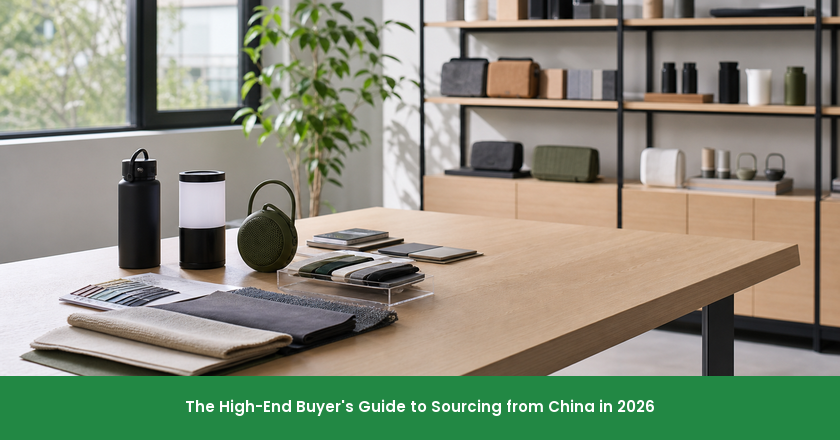
High-end sourcing from China in 2026 is not about finding the lowest factory quote; it is about protecting product intent, brand quality, landed cost, delivery timing, and customer trust through a managed procurement process.
High-end buyers have a different risk profile from price-only buyers. They may still care about cost, but they cannot let price savings weaken materials, packaging, finish, customer experience, or launch timing. The question is not whether China can produce high-quality goods. The question is whether the buyer can control the sourcing process well enough to receive the product version the market expects.
A high-end buyer should treat China sourcing as a sequence of decisions: define the product promise, lock the specification, approve a production-ready sample, manage cost without hidden downgrades, control production changes, inspect against category-specific defects, and release goods only when quality evidence and logistics are aligned. If any step is skipped, the order may still ship, but the brand may pay later through returns, reviews, rework, or delayed launches.
NewBuyingAgent fits high-end sourcing when buyers need China-side procurement ownership without personally managing every factory-facing detail. Buyers share product specs, volume, target price, destination, and timing. NewBuyingAgent prepares a quote and manages product selection, cost negotiation, quality management, production follow-up, and logistics through final delivery.
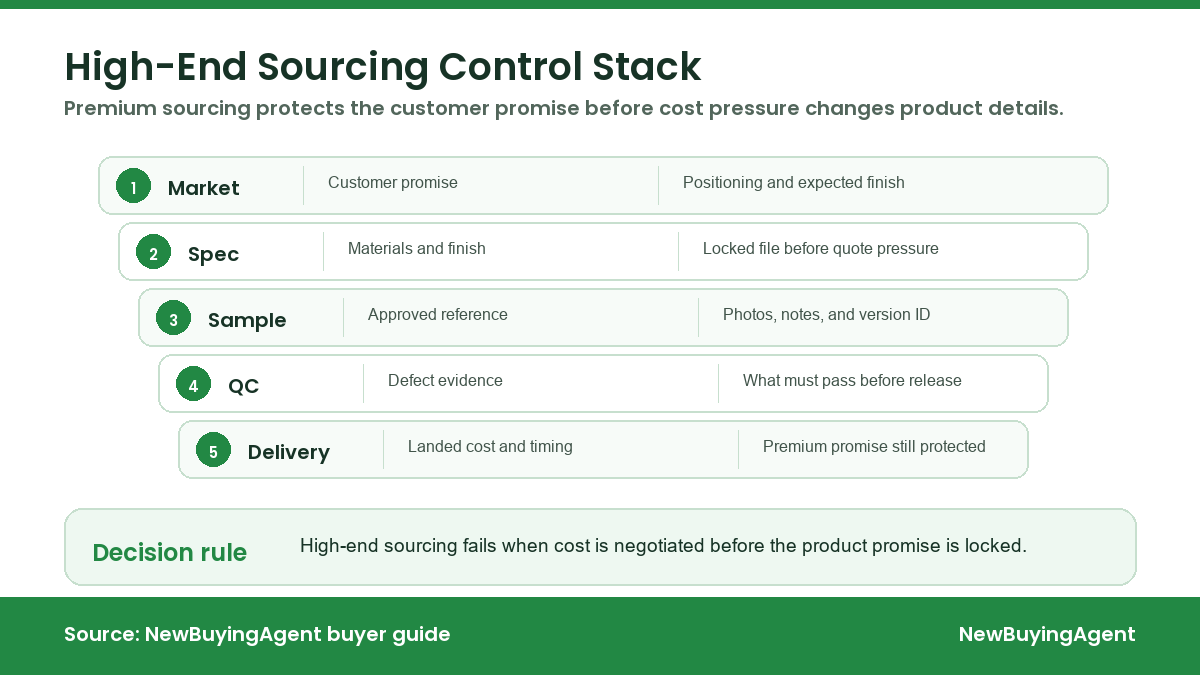
High-end buyers should control product intent, sample standard, quality evidence, landed cost, and delivery timing as one system.
What Makes High-End China Sourcing Different
High-end sourcing is different because small product changes have larger business consequences. A slight material downgrade can change feel. A weak carton can damage a premium unboxing experience. A color shift can break a collection. A packaging typo can make a brand look careless. A late shipment can miss a retail window or product launch.
The buyer should therefore define product intent before talking about price. Product intent includes who the product is for, what price tier it supports, what customer experience must be protected, what materials or finishes matter, and what defects would damage the brand. Without that intent, suppliers and agents may optimize for a cheaper version that technically matches a photo but misses the market.
Official product-safety and trade resources also matter for high-end buyers. The CPSC business education page reminds businesses to identify applicable product safety requirements, while the European Commission product safety page shows why destination-market rules cannot be left until after production. High-end buyers do not need more paperwork for its own sake. They need early clarity about which documents, labels, tests, and release evidence matter for the product.
The High-End Sourcing Control Stack
A high-end sourcing program should be controlled through five connected layers: market intent, specification, sample, quality, and delivery. Each layer protects the next one. If the product intent is vague, the specification will drift. If the specification drifts, the sample will not scale. If the sample does not scale, QC becomes a late argument instead of a planned release decision.
1. Market Intent
Market intent tells the sourcing team why the product exists. A premium furniture buyer may care about finish, stability, and packaging. A DTC home brand may care about customer reviews and unboxing. A retailer may care about shelf consistency and reorder reliability. An Amazon brand may care about defect rate, review risk, and packaging durability.
Buyers should write market intent in plain terms: target customer, target retail price, margin requirement, launch window, must-have product features, and unacceptable customer complaints. This lets the sourcing partner understand which compromises are possible and which would damage the business model.
2. Specification Discipline
High-end buyers need specifications that are practical, not decorative. The spec should identify material, dimensions, finish, tolerance, function, packaging, labels, accessories, destination market, and quality concerns. If the product has compliance or documentation needs, those should be listed before sample approval.
Specification discipline also includes change approval. A supplier-side material change, carton change, hardware change, or finish change may seem minor until it affects customer experience. The buyer should define which changes require approval and which can be optimized during procurement. NewBuyingAgent can manage product selection and production follow-up more effectively when these rules are clear.
3. Sample Standard
The sample is the bridge between the product idea and mass production. High-end buyers should approve samples with written corrections and photo evidence. The approval should record what is final, what still needs adjustment, and what must not change in production. A sample approval that says only "approved" is too weak for a premium product.
For furniture and composite wood products, the EPA TSCA Title VI page is a reminder that materials and documentation can affect product acceptance in the U.S. For covered product types such as clothing storage units or bunk beds, CPSC guidance can become directly relevant. The buyer should not wait until shipment to ask whether the sample represents a compliant and market-ready product version.
4. Quality Evidence
Quality evidence should be planned before production. Buyers should define critical, major, and minor defects by product type. A cosmetic scratch, missing accessory, unstable assembly, wrong label, color mismatch, odor, sharp edge, or weak carton may have different consequences depending on the product. Generic inspection language is not enough.
The ISO 2859-1:2026 page describes AQL-indexed sampling plans for inspection by attributes. Sampling helps structure lot review, but it does not replace product-specific defect definitions. High-end buyers should decide what evidence they need before release: QC photos, measurements, packaging proof, label proof, carton marks, function checks, and document records.
5. Delivery and Landed Cost
Delivery and landed cost complete the control stack because high-end sourcing fails if goods arrive late, damaged, or commercially unviable. The International Trade Administration's Incoterms guidance explains that trade terms affect costs, risks, documentation, insurance, customs clearance, and logistics tasks. The buyer should understand delivery terms before approving a quote.
Landed cost should include unit price, packaging, QC, freight, duty, customs fees, inland delivery, expected rework, and launch-timing risk. A quote that looks attractive at the factory gate may be weak after these factors are added. NewBuyingAgent can support cost negotiation and logistics coordination, but the buyer should give the commercial target and destination-market context early.
The Cost of a Small Quality Drift
Consider a high-end buyer ordering 3,000 units for a premium launch. If only 4% of units arrive with visible finish inconsistency, that is 120 units. If each affected unit needs a $12 discount, replacement part, or handling cost, the visible defect creates $1,440 in direct cost before counting review risk, customer support, delayed launch, or internal time. The number is illustrative, but the decision lesson is clear: high-end buyers should control quality drift before goods leave China, not after customers see the issue.
That is why the control stack matters. The buyer does not need to personally manage every factory message, but it needs a procurement system that connects product intent, sample approval, production follow-up, QC evidence, and delivery release.
High-End Buyer Checklist
The checklist below helps buyers decide whether a sourcing process is strong enough for a premium product.
| Control Layer | Buyer Should Define | Evidence to Request | Risk if Weak |
|---|---|---|---|
| Market intent | Customer, price tier, margin, launch date | Written brief and product priority | Factory optimizes for the wrong version |
| Specification | Material, dimensions, finish, packaging | Spec sheet, drawings, approved references | Quote changes and sample drift |
| Sample | Approved version and correction notes | Photo record and sample approval file | Mass production does not match expectation |
| Quality | Critical, major, minor defects by category | QC report, photos, measurements, packaging proof | Late discovery after goods are hard to fix |
| Delivery | Incoterms, freight, duty, launch timing | Shipment documents and release confirmation | Margin loss or missed sales window |
When NewBuyingAgent Should Step In
NewBuyingAgent should step in when the buyer has a product requirement but does not want to run daily China-side procurement work. The strongest fit is a project where product quality, packaging, timing, or margin matters enough that factory-facing execution needs disciplined ownership.
Buyers should not wait until production is already late or defects are already visible. The earlier NewBuyingAgent receives the product specs, target price, order volume, destination, packaging expectations, and timing, the more it can manage product selection, cost negotiation, quality management, production follow-up, and logistics as one process.
The buyer still owns market decisions: what product tier to sell, which sample to approve, which defects are unacceptable, how much margin is required, and when launch timing cannot move. NewBuyingAgent handles China-side execution so those decisions can become a quote, production plan, QC evidence, and delivery handoff.
What High-End Buyers Should Send Before Requesting a Quote
High-end buyers should send a product brief, photos or drawings, material requirements, target price, order quantity, destination market, packaging expectations, quality concerns, launch timing, and any compliance or documentation notes. If the buyer has a failed product, previous sample, or customer complaint history, those materials are useful because they show what must be improved.
Buyers ready to source a high-end product from China can request a quote from NewBuyingAgent. Buyers still building their procurement model can review NewBuyingAgent's China sourcing guide before preparing the RFQ package.
Who Is NewBuyingAgent?
NewBuyingAgent is a one-stop China sourcing agent for global buyers that want to source products from China without managing factory conversations, production follow-up, quality control, and logistics themselves.
Backed by 30 years of trade, manufacturing and quality control experience, NewBuyingAgent supplies products that meet buyers’ purchasing requirements. Buyers share their purchasing needs, and NewBuyingAgent handles product selection, cost negotiation, quality management, and logistics—delivering goods that satisfy market demand, ship on schedule, and safeguard the buyers’ bottom line.
Its sourcing network includes 50,000+ partner factories and 20,000+ product development & QC experts. For high-end buyers, the value is not only lower cost. It is protecting the approved product version, brand quality, production follow-up, and delivery timing while the buyer focuses on sales and growth.
What High-End Buyers Should Control Before the First Quote
High-end sourcing is often described as a search for better factories, but the more reliable starting point is a controlled buying brief. A premium buyer should define the product promise before discussing price: what the customer must feel, what defect would damage the brand, what packaging experience is expected, what tolerance is acceptable, which markets will receive the product, and which dates cannot move. Without that control, a low quote can win the conversation while the product quietly drifts away from the brand standard.
A high-end buyer also needs to decide which elements are negotiable and which are fixed. Material grade, surface finish, stitching, color tolerance, hardware weight, carton protection, instruction quality, and labeling requirements may not all be equally important. If every feature is described as critical, the procurement team has no way to make smart tradeoffs. If too few features are protected, the finished product may become cheaper but less brand-credible. The useful middle ground is a specification hierarchy: brand-critical, performance-critical, cost-sensitive, and optional.
NewBuyingAgent is strongest when the buyer can send that hierarchy with volume, target price, destination, and delivery timing. The team can then prepare a quote around the product version that should actually be purchased and manage product selection, cost negotiation, quality management, production follow-up, and logistics. For high-end buyers, the value is not just finding a workable production path. It is keeping the approved version intact as the order moves from idea to sample, production, inspection, and delivery.
The Premium Buyer Brief
A premium buyer brief should not read like a casual product wish list. It should behave like a control document. The brief can include product photos, drawings, target materials, performance requirements, finish references, logo or private-label rules, packaging examples, certification expectations, inspection focus, and any customer complaint history from earlier orders. For a retailer, the brief should also include shelf, warehouse, and return constraints. For an ecommerce brand, it should include carton drop risk, assembly clarity, review sensitivity, and replacement-part expectations.
The brief should also identify the cost line that matters most. Some high-end buyers care about ex-factory price because their logistics model is already mature. Others need a delivered-cost view because freight, duties, carton size, and storage fees can erase the apparent saving. If the buyer only states a target product price but ignores packaging volume, MOQ, duty, and freight assumptions, the sourcing team may optimize the wrong number.
| Brief element | High-end risk controlled | Good input | Weak input |
|---|---|---|---|
| Brand-critical features | Product feels cheaper than the promise | Ranked must-have features and finish references | "Premium quality" with no examples |
| Inspection focus | Wrong defects receive attention | Top failure modes, AQL level, photo requirements | Generic final inspection only |
| Packaging standard | Good product arrives damaged or feels low-value | Carton, inner protection, unboxing, label rules | Packaging left to the factory |
| Landed-cost target | Margin fails after duty and freight | Destination, Incoterm preference, duty assumption | Only ex-factory target price |
How Premium Procurement Breaks Down in Practice
High-end sourcing rarely fails because one person wanted a bad product. It fails because responsibility is fragmented. The sample may be approved by a product manager, price may be negotiated by purchasing, packaging may be handled by another team, compliance may appear late, logistics may only see carton data after production, and customer service may inherit defects after delivery. Each handoff can be reasonable in isolation, yet the whole system loses control.
The first breakdown is sample drift. A pre-production sample can feel right, but mass production may use a substitute material, lighter hardware, looser stitching, weaker adhesive, different surface treatment, or less protective packaging. That drift is not always malicious. Sometimes it happens because the approved sample is not converted into measurable production requirements. A high-end buyer should therefore capture the approved sample with photos, measurements, material notes, color references, and defect limits before production starts.
The second breakdown is price pressure without version control. A buyer may negotiate strongly, but if the quote target is not attached to a locked specification, the product may change to meet the price. High-end buyers should ask whether cost reduction comes from process efficiency, volume leverage, material change, packaging change, tolerance change, or inspection reduction. Those sources of savings are not equal. Some are good procurement work; others quietly reduce the product promise.
The third breakdown is late compliance review. A premium product can still be delayed or rejected if labeling, testing, documentation, or destination-market expectations are missed. Consumer product categories, electrical items, children's goods, composite wood products, textiles, cosmetics packaging, food-contact items, and furniture can all carry different evidence needs. The buyer should flag destination markets and product use early, then let qualified compliance professionals or brokers confirm the final requirements.
The fourth breakdown is logistics afterthought. Premium products often have heavier packaging, larger cartons, stricter finish protection, or more fragile components. If carton dimensions and packing method are ignored until the end, freight cost and damage risk can surprise the buyer. A good quote process should connect packaging design, carton data, shipment terms, and delivery timing before production release.
A Decision Framework for High-End China Sourcing in 2026
High-end buyers can make better decisions by scoring each sourcing path against five practical questions. First, does the quote protect the features that customers will notice? Second, does the quality plan inspect the failure modes that create refunds, negative reviews, or brand embarrassment? Third, does the production timeline include sample approval, material confirmation, in-process checks, final inspection, and document readiness? Fourth, does the landed-cost view include freight, duty, packaging volume, testing, and storage effects? Fifth, does one accountable team manage the path from quote to delivery?
If a sourcing path scores well on price but weakly on the other four questions, it may be a purchasing shortcut rather than a premium procurement plan. If a path scores well on quality but ignores landed cost, it may become commercially fragile. The strongest path is balanced: clear product version, realistic cost target, controlled production, visible quality gates, and logistics planned early enough to protect both timing and margin.
That is the reason NewBuyingAgent's one-stop model fits high-end buyers who do not want to manage scattered factory-facing tasks. The buyer provides the commercial and product intent; NewBuyingAgent prepares the quote and manages product selection, cost negotiation, production follow-up, quality management, and logistics. The buyer still makes the brand and commercial decisions, but the execution path becomes easier to control.
How to Run a High-End Pilot Order
A pilot order should test the system, not only the product. The buyer should confirm whether the approved sample can be repeated, whether carton protection survives the intended channel, whether inspection photos reveal the right details, whether documents arrive early enough for customs or internal review, and whether the production schedule is communicated before problems become urgent. A pilot that only checks unit price can create false confidence. A pilot that checks repeatability, packaging, QC evidence, and delivery handoff tells the buyer whether a larger order is sensible.
The pilot brief should therefore include a success definition. For example, the buyer may decide that a pilot passes only if finish variation stays within the approved tolerance, functional defects stay below the agreed threshold, carton damage is not visible after transport, documents are complete before shipment release, and landed cost stays within the approved margin range. Those criteria make the next decision clearer: scale the SKU, revise the product, change packaging, renegotiate cost, or stop before more capital is committed.
Internal Alignment for Premium Buyers
High-end sourcing also needs internal alignment. Product, brand, finance, compliance, logistics, and customer service should agree on what the product must achieve before the China-side work begins. If finance pushes for a target price that conflicts with brand-critical materials, the procurement team needs to know which priority wins. If logistics needs a carton limit for warehouse handling, that limit should be in the brief. If customer service knows which defects drive refunds, those defects should appear in the inspection focus. The best China sourcing process cannot protect a standard that the buyer's own team has not defined.
Frequently Asked Questions
Can high-end buyers source reliable products from China?
Yes, high-end buyers can source reliable products from China when the process controls product intent, specifications, sample approval, quality evidence, packaging, and delivery timing. The risk is not sourcing from China itself. The risk is approving vague requirements, chasing low quotes, and discovering quality drift after production is already complete.
What should high-end buyers check before comparing quotes?
High-end buyers should check material, finish, dimensions, packaging, target margin, destination market, quality expectations, compliance questions, and delivery timing before comparing quotes. A quote is meaningful only when it is tied to a defined product version. Otherwise the lowest price may reflect a weaker product than the buyer intended.
How does a sourcing agent protect brand quality?
A sourcing agent protects brand quality by translating the buyer's product requirements into quote assumptions, sample corrections, production follow-up, QC checks, packaging proof, and release evidence. The buyer still approves business-critical decisions, while the sourcing partner manages China-side execution so the approved standard is not lost during production.
When should a high-end buyer avoid direct factory sourcing?
A high-end buyer should avoid direct factory sourcing when the order has private-label packaging, strict sample standards, multiple SKUs, narrow launch timing, recurring defects, or limited internal capacity for China follow-up. Direct contact can work for simple projects, but premium products often need a managed procurement process.
NewBuyingAgent
Related Resources

Get Started Today
Let's Turn Your Sourcing Goals into RealityWeChat:+86 15157124615
WhatsApp:+86 15157124615
Address:Building 10 #39 Xiangyuan Road, Hangzhou, China
