
Spot freight from China is the better choice when your next ready dates and container count can still change. Contract freight is the better choice when repeat cargo can reliably use a stated commitment period and service scope. The decision is not about finding a rate label that sounds lower; it is about matching the freight arrangement to the shipments your production, quality release, and destination plan can actually support.
Choose the Commitment That Matches Your Shipping Rhythm
A freight choice should follow the cargo calendar and commitment exposure, not a rate label alone. Spot freight from China is usually stronger when the date goods will actually be ready can move, the container count is still forming, or a buyer needs to react shipment by shipment. Contract freight is stronger when repeat cargo on a known lane can use a defined period of terms without forcing the team to ship early, hold unwanted inventory, or accept a service scope it has not checked.
Start with the dates that product can leave the factory after production and quality release, rather than the date a purchase order was issued. Then record the expected container count, origin, destination, required departure window, and who will approve a booking change. This turns a vague freight conversation into a decision with operating evidence behind it. A low headline rate can be useful, but it is not a saving if the buyer cannot use the commitment or discovers a cost outside the quoted scope.
There is no universal winner. A buyer with dependable monthly full-container loads may value planned terms and repeatable booking control. A buyer preparing an uncertain launch may value the option to book only when goods are ready. The practical test is simple: can the next several shipments support the commitment that the rate approach expects?
- Use spot freight when timing or volume changes faster than a period commitment can be used.
- Use contract freight when recurring cargo, dates, and service needs are reliable enough to plan against written terms.
- Compare all-in scope, cut-offs, and change exposure before comparing a base rate.
- Keep the cargo calendar, Incoterm, and booking responsibility in the same working file.
What Spot and Contract Freight Actually Commit You To
Maersk distinguishes on-demand spot bookings from contracts with predetermined rates and schedules. That is a helpful starting distinction, but the buyer should still read the named product, route, validity period, and booking confirmation. A carrier's explanation of its own service does not make every contract identical, and a forwarder quote may use a different structure.
Spot freight means a shipment-by-shipment rate and booking approach. The buyer normally asks for capacity and a price based on the cargo that is ready now or expected shortly. It gives the purchasing and logistics teams room to wait for a confirmed ready date, change the container count, or use an alternative routing conversation when the original plan no longer fits. In return, the buyer accepts that space, price, and departure choices may look different on the next booking.
Contract freight means freight terms arranged for a stated period or volume plan. It can make a recurring lane easier to plan because the buyer has a defined framework for the rate and service conversation. The commitment is not only commercial. It needs a reliable operating rhythm behind it: goods must be ready often enough, product release must be coordinated, and someone must see forecast drift before the missed volume becomes a surprise.
Spot Freight Buys Flexibility by Shipment
Spot freight is more useful when ready dates and shipment quantities can change before booking. Consider a seasonal order, a new product launch, mixed containers that still need consolidation, or production that cannot yet promise a dependable weekly or monthly release. In those cases, a buyer can make each booking after checking the current cargo state instead of defending an old forecast.
Flexibility is not the same as no discipline. The team still needs the packing list assumptions, container type, cargo-ready date, loading location, destination, and requested departure window. It should also distinguish an urgent shipment from a merely late internal estimate. The more precise the ready-date signal becomes, the more useful a spot quote becomes as a real choice rather than an emergency purchase.
Contract Freight Buys Planning Discipline Over a Period
A Maersk Go FAQ says its General cargo can use fixed or variable contract rates, subject to the product's own conditions. Treat that as a product-specific example, not a promise about another carrier, forwarder, trade lane, or cargo type.
The useful benefit of a contract is planning discipline. It can give the buyer a clearer basis for budget review, bookings, and repeated shipments, particularly when the same origin-destination lane and container pattern recur. Its value rises when the sales plan, production plan, inspection release, and receiving capacity point to a similar shipment cadence. Its value falls when the forecast is a hope rather than a controlled plan.
The Four Questions That Decide the Freight Fit
Treat the named Incoterm as one boundary in the decision, then test the commercial rate scope and commitment separately. Incoterms are international trade rules that assign named tasks, costs, and risk. They help the buyer identify where responsibility changes, but they do not by themselves determine whether the forecast is stable enough for a freight commitment.
Use the four questions below before asking a carrier or forwarder to compare spot and contract options. The answers do not produce a universal rate recommendation. They make the commercial request more complete and expose the facts that should change the answer.
| Question | Spot signal | Contract signal | What to record |
|---|---|---|---|
| How stable are ready dates? | Dates move often or depend on launch, testing, or consolidation. | Release dates are repeatedly met within a usable planning window. | Factory-ready date and quality-release date. |
| How certain is the volume? | Container count is still being revised. | Expected volume is repeatable across the commitment period. | Container type, count, and forecast confidence. |
| How tight is the departure window? | A later or alternate sailing can work. | Service and departure consistency are operationally important. | Latest acceptable departure and arrival consequence. |
| What does the quote include? | Each booking needs a current scope check. | Validity, inclusions, exclusions, and change terms need written confirmation. | Origin charges, surcharges, destination costs, and amendment exposure. |
When Spot Freight Wins
Maersk's freight-cost guide says spot freight offers flexibility and should be matched to cargo volume and shipping needs. That principle is especially useful when a China order is still proving its launch timing, packaging configuration, or mix of factory-ready SKUs.
Spot often wins for a first shipment of a new range, a replenishment order with uneven demand, a project where release depends on a customer approval, or a consolidation plan that may finish with fewer containers than expected. In each case, paying for a decision only when the cargo state is clearer can be more valuable than chasing a period rate. The buyer is buying the ability to align freight with product reality.
That does not mean the buyer should wait until the last possible day. A controlled spot process still asks for early visibility: a rolling ready-date forecast, a decision owner, a latest acceptable departure, and a pre-booking check of cargo dimensions and documentation. For a new product requirement, NewBuyingAgent's product supply route can connect the product specification, quantity, target price, destination, and timing to a China supply discussion before freight is treated as a separate last-minute task.
A practical spot rule is to keep two dates visible. The first is the earliest date the factory believes goods can be ready. The second is the date the goods are actually released for shipment after the required quality work is complete. The gap between those dates is a warning against committing freight volume too early.
When Contract Freight Wins
A contract is useful only when its booking changes, charges, and conditions remain usable for the buyer's actual shipment plan. It can be the stronger choice when the same lane has repeat cargo, the production plan has credible release dates, and the receiving team can work with a planned arrival rhythm.
Think of a buyer that ships a similar container count from the same China origin to the same destination every month. The cargo may still vary by SKU, but the shipper can estimate the container pattern, the release cadence, and the window in which product needs to depart. A contract can make the rate and capacity conversation more structured because the buyer has something real to plan against.
Before selecting that route, ask whether the expected volume is operationally usable, not merely forecast in a sales file. Review the period, lane, equipment, named service, rate validity, origin and destination charge treatment, and the process if production slips. Put the review date on the cargo calendar. A contract works best when it is actively managed as conditions change, not filed away after it is signed.
Use One Freight Calendar Before You Choose
For U.S.-related trade, the FMC says VOCC tariffs must show rates, charges, rules, and practices. A vessel-operating common carrier is a carrier category used in U.S. maritime regulation. For the buyer, the useful lesson is narrower: read a freight arrangement as a defined scope of rates, charges, and operating rules rather than a single number.
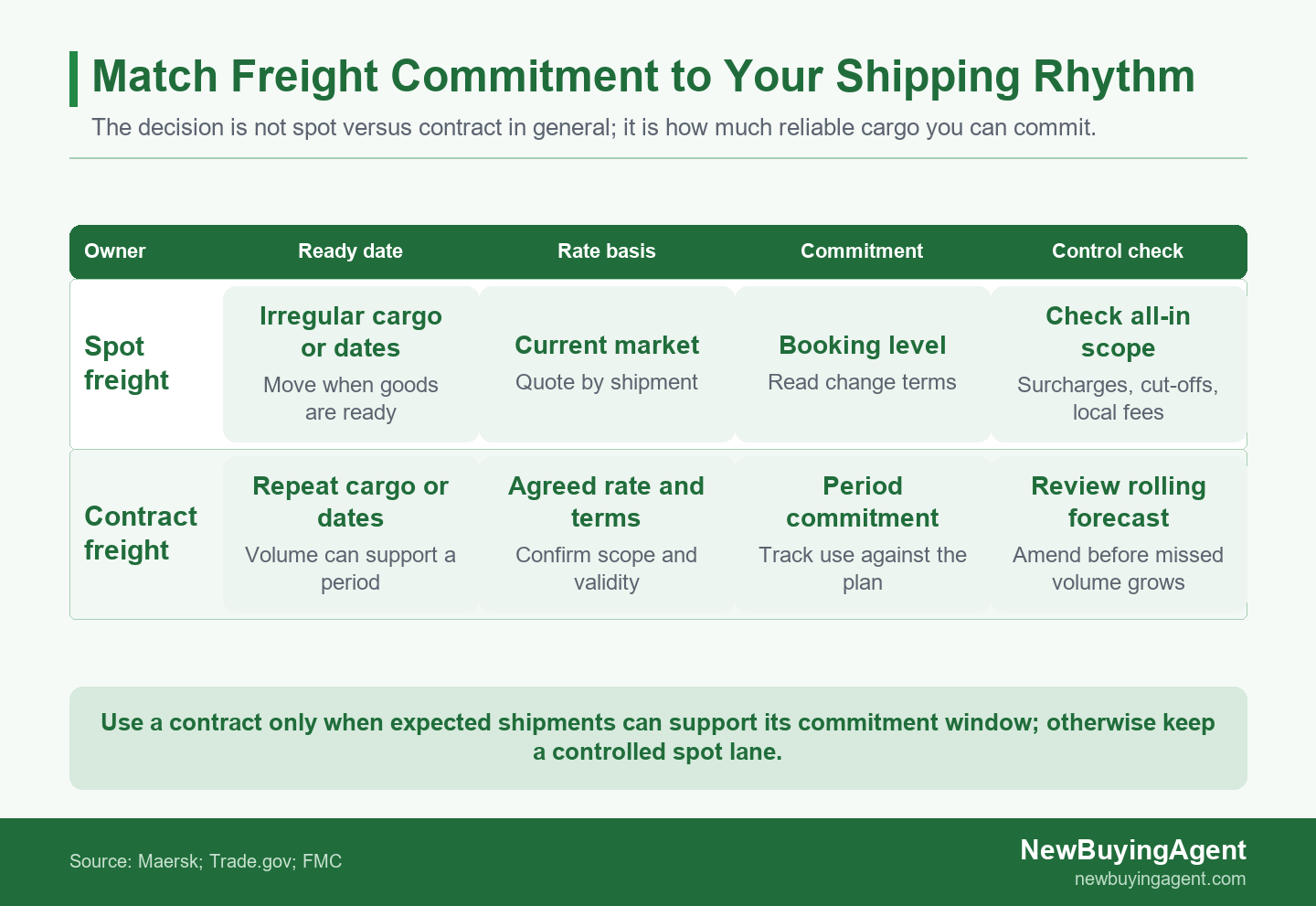
Compare both routes against the same cargo calendar before treating a rate label as the decision.
Build one rolling freight calendar that is visible to purchasing, production follow-up, quality control, and logistics. For each planned shipment, record the purchase order or SKU group, factory-ready date, quality-release date, booking cut-off, requested departure, container count, Incoterm, rate option, and owner. Add a short note whenever any item changes. This is enough to show whether the next eight weeks resemble a repeatable commitment or a series of individual decisions.
The calendar should also show the exception path. If a factory cannot release cargo on time, who confirms the revised date? If the container count drops, who checks the terms before booking? If a destination cannot receive goods in the planned window, who updates the service scope? Clear ownership prevents a commercial commitment from drifting away from the physical shipment.
Worked Scenario: The Forecast Falls Below Its Commitment
An illustrative buyer should not create cargo merely to consume a freight commitment after a launch delay. The following example is not a client case. It shows how a buyer can make the question visible early enough to choose a documented correction instead of reacting after missed volume or an unplanned booking.
An illustrative home-storage buyer plans 12 FCL from Ningbo to the U.S. West Coast across six months. The commercial plan assumes two containers will be ready each month. The product, destination, and lane are known, so a period freight arrangement looks reasonable on the original spreadsheet. The weak point is that the launch schedule still depends on final retail content and release timing.
Separate the Cargo Calendar From the Rate Commitment
A rolling cargo calendar and written amendment record expose the decision before costs accumulate. The key discipline is to distinguish the container volume that was hoped for when terms were discussed from the product that is actually ready and released for a specific sailing.
Buyer context: the buyer is preparing a repeat home-storage range for a U.S. West Coast launch and expects China production to support a monthly arrival rhythm.
Order context: the illustrative plan covers 12 FCL across six months, initially modeled as two containers per month from Ningbo.
Readiness state: a launch delay shifts the first 3 months of factory-ready dates, so the original monthly volume expectation no longer matches the product calendar.
Observation: some cartons can be packed, but the full SKU mix is not released at the dates assumed in the original freight plan.
Observation: the revised forecast shows that the first three months may not use the expected container count, even though later demand could still recover.
Analysis: the buyer should not manufacture extra inventory, load incomplete product, or split shipments without checking the operational consequence just to meet a freight target. The immediate task is to reconcile actual ready dates with the named terms, then identify what cargo can move safely under a shipment-level option while the revised plan is being evaluated.
Decision: assign one owner to update the eight-week cargo calendar, request written clarification of the applicable amendment, cancellation, or booking path, and make each near-term booking only after the ready cargo and rate scope are confirmed.
Corrective action: record production status, quality-release status, booking cut-off, volume status, and the latest acceptable departure for every planned shipment. The owner flags a mismatch as soon as the forecast moves rather than after a missed month.
Verification gate: retain the updated rate scope, the written booking or amendment confirmation, and a dated record of any no-show or cancellation exposure before the buyer relies on the revised volume plan.
Boundary: this is an illustrative planning pattern. Actual cancellation rights, charges, and amendments depend on the named carrier or forwarder product and the parties' agreement.
Where NewBuyingAgent Fits Before a Freight Quote Is Locked
NewBuyingAgent's existing-factory management route is relevant when NewBuyingAgent has separate routes for a new product supply need and existing China-factory management. The relevant route depends on what the buyer already controls, not on a generic freight label.
For a new purchasing requirement, the starting point is the product specification, quantity, target price, destination, and timing. The freight discussion is then connected to a planned China supply path, production timing, quality release, and shipment coordination. This helps keep the quote brief grounded in the product and schedule that will actually move.
For an existing China factory, the problem may be different: product is already in production, but ready dates, inspection results, packing, booking, and delivery coordination need one owner. The existing-factory management route is more appropriate when the buyer needs China-side execution to make the freight calendar credible, rather than a fresh product search. In both cases, the useful input is the same: a clear product brief plus a working view of volume, origin, destination, and timing.
Before the quote request goes out, make the team name the origin point, the party that will load or hand over the goods, the first date the cargo can be ready, the date it is expected to pass the release check, and the latest acceptable departure. Add the container pattern rather than only a product quantity. If the forecast is still uncertain, label it as a forecast and state when it will be reconfirmed. These details reduce avoidable back-and-forth and make it easier to see whether a spot lane should remain available beside any longer-period arrangement.
Once those facts are available, prepare the product details, expected container pattern, earliest and latest ready dates, destination, requested Incoterm, and any required arrival window, then share the purchasing and shipment brief.
Frequently Asked Questions
The questions below resolve scope and preparation boundaries. They are practical planning answers, not a forecast of future rates or a replacement for the named provider's current booking terms.
Can I Use Spot Freight for Regular China Shipments?
Regular shipments may remain better suited to controlled spot bookings when the volume and dates are not reliably forecast. A recurring pattern is helpful, but it is not proof that every month will produce the same container count or release window. Use a contract conversation when the calendar shows repeatable cargo and the team can monitor its use. Use spot when the next booking still depends on product readiness, launch timing, or a changing consolidation plan.
Does a Contract Rate Cover Every Freight Charge?
A rate needs its inclusions, exclusions, validity, and amendment conditions checked before it is treated as all-in. The exact terms depend on the named product, route, cargo, and provider. Ask for the rate basis, origin and destination charges, applicable surcharges, service definition, cut-off assumptions, and the exposure if the booking is changed, cancelled, or not used. Then compare the same scope across options.
Do Incoterms Decide Whether I Need Spot or Contract Freight?
Incoterms clarify named responsibilities but do not decide the commercial freight commitment. Trade.gov explains that the rules define tasks, costs, and risk, while other commercial matters remain outside that framework. Confirm the named Incoterm in the sales contract, then separately decide whether the cargo calendar supports shipment-level flexibility or a period commitment.
What Should I Share Before Requesting a Freight Quote?
A quote-ready freight brief states the product, volume, ready dates, origin, destination, Incoterm, and service scope. Include the packing configuration, container type or dimensions, hazardous or special-handling status if relevant, desired departure window, destination receiving constraints, and whether the volume is firm or forecast. Explain the difference between the earliest possible ready date and the date goods are expected to be released. That gives the provider enough context to discuss a route without pretending the rate decision can be made from origin and destination alone.
NewBuyingAgent
Related Resources



Get Started Today
Let's Turn Your Sourcing Goals into RealityWeChat:+86 15157124615
WhatsApp:+86 15157124615
Address:Building 10 #39 Xiangyuan Road, Hangzhou, China