

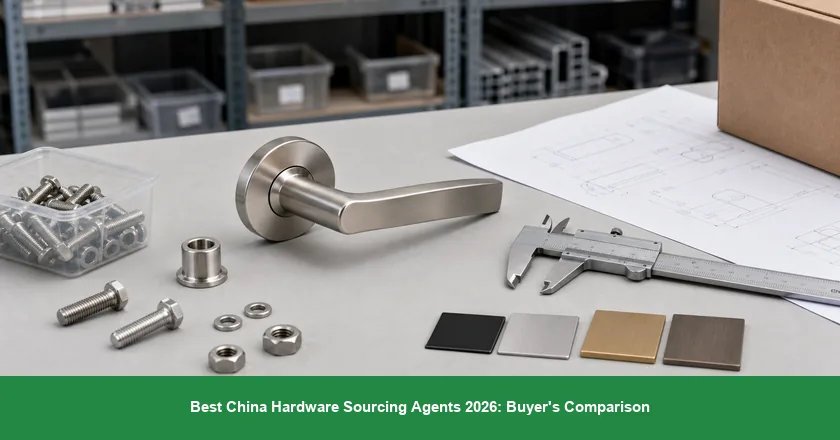
The best China hardware sourcing agent is not a universal winner. It is the provider whose public scope matches the first requirement you cannot yet prove for your order: a drawing, material grade, surface finish, functional test, lot record, packing method, or delivery handoff.
This comparison uses stated public scope and buyer fit rather than private fee data, popularity, or satisfaction scores. NewBuyingAgent publishes this page and is included under the same disclosed criteria. Treat every entry as a focused conversation to test against your actual hardware brief.
What Makes a Hardware Agent Worth Comparing
A useful comparison begins with a proof gap: the next requirement you cannot verify with a document, approved sample, test, or clearly named owner. A provider that can source a broad hardware category may still be the wrong fit if it cannot show how the exact part will be controlled.
- Custom part risk: Start with the drawing, material, tolerance, finish, and production process that must be confirmed.
- Catalog range risk: Start with SKU-level specifications, bundled packing, inspection rules, and carton identification.
- Release risk: Start with the lot, rework record, retest result, and loading evidence that support shipment.
- Provider decision: Ask each candidate to explain how it closes the highest unresolved risk before you compare a headline price.
That approach does not certify any company or predict an order result. It simply gives the buyer a fairer way to choose which discussions deserve time and which claims need product-specific proof first.
How This Buyer Comparison Was Built
The entries below compare four providers by what their current public pages actually describe, then attach a practical boundary to each fit. The method does not rank market share, fees, factory network size, customer satisfaction, or technical capability that is not documented for the specific hardware order.
Each entry answers four questions: What buying situation does the public scope suggest? What does that scope not prove? What evidence should the buyer request? And when should the buyer speak to a different type of provider? This prevents a comparison page from turning a broad marketing statement into an unsupported promise about tooling, metallurgy, plating, testing, or delivery.
Use the same product brief with every conversation. That means the same part drawing or reference sample, material and finish, quantity, destination, target timing, acceptance criteria, packing requirement, and delivery term. A comparison is only useful when the candidates are responding to the same commercial and technical boundary.
Why Hardware Orders Need a Different Shortlist
ISO 2859-1:2026 describes AQL-indexed acceptance sampling for lot-by-lot inspection. In plain language, AQL is a sampling method used to decide whether a production lot meets agreed thresholds. It does not create the drawing, material grade, finish reference, functional test, or packing requirement that the lot must meet.
A door handle can be dimensionally correct but have the wrong finish. A fastener can look right but fail the specified mechanical property. A tool kit can pass a count check while its inner trays allow mixed SKUs. These are different failure mechanisms, so a general statement that an agent “does hardware” is only a starting point.
The destination can add another layer. Trade.gov's China standards guidance is a reminder that standards, testing, certification, and conformity assessment depend on the product and market. It is not a substitute for destination-specific advice. It does mean the buyer should name applicable evidence before treating a quote as a complete sourcing route.
For a simple repeat SKU, the first proof may be a pack count and a repeatable finish sample. For a custom lockset, bracket, fitting, or fastener, it may be a drawing revision, material certificate, dimensional record, coating test, or lot map. The hardware sourcing agent worth comparing is the one prepared to make that next proof visible.
Four China Hardware Sourcing Agents to Compare by Fit
The four providers below are compared by published scope and conditional buyer fit, not by market share or private performance data. The order is not a claim of universal superiority. NewBuyingAgent is the publisher, and that affiliation is disclosed here so the reader can judge its entry on the same terms as the others.
Before contacting any provider, decide whether your order is mainly a broad product-supply problem, a drawing-to-batch problem, a packaging and delivery problem, or an existing-factory recovery problem. That choice changes the questions you should ask.
NewBuyingAgent: Best Fit for Broad Hardware Supply or Existing-Factory Follow-Up
NewBuyingAgent is included because it is the publisher. Its strongest fit is a global buyer who needs China-sourced hardware supplied with better price, quality, and service from a defined purchasing need, rather than a buyer who only wants a generic directory. Buyers provide the product requirement, quantity, target price, destination, and timing; NewBuyingAgent uses local China factory resources and product/QC capability to quote and supply products from China.
This is most relevant when the hardware order needs price, quality, packing, and delivery considered together. For a new route, see the China hardware product-supply path. For a technical part, the buyer should still ask how the drawing, finish reference, approval sample, acceptance checks, and delivery assumptions will be tied to the specific order. The fit is not universal: an undefined concept or a request for an unfiltered list of factories needs a different starting point.
Maple Sourcing: Best Fit for Drawing-to-Batch Custom Hardware
Maple Sourcing's hardware page describes custom metal parts and hardware from drawing to batch, including CNC prototypes, laser-cut parts, die castings, stampings, and household hardware. That makes it a relevant conversation when a drawing or prototype is the main source of risk rather than a standard catalog SKU.
The buyer should not turn that published scope into a conclusion about the exact part. Ask which drawing revision will control production, how material and surface treatment will be confirmed, what sample becomes the approved reference, and how dimensional or functional findings will be recorded. Maple is less natural as a first conversation when the order is entirely standard hardware and the real problem is packing a wide SKU range for a retail launch.
Easy Imex: Best Fit When Product Launch and Delivery Scope Are Central
Easy Imex publicly presents a process that includes sourcing, negotiation, sampling and QA, quality control, and shipping. That scope can make it a useful conversation for a hardware purchase where the buyer needs to connect product launch, packaging, and delivery rather than discuss a single part in isolation.
For example, a retail tool set may need the finished item, instructions, inserts, carton drop protection, and shipment assumptions to remain aligned. The critical follow-up is hardware-specific: ask how the sample, finish, functional checks, packaging tests, and handoff will be defined for your SKU. A broad product-to-market process does not by itself demonstrate specialist knowledge of every alloy, lock mechanism, electrical component, or test method.
JingSourcing: Best Fit for Broad Catalog and Packaging-Heavy Hardware
JingSourcing publicly describes broad sourcing, customized packaging, product inspections, warehousing, and supplier-audit services. That makes it a relevant conversation for a wide consumer-hardware catalog, bundle, or accessory range where SKU coordination, inspection, packing, and storage are central to the buying challenge.
Ask for SKU-level requirements rather than accepting a category label. The useful brief names the material and finish for each priority item, the count per inner and master carton, the permitted substitutions, the inspection checks, and the label or barcode rules. This is a weaker fit when the order's central risk is a highly specialized engineered component that requires unproven process knowledge, detailed tolerance control, or a specific laboratory path.
Choose by the First Proof You Cannot Skip
ASTM F1470 addresses fastener sampling for specified mechanical properties and performance inspection. The practical lesson for a hardware buyer is simple: inspection has to be connected to the property being checked. A sampling plan is useful only after the product requirement is clear.
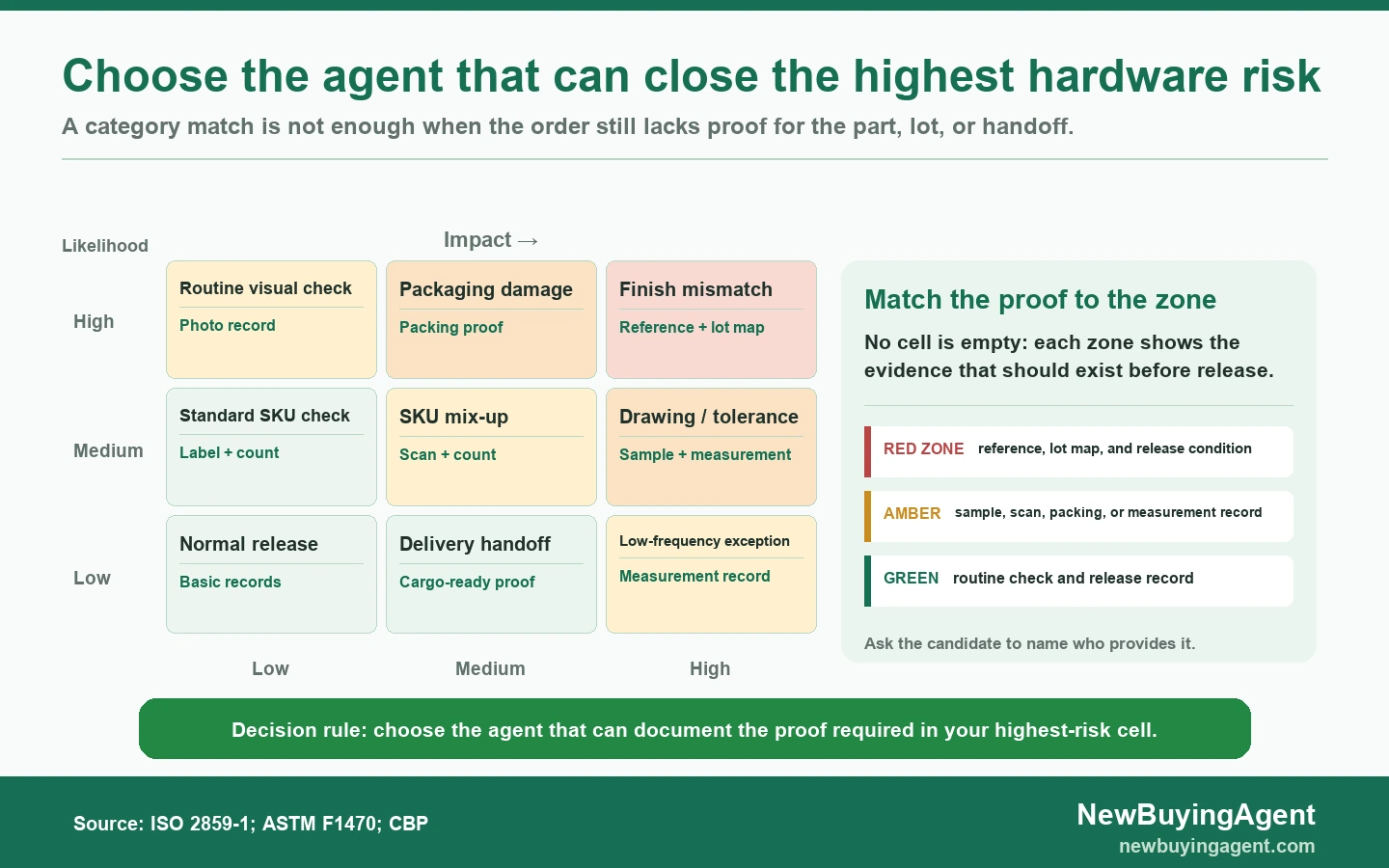
Choose the provider that can show the proof needed for the highest-risk cell in your hardware order.
Use this four-question screen with every candidate. It converts a provider comparison into a request for evidence, rather than a debate about who has the most persuasive service page.
| Question | What a useful answer names | What to request before commitment |
|---|---|---|
| What part can fail? | Drawing revision, material, finish, functional property, or SKU rule | Approved reference and acceptance criteria |
| Which population is affected? | Lot, carton range, production window, or identifiable subset | Lot map and traceable records |
| How will it be checked? | Method, sample plan, responsible party, and report format | Inspection or test plan tied to the part |
| What happens if it fails? | Hold, rework, retest, replacement, or split-release decision | Written release condition and handoff evidence |
The provider that can answer the highest-risk row with product-specific evidence is usually the better next conversation. A lower quote that leaves a red-zone risk unanswered is not automatically the lower total cost.
Worked Scenario: A Rework Promise Is Not a Release Decision
The following is an illustrative example, not a client case. It shows why a rework promise cannot support release if the affected goods and reworked goods cannot be distinguished.
Separate the Lot Before You Trust the Retest
Lot traceability means the record that connects a group of goods to its production and evidence records. In this scenario, it is the difference between a meaningful retest and a vague assurance.
An online and project-hardware distributor needs satin-nickel door locksets for a repeat customer program. The customer expects a uniform finish because the hardware will be installed across the same property.
The illustrative order covers 2,400 locksets across two production lots, with a USD 72,000 product budget and a nine-week delivery target. The commercial pressure is real, but it does not make an uncertain lot safe to release.
The approved sample named the finish. During inspection, however, the production record did not reliably separate later reworked units from earlier units. The buyer had a sample reference but not a clean link between cartons, rework, and retest evidence.
First, inspection photos showed visible color variation on a subset of handles from the first lot. The issue might be limited, but the evidence did not show the exact carton range.
Second, the factory said it reworked the finish, yet the carton labels and retest list did not identify which units were reprocessed. A passed retest could therefore describe some goods without proving that it covered the uncertain population.
The right response is not to demand a universal inspection level. It is to separate the decision. A general rework statement is weak because packaging can mix corrected and uncorrected units. The buyer needs a defined finish criterion, an isolated lot, and evidence that the report belongs to that isolated lot.
The buyer holds the uncertain lot, agrees the finish and functional retest criteria, and permits release only for the documented portion that meets those criteria. That protects the customer delivery without pretending that an unsupported rework promise resolves the issue.
The corrective action is a lot map: segregate the questionable cartons, retain the approved sample and finish reference, retest the isolated lot, then connect the result to carton labels and the loading record. A capable China-side route should make this sequence practical rather than leaving the buyer to infer it from photos.
Before release, the buyer receives a lot list, a retest result against the agreed criterion, carton-to-lot mapping, and loading evidence for the released portion. That is a lot-specific release packet, not a blanket claim that all rework was successful.
This example does not prescribe a finish standard, AQL level, or compliance obligation. The correct threshold depends on the part, intended use, customer promise, and market. Its purpose is to show what credible evidence looks like after a quality event.
Where NewBuyingAgent Fits After the Hardware Comparison
NewBuyingAgent has two different starting routes, and the right one depends on where your hardware order begins. For a new purchase need, the buyer provides the part requirement, quantity, target price, destination, and timing; NewBuyingAgent then uses its local China factory network and product/QC capability to quote and supply China-sourced products with better price, quality, and service.
If the buyer already has a China factory, the more relevant route is the existing-factory management option. It can be relevant when production follow-up, quality evidence, communication, or logistics coordination is the problem, rather than the initial product-supply route. Buyers can also review NewBuyingAgent success stories for broader sourcing context.
For a hardware inquiry, give the team the actual part or reference sample, material and finish, volume, target price, destination, required tests, packing, and delivery date. That lets the discussion focus on the one or two proof gaps that protect margin and delivery. To start that conversation, submit your hardware requirements.
Frequently Asked Questions
These questions address the comparison boundaries that matter most before you ask any provider to quote or coordinate a hardware order.
Should I Compare Hardware Agents by Their Quoted Price?
No, compare prices only after the product, proof, packing, and delivery scope are aligned across every candidate's quote in writing. One quote may include a defined finish reference, inspection plan, inner-carton layout, and delivery assumption while another leaves those points open. Start by asking each provider what is included, excluded, and still unverified. Then compare the commercial numbers against the same part, quantity, acceptance criteria, packing, and trade-term assumptions.
Is AQL Enough for a Hardware Inspection Plan?
No, AQL is a sampling method for a production lot, so it cannot define the material, finish, function, or packing requirement. ISO 2859-1:2026 provides a system for lot-by-lot acceptance sampling, but it does not tell you which alloy, dimension, torque, or condition makes your part acceptable. Write those requirements first. Then use a sampling method to check the agreed criteria. If the part has a critical functional or safety characteristic, confirm the appropriate test and acceptance approach rather than relying on a generic AQL label.
Does a Sourcing Agent Take Over Product Compliance Duties?
No, a sourcing agent can organize product files and shipment information, but the buyer must still confirm product, market, and import-route obligations. CBP's customs-broker guidance offers a U.S. example: a broker can assist with entry work, while the importer of record remains responsible for the entry and applicable payments. Use qualified advice for product-specific obligations.
What Belongs in a Hardware Sourcing Brief?
Include the part drawing or reference sample, material, surface finish, dimensions and tolerances, quantity, target price, destination, target date, functional or inspection criteria, packing rules, delivery term, and any required documents. Add photos of the approved appearance and note what must not change. A brief is useful when it tells a provider both what to supply and what evidence must exist before the buyer commits a deposit or releases shipment.
NewBuyingAgent
Related Resources

Get Started Today
Let's Turn Your Sourcing Goals into RealityWeChat:+86 15157124615
WhatsApp:+86 15157124615
Address:Building 10 #39 Xiangyuan Road, Hangzhou, China
