

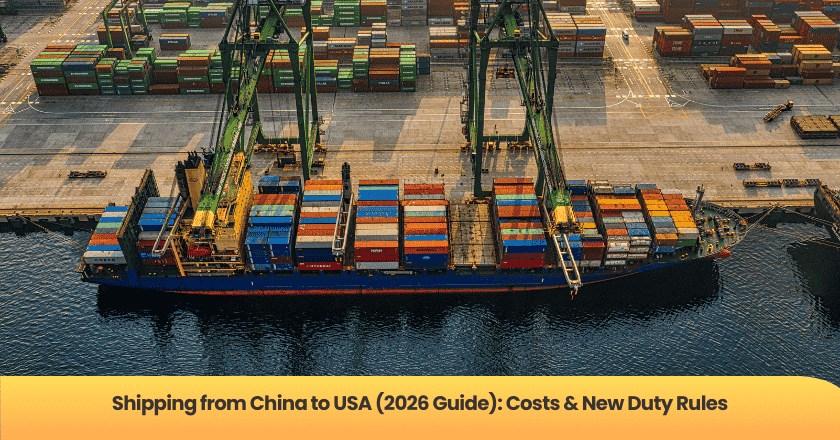
The logistics landscape between China and the United States has undergone a fundamental transformation over the past twelve months, shifting from a market driven purely by freight rates to one dominated by regulatory compliance and strategic foresight. For years, importers could simply book a container and assume relatively smooth sailing. However, the trade environment of 2026 is defined by stricter enforcement, the elimination of key tax exemptions, and a volatility in ocean transit times that demands a sophisticated approach to supply chain management.
For e-commerce sellers, retailers, and wholesalers, the question is no longer just "How much does it cost?" but rather "How do I ensure my goods clear US Customs without delay or penalty?" As the gap between low-end freight forwarding and professional supply chain management widens, successful businesses are pivoting towards integrated solutions that combine sourcing proficiency with logistical expertise.
This comprehensive guide will navigate you through the complexities of shipping from China to the US in 2026, offering actionable strategies to mitigate risk, optimize landed costs, and leverage partners to secure your competitive edge.
The 2026 Regulatory Shift: The End of "De Minimis" and What It Means
The most significant shock to the trans-pacific trade route in 2026 has been the effective closure of the "De Minimis" loophole. For over a decade, this provision allowed shipments valued under $800 to enter the United States duty-free and with minimal documentation. This was the lifeblood of many dropshippers and direct-to-consumer brands. However, as of mid-2025, new legislation specifically targeting goods of Chinese origin has dismantled this exemption to level the playing field for domestic retailers.
The implications of this policy shift are profound and far-reaching. Importers who previously split large orders into hundreds of small packages to avoid duties are now facing a stark reality: every single shipment, regardless of size, is now subject to formal customs entry and tariff assessment. This has not only increased the direct cost of goods sold but has also created a bottleneck at major entry hubs like Los Angeles and JFK, where Customs and Border Protection (CBP) has intensified inspections.
Consequently, the casual approach to logistics is no longer viable. Importers must now prioritize accurate classification (HS Codes) and transparent valuation.
Expert Tip: Under the 2026 regulations, a mismatch between your payment records and the declared commercial invoice value is a primary trigger for CBP audits. Ensure that your sourcing agent provides a unified commercial invoice that perfectly matches your bank wire or trade assurance payment. "Undervaluing" is no longer a grey area; it is a fast track to having your importer bond revoked.
Strategic Shipping Methods: Balancing Speed, Cost, and Inventory Flow
Choosing the appropriate shipping method in 2026 requires a nuanced understanding of your inventory turnover and capital flow. The decision is rarely binary; sophisticated importers often utilize a "hybrid strategy," sending a portion of goods via air to prevent stockouts while the bulk of the inventory travels via sea to maximize profitability.
Sea Freight: The Backbone of Global Trade
Despite the rise of air commerce, ocean freight remains the only viable option for scaling a business. However, the dynamics between LCL (Less than Container Load) and FCL (Full Container Load) have shifted. With ocean carriers introducing larger vessels into the Pacific lane this year, FCL rates have stabilized, making it incredibly cost-efficient. FCL offers the security of a sealed container, significantly reducing the risk of damage or pilferage that can occur during the consolidation processes at port warehouses.
Conversely, LCL remains a necessary bridge for smaller businesses, but it comes with a warning: the "break-bulk" fees at US ports have risen sharply due to increased labor costs. If your shipment volume approaches 15 cubic meters (CBM), the mathematical tipping point has been reached where booking a partially empty 20ft container (FCL) is often cheaper—and faster—than paying the high handling fees associated with LCL cargo.
Air Freight and Express: The Premium Channels
Air freight in 2026 has bifurcated into two distinct categories: Traditional Air Cargo and Courier Express (DHL/UPS/FedEx). While Express services offer door-to-door convenience and speed (3-5 days), the removal of the De Minimis exemption means that courier shipments are no longer cleared instantly. They are now subject to the same duty assessments as heavy cargo, which can add 24-48 hours to transit times. Standard Air Cargo (Airport-to-Airport) remains the preferred method for shipments between 100kg and 500kg, offering a balance of speed (5-8 days) and cost, particularly for high-value electronics or fashion items where time-to-market is critical.
Common Mistake to Avoid: Do not assume that "Air Freight" includes delivery to your door. Traditional air cargo only gets your goods to the airport (e.g., LAX or ORD). You are responsible for hiring a local trucking company and a customs broker to retrieve the goods.
Deciphering the True Cost: Beyond the Freight Rate
A novice importer looks at the shipping quote; a seasoned expert looks at the Landed Cost. In 2026, the freight rate provided by a forwarder is often just the tip of the iceberg. To build a resilient business model, you must account for the granular elements that constitute the total logistics spend.
The calculation begins with the Volumetric Weight (Dimensional Weight). Logistics carriers are in the business of selling space, not just weight capacity. If you are importing lightweight, bulky items—such as plush toys, automotive bumpers, or plastic storage bins—you will be charged based on the volume the goods occupy rather than their actual weight. This is calculated using a divisor (typically 6000 for air freight and 5000 for express), which can often double or triple the billable weight.
Furthermore, destination charges have become a significant pain point in US ports. These include Terminal Handling Charges (THC), Chassis Split Fees, and the dreaded Demurrage and Detention charges—penalties for not picking up your container or returning the empty equipment on time. The congestion at West Coast ports often exacerbates this, leading to unexpected bills that can wipe out the profit margin of a shipment.
This is where the value of a consolidation service becomes quantifiable. Newagent excels in optimizing packaging before the goods ever leave China. By removing unnecessary retail packaging, vacuum-sealing soft goods, and creatively nesting products, they can reduce the total volume of a shipment by up to 30%. This is not merely a logistical service; it is a direct financial saving that lowers the per-unit shipping cost.
Expert Tip: Always request a "Subject to Rollover" clause in your freight contract during peak seasons (August to October). Some budget forwarders will book your cargo on "standby" status to save money, meaning your goods could sit on the Shanghai docks for weeks waiting for an available slot. Paying a premium for "Guaranteed Loading" is an investment in reliability.
Incoterms 2026: Why DDP is the Safest Bet for SMBs
International Commercial Terms (Incoterms) define the transfer of risk and responsibility between buyer and seller. While terms like EXW (Ex Works) and FOB (Free on Board) have traditionally been the standard for large multinational corporations with their own logistics departments, the complexity of the 2026 customs environment has driven a massive shift towards DDP (Delivered Duty Paid).
Under an EXW agreement, you are responsible for the goods the moment they leave the factory floor in China. This exposes you to the risks of Chinese export compliance, inland trucking accidents, and lost documentation. FOB is safer, as the supplier handles the Chinese side, but you are still left to navigate the labyrinth of US Customs and arrange domestic US trucking.
For the vast majority of small to medium-sized enterprises (SMEs), DDP has emerged as the superior choice. In a DDP arrangement, the service provider takes total responsibility for the shipment until it arrives at your warehouse or Amazon FBA center. They act as the importer of record (or facilitate it through their partners), pay the duties, handle the bond, and manage the trucking. This model provides a fixed, all-inclusive price per kilogram or cubic meter, effectively insulating the buyer from the volatility of tariff hikes or port fees. It transforms logistics from a variable cost center into a predictable fixed cost.
Common Mistake to Avoid: Be wary of suppliers offering "DDP" prices that seem too good to be true. Some unscrupulous agents may misdeclare goods (e.g., labeling leather shoes as "plastic slippers") to pay lower duties. When Customs eventually audits the shipment, you—the receiver—are liable for the back taxes and penalties. Always work with a reputable partner that prioritizes compliant declaration.
The Integrated Supply Chain: From Sourcing to Doorstep
Shipping should not be viewed in isolation; it is the final link in a chain that begins with product selection. The most efficient importers in 2026 treat Sourcing, Quality Control, and Logistics as a single, fluid process.
The journey begins with Verification and Sourcing. Before a single unit is produced, understanding the factory's capability is paramount. Is the supplier a manufacturer or a trading company? Do they have the necessary export licenses? Once production is underway, the focus shifts to Quality Control (QC). Shipping defective products to the US is a financial disaster; the cost of reverse logistics is often higher than the value of the goods themselves. Therefore, a Pre-Shipment Inspection (PSI) is non-negotiable.
This is where the traditional model, utilized by companies, often fell short. They treated shipping as a separate transaction. In contrast, the newagent model integrates these steps. By managing the sourcing, they can coordinate production schedules with shipping windows. By handling the QC, they ensure that only sellable goods are loaded into the container. And by managing the logistics, they can consolidate samples and orders from multiple factories into a single shipment, saving the importer from paying multiple minimum freight charges.
Frequently Asked Questions (FAQ)
Q: With the removal of the De Minimis exemption, do I have to pay taxes on every shipment from China?
A: Yes. As of the regulatory updates in 2026, the $800 duty-free threshold has been eliminated for goods of Chinese origin. This means that duties are assessed on all shipments, regardless of value. It is crucial to calculate these duties into your product pricing.
Q: What is the difference between "Actual Weight" and "Volumetric Weight," and how can I reduce it?
A: Carriers charge based on whichever is greater: the scale weight or the space the package occupies. A box of pillows might weigh 5kg but take up the space of 20kg worth of steel; you will be charged for 20kg. The best way to reduce this is through professional repacking.
Q: How much time should I buffer for shipping delays in 2026?
A: While ocean transit times have stabilized, US port processing can still be unpredictable. For West Coast shipments, plan for 30-35 days total (port-to-door). For East Coast shipments, allow 45-50 days. Always add a 7-day buffer for customs clearance, especially during Q4 (October-December) or leading up to Chinese New Year, when congestion is at its peak.
Q: Why should I use a Sourcing Agent for shipping instead of a direct Freight Forwarder?
A: A direct freight forwarder only cares about the transit. A sourcing agent cares about the product. If your goods are stopped at customs due to missing paperwork or poor packaging, a forwarder will simply charge you storage fees. A sourcing agent, who managed the order from the start, has the documentation and supplier relationships to resolve the issue quickly and often proactively prevents these problems during the QC phase.
Conclusion
The era of cheap, unregulated shipping is over, replaced by a system that favors compliance, consolidation, and professional management. By understanding the new regulatory landscape and partnering with an integrated service provider , you can turn your supply chain from a source of stress into a competitive advantage.
NewBuyingAgent
Related Resources
Get Started Today
Let's Turn Your Sourcing Goals into RealityWeChat:+86 15157124615
WhatsApp:+86 15157124615
Address:Building 10 #39 Xiangyuan Road, Hangzhou, China
