

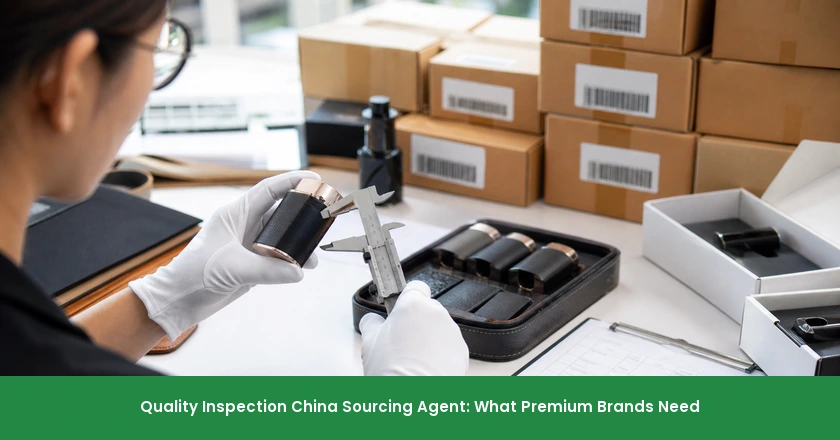
A quality inspection China sourcing agent is most valuable to premium brands when inspection evidence changes sourcing decisions before quality failure reaches customers. The goal is not a thicker report; it is a clearer release rule for product claims, sample standards, production control, packaging proof, and shipment readiness.
Premium brands need inspection to protect price position, channel trust, retail presentation, customer reviews, and repeat-order confidence. That requires a China sourcing agent who understands inspection as part of the supplied product outcome, not as a detached end-of-line check.
Key Takeaways
- Definition: A quality inspection China sourcing agent should connect inspection evidence to product sourcing, production follow-up, QC, packaging, logistics, and release decisions.
- Premium risk: Premium brands are exposed to failure costs beyond unit defects, including launch delay, returns, markdowns, channel penalties, and reputation damage.
- Framework: The Premium Inspection Decision Framework ranks six inspection needs that should be controlled before shipment release.
- Service fit: NewBuyingAgent is relevant when buyers need China-sourced products backed by local factory resources, product/QC capability, production evidence, and delivery coordination.
Premium Brands Need Inspection Before the Final Lot Is the Only Option
Premium brands should treat inspection as a decision system that starts before final release. ISO 9001:2015 defines requirements for a quality management system and emphasizes controlled processes for meeting customer expectations. In sourcing terms, the premium buyer should not wait until the final lot is packed before asking whether the product promise can be proven.
Final inspection still matters. ISO 2859-1 provides sampling procedures indexed by acceptance quality limit for lot-by-lot inspection. That gives buyers a formal sampling logic. But a premium brand still has to define what defect categories mean for its own product: a finish mark, color drift, weak seam, unstable carton, incorrect insert, or barcode issue may have brand-level consequences even when the product appears usable.
The Premium Inspection Decision Framework helps buyers avoid a late surprise. It starts with the product claim, then moves through sample standard, production evidence, defect classification, packaging proof, and shipment release. A sourcing agent who can connect those layers gives the buyer more than inspection data. The buyer gets a decision path.
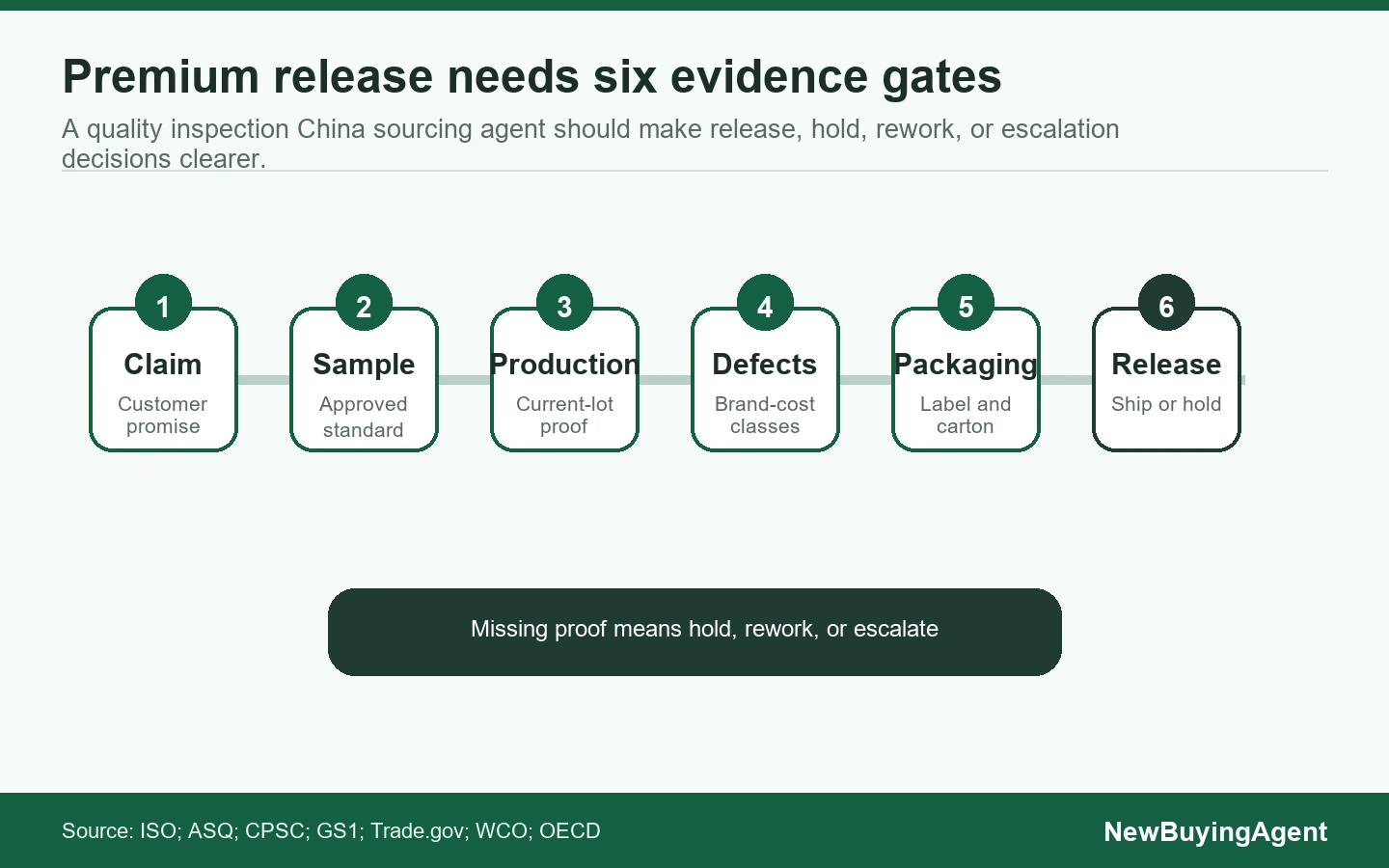
The Premium Inspection Decision Framework ranks the six evidence layers premium brands need before accepting a China sourcing release decision.
The Six Inspection Needs Premium Brands Should Rank First
1. Product claim and customer promise
The first inspection need is the promise the product makes to the customer. A premium outdoor product may promise durability. A furniture item may promise stability and finish. A baby-adjacent item may raise safety expectations. A beauty accessory may depend on surface finish and packaging feel. The inspection plan should start from that promise because the cost of failure is different in each case.
CPSC manufacturing best practices advise companies to identify hazards, assess risks, write product specifications, and build safety into the supply chain. Premium brands can use the same discipline even when the issue is not a regulatory hazard: define the customer promise, then inspect what would break that promise.
2. Approved sample standard
The approved sample is the buyer's most visible quality reference, but it can become dangerous if the production lot is not controlled against it. Premium buyers should define what the sample proves: material, color, finish, dimensions, function, accessory set, packaging appearance, instruction clarity, or retail presentation. The inspection scope should then verify the current lot against those specific proof points.
A sample without a written acceptance boundary creates argument room. If color, finish, tolerance, or packaging feel can be debated after production, the buyer may have a report but not a release decision. The sample standard should be turned into measurable checkpoints before production begins.
3. Production-stage evidence
Premium inspection is weaker when it appears only at the final stage. Production-stage evidence can show whether the bulk lot is following the approved basis while the buyer still has correction leverage. This may include in-process photos, current-lot measurements, material confirmation, packaging mockups, accessory checks, and production progress records.
ISO 19011:2026 provides guidance on auditing management systems, including audit principles, audit program management, and consistent methodology. For sourcing buyers, the lesson is not to run a formal audit for every order. The lesson is to use a repeatable evidence method so production findings can be trusted.
4. Defect classification tied to brand cost
Defect classes should reflect brand cost, not just factory convenience. A small scratch on a hidden component may be minor. A similar mark on a visible premium surface may create returns or retail rejection. Missing hardware may be a functional problem. A wrong instruction sheet may become a customer-service burden. Premium brands should define critical, major, and minor defects around the product's real market risk.
ASQ's cost of quality resource is useful because it separates prevention, appraisal, internal failure, and external failure costs. A premium inspection plan should spend enough prevention and appraisal effort to avoid external failure costs such as returns, complaints, replacements, and brand damage.
5. Packaging, labeling, and retail presentation
Packaging is part of quality for premium brands. A product can pass function and still fail the channel if retail packaging is crushed, the insert is missing, the barcode is wrong, the instruction sheet is unclear, or carton strength is insufficient. Inspection should therefore include packaging proof before release, especially when the product is sold through retail, marketplace, or brand-owned ecommerce channels.
GS1's barcode standards overview shows why identification standards matter for products moving through commerce. A barcode or label issue may feel like a document problem, but for premium brands it can become a receiving, selling, or customer-experience problem.
6. Shipment release rule and escalation path
The final inspection need is the release rule. A report becomes useful only when the buyer knows what happens next: release, hold, rework, sort, discount, replace, re-inspect, or revise shipment. Premium brands should define escalation before the report arrives so the team is not improvising under schedule pressure.
Trade.gov's Incoterms overview is a reminder that shipment responsibilities affect risk transfer. Inspection release should therefore connect to the delivery path. A buyer should know whether the product is ready for handoff, whether packing evidence matches the delivery term, and what must be fixed before goods move.
What the Inspection Should Change
Inspection evidence should change decisions, not merely decorate a file. A premium buyer should know whether the current lot can ship, whether the product needs rework, whether the order should be split, whether packaging must be corrected, whether documentation is incomplete, or whether the next production run needs a revised standard. If the report does not change a decision, the inspection scope may be too generic.
Trade.gov's China standards guidance explains why standards, conformity assessment, and certification can matter in China trade. Premium buyers should not assume every category requires the same evidence, but they should identify whether the product's destination market, safety expectations, labeling, or channel requirements affect inspection scope.
The World Customs Organization's Harmonized System overview also shows why product description and classification matter in cross-border trade. Inspection is not customs classification, but current product details, material description, labeling, and packing records can support cleaner shipment documentation when they are gathered before release.
| Inspection evidence | Decision it should support | Premium brand risk | Escalation trigger |
|---|---|---|---|
| Sample match | Approve current lot or require correction | Customer sees a lower-grade version | Material, finish, size, or accessory drift |
| Defect classification | Release, hold, rework, or re-inspect | Minor-looking defect damages premium perception | Critical or repeated major defects |
| Packaging proof | Approve shipment readiness | Retail, unboxing, or transit failure | Wrong labels, weak cartons, missing inserts |
| Release file | Pay, ship, hold, or revise | Team approves without current evidence | Report does not answer release question |
Based on this comparison, the right inspection partner is the one that makes the next decision clearer. A report that cannot support release, hold, rework, or escalation is not enough for a premium brand.
Where NewBuyingAgent Fits in Premium Quality Inspection
NewBuyingAgent is most relevant when premium buyers want quality considerations integrated into the overall China sourcing outcome. Buyers share their product requirements, and NewBuyingAgent combines factory resources, product development capabilities, quality-control expertise, and sourcing experience to help ensure that product quality, pricing, and delivery expectations remain aligned throughout the sourcing process.
For new product sourcing, NewBuyingAgent's product-supply service helps buyers incorporate quality requirements from the beginning, including product specifications, sample standards, production expectations, packaging requirements, and delivery needs. This allows quality decisions to be considered as part of the sourcing outcome rather than as a separate final-stage inspection step.
For buyers already working with China factories, NewBuyingAgent's factory-management service provides China-side support through supplier communication, production follow-up, quality coordination, and sourcing visibility. This helps buyers gain stronger control over existing supplier relationships while improving consistency in production and delivery outcomes.
NewBuyingAgent’s capabilities are supported by 30+ years of trade, manufacturing, and quality-control experience, 50,000+ cooperating factories, and 20,000+ product development and QC experts. Combined with AI-driven product insights and multi-industry sourcing experience, these capabilities support more consistent sourcing outcomes across product quality, pricing, and delivery reliability.
Inspection Brief for Premium Brands
Before requesting a quality inspection China sourcing agent, premium buyers should prepare an inspection brief. Include product claim, approved sample standard, defect classification, packaging requirements, labeling needs, destination market, channel risk, order quantity, shipment timing, and the release rule. The brief should also name what the buyer cannot accept: finish drift, unstable assembly, missing accessories, wrong inserts, weak carton strength, or current-lot evidence gaps.
The brief should separate cosmetic acceptance from functional acceptance. A cosmetic issue may affect premium perception even when the product works, while a functional issue may create safety, durability, or customer-use risk even when the surface looks acceptable. Mixing those categories makes escalation messy. The buyer should define which findings require immediate hold, which can be sorted, which can be repaired before shipment, and which may be accepted only with a documented commercial decision.
Premium buyers should also decide what evidence must be current. Old sample photos, outdated carton data, or a report from a previous lot may help explain context, but they should not replace current-lot proof. The inspection brief should ask for evidence tied to the actual order that will ship, because the release decision depends on today's goods, today's packing, and today's shipment handoff.
Responsible sourcing also benefits from an ongoing view. OECD due diligence guidance describes due diligence as a process for identifying, preventing, mitigating, and accounting for adverse impacts. Premium buyers can apply that mindset by treating inspection evidence as a repeated control loop across orders rather than a single report for one shipment.
If the buyer is ready to turn the inspection brief into a sourcing discussion, NewBuyingAgent's contact page is the practical next step. Include the product brief, order quantity, target price, destination, timeline, and the specific quality risks that would damage the brand if missed.
Frequently Asked Questions
What is a quality inspection China sourcing agent?
A quality inspection China sourcing agent helps buyers connect China-side inspection evidence with product sourcing, production follow-up, QC, packing, logistics, and shipment release decisions. For premium brands, the value is not just finding defects; it is deciding whether the current lot can protect the brand promise before it ships.
When should premium brands inspect China orders?
Premium brands should plan inspection before production starts, collect production-stage evidence when risk is high, and use final inspection as a release gate. The exact timing depends on product claim, material risk, order value, channel sensitivity, and whether defects can still be corrected before shipment.
What should be in a premium inspection checklist?
A premium inspection checklist should include approved sample match, product claim, material or component confirmation, workmanship, dimensions, function, packaging, labels, accessories, carton strength, defect classification, photos, and release rules. The checklist should be specific to the product's brand risk rather than copied from a generic template.
How does NewBuyingAgent support quality inspection for premium buyers?
NewBuyingAgent supports premium buyers by connecting quality inspection with local China factory resources, product development and QC capability, packing evidence, and release discipline. Buyers provide the purchasing need, and NewBuyingAgent works toward China-sourced products with quality evidence considered before release.
NewBuyingAgent
Related Resources
Get Started Today
Let's Turn Your Sourcing Goals into RealityWeChat:+86 15157124615
WhatsApp:+86 15157124615
Address:Building 10 #39 Xiangyuan Road, Hangzhou, China
