

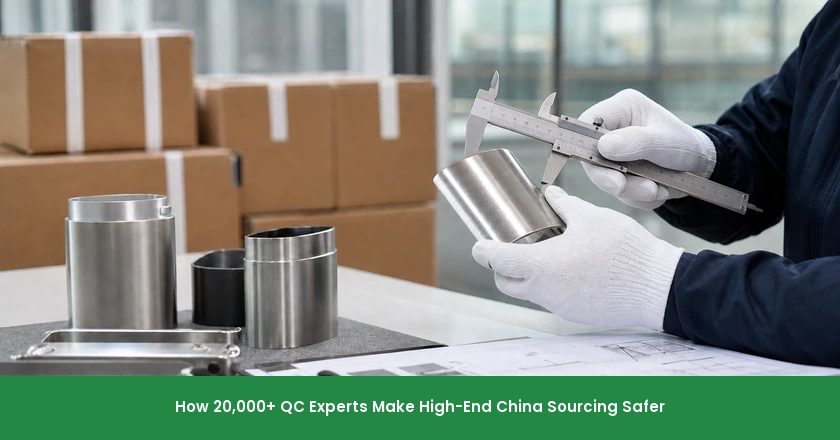
For high-end China sourcing, 20,000+ QC experts matter only when that capability becomes earlier evidence, stronger production judgment, and clearer release decisions. A large quality-control resource base does not make sourcing safer by existing in the background; it makes sourcing safer when it prevents brand-level mistakes before the buyer has paid for them.
NewBuyingAgent describes its strength as 20,000+ product development and quality-control expert resources. The safer reading is capability depth: access to product, material, production, and QC judgment across categories. For premium brands, that depth is most valuable when it turns vague confidence into verifiable evidence before mass production, during production, and before final release.
Key Takeaways
- Key advantage: QC expert depth is valuable when it moves quality control upstream into specs, samples, materials, packaging, production progress, and release evidence.
- Risk: High-end buyers lose leverage when defects are found only at final inspection after materials, production time, and launch commitments are already sunk.
- Framework: The Evidence-to-Release Framework ranks five evidence layers that premium brands should control before shipment approval.
- Service fit: NewBuyingAgent connects product development and quality-control capability with local China factory resources and release-focused China-side execution.
High-End Sourcing Needs Evidence Before the Final Inspection
High-end sourcing becomes safer when quality is treated as an evidence system rather than a final report. ISO 9001:2015 frames quality management around planned processes, customer requirements, and continual improvement. For sourcing buyers, that means quality cannot wait until the finished lot is sitting in cartons. The buyer needs evidence that the product version, material, workmanship, packaging, and release criteria were controlled before the final gate.
Sampling standards are useful, but they do not replace product judgment. ISO 2859-1 provides sampling schemes indexed by acceptance quality limit for lot-by-lot inspection. That helps define sample size logic and defect acceptance, yet premium buyers still need to decide what counts as a critical, major, or minor defect for their product and market. A luxury-finish scratch, weak seam, unstable color, or packaging compression mark may not carry the same meaning across categories.
The Evidence-to-Release Framework is the practical bridge. It asks what evidence must exist before the buyer releases money, shipment, or channel commitments. A final inspection can confirm part of the picture, but earlier layers decide whether the inspection will be meaningful. If the approved sample, material basis, production controls, and packaging evidence are weak, the final report may only document a problem that should have been prevented.
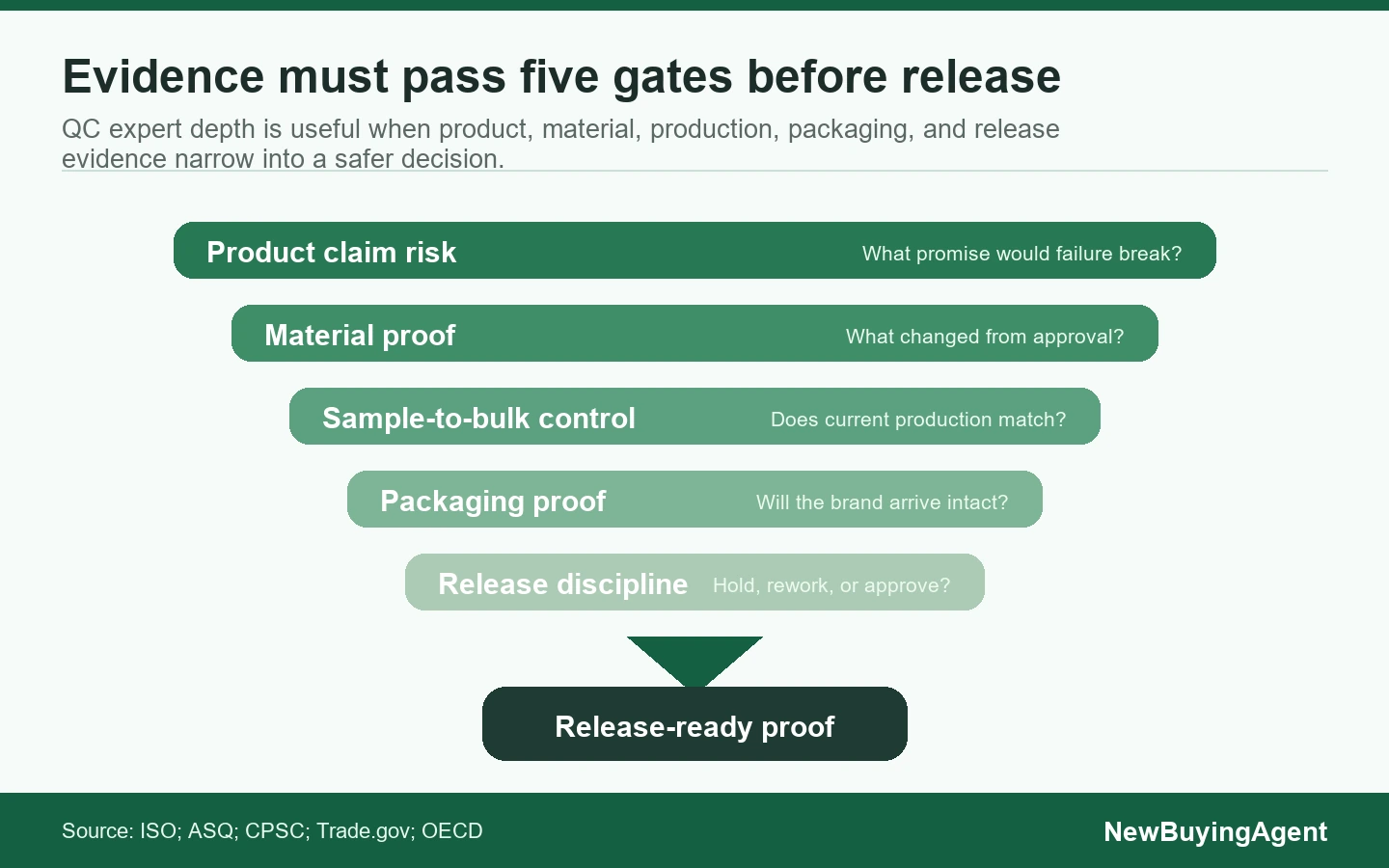
The Evidence-to-Release Framework turns QC expert depth into five evidence layers before a high-end sourcing release decision.
The Evidence-to-Release Framework for High-End Buyers
1. Product-claim risk comes first
The first rank is the product claim because it defines the consequence of failure. A decorative home item, a load-bearing outdoor product, a baby-adjacent item, a powered device, and a branded retail accessory do not carry the same risk. Premium brands should identify the promise the product makes to the customer: safety, durability, finish, compatibility, comfort, performance, or appearance. That promise determines what evidence is needed.
CPSC manufacturing best practices advise manufacturers and importers to build safety into design, specifications, and supply chain controls. Even when a product is outside a specific CPSC category, the sourcing lesson is broader: the product claim should shape the specification before production, not after a quality dispute.
2. Material and component evidence controls premium feel
High-end buyers often lose brand value through small material differences. The product may pass a basic function check but fail the customer's expectation of weight, color, texture, finish, fit, or durability. Material evidence should include what was approved, what was used in production, and what variations are acceptable. That evidence may be photos, swatches, lab documents when relevant, batch records, or production-stage confirmation.
The point is not to turn every order into a technical audit. It is to prevent "almost the same" from becoming the default production standard. Premium brands should define where material substitution, finish drift, or component shortcuts would change the buyer's promise to the customer.
3. Sample-to-production control prevents the approval illusion
An approved sample is not enough if the production version moves away from it. The approval illusion appears when the buyer assumes that a good sample proves a controlled production lot. A safer setup records how the sample standard will be carried into bulk production: tolerance, color, surface finish, stitching, assembly, accessory count, label placement, instruction clarity, and packaging fit.
ISO 19011:2026 provides guidance for auditing management systems, including audit principles and audit program management. For high-end sourcing, the relevant idea is consistency of method. The buyer needs a repeatable way to check whether production practice still matches the approved quality basis.
4. Packaging and transit evidence protect the brand after production
Premium products can be well made and still arrive in brand-damaging condition. Carton strength, inner protection, moisture risk, label accuracy, accessory placement, instruction sheets, retail packaging, and pallet handling affect the customer's first impression. Packaging evidence should be part of the quality file, not a separate logistics afterthought.
When the product is retail-facing, packaging becomes part of the product experience. A crushed gift box, missing insert, wrong barcode, or weak outer carton may not look like a factory defect, but it can still create returns, reviews, and channel friction. High-end buyers should therefore treat packing proof as release evidence.
5. Release discipline decides whether evidence is usable
The fifth rank is release discipline: the rule that says what happens when evidence is incomplete. A buyer can have photos, reports, messages, and inspection notes yet still lack a decision rule. Release discipline defines which findings require hold, rework, discount, sample resubmission, extra inspection, or shipment approval.
The cost difference can be substantial. ASQ's cost of quality resource distinguishes prevention, appraisal, internal failure, and external failure costs. For premium brands, the safest release discipline moves cost toward prevention and appraisal before external failure reaches customers.
Why 20,000+ QC Expert Resources Matter at Brand Level
NewBuyingAgent's 20,000+ product development and quality-control expert resources matter because premium sourcing problems rarely belong to one checkpoint. A finish problem may start with material, become visible during production, worsen through packaging, and finally become expensive through returns. A large product/QC capability base helps connect those signals earlier.
For a premium buyer, that earlier connection changes the quality conversation. Instead of asking whether the final lot is acceptable in a broad sense, the team can ask whether the current lot still protects the product claim, whether material evidence supports the approved feel, whether packaging protects the channel experience, and whether the release rule is clear enough for a brand-sensitive order.
That capability is most useful when combined with NewBuyingAgent's local China factory network and industrial-cluster sourcing access. High-end buyers do not only need someone to see a defect. They need product judgment before quoting, material judgment before approval, production follow-up before the lot is finished, and shipment coordination before the brand absorbs the cost.
Through NewBuyingAgent's product-supply service, a premium buyer's commercial brief can become a quoted China product path with release evidence designed into the sourcing decision. The advantage comes from local factory resources, product development/QC capability, category judgment, and China-side execution that connects price, quality, market fit, and shipment readiness.
For buyers with existing China sources, NewBuyingAgent's factory-management service can support China-side communication, production progress, staged QC inspections, real-time reporting, official reports within 24 hours, and door-to-door logistics coordination. That path is relevant when the buyer already has a producer but lacks reliable evidence and release visibility.
Scenario: When Final Inspection Finds the Wrong Problem
Consider a premium home product with a $60,000 order value and a fixed retail launch. The approved sample looks correct, but bulk production uses a slightly different finish that photographs poorly under retail lighting. Final inspection catches color variation and some surface marks, but the real issue is earlier: the production finish was not controlled against the channel's appearance standard.
Under an illustrative calculation, if 15% of units need discounting by $6 each on a 4,000-unit order, the visible markdown cost is $3,600. If the launch loses one week and the buyer spends 30 internal hours coordinating rework, photo updates, and channel messaging at $45 per hour, the internal burden adds $1,350. If replacement packaging or repacking costs another $2,000, the defect burden is already $6,950 before customer trust is priced in.
This calculation does not prove every premium order needs maximum inspection. It proves the Evidence-to-Release Framework should catch the right problem earlier. The finish requirement belongs in the product claim and material evidence layer, not only in the final inspection layer.
Trade.gov's China standards guidance also shows why standards, conformity assessment, and certification context can matter in China trade. Premium buyers should know whether their product has regulatory, safety, labeling, or market-entry expectations before the sourcing path is priced.
How High-End Buyers Should Use QC Expert Depth
High-end buyers should use QC expert depth as a planning tool. The first step is to define the brand promise that failure would damage. The second step is to translate that promise into evidence: sample standard, material basis, production control point, packaging proof, inspection scope, release threshold, and logistics handoff. The third step is to decide who can obtain and interpret that evidence in China before the buyer loses leverage.
CPSC's Business Education library organizes product safety guidance across categories such as apparel, toys, furniture, outdoor products, and accessories. A premium buyer sourcing consumer products should treat this type of product-category review as part of the brief. It may not replace legal or compliance advice, but it helps the buyer ask better questions before production.
Responsible sourcing also requires a wider view than defect counting. OECD due diligence guidance describes due diligence as an ongoing process for identifying, preventing, mitigating, and accounting for adverse impacts. In sourcing terms, premium buyers should build a living evidence file rather than treat quality as a one-time pass or fail.
| Evidence layer | Premium risk | Proof to request | Release rule |
|---|---|---|---|
| Product claim | Safety, durability, finish, or performance promise | Claim-specific spec and defect classes | Hold if the claim lacks measurable evidence |
| Material basis | Substitution or finish drift | Approved swatch, batch, or material confirmation | Hold if production basis differs from approval |
| Production control | Good sample, weak bulk lot | In-process photos, checkpoints, current-lot records | Escalate when lot evidence drifts |
| Packaging proof | Damage, missing inserts, retail-box failure | Carton, inner pack, labels, and accessory proof | Do not release if packing evidence is incomplete |
Based on the Evidence-to-Release Framework, the safest high-end sourcing setup is the one that makes evidence visible early enough to change the outcome. A final report is useful, but it should not be the first moment the buyer understands the product's real risk.
When high-end buyers want this discipline built into China sourcing, they can review NewBuyingAgent success stories to see how cost, inspection savings, product improvement, payment terms, and operational time can connect in real buyer scenarios. Case outcomes should be treated as examples, not universal promises.
Frequently Asked Questions
Does 20,000+ QC experts mean every order gets a larger inspection team?
No. The safest interpretation is capability depth across product development and quality-control expert resources, not a promise that every order uses a large inspection group. High-end buyers should care less about headcount imagery and more about whether the sourcing path produces earlier product, material, production, packaging, and release evidence.
Why is final inspection not enough for premium sourcing?
Final inspection is useful, but it happens late. If the sample standard, material basis, production process, or packing plan was weak, final inspection may only document a problem after cost and timing are already committed. Premium sourcing needs earlier evidence gates so defects can be prevented or corrected before release pressure rises.
What evidence should high-end buyers require before shipment?
High-end buyers should require current-lot evidence for the product claim, material basis, production version, workmanship, packaging, labels, accessories, and inspection scope. The exact proof depends on category risk. A cosmetic accessory may need finish and packaging proof, while baby, outdoor, furniture, or electronic products may need stronger safety or performance evidence.
How does NewBuyingAgent make high-end sourcing safer?
NewBuyingAgent can make high-end sourcing safer by using local China factory resources and product/QC capability to build release evidence into the supplied product path. The buyer defines the commercial need, and NewBuyingAgent works toward a China-sourced product outcome where evidence is considered before shipment pressure rises.
NewBuyingAgent
Related Resources

Get Started Today
Let's Turn Your Sourcing Goals into RealityWeChat:+86 15157124615
WhatsApp:+86 15157124615
Address:Building 10 #39 Xiangyuan Road, Hangzhou, China
