

Introduction
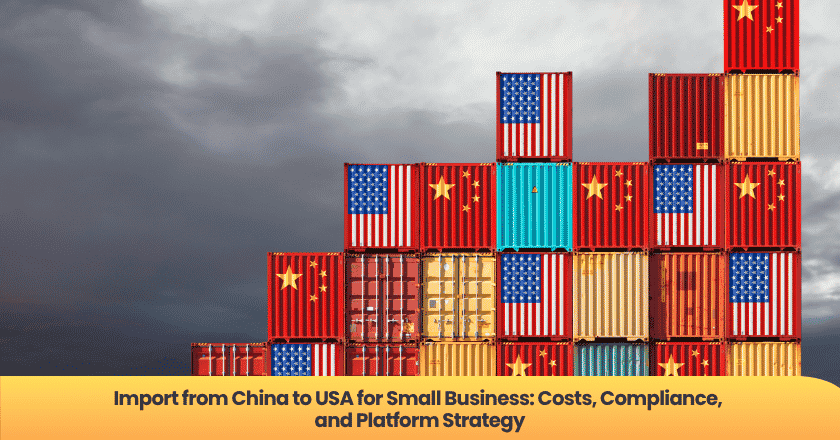
The unit price from your Chinese supplier was $4, so you priced your product at $20 and expected a healthy margin — then duties, freight, customs fees, and a quality problem you couldn't fix from afar quietly ate most of it. Importing from China to the US is entirely workable for a small business, but the unit price is the smallest part of the real cost, and the gap between "cheap from the factory" and "profitable in your warehouse" is where unprepared importers lose money.
Getting this right means understanding landed cost, the compliance and customs steps that can't be skipped, and where you'll actually sell the product. The pattern is consistent: the importers who profit are the ones who calculated the full cost, prepared for compliance, and chose their platform before placing an order — not after.
Key Takeaways
• The unit price is a fraction of landed cost; freight, duties, and fees decide real profitability.
• Tariffs and duties on China-origin goods shift, so check current rates before pricing your product.
• Customs compliance and product safety requirements are mandatory and vary by product category.
• Your sales platform (Amazon, Shopify, wholesale) shapes margins, fees, and how you should source.
• Verified suppliers and quality control protect the margin that import costs are already squeezing.
Understanding the Real Cost of Importing
Landed cost is the only number that matters
The figure that determines whether you make money is landed cost — the total to get a unit into your warehouse, ready to sell. It includes the unit price, international freight, duties and tariffs, customs brokerage, insurance, port and handling fees, and inland delivery. A $4 unit can land at $7 or more once everything is counted, and pricing off the factory quote alone is how margins evaporate. Build a landed-cost spreadsheet before committing, with every line, and price from that number.
Freight is a major and variable line. Ocean freight is far cheaper per unit than air but slower and bought by container space, so small orders that don't fill a container pay more per unit. Air freight suits small, urgent, or high-value shipments. Through 2026, freight rates have stayed less predictable than pre-2020, so quote current rates rather than relying on old assumptions.
Small importers face a particular freight wrinkle: the choice between a full container load (FCL) and less-than-container load (LCL — sharing container space with other shippers). LCL lets you ship smaller volumes without paying for a whole container, which suits a first or modest order, but it costs more per unit and adds handling time as goods are consolidated and deconsolidated. As your order grows, a full container becomes cheaper per unit, and there's a crossover point worth calculating. Understanding where your volume sits relative to that threshold helps you decide order size — sometimes ordering a bit more to fill a container lowers your per-unit landed cost enough to justify it, the same way ordering above a supplier's price break does. Freight strategy and order quantity are linked, and treating them together rather than separately is part of importing efficiently.
Duties, tariffs, and the de minimis question
Imports from China carry duties based on the product's HTS code (Harmonized Tariff Schedule — the classification that sets the duty rate), and China-origin goods have faced additional tariffs that have changed repeatedly. Because these rates shift with policy, confirm the current duty and tariff for your specific product before pricing — an assumption here can erase a margin. The treatment of low-value shipments (the de minimis threshold) has also been a moving target for China-origin goods, affecting small direct-to-consumer importers in particular. The practical rule: verify current rates for your product and import model rather than relying on what was true last year.
Expert Tip: Get your product's HTS classification right before you import, ideally confirmed with a customs broker. The HTS code sets your duty rate, and misclassifying — even unintentionally — can mean overpaying duties for years or, worse, underpaying and facing penalties and back-duties later. A broker's classification fee is trivial against the cost of a wrong code applied across every shipment. Getting the classification right once, at the start, is one of the highest-return administrative steps in importing.
Compliance and Customs
Product compliance varies by category
US import compliance is product-specific and unforgiving. Electronics need FCC compliance; children's products face CPSIA (the Consumer Product Safety Improvement Act — strict limits on lead, phthalates, and testing for children's goods); cosmetics fall under FDA and MoCRA rules; textiles need fiber-content and care labeling; food-contact items have their own standards. Shipping a product that doesn't meet its category's requirements risks a customs hold, seizure, or a later recall. Confirm your product's specific requirements and that your supplier can meet and document them before producing.
Intellectual property is a compliance dimension small importers often overlook until it bites. US Customs actively seizes goods that infringe trademarks, copyrights, or patents, so importing a product that copies a protected design — even unknowingly, because a supplier offered it — can mean a destroyed shipment and legal exposure. Confirm that what you're importing doesn't infringe someone else's IP, and be wary of suppliers offering suspiciously close copies of brand-name products. The flip side applies too: registering your own trademark and, on Amazon, enrolling in Brand Registry protects your product from copycats once it succeeds. Treating IP as part of your compliance check, both defensively and protectively, avoids a category of expensive surprise that has nothing to do with product safety.
The customs clearance process
Clearing customs requires the right paperwork — commercial invoice, packing list, bill of lading, and any category-specific certifications — and usually a customs broker to file the entry. A small business almost always uses a broker, whose fee is modest against the delay and risk of filing wrong. You'll also likely need a customs bond for commercial imports. Getting documentation right at the supplier end, before goods ship, prevents the holds that strand inventory at port and rack up storage fees.
The paperwork accuracy that matters most starts at the supplier. The commercial invoice must accurately describe the goods, their value, and their country of origin, because customs uses it to assess duties and to screen for compliance. Under-declaring value to lower duties is illegal and risks serious penalties, and a vague or inaccurate description can trigger an inspection that holds your shipment. Country-of-origin marking is its own requirement — most products must be marked with their origin, and getting this wrong at the factory means relabeling under customs supervision or refused entry. Coordinating accurate, complete documentation with your supplier before the goods leave China is unglamorous but decisive, because the most expensive customs problems are the ones built into the paperwork before the container ever sails.
Common Mistake to Avoid: Pricing your product off the supplier's unit quote and treating duties, freight, and compliance as afterthoughts. Small importers calculate margin on the $4 factory price, set a retail price, then discover landed cost is nearly double once everything's counted — and the margin they planned doesn't exist. Build the full landed-cost model first, including current duties and freight, and confirm compliance costs. The factory price is a starting input, never the basis for your pricing.
Platform Strategy and Protecting Margin
Where you sell shapes how you source
Your sales channel changes the math, so decide it before sourcing. Selling on Amazon means platform fees, FBA (Fulfillment by Amazon — Amazon stores and ships your inventory) costs, and fierce price competition, which pushes you toward differentiated or higher-margin products that survive the fees. A Shopify or own-site store keeps more margin but requires you to drive your own traffic. Wholesale to retailers means lower per-unit margin at higher volume. Each model implies different products, order sizes, and acceptable landed costs — sourcing without knowing your channel is sourcing blind.
The channel also dictates your inventory and cash-flow rhythm, which a small importer feels acutely. Amazon FBA requires you to ship inventory into Amazon's warehouses ahead of sales, tying up cash in stock and import costs before any revenue arrives — and import lead times from China mean ordering months before you sell. A direct-to-consumer store gives more control over inventory timing but puts fulfillment on you. Wholesale may offer terms but ties up the most capital in large orders. For a small business, the interplay of long China lead times, upfront import costs, and a channel's inventory demands is often the real constraint, more than the product itself. Planning cash flow around the full cycle — order, ship, clear customs, stock, sell, get paid — is what keeps an otherwise profitable import from becoming a liquidity crisis.
Protecting the margin import costs are squeezing
Because import costs already compress your margin, the supplier end is where you protect it. A failed order, a quality problem you can't resolve from abroad, or a supplier who turns out to be a middleman can turn a thin-margin import into a loss. Verified suppliers and quality control aren't luxuries here — they're margin protection. Small importers, who rarely have bargaining power alone and often struggle to tell a real factory from a reseller, gain the most from getting that supplier end right before the first order ships.
Expert Tip: Start your first import small enough to learn the whole process cheaply, even if the per-unit cost is higher. A modest first order — accepting that small volumes pay more in freight and unit price — lets you run the full cycle (sourcing, compliance, customs, selling) and find your mistakes when they're cheap. Importers who go big on the first order to chase unit economics often turn a process error into an expensive one. Treat the first import as tuition; scale once you've proven the product and the process.
How NewBuyingAgent Helps You Import from China
Importing already squeezes your margin, and the supplier end is where you defend it — yet that's exactly where small importers get caught: unable to reach a verified factory, landing on a middleman, and stretched too thin to manage it all. Handing the sourcing side to a partner is a natural move. NewBuyingAgent is your perfect partner for global sourcing from China, backed by 30 years of expertise in trade, manufacturing and quality control.
Connecting your product to a genuine, verifiable factory rather than a layer of resale comes first: with 100% Access to China's Factories, you use their 50,000+ cooperated partner factories—no language/region/time zone barriers. Their local reputation gets you full factory cooperation. With duties and freight already taking their bite, every point saved on the sourcing side drops straight into your margin: with Lower Prices Than Direct Sourcing, their wide factory network lets them pick low-cost, high-cooperation suppliers. Even with their margin included, they cut your costs by 5%-10%. Taking the back-and-forth off your plate also frees you to put your energy back into selling, which is the other half of what NewBuyingAgent provides: with Save Time for Local Market Growth, they handle all factory communication—perfect for multi-category buyers. Free up your time to focus on expanding your local market sales.
Frequently Asked Questions
What's the real cost of importing from China to the USA?
Far more than the unit price. Landed cost includes freight, duties and tariffs, customs brokerage, insurance, port fees, and inland delivery — a $4 unit can land at $7 or more. Build a full landed-cost model with every line and price from that number, not the factory quote, or your planned margin may not exist.
How do I know what duties and tariffs I'll pay?
Duties are set by your product's HTS classification, and China-origin goods have faced additional tariffs that change with policy. Because rates shift, confirm the current duty and tariff for your specific product and import model before pricing — ideally with a customs broker — rather than relying on last year's figures or a general estimate.
What compliance does my product need to enter the US?
It's product-specific: electronics need FCC compliance, children's products CPSIA testing, cosmetics FDA/MoCRA rules, textiles fiber and care labeling, and so on. Confirm your category's exact requirements and that your supplier can meet and document them before producing, since a non-compliant product risks customs holds, seizure, or recall.
Do I need a customs broker to import from China?
Almost always, for commercial imports. A broker files your customs entry and helps with classification and documentation, and the fee is modest against the delay and penalty risk of filing wrong. You'll also typically need a customs bond. Getting paperwork right before goods ship prevents the holds that strand inventory and accrue storage fees.
How does my sales platform affect how I should source?
Heavily. Amazon's fees and price competition push toward differentiated, higher-margin products; a Shopify store keeps more margin but needs you to drive traffic; wholesale trades margin for volume. Each implies different products, order sizes, and acceptable landed costs, so decide your channel before sourcing — otherwise you may source a product your channel can't sell profitably.
Conclusion
Importing from China to the US profitably is a planning exercise more than a price hunt. Calculate true landed cost with current duties and freight, confirm your product's compliance and customs requirements before producing, choose your sales platform before sourcing, and protect your already-squeezed margin with verified suppliers and quality control. Start small, treat the first import as learning, and scale once the product and process are proven. When the sourcing and quality end of that — finding verified suppliers and protecting your margin from a distance — is more than you want to manage alone, it's worth having a partner handle it so you can focus on selling.
NewBuyingAgent
Related Resources
Get Started Today
Let's Turn Your Sourcing Goals into RealityWeChat:+86 15157124615
WhatsApp:+86 15157124615
Address:Building 10 #39 Xiangyuan Road, Hangzhou, China
